
Recursos
Exploren una amplia gama de recursos valiosos en GCED para profundizar su comprensión y promover su búsqueda, incidencia, enseñanza y aprendizaje.
178 resultados encontrados
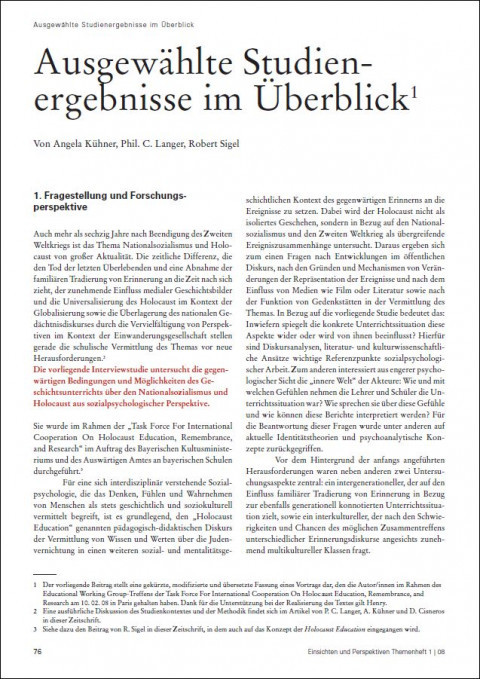 Overview of Selected Research Results Año de publicación: 2008 Autor: Angela Kühner | Phil. C. Langer | Robert Sigel The original title: Ausgewählte Studienergebnisse im Überblick(Einsichten und Perspektiven, Bayerische Zeitschrift für Politik und Geschichte, 1(8), pp. 76-82)The article deals with the results of a pilot study carried out in Bayern, which focuses on the subjective experiences and representations of teachers and students from a social-psychology perspective. The research questions: How does the educational situation reflect remembrance today? How do teachers and students interpret situations of “Holocaust Education,” and what feelings do they report? The study carried out qualitative interviews with students and their teachers, and analyzes the pedagogical setting of history classes in secondary schools. Intercultural and intergenerational dimensions are also analyzed. The authors conclude that both sides, students and teachers, show a high degree of interest to the topic, but also a tendency to Selbst-Überforderung ; thus, concrete possibilities and spaces for self-reflection about their own feelings and conflicting pedagogical aims must be recognized and supported. The above abstract is taken from the International Holocaust Remembrance Alliance Education Research Project. Please also consult the full list of abstracts in 15 languages and the accompanying publication Research in Teaching and Learning about the Holocaust: A Dialogue Beyond Borders. Ed: IHRA, Monique Eckmann, Doyle Stevick, Jolanta Ambrosewicz-Jacobs, 2017, Metropol Verlag at www.holocaustremembrance.com/resources/publications.
 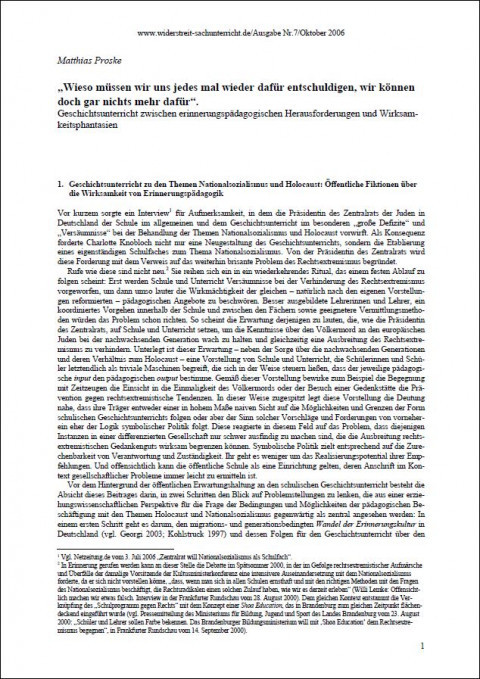 “Why Do We Have to We Apologize for It All the Time, We Can’t Help it”: History Education between Memory-Pedagogy Challenges and Fantasies about Effectiveness Año de publicación: 2006 Autor: Matthias Proske The original title: “Wieso Müssen Wir Uns Jedes Mal Wieder dafür Entschuldigen, Wir Können Doch Gar Nichts Mehr Dafür”: Geschichtsunterricht zwischen Erinnerungspädagogischen Herausforderungen und Wirksamkeitsphantasien(Widerstand sachunterricht, 7, pp. 1–10)Against the background of public expectations on the schools’ history education, the article connects a theoretical analysis of the changes in the German historical culture and their consequences for history education about the Holocaust and Nazism with a discussion about how students and teachers take on these themes in educational practice. This is exemplified with a case study from a 9th grade history class. The above abstract is taken from the International Holocaust Remembrance Alliance Education Research Project. Please also consult the full list of abstracts in 15 languages and the accompanying publication Research in Teaching and Learning about the Holocaust: A Dialogue Beyond Borders. Ed: IHRA, Monique Eckmann, Doyle Stevick, Jolanta Ambrosewicz-Jacobs, 2017, Metropol Verlag at www.holocaustremembrance.com/resources/publications.
 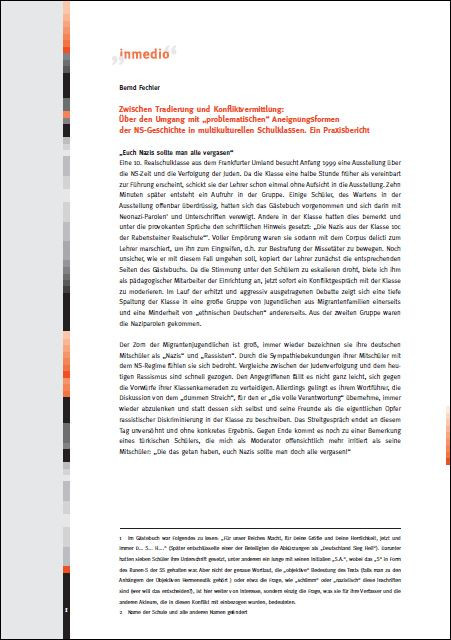 Between Transmission and Conflict Mediation: On the Handling of “Problematic” Forms of Appropriation of Nazi History in Multicultural School Classes Año de publicación: 2000 Autor: Bernd Fechler The original title: Zwischen Tradierung und Konfliktvermittlung: Über den Umgang mit “Problematischen” Aneignungsformen der NS-Geschichte in Multikulturellen Schulklassen(Erziehung nach Auschwitz” in der multikulturellen Gesellschaft: Pädagogische und soziologische Annäherungen, pp.1-18) Discussion of the challenges of Holocaust education a multicultural setting, based on a case when a German 10th grade class visited an exhibition about the Nazi period, something which led to an intense conflict between “German” and “immigrant” students.The above abstract is taken from the International Holocaust Remembrance Alliance Education Research Project. Please also consult the full list of abstracts in 15 languages and the accompanying publication Research in Teaching and Learning about the Holocaust: A Dialogue Beyond Borders. Ed: IHRA, Monique Eckmann, Doyle Stevick, Jolanta Ambrosewicz-Jacobs, 2017, Metropol Verlag at www.holocaustremembrance.com/resources/publications
 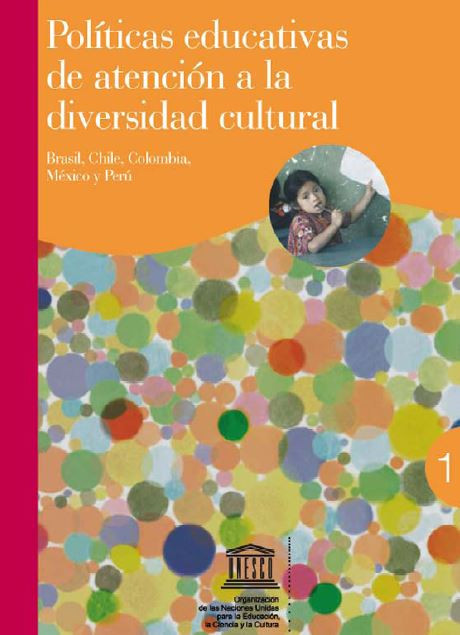 Políticas educativas de atención a la diversidad cultural: Brasil, Chile, Colombia, México y Perú; volumen 1 Año de publicación: 2005 Autor: Carolina Hirmas R. | Ricardo Hevia R. | Ernesto Treviño | Pablo Marambio V. Autor corporativo: UNESCO Santiago Esta publicación consta de tres volúmenes. El primero da cuenta de un análisis de cómo las políticas educativas de cinco países de la región –Brasil, Chile, Colombia, México y Perú- abordan el tema de la diversidad cultural, tanto a través de su legislación como de sus políticas curriculares, de formación de maestros y de gestión institucional.El segundo presenta un conjunto de estudios etnográficos realizados en estos mismos países con el fin de mostrar cómo se da en la vida cotidiana de la escuela el fenómeno de la “discriminación cultural”, la cara opuesta del “pluralismo cultural” que la escuela está llamada a construir. El tercer volumen es un compendio de materiales educativos sobre cinco temas relevantes acerca de la diversidad cultural para ser trabajados con docentes y estudiantes en los centros educativos.
 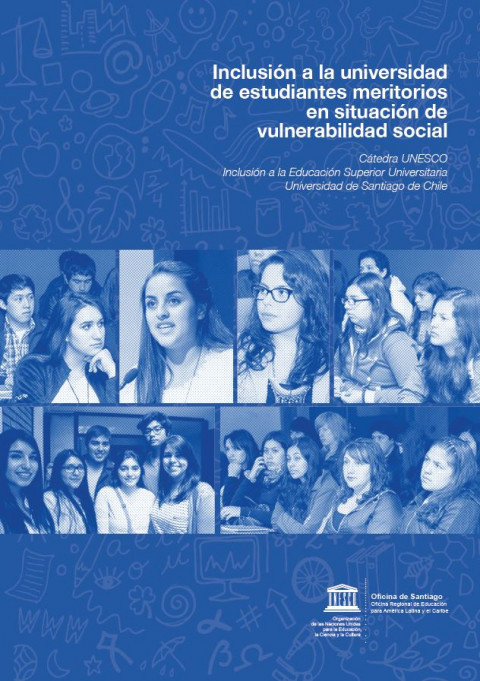 Inclusion at the University of Meritorious Students in Situations of Social Vulnerability Año de publicación: 2015 Autor: Marcela Orellana | Karla Moreno | Francisco Javier Gil Autor corporativo: UNESCO Santiago | UNESCO Chair on Inclusion in Higher Education The first edition of this work was published by the OREALC / UNESCO Santiago for its dissemination among those attending the Education for All Ministerial Meeting in Latin America and the Caribbean: Balance and Challenges post 2015, within the framework of the Regional Education Project for America Latin America and the Caribbean (PRELAC), held in Lima, Peru on October 30 and 31, 2014. In this second edition, we are pleased to add other inclusion mechanisms that arise from the commitment of the UNESCO Chair in Inclusion in Higher Education, the valuable support from non-profit private foundations and the support of OREALC / UNESCO Santiago. The generation of these alliances constitutes a fundamental contribution to the collection of relevant information for the design of public policy proposals aimed at reducing the inequality gaps in higher education, guaranteeing the right to a quality education and to collaborate in the construction of societies with greater social justice. Inclusión a la universidad de estudiantes meritorios en situación de vulnerabilidad social Año de publicación: 2015 Autor: Marcela Orellana | Karla Moreno | Francisco Javier Gil Autor corporativo: UNESCO Santiago | UNESCO Chair on Inclusion in Higher Education La primera edición de este trabajo fue publicada por la OREALC/UNESCO Santiago para su difusión entre los asistentes a la Reunión Ministerial Educación para Todos en América Latina y el Caribe: Balance y desafíos post 2015, en el marco del Proyecto Regional de Educación para América Latina y el Caribe (PRELAC), realizada en Lima, Perú el 30 y 31 de octubre de 2014. En esta segunda edición, nos complace sumar otros mecanismos de inclusión que surgen del compromiso de la Cátedra UNESCO de Inclusión en la Educación Superior, el valioso apoyo de fundaciones privadas sin fin de lucro y el apoyo de la OREALC/UNESCO Santiago. La generación de estas alianzas constituye un aporte fundamental para el levantamiento de información relevante para el diseño de propuestas de políticas públicas tendientes a disminuir las brechas de desigualdad en la educación superior, a garantizar el derecho a una educación de calidad y a colaborar a la construcción de sociedades con mayor justicia social.
 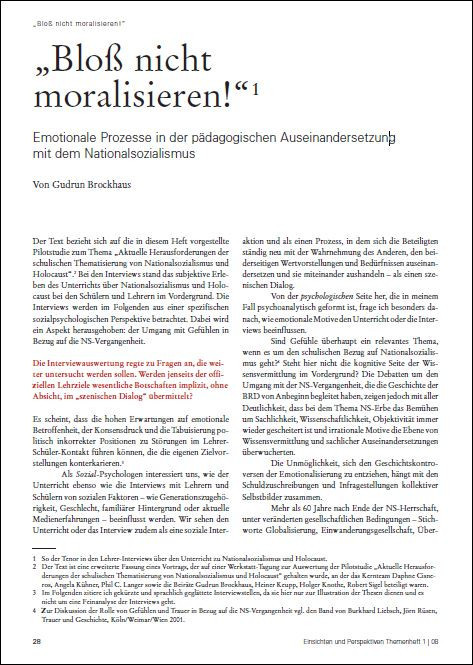 “Just Don’t Moralize!” Emotional Processes in the Pedagogical Engagement with National Socialism Año de publicación: 2008 Autor: Gudrun Brockhaus The original title: “Bloß nicht moralisieren!” Emotionale Prozesse in der pädagogischen Auseinandersetzung mit dem Nationalsozialismus(Einsichten und Perspektiven, Bayerische Zeitschrift für Politik und Geschichte, 1(8), pp. 28–33.) The article is a critical reflection on the outcomes of an empirical study (Kühner 2008; Kühner et al. 2008), based on a psychological/psychoanalytical perspective: how should we deal with emotions when dealing with the Holocaust? The author highlights the teachers’ very high expectations regarding the emotional Betroffenheit, the pressure on consensus, and the tabooisation of “political incorrectness” in the classroom, tendencies that can lead to a problematic teacher-student relationship. Thus, teachers encounter specific didactical difficulties and show a certain lack of self-assertion. Brockhaus assumes that this is based on how the teacher relates, as a person and as a pedagogue, to the heritage of National Socialism. Brockhaus concludes by insisting on the necessity to reflect openly, as students and as teachers, on the emotional processes and the reluctance caused by the topic of the Holocaust in this society. The above abstract is taken from the International Holocaust Remembrance Alliance Education Research Project. Please also consult the full list of abstracts in 15 languages and the accompanying publication Research in Teaching and Learning about the Holocaust: A Dialogue Beyond Borders. Ed: IHRA, Monique Eckmann, Doyle Stevick, Jolanta Ambrosewicz-Jacobs, 2017, Metropol Verlag at www.holocaustremembrance.com/resources/publications
  Lessons learned from the Holocaust blogging to teach critical multicultural literacy This qualitative dual-case study addresses two 21st century teacher education imperatives, technology infusion and critical multicultural literacy instruction. We researched the integration of a blog as a tool to promote technology use in a graduate course on literacy and technology with a thematic focus on the Holocaust. Using a grounded theory approach (Corbin & Strauss, 2008), we analyzed data sources, including interviews, blog postings and surveys. We conducted a second analysis using a priori coding schemes to further analyze students’ blog posts. Findings suggest that blogging has the potential to enhance knowledge of the ways technology can be harnessed to promote critical multicultural literacy instruction. From an action research stance, we also discuss implications for our future practice. (By the author)
 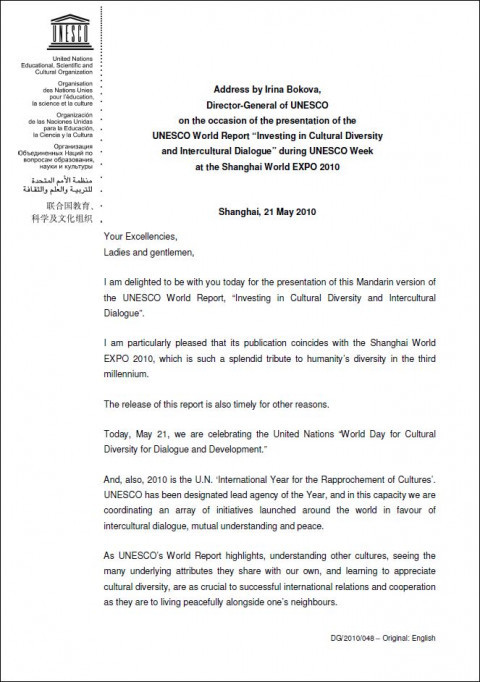 Address by Irina Bokova, Director-General of UNESCO on the occasion of the Presentation of the UNESCO World Report: Investing in Cultural Diversity and Intercultural Dialogue, during UNESCO Week at the Shanghai World EXPO 2010; Shanghai, 21 May 2010 Año de publicación: 2010 Autor corporativo: UNESCO. Director-General, 2009-2017 (Bokova, I.G.) This address was delivered by Irina Bokova, Director-Geneeral of UNESCO on the occasion of the presentation of the UNESCO world report in investing in cultural diversity and intercultural dialogue during UNESCO week at the Shanghai World Expo 2010. In this address she highlited the importance of cultural diversity and intercultural communication, and requested the protection of Chinese cultural heritage by Chinese governments. Discours de Mme Irina Bokova, Directrice Générale de l'UNESCO à l'occasion de la Présentation du Rapport Mondial de l'UNESCO: Investir dans la Diversité Culturelle et le Dialogue Interculturel, au cours de la Semaine de l'UNESCO à l'EXPO Shanghai 2010 Año de publicación: 2010 Autor corporativo: UNESCO. Director-General, 2009-2017 (Bokova, I.G.) Cette adresse a été prononcé par Irina Bokova, Directrice Geneeral de l'UNESCO à l'occasion de la présentation du rapport mondial de l'UNESCO à investir dans la diversité culturelle et le dialogue interculturel pendant la semaine de l'UNESCO à l'Exposition Universelle de Shanghai 2010. Dans cette adresse, elle a souligné l'importance de la diversité culturelle et la communication interculturelle, et a demandé la protection du patrimoine culturel chinois par les gouvernements chinois.