
Recursos
Exploren una amplia gama de recursos valiosos en GCED para profundizar su comprensión y promover su búsqueda, incidencia, enseñanza y aprendizaje.
8 resultados encontrados
 UNESCO Framework for Culture and Arts Education: Implementation Guidance Año de publicación: 2025 Autor corporativo: UNESCO Culture and the arts are integral to inclusive, equitable and quality education. They nurture creativity, critical thinking, and respect for cultural diversity, empowering learners to engage meaningfully with the world and to build more just, sustainable and peaceful societies. Yet, countries have not systematically incorporated culture and arts education across all levels of education. This Implementation guidance for the UNESCO Framework for Culture and Arts Education is a collective invitation to reimagine education by placing culture and the arts at its heart and advancing a transformative vision of education for all.Through a holistic approach, the Guidance supports the integration of culture and the arts across formal, non-formal and informal education, throughout life. It offers practical orientations to help Member States fulfil the commitment enshrined in the UNESCO Framework for Culture and Arts Education, adopted by Ministers of Culture and Education in 2024. With a global perspective, this Guidance will equip policy-makers, educators and cultural actors in developing inclusive, context-relevant policies, curricula and learning environments.The Guidance is a milestone on a shared journey, inviting countries to harness their cultural strengths, respond to emerging challenges, and work together towards a more inclusive education for all.
  Humanistic Futures of Learning: Perspectives from UNESCO Chairs and UNITWIN Networks Año de publicación: 2020 Autor corporativo: UNESCO UNESCO’s Futures of Education initiative aims to rethink education and shape the future. The initiative is catalyzing a global debate on how knowledge, education and learning need to be reimagined in a world of increasing complexity, uncertainty and precarity. This publication presents the first curated input to the Futures of Education initiative from the UNITWIN/UNESCO Chairs Programme, which now represents an extensive global network of more than 800 higher education institutions in over 115 countries. It features think pieces that highlight key dimensions to be considered in re-visioning and re-purposing education for the future of humanity and the planet. The collection of the pieces calls for greater focus on a number of critical areas such as: The role of culture in strengthening social and environmental sustainability; the values and attitudes that are needed to shape future generations; the importance of both robust public education, as well as of other learning spaces; the need to strengthen human creativity and capability in the digital era, as well as the role of higher education in generating the knowledge and driving the innovation required to transform our world. Les futurs humanistes de l’apprentissage: Perspectives des chaires UNESCO et des réseaux UNITWIN Año de publicación: 2020 Autor corporativo: UNESCO L’initiative de l’UNESCO intitulée Les futurs de l’éducation vise à repenser l’éducation et à façonner l’avenir, en lançant un débat mondial sur la manière de réinventer le savoir, l’éducation et l’apprentissage dans un monde de plus en plus complexe, incertain et précaire. Le présent volume constitue la première collection de contributions soumises à l’initiative Les Futurs de l’éducation de l’UNESCO par le Programme des chaires UNESCO/UNITWIN, un vaste réseau mondial regroupant plus de 800 établissements d’enseignement supérieur dans plus de 115 pays. Les documents de réflexion qu’il contient mettent en évidence les dimensions essentielles à prendre en compte pour ré-imaginer et redéfinir l’éducation dans l’intérêt de l’avenir de l’humanité et de la planète. Cette collection appelle à insister davantage sur un certain nombre de domaines critiques tels que le rôle de la culture dans le renforcement de la durabilité sociale et environnementale, les valeurs et les attitudes nécessaires pour préparer les générations futures, l’importance d’une éducation publique et robuste, ainsi que d’autres espaces d’apprentissage, la nécessité de renforcer la créativité et les capacités humaines à l’ère numérique, ainsi que le rôle de l’enseignement supérieur concernant la génération des savoirs et la conduite de l’innovation nécessaire pour transformer notre monde.
 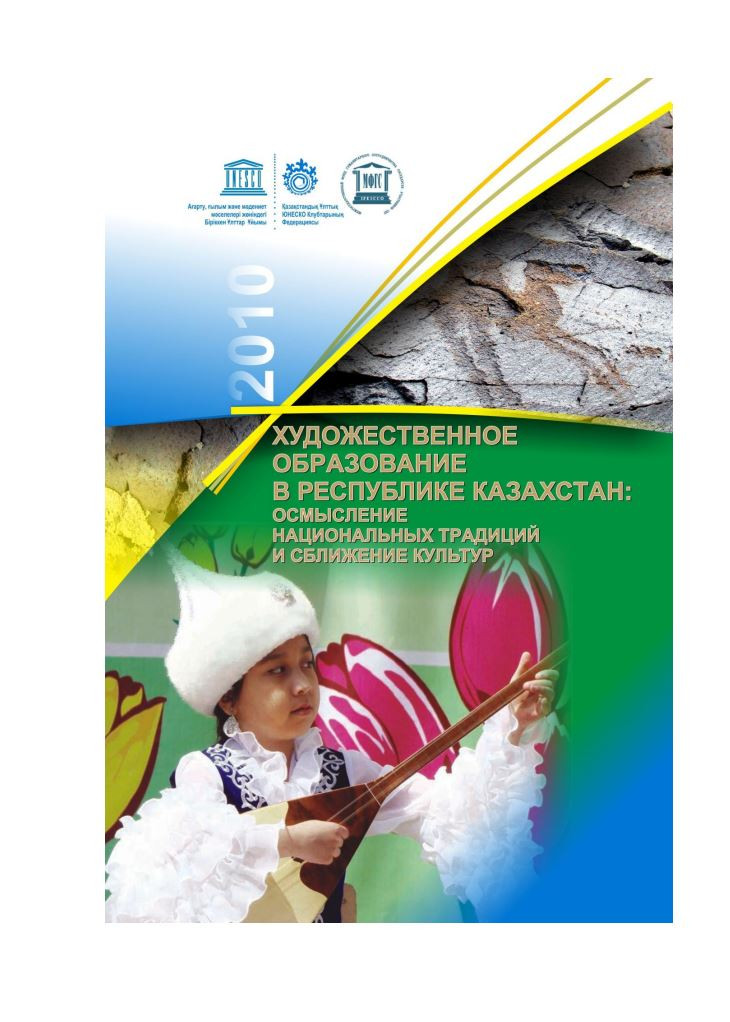 Art Education in the Republic of Kazakhstan: Perception of the National Traditions and Rapprochement of the Cultures; Research Paper Año de publicación: 2010 Autor: Rustam Muzafarov Kazakhstan has the unique feature of ethno-cultural diversity that appeared historically due to multi-ethnic and multi-confessional population's development. Such an environment urges the state to facilitate the revival and development of ethnic cultures and cross-cultural interaction for the benefit of national unity. The adoption of the concept of ethno-cultural education means that the creation of national education system would enhance the idea of cultural and linguistic pluralism, combining the advanced education techniques and information facilities with traditional cultural values. In fact, the educated personality feels real belonging to the historical and cultural traditions of the country. Художественное образование в Республике Казахстан: осмысление национальных традиций и сближение культур. Аналитический доклад. Año de publicación: 2010 Autor: Rustam Muzafarov Уникальность этнокультурного многообразия Казахстана обусловлена исторически сложившимся полиэтническим и многоконфессиональным составом населения. В таких условиях важно создание возможностей для возрождения и развития этнических культур, взаимодействия между ними в интересах общенационального единства. Принятие идеи этнокультурного образования означает создание национальной системы обучения и воспитания, базирующейся на идее культурного и лингвистического плюрализма, сочетающей мировой уровень технической и информационной оснащенности образования с традиционными культурными ценностями. Именно образование формирует причастность личности к исторической и культурной традиции.
  Bringing Living Heritage to the Classroom in Asia-Pacific: A Resource Kit Año de publicación: 2022 Autor corporativo: UNESCO Bangkok | APCEIU | International Information and Networking Centre for Intangible Cultural Heritage in the Asia-Pacific Region (ICHCAP) Integrating living heritage in school teaching and learning can enhance education quality, enliven the experiences of students and teachers, and contribute to keeping this heritage alive for current and future generations. In addition, as the ongoing COVID-19 pandemic has also demonstrated, living heritage can play an important role in ensuring the well-being and resilience of communities. UNESCO encourages countries to safeguard living heritage through formal and non-formal education. From the end of 2019 to early 2022, UNESCO has been working with partners to implement a pilot project “Teaching and Learning with Living Heritage in Schools” in six countries in Asia and the Pacific - including Cambodia, Kazakhstan, Kyrgyzstan, Nepal, Republic of Korea and Thailand. Over 1900 students from 21 schools had the opportunity to participate in these innovative classes. Throughout the process, 86 teachers, with more than two thirds being women, have developed and tested 101 lesson plans and activities. This Resource Kit provides step-by-step guidance and key resources on why and how to integrate living heritage in lessons and extracurricular activities in schools. Whoever you are – policy-maker, school director, teacher, student, parent, heritage practitioner – you have a vital role to play in this process. Иcпользование живого наследия в учебном процессе в азиатскотихоокеанском регионе: комплект методических материалов Año de publicación: 2022 Autor corporativo: UNESCO Bangkok | Азиатско-Тихоокеанский центр образования для международного понимания (APCEIU) | International Information and Networking Centre for Intangible Cultural Heritage in the Asia-Pacific Region (ICHCAP) Использование концепций и практики живого наследия в учебном процессе может повысить качество образования, способствовать оживлению учебного процесса для учащихся и учителей и способствовать сохранению такого наследия для нынешнего и будущих поколений. Кроме того, как показала продолжающаяся пандемия COVID-19, живое наследие может играть важную роль в обеспечении благополучия и жизнеспособности человеческих сообществ. ЮНЕСКО призывает страны сохранять живое наследие посредством формального и неформального образования. С конца 2019 по начало 2022 года ЮНЕСКО совместно со своими партнёрами реализовала пилотный проект «Преподавание и обучение с использованием элементов живого наследия в школах» в шести странах Азиатско-Тихоокеанского региона — Камбодже, Казахстане, Кыргызстане, Непале, Южной Корее и Таиланде. Более 1900 учащихся из 21 школы получили возможность принять участие в этих инновационных занятиях. В ходе этого проекта 86 учителей, из которых более двух третей — женщины, разработали и опробовали 101 план уроков и мероприятий. Данный комплект методических материалов содержит пошаговое руководство и основные сведения, позволяющие понять важность и научиться интегрировать концепции и практику живого наследия в учебные и внеклассные мероприятия в школах. Кем бы вы ни были — сотрудником директивных органов, директором школы, учителем, учеником, родителем, практикующим носителем живого наследия — вам предстоит сыграть жизненно важную роль в этом процессе.
  Arts for Transformative Education: A Guide for Teachers from the UNESCO Associated Schools Network Año de publicación: 2024 Autor: Benjamin Bolden | Sean Corcoran | Tiina Kukkonen | Jeffrey Newberry | Nathan Rickey Autor corporativo: UNESCO | Canadian Commission for UNESCO UNESCO’s vision of transformative education involves building learners’ capacities and empowering them to take action for a more peaceful and sustainable world. The arts offer tremendous potential for supporting learning that transforms individuals and communities. To fully realize that potential, teachers need to structure and support educational experiences that optimize what students will take away from them. This guide presents the research-informed Arts for Transformative Education model, a pioneering approach and thinking tool for teachers. The model was developed from data provided by over 600 teachers of the UNESCO Associated Schools network from 39 countries. The publication presents Learning Experience Descriptions and Snapshots illustrating how the model functions in real-world projects from around the globe, as well as Guidelines for Teachers outlining a step-by-step process for activating arts learning to empower transformative education.