
Recursos
Exploren una amplia gama de recursos valiosos en GCED para profundizar su comprensión y promover su búsqueda, incidencia, enseñanza y aprendizaje.
137 resultados encontrados
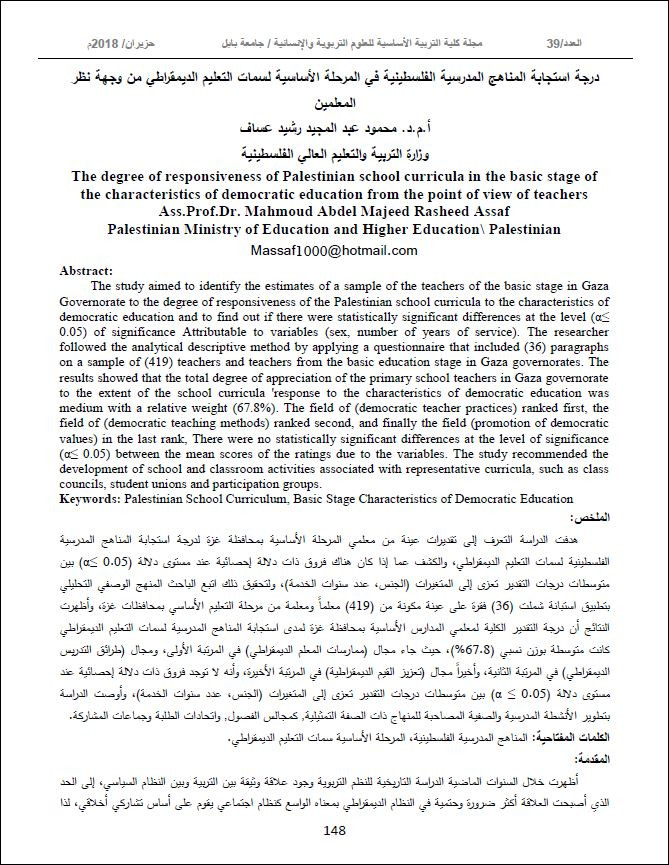 درجة استجابة المناهج المدرسية الفلسطينية في المرحلة الأساسية لسمات التعليم الديمقراطي من وجهة نظرالمعلمين Año de publicación: 2018 Autor: Mahmoud Abdel Majeed Rasheed Assaf Autor corporativo: University of Babylon هدفت الدراسة التعرف إلى تقديرات عينة من معلمي المرحلة الأساسية بمحافظة غزة لدرجة استجابة المناها المدرسية الفلسطينية لسمات التعليم الديمقراطي، والكشف عما إذا كان هنالك فروق ذات دالة إحصائية عند مستوى دالة (05.0≤ α (بين متوسطات درجات التقدير تعزى إلى المتغيرات )الجنس، عدد سنوات الخدمة(، ولتحقيق ذلل اتبع الباحث المنها الوصفي التحليلي بتطبيق استبانة شملت )36 )فقرة على عينة مكونة من )419 )معلما ومعلمة من مرحلة التعليم الأساسي بمحافظات غزة، وأظهرت النتائج أن درجة التقدير الكلية لمعلمي المدارس الأساسية بمحافظة غزة لمدى استجابة المناها المدرسية لسمات التعليم الديمقراطي كانت متوسطة بوزن نسبي )8.67 ،)%حيث جاء مجال )ممارسات المعلم الديمقراطي( في المرتبة الأولى، ومجال )طرائق التدريس وأخي ار مجال )تعزيز القيم الديمقراطية( في المرتبة الأخيرة، وأنث ال توجد فروق ذات دالة إحصائية عند الديمقراطي( في المرتبة الثانية، مستوى دالة (05.0 ≤ α (بين متوسطات درجات التقدير تعزى إلى المتغيرات )الجنس، عدد سنوات الخدمة(، وأوصت الدراسة بتطوير الأنشطة المدرسية والصفية المصاحبة للمنهاج ذات الصفة التمثيلية, كمجالس الفصول, واتحادات الطلبة وجماعات المشاركة. The Degree of Responsiveness of Palestinian School Curricula in the Basic stage of the Characteristics of Democratic Education from the Point of View of Teachers Año de publicación: 2018 Autor: Mahmoud Abdel Majeed Rasheed Assaf Autor corporativo: University of Babylon The study aimed to identify the estimates of a sample of the teachers of the basic stage in Gaza Governorate to the degree of responsiveness of the Palestinian school curricula to the characteristics of democratic education and to find out if there were statistically significant differences at the level (α≤ 0.05) of significance Attributable to variables (sex, number of years of service). The researcher followed the analytical descriptive method by applying a questionnaire that included (36) paragraphs on a sample of (419) teachers and teachers from the basic education stage in Gaza governorates. The results showed that the total degree of appreciation of the primary school teachers in Gaza governorate to the extent of the school curricula 'response to the characteristics of democratic education was medium with a relative weight (67.8%). The field of (democratic teacher practices) ranked first, the field of (democratic teaching methods) ranked second, and finally the field (promotion of democratic values) in the last rank, There were no statistically significant differences at the level of significance (α≤ 0.05) between the mean scores of the ratings due to the variables. The study recommended the development of school and classroom activities associated with representative curricula, such as class councils, student unions and participation groups.
  The Course: Citizenship Education Año de publicación: 2021 Autor: Bader Abdul Qadir Autor corporativo: University of Jordan This file is a blueprint for the Citizenship education course at the University of Jordan. The course outline shows the course objectives, plan, and topics covered. At the end of the chart is a list of references.
  الإطار العام لمعايير المناهج: التربية الوطنية والدراسات الاجتماعية Año de publicación: 2014 Autor: Khalid Abdaslam Autor corporativo: United Arab Emirates. Ministry of Education يعتبر الملف وثيقة مرجعية للإطار العام لمعايير المناهج في التربية الوطنية والدراسات الاجتماعية بدولة الامارات العربية المتحدة. يوضح الملف الخطط الدراسية لمواد الدراسات الاجتماعية ونواتج التعلم ومعايير الأداء وموجهات عامة للتخطيط. وينتهي الملف بمجموعة من نماذج تصميم الدروس. General Framework of Curriculum Standards: National Education and Social Studies Año de publicación: 2014 Autor: Khalid Abdaslam Autor corporativo: United Arab Emirates. Ministry of Education The file is a reference document for the general framework of curriculum standards in national education and social studies in the United Arab Emirates. The file outlines study plans for social studies subjects, learning outcomes, performance standards, and general guidelines for planning. The file ends with a set of lesson design templates. مقرر التربية الوطنية Año de publicación: 2021 Autor: Bader Abdul Qadir Autor corporativo: University of Jordan الملف هو مخطط لمقرر "التربية الوطنية" بالجامعة الأردنية. يوضح مخطط المقرر أهداف المقرر والخطة والمواضيع التي يغطيها. ويوجد في نهاية المخطط قائمة من المراجع.
  제22회 한국국제이해교육학회 국제학술대회: 미래형 교육과정과 세계시민교육: 도전과 과제 Año de publicación: 2021 Autor corporativo: 한국국제이해교육학회 2021년 11월 13일에 개최되었던 제22회 한국국제이해교육학회 국제학술대회 자료집으로 '미래형 교육과정과 세계시민교육: 도전과 과제'라는 주제로 세계시민교육의 역할과 가능성을 어떻게 학교교실 안으로 가져올지에 대한 토론과 발표내용을 담고 있습니다. 본 자료집에는 기조강연/패널부터 자유 발표 등에 이르기까지 모든 발표자들의 자료가 포함되어 있으며 기조강연 및 패널, 패널4(이기 프로젝트)의 경우 일본어 번역자료도 함께 수록되어 있습니다.
  A study of the middle school social studies and moral education curriculum to foster global citizenship Año de publicación: 2009 Autor: Geunho Lee | Deokgeun Kim | Byungsu Min | Hyunjeong Oh | Jeongmin Eom | Hyojeong Kim | Junsik Park Autor corporativo: Korea Institute for Curriculum and Evaluation (KICE) This study was conducted to analyze the determinants (i.e. multicultural acceptability, national identity, and moral values) influencing global citizenship in order to examine the construct of global citizenship as well as to find the moral education about global citizenship for teacher education. Hierarchical regression was used to analyze the survey of 116 college students in university of education. The results are following. Firstly, The hierarchical regression analysis of ModelⅢ with influencing three factors to global citizenship explained 25% of the variance in student’s global citizenship, and it was found common good among moral values and experience of living a life in the foreign countries as important factors in the model. Second, They regressed into the variance of moral values even though a few ones of multi-cultural acceptability and national identity were influential factors before modelⅢ. Contrary to theoretical expectations, they are turned into be a half of influential factors to global citizenship. Based on the results, we suggested that to solve the global problems need to be strengthen in the developing the education curriculum for global citizenship. Furthermore, future research with stratified sampling will be conducting to generalize the result of this study. L’Étude sur l'Éducation à la Citoyenneté Mondiale dans l'enseignement de premier cycle Año de publicación: 2009 Autor: Geunho Lee | Deokgeun Kim | Byungsu Min | Hyunjeong Oh | Jeongmin Eom | Hyojeong Kim | Junsik Park Autor corporativo: Korea Institute for Curriculum and Evaluation (KICE) Cette étude a été menée pour analyser les déterminants (à savoir d'aceptabilité multiculturelle, identité nationale, et les valeurs morales) qui influent sur la citoyenneté mondiale en vue d'examiner la construction de la citoyenneté mondiale, ainsi que de trouver l'éducation morale de la citoyenneté mondiale pour la formation des enseignants. Régression hiérarchique a été utilisé pour analyser le sondage auprès des 116 étudiants de niveau collégial à l'université de l'éducation. Les résultats suivent. Tout d'abord, l'analyse de régression hiérarchique des ModelⅢ d'influencer trois facteurs à la citoyenneté mondiale explique 25% de la variance de la citoyenneté mondiale de l'étudiant, et il a été trouvé bien commun entre les valeurs morales et de l'expérience d'une vie dans les pays étrangers comme des facteurs importants dans la modèle. Deuxièmement, ils ont régressé dans la variance des valeurs morales, même si quelques uns d'aCECptabilité multi-culturelle et l'identité nationale sont des facteurs influents avant modelⅢ. Contrairement aux attentes théoriques, ils sont transformés en une moitié de facteurs influents à la citoyenneté mondiale. D'après les résultats, nous avons proposé que pour résoudre les problèmes mondiaux doivent être renforcer dans le développement du programme d'éducation à la citoyenneté mondiale. En outre, les recherches futures avec échantillonnage stratifié sera conduit à généraliser le résultat de cette étude. 세계 시민의식 고취를 위한 중학교 사회과ㆍ도덕과 교육과정 선진화 연구 Año de publicación: 2009 Autor: 이근호 | 김덕근 | 민병수 | 오현정 | 엄정민 | 김효정 | 박준식 | 김종람 Autor corporativo: 한국교육과정평가원 This study was conducted to analyze the determinants (i.e. multicultural acceptability, national identity, and moral values) influencing global citizenship in order to examine the construct of global citizenship as well as to find the moral education about global citizenship for teacher education. Hierarchical regression was used to analyze the survey of 116 college students in university of education. The results are following. Firstly, The hierarchical regression analysis of ModelⅢ with influencing three factors to global citizenship explained 25% of the variance in student’s global citizenship, and it was found common good among moral values and experience of living a life in the foreign countries as important factors in the model. Second, They regressed into the variance of moral values even though a few ones of multi-cultural acceptability and national identity were influential factors before modelⅢ. Contrary to theoretical expectations, they are turned into be a half of influential factors to global citizenship. Based on the results, we suggested that to solve the global problems need to be strengthen in the developing the education curriculum for global citizenship. Furthermore, future research with stratified sampling will be conducting to generalize the result of this study.