
Recursos
Exploren una amplia gama de recursos valiosos en GCED para profundizar su comprensión y promover su búsqueda, incidencia, enseñanza y aprendizaje.
137 resultados encontrados
 Holocaust Education: Analysis of Curricula and Frameworks: A Case Study of Illinois This article addresses how far educational institutions have come in designing authentic and meaningful curricula for teaching the Holocaust at the secondary level. Examined in this article are the historical development of Holocaust education in the United States, with a focus on the state of Illinois as a case study, what contributes to the development of a full curriculum, and what constitutes the boundary between a curriculum and a framework, based on examination of the work of scholars and institutions in the field. Analysis of existing frameworks according to criteria developed by the authors has yielded the finding that a framework can only guide teachers to an extent because of its looser structure. A full curriculum, however, is structured with greater detail and more direct ways of determining evidence that demonstrates understanding of the content and mastery of essential skills. Recommendations are provided for Holocaust Education curriculum development, underscoring the significance of an engaging design that makes learning more lasting and meaningful. (By the author)
  Understanding Matters: Holocaust Curricula and the Social Studies Classroom Over the past two decades, interest in Holocaust education has grown substantially as individual states, starting in the 1980s, began to mandate and/or recommend Holocaust studies as part of the social studies curriculum. As a result, these mandates and/or interest in the Holocaust have spawned any number of curriculum products, some of which seek less to help the student of history acquire an understanding of this historical event, and more in terms of dictating to the social studies student what he or she should understand. Hence, the purpose of this paper is to critique Holocaust curricula that have been developed under the auspices of a state department of education (SDE) or endorsed by a SDE, as we believe that teachers unfamiliar with the Holocaust will turn to these products as sources of authority. We base this critique on what we refer to as three approaches or considerations to understanding history—the body of work on historical thinking which we view as the underpinning of historical empathy and positionality, historical empathy as articulated by Elizabeth Yeager, O.L. Davis, Jr., and Stuart Foster, and the guidelines on teaching the Holocaust developed for the U.S. Holocaust Memorial Museum by William Parsons and Samuel Totten. These three elements, each in their own way, help us to understand the challenge for teachers and students whose foundation for understanding the Holocaust may solely rest upon curriculum products whose curricular aims and/or design often obstruct the quest to “understand,” e.g., lack of historical accuracy, lack of depth, and historical gaps. (By the author)
 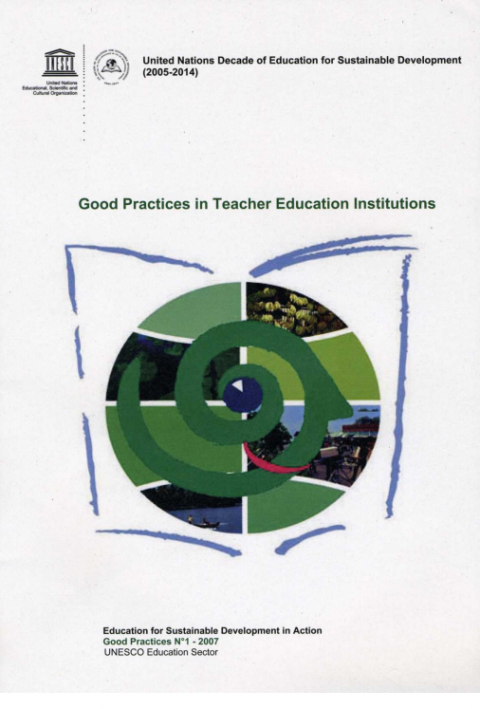 Good practices in education for sustainable development: teacher education institutions Año de publicación: 2007 Autor: Rosalyn McKeown Autor corporativo: UNESCO Chair in Reorienting Teacher Education towards Sustainability | International Network of Teacher Education Institutions The case studies in this document reflect individual and institutional efforts to reorient curriculum, programs, practices, and policies to address sustainability at institutions of teacher education. The studies come from Africa, Asia, the Caribbean, Europe, and North America. The case studies deal with professional development for in-service teachers, curriculum revision at the pre-service level, research with students in a local school, greening of a building and its garden, creating a network of universities, starting a journal, and creating new undergraduate and graduate programs. The diversity of efforts is broad; the impact is deep. The dedication of teacher educators around the world is evident on every page of this document. Les bonnes pratiques en matière d'éducation pour le développement durable: institutions de formation des enseignants Año de publicación: 2007 Autor: Rosalyn McKeown Autor corporativo: UNESCO Chair in Reorienting Teacher Education towards Sustainability | International Network of Teacher Education Institutions Les études de cas présentées dans ce document reflètent les efforts individuels et institutionnels pour réorienter le curriculum, les programmes, les pratiques et les politiques de lutte contre le développement durable dans les établissements de formation des enseignants. Les études viennent d'Afrique, d'Asie, des Caraïbes, en Europe et en Amérique du Nord. Les études de cas portent sur le développement professionnel des enseignants en service, la révision des programmes au niveau pré-services, la recherche avec les étudiants dans une école locale, l'écologisation d'un bâtiment et son jardin, la création d'un réseau d'universités, à partir d'un journal, et la création de nouveaux programmes de premier cycle et des cycles supérieurs. La diversité des efforts est large; l'impact est profond. Le dévouement des formateurs d'enseignants à travers le monde est évident sur chaque page de ce document.
  Breaking Historical Silence through Cross-cultural collaboration: Latvian curriculum writers and United States Holocaust Memorial Museum fellows In response to the need for Holocaust curricula in Latvia, Latvians and Americans worked collaboratively to overcome the historical silence surrounding this event. During their project, Latvian curriculum writers worked with teachers and scholars at the United States Holocaust Memorial Museum. This descriptive analysis of the Latvians' experience with Museum Fellows revealed opportunities to learn from each other the complexities of teaching the Holocaust in a country viewed by some as collaborators and still somewhat anti-Semitic. Findings included depth of guidance, values, and limits of innovative teaching methods, cross-cultural benefits, and continued collaboration. Recommendations for future efforts by post-Communist countries and American partners to develop curriculum on teaching a most complex and contentious aspect of history such as the Holocaust conclude the study. (By the author)
  “We did also save people”: A Study of Holocaust Education in Romania After Decades of Historical Silence Año de publicación: 2008 Autor: Thomas Misco This research study seeks to understand the current state of Holocaust education in Romanian classrooms and the variety of forces that influence its treatment. By identifying obstacles, challenges, and successes, this study provides a generative knowledge base for curriculum proposals, symposia, and other initiatives that seek to disrupt reticence on this topic. Given the wide range of possible influences on Holocaust instruction, this study employs ethnographic methods to seek out constructed meanings among students, teachers, subject matter, and numerous forces within the milieu. The findings reveal some promise for addressing this history in schools, including teacher autonomy, institutional support, and teacher trainings. Yet Romania faces a number of challenges, such as the legacy of communism, the role of Antonescu in the curriculum, few opportunities to address controversies, limited instructional time, and other institutional and community forces. Holocaust education is a relatively new phenomenon in Romania and understanding its evolution can inform other societies and cultures that are working to introduce Holocaust studies or controversial issues into their curricula. As more post-Soviet and post-communist states attempt to build pluralistic, tolerant and open-minded societies, their treatment of historical silences and the renegotiation of their past become critical features for the development of democratic citizens. (By the author)
  Israeli Youth Pilgrimages to Poland. Rationale and Polemics The article, based on material collected as part of a project evaluating the pilgrimage trips to Poland by Israeli adolescents as part of the Holocaust curriculum, attempts to provide the reader with the background for these trips. In this context, the authors discuss the evolving national agenda in Israel, and the transition from experiencing independence to experiencing the Holocaust. The authors of the article stress that in the wake of the profound social changes that took place in Israeli society, the memory of the Holocaust gained new significance among the country’s national priorities. While a policy known as “the great silence” regarding the Holocaust prevailed among the first generation after statehood, the Holocaust has now become a factor that shaped the national ethos. In 1979, for the first time, the Ministry of Education commissioned two curricula dealing exclusively with the Holocaust. The article notes that the Holocaust and its lessons can be examined from three different perspectives: The first focuses on presenting the universal significance of the Holocaust and perceiving it as parallel to other cases of genocide. The second focuses on presenting the national significance of the Holocaust as a unique and unparalleled case of the Jewish People. The perception held by this approach is actually “the whole world is against us.” The third perspective is a synthesis of these two approaches. In this article, the authors note that the longstanding debate in Israeli society over the various methods for instilling the Holocaust and the journeys to Poland by adolescents expresses these three perspectives. (By the author) The Construction of the American Holocaust Curriculum Remembering the Holocaust has become a central part of American culture. The Holocaust has also become an important topic in the nation's schools. By the 1990s many states had adopted or mandated their own Holocaust curricula in addition to the dozens of organizations dedicated to Holocaust study and education in the United States. This rise in interest was accompanied by a public debate over how to represent the Holocaust properly in American life, making the Holocaust one of the most controversial historical topics of the late twentieth century. This study traced the construction of the Holocaust curriculum through historical case studies of five of the first Holocaust curricula taught in American classrooms, through which I present two major arguments. First, that Holocaust education was a grassroots movement engineered by school teachers ‒ many of whom were not Jewish. These teachers introduced the Holocaust as way to help students navigate the moral and ethical dilemmas of the time. Certain researchers have suggested that Jewish elites pushed the Holocaust into the American consciousness, or that this interest was initiated by events in popular culture. My research will complicate both these claims. My second argument is that the intense debate over how to represent the Holocaust in the curriculum has been misinterpreted as a cultural clash over different interpretations of the event ‒ the Jewish version vs. the "Americanized" one. This explanation is too simplistic. The controversy is better understood as a curricular debate over the teaching of history. For nearly a century, educational researchers, interest groups, and historians have argued over the role and purpose of history in the schools. Having entered into this debate, the topic of the Holocaust has made these issues more conspicuous to the general public. (By the author) “What Happened to Their Pets?”: Third Graders Encounter the Holocaust Though widely believed to contain moral lessons of import for audiences of all ages, the Holocaust is often considered too complex, too appalling, too impenetrable, or too emotionally disturbing a subject to be taught to young children, even if taught only in its most “preparatory version,” to use Jerome Bruner’s famous phrasing. The subject matter, after all, deals at its core with human brutality, barbarous indifference, and industrialized mass murder. Nonetheless, a burgeoning market in materials designed to expose young children to the Holocaust implies that students are learning about the topic in earlier and earlier grades, a phenomenon that may be referred to as “curricular creep.” Such a trend raises the question of whether students should be exposed, purposefully and formally, to the horrors of the Holocaust, or, conversely, whether curricular creep should be somehow corralled. Although authors have weighed in on the ethics of Holocaust education, its history, practices, and materials, few have discussed its rightful place in the elementary school curriculum. Fewer still have empirically examined what the Holocaust looks like when taught to a young audience. (By the author) Teaching the Shoah in History Classes in Israeli High Schools The Shoah is the only subject in the school curriculum that is anchored in the 1980 Compulsory State Educational Law, and is therefore an important integral part in the school history curriculum. Since the Shoah is part of the Israeli collective memory and has a substantial presence in its public discourse, it has been a didactic challenge for the composers of the curricula. This article examines the teaching of a curriculum set in 2000 to implement a new educational policy that emphasizes acquiring knowledge, disciplinary skills, and historical concepts rather than values and sentiments. It looks into teaching itself by studying official and unofficial textbooks, exams, and summaries in four subjects: central themes in former curricula (armed resistance, steadfastness, ghettos, and the participants), new themes in historical research (work, regional studies, the "other"), integration of Jewish and general history, and academic skills (processes, documents). (By the author)