
Recursos
Exploren una amplia gama de recursos valiosos en GCED para profundizar su comprensión y promover su búsqueda, incidencia, enseñanza y aprendizaje.
35 resultados encontrados
 Mainstreaming the General History of Africa into Education Systems: The Curriculum Pathway Año de publicación: 2025 Autor corporativo: UNESCO Education about the history of Africa in formal, non-formal and informal learning settings continues to be dominated by Eurocentric perspectives, which has led to imbalanced representation of Africa’s history and preconceptions.This publication is a tool to support countries in challenging the skewed perspectives on how African history is taught and how Africa is perceived. It aims to bring to the foreground Africa’s history, cultures and heritage through the curriculum to strengthen knowledge, skills, values and attitudes that contribute towards addressing long-standing hegemonic, colonial thinking and connected racial bias, while forging a united, prosperous and peaceful Africa and world.Stemming from the decolonial vision and content of the volumes of the General History of Africa, the publication proposes guiding principles and approaches for designing and implementing the General History of Africa into the curriculum. It puts forth curriculum outlines for basic and secondary education to offer renewed and broader perspectives on the history of Africa and its diasporas, and their contributions to humanity.The curriculum outlines are structured around nine thematic Learning Units, arranged chronologically from the origins of humanity and civilizations to Africa’s most recent history.
 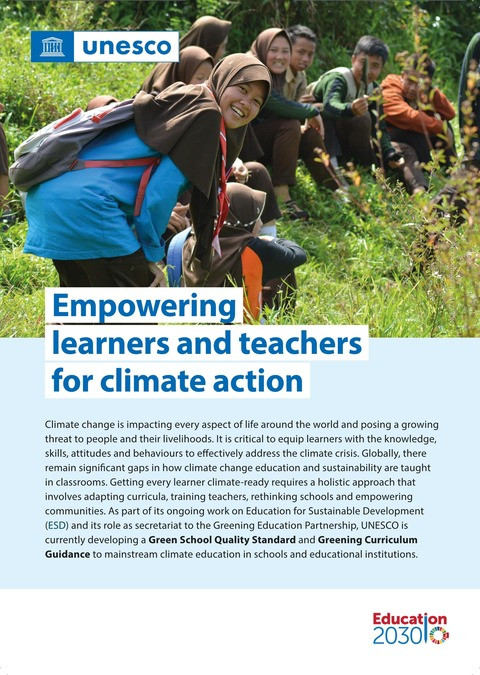 Empowering Learners and Teachers for Climate Action Año de publicación: 2023 Autor corporativo: UNESCO Climate change is impacting every aspect of life around the world and posing a growing threat to people and their livelihoods. It is critical to equip learners with the knowledge, skills, attitudes and behaviours to effectively address the climate crisis. Globally, there remain significant gaps in how climate change education and sustainability are taught in classrooms. Getting every learner climate-ready requires a holistic approach that involves adapting curricula, training teachers, rethinking schools and empowering communities. As part of its ongoing work on Education for Sustainable Development (ESD) and its role as secretariat to the Greening Education Partnership, UNESCO is currently developing a Green School Quality Standard and Greening Curriculum Guidance to mainstream climate education in schools and educational institutions.
  الإرشادات التوجيهية لتخضير مناهج التعليم والتعلّم من أجل العمل المناخيّ Año de publicación: 2024 Autor corporativo: UNESCO This Guidance responds to the calls from young people for a holistic approach to climate change and sustainability in the curriculum. It outlines a common language on how quality climate change and sustainability can be reflected in the curriculum by setting expected learning outcomes per age group (from 5-year olds and up to 18+ age group, including a lifelong learning approach).This is crucial for accelerating country-level action and ensuring joint monitoring of progress. The objective is to have 90 per cent of all countries include climate change in their curricula by 2030, as established by the Greening Education Partnership.This Guidance aims to support countries, schools or individual practitioners in reassessing their ongoing practices to adopt a more action-oriented, holistic, scientifically accurate, justice-driven and lifelong learning approach to climate change.
  AI Competency Framework for Students Año de publicación: 2024 Autor: Fengchun Miao | Kelly Shiohira Autor corporativo: UNESCO Artificial intelligence is increasingly integral to our lives, necessitating proactive education systems to prepare students as responsible users and co-creators of AI. Integrating AI learning objectives into official school curricula is crucial for students globally to engage with AI safely and meaningfully.The UNESCO AI Competency Framework for Students aims to help educators in this integration, outlining 12 competncies across four dimensions:- A human-centred mindset- Ethics of AI- AI techniques and applications- AI system designThese competencies span three progression levels:- Understand- Apply- Create The framework details curricular goals and domain-specific pedagogical methodologies.Grounded in the vision of students as AI co-creators and responsible citizens, the publication emphasizes critical judgement of AI solutions, awareness of citizenship responsibilities in the AI era, foundational AI knowledge for lifelong learning, and inclusive, sustainable AI design.
  Greening Curriculum Guidance: Teaching and Learning for Climate Action Año de publicación: 2024 Autor corporativo: UNESCO This Guidance responds to the calls from young people for a holistic approach to climate change and sustainability in the curriculum. It outlines a common language on how quality climate change and sustainability can be reflected in the curriculum by setting expected learning outcomes per age group (from 5-year olds and up to 18+ age group, including a lifelong learning approach).This is crucial for accelerating country-level action and ensuring joint monitoring of progress. The objective is to have 90 per cent of all countries include climate change in their curricula by 2030, as established by the Greening Education Partnership.This Guidance aims to support countries, schools or individual practitioners in reassessing their ongoing practices to adopt a more action-oriented, holistic, scientifically accurate, justice-driven and lifelong learning approach to climate change.
  Guía para hacer verdes los currículos: enseñanza y aprendizaje para la acción climática Año de publicación: 2025 Autor corporativo: UNESCO Hacer verdes los currículos con el fin de preparar a todos los estudiantes para el cambio climático. La educación es una herramienta poderosa para transformar el mundo e impulsar la acción contra el cambio climático a largo plazo.Esta guía responde a los llamados de las juventudes en favor de un enfoque holístico del cambio climático y la sostenibilidad en los planes de estudio. Define un lenguaje en común sobre cómo debe reflejarse con calidad el cambio climático y la sostenibilidad en los planes de estudio, mediante el establecimiento de los resultados de aprendizaje esperados por grupo etario (grupos de 5 años hasta mayores de 18 años, incluyendo un enfoque de aprendizaje a lo largo de toda la vida).Esto es crucial para acelerar la acción a nivel de los países y garantizar el seguimiento conjunto de los progresos. La meta es lograr que el 90 por ciento de todos los países incluyan el cambio climático en sus planes de estudio para el año 2030, según lo establecido por la Alianza para una Educación Verde.Esta guía tiene el propósito de apoyar a países, escuelas y profesionales en la revisión de las prácticas que tienen en marcha para adoptar un enfoque del cambio climático más orientado a la acción, holístico, científicamente preciso, impulsado por la justicia y con una perspectiva de aprendizaje a lo largo de toda la vida.
  Guide on Human Rights Education Curriculum Development Año de publicación: 2021 Autor: Cecilia Decara | Carol Rask | Felisa Tibbitts Autor corporativo: Danish Institute for Human Rights This document aims to bring conceptual clarity on human rights education and curriculum development and provide concrete suggestions on how to build human rights curricula ft for 21st century human rights challenges, while contributing to the realisation of the SDG goals and targets set by the international community.
  Curriculum in Transformation Mode: Rethinking Curriculum for the Transformation of Education and Education Systems Año de publicación: 2023 Autor: Renato Opertti Autor corporativo: UNESCO International Bureau of Education (IBE) Through these pages, Renato Opertti shares a series of reflections that invite us to revisit the curriculum as an opportunity and lever for societies to express their visions and aspirations. Curriculum can serve to position education as the pillar of a renewed social contract grounded on the welfare of all learners as persons and supporting societies and communities give effect to sustainable and better futures for the younger generations. To do so, we need to re-conceptualize curriculum at large: from a mere specification of frequently fragmented learning contents to its understanding as both a process and product of public policy developments in which diversity of stakeholders own and take responsibility for education as a global common good. Curriculum and pedagogy, by going hand-inhand, and supported by effective teaching, learning and assessment processes, can play a key role in fulfilling the right to education for every learner equally, according to their own individual needs. Key ideas in this book help us to rethink curriculum with future-oriented approaches, entailing a stronger involvement of younger generations in the decision-making process and a careful attention to vulnerability and disadvantaged groups. A curriculum that embraces individuality and diversity within collaborative and caring learning settings, nurtures freedom and autonomous thinking, connects meaningfully the global and the local, and assumes the hybridization of education. The book also delves into perspectives for educational transformation prioritizing the development of learners’ foundational and transformative competencies as the barometer of a progressive curriculum. Crucially, this entails rethinking the mindsets and practices of education systems in light of the interconnected challenges posed by the Fourth Industrial Revolution, post COVID-19, generative AI and the sustainability of the planet and the world.
  The Impact of AI on Curriculum Systems: Towards an Orbit-Shifting Dialogue (In-Progress Reflection; no. 32, 2019) Año de publicación: 2019 Autor corporativo: UNESCO International Bureau of Education (IBE) ‘Artificial Intelligence’ (AI) refers to the theory and development of computer systems able to perform tasks normally requiring human intelligence. In order to achieve transformational change in contemporary curriculum systems and learning environments, we need to engender an orbitshifting dialogue about the potential relationship between AI and education, in terms of both independent variables (threats), and dependent variables (opportunities). Through such a dialogue, we need to create foresight indicators that can predict the process of this relationship. It is, however, crucial that the relationship between AI and education is strong and directly proportionate. If the potential of the relationship is not exploited sufficiently, then underdeveloped education systems will lag behind and fail to achieve their potential for transformation, whether radical or incremental. Indeed, some may even become obsolete. The paper contends that in order to effectively contribute to the knowledge economy and to sustainable development in the age of the 4th Industrial Revolution (characterized by a fusion of cyber-physical technologies) modern educational systems need to overcome obstacles to innovation in order to maximize the potential for transformative change. To achieve this will require an ‘orbital shift’ in educational planning, practice and resourcing, to enable schools to respond more effectively to the rapidly changing needs of young people, society, the economy and environment in the third decade of the 21st century. Schools, educational institutions and environments, need to transform from being primarily spaces for teaching and taking exams, into spaces for innovation and personal learning, based on a culture of actively listening to the voices, choices, needs and goals of learners. Teachers need to become facilitators, coaches and mentors for learners. Schools need to create AI-enabled, flexible, collaborative working spaces. Visionary, energetic educational leaders need to communicate effectively with all stakeholders, including employers and parents, to inspire and manage change and smart decision-making to develop schools of the future. The aim of this reflection is to initiate an ‘orbit-shifting’ dialogue about the potential of AI applications to transform all components of the curriculum system to meet emergent 21st century educational goals. The conceptualization aims to explore the variable roles and impact of curriculum learning and assessment on these emerging educational goals. Theme 1 of the paper outlines the concepts and characteristics of a range of existing AI systems and their potential to enhance teaching learning and assessment. Theme 2 reflects on the potential to embrace AI systems across the curriculum system. Theme 3 proposes an action model to enable AI to have an ‘orbit shifting impact’ on all the components of the curriculum system (i.e. learners, teachers, learning environments, leadership and management, content, pedagogy and assessment) by enhancing opportunities for individualization, creativity and uniqueness.
  Strengthening Social and Emotional Learning in Hybrid Modes of Education: Building Support for Students, Teachers, Schools and Families; A UNESCO-IBE Discussion Paper Año de publicación: 2024 Autor corporativo: UNESCO International Bureau of Education (IBE) The COVID-19 pandemic intensified existing educational disparities globally, prompting a reevaluation of school curricula to include Social and Emotional Learning (SEL). This shift recognized the holistic needs of learners, teachers, and families, emphasizing competencies beyond traditional knowledge acquisition. Despite SEL's increasing global recognition, it is often absent from formal curricula, prompting the UNESCO-IBE to address this gap. This Discussion Paper explores the crucial role of SEL in the broader transformation of global education, particularly in the post-COVID-19 era. It highlights six key topics, presenting diverse experiences in integrating SEL into education. Experts from various fields contribute insights, focusing on socio-emotional and hybrid learning advancements worldwide. The report aims to inspire global change-makers, advocating for robust policies aligned with UNESCO's Futures of Education framework. This call to action aligns with the UNESCO-IBE's HELA initiative, promoting flexible hybrid learning models for crisis response and sustainable educational strategies in line with the UN Transforming Education Summit's vision.