
Recursos
Exploren una amplia gama de recursos valiosos en GCED para profundizar su comprensión y promover su búsqueda, incidencia, enseñanza y aprendizaje.
88 resultados encontrados
 Présentation de l'assurance de la qualité de l'éducation à la citoyenneté démocratique dans les écoles - étude comparative de 10 pays Año de publicación: 2009 Autor corporativo: Conseil de l'Europe (Recommandation Rec (2002) 12). Selon cette recommandation, les gouvernements européens ont reconnu leur responsabilité de veiller à la base culturelle de la démocratie par l'éducation. Cependant, la politique est pas si simple que les recommandations supranationales sont immédiatement traduites en politique dans les Etats nationaux. Cet écart entre les politiques convenues et réalisés a été appelé un «écart de conformité». Une des raisons les plus logiques pour la non-conformité provient d'un manque de sensibilisation ou de compétences. Par conséquent, le Conseil de l'Europe concentrée sur la production de matériaux qui pourraient aider à sensibiliser et développer les compétences. Les principaux produits résultant de cet effort ont été collectées comme un «ECD / EDH Pack » depuis 2005. Cette collection couvre les domaines de l'élaboration des politiques, la gouvernance démocratique des établissements d'enseignement, la formation des enseignants et l'assurance qualité. Le «Outil pour l'assurance qualité de l'éducation à la citoyenneté démocratique dans les écoles» (Bîrzea et al., 2005), qui est l'un de ces matériaux, constitue le document de référence pour cette étude. Cette étude analyse les conditions pertinentes et les activités possibles en ce qui concerne la mise en œuvre de l'outil dans 10 systèmes éducatifs nationaux. Comme les conditions pertinentes, l'étude considère les tentatives existantes pour offrir une qualité d'enseignement au sein des pays, ainsi que les programmes de formation des enseignants qui accompagnent ces tentatives. Comme les activités possibles, les adaptations nationales de l'outil, et diverses façons de travailler avec différents groupes cibles, sont également pris en compte. Les sections suivantes fournissent des informations de base concernant le projet. Cela aidera le lecteur à comprendre pourquoi l'outil doit être adapté dans des circonstances différentes. La section 2 présente des points de référence qui ouvrent des perspectives théoriques sur le travail présenté. Section 3 fournit une justification pour la sélection des pays participants et donne et décrit la méthodologie utilisée lors de la réalisation de cette étude. Enfin, la section 4 donne un aperçu du reste du contenu de ce livre.
 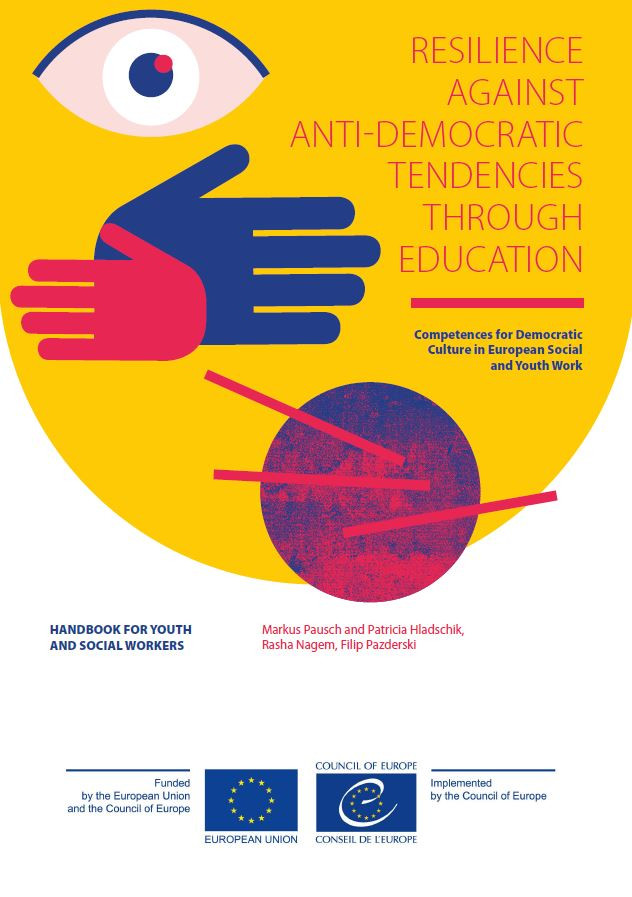 Resilience Against Anti-Democratic Tendencies through Education: Competences for Democratic Culture in European Social and Youth Work Año de publicación: 2021 Autor: Markus Pausch | Patricia Hladschik | Filip Pazderski | Rasha Nagem Autor corporativo: Council of Europe In this handbook the authors focus on competences for democracy and thus on how to prevent and avoid anti-democratic phenomena like authoritarianism, violent radicalisation, extremism, hate speech or conspiracy theories. This material contains a set of new or refreshed educational methods, tailored to work specifically with social workers and youth workers. All of them should help them prepare to counter these tendencies. Handbook was developed in the project “Resilience through Education for Democratic Citizenship” (REDE), implemented in the programme “Democratic and Inclusive School Culture in Operation” (DISCO) of the European Commission and the Council of Europe. Introducing quality assurance of education for democratic citizenship in schools - comparative study of 10 countries Año de publicación: 2009 Autor corporativo: Council of Europe For over a decade the Council of Europe has been working on policies in the field of education for democratic citizenship (EDC). One result has been that the Committee of Ministers of the Council of Europe agreed on a recommendation stating that EDC is central to educational politics, and that it is a “factor for innovation in terms of organising and managing overall education systems, as well as curricula and teaching methods” (Recommendation Rec(2002)12). According to this recommendation, European governments acknowledged their responsibility for ensuring the cultural basis of democracy through education. However, politics is not so simple that supranational recommendations are immediately translated into policy in national states. This gap between agreed and realised policies has been termed a “compliance gap”. One of the most logical reasons for noncompliance comes from a lack of awareness or competences. Therefore the Council of Europe concentrated on producing materials that could help raise awareness and develop competences. Key products resulting from this effort have been collected as an “EDC/HRE Pack” since 2005.This collection covers the areas of policy making, democratic governance of educational institutions, teacher training and quality assurance. The “Tool for Quality Assurance of Education for Democratic Citizenship in Schools” (Bîrzea et al., 2005), which is one of these materials, forms the reference document for this study.This study analyses relevant conditions and possible activities with regard to implementing the tool in 10 national educational systems. As relevant conditions, the study considers the existing attempts to deliver educational quality within countries, together with the teacher training programmes that accompany these attempts. As possible activities, national adaptations of the tool, and various ways of working with different target groups, are also taken into account.The following sections provide background information concerning the project. This will help the reader understand why the tool needs to be adapted in different circumstances. Section 2 presents points of reference that open theoretical perspectives on the work presented. Section 3 provides a rationale for the selection of participating countries and gives and describes the methodology used when conducting this study. Finally, Section 4 provides an overview of the remaining contents of this book.
 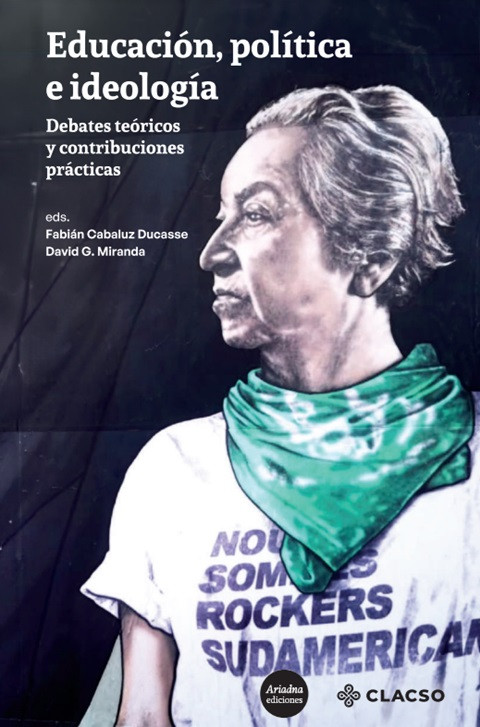 Education, Politics and Ideology: Theoretical Debates and Practical Contributions Año de publicación: 2024 Autor: David G. Miranda | Jorge Fabián Cabaluz Ducasse Autor corporativo: Latin American Council of Social Sciences (CLACSO) This book, "Education, Politics and Ideology: Theoretical Debates and Practical Contributions", is a work by the Latin American Pedagogies Research Group at the University of Playa Ancha, which is positioned from a critical perspective in the educational and pedagogical field. This currently implies, among other things, the relevance of discussing, polemizing and confronting those perspectives that have technified and instrumentalized pedagogy, reducing it to a merely practical, technical field, unrelated to epistemological, ethical, philosophical and/or political issues. In this direction, the essays that make up the book distance themselves substantially from those perspectives that conceive our field as a terrain that must advocate for neutrality, impartiality, and asepsis; and they propose clear and explicit positions with respect to social justice, democracy, equality, and dignity. Educación, política e ideología: Debates teóricos y contribuciones prácticas Año de publicación: 2024 Autor: David G. Miranda | Jorge Fabián Cabaluz Ducasse Autor corporativo: Latin American Council of Social Sciences (CLACSO) Este libro "Educación, política e ideología: debates teóricos y contribuciones prácticas", surge desde el Grupo de Investigación de Pedagogías Latinoamericanas de la Universidad de Playa Ancha, el cual se encuentra posicionado desde las perspectivas críticas del campo educativo y pedagógico, lo que implica en la actualidad, entre otras cosas, la relevancia de discutir, polemizar y confrontar aquellas perspectivas que han tecnificado e instrumentalizado la pedagogía, reduciéndola a un campo meramente práctico, técnico, ajeno a cuestiones epistemológicas, éticas, filosóficas y/o políticas. En esta dirección, los ensayos que componen el libro se distancian sustancialmente de aquellas perspectivas que conciben nuestro campo como un terreno que debe abogar por la neutralidad, la imparcialidad, la asepsia; y proponen posicionamientos claros y explícitos con respecto a la justicia social, la democracia, la igualdad, la dignidad.
 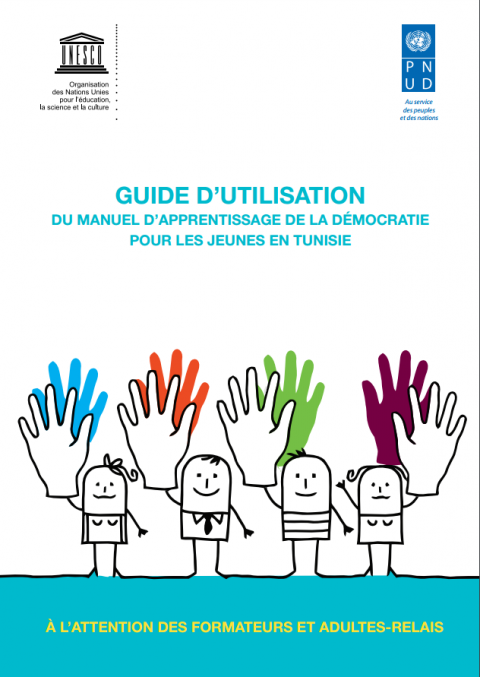 دليل لفائدة المكونين و الوسطاء لإستعمال " دليل شباب تونس في تعلم الديمقراطية " Año de publicación: 2013 Autor corporativo: UNESCO Rabat The main aim of these manual and guide is to raise awareness among Tunisian youth about the values of democracy, human rights and responsible citizenship, and empower youth to make their voice heard during this critical period in the Tunisian democratic transition. Guide d'utilisation du manuel d'apprentissage de la démocratie pour les jeunes en Tunisie, à l'attention des formateurs et adultes-relais Año de publicación: 2013 Autor corporativo: UNESCO Rabat The main aim of these manual and guide is to raise awareness among Tunisian youth about the values of democracy, human rights and responsible citizenship, and empower youth to make their voice heard during this critical period in the Tunisian democratic transition. Democracy and diversity: principles and concepts for educating citizens in a global age Año de publicación: 2005 Autor: James A. Banks | Cherry A. McGee Banks | Carlos E. Cortes | Carole L. Hahn | Merry M. Merryfield | Kogila A. Moodley | Stephen Murphy-Shigematsu | Audrey Osler | Caryn Park | Walter C. Parker Autor corporativo: Center of Multicultural Education, University of Washington The Center for Multicultural Education at the University of Washington convened—with support from the Spencer Foundation—a Diversity, Citizenship, and Global Education Consensus Panel. The Panel’s goal was to develop a set of principles, concepts, and guidelines that school practitioners can use to build or renew citizenship education programs that balance diversity and unity and prepare students to become effective citizens in a global context. An important resource for the Panel’s work was the book that resulted from an earlier conference sponsored by the Center, Diversity and Citizenship Education: Global Perspectives (Banks, 2004a).The Consensus Panel developed four principles and identified ten concepts, which are detailed in this publication. The Panel also developed a checklist that is designed for use by educators who want to consider the extent to which the principles and concepts identified by the Panel are reflected in their classrooms and schools.PRINCIPLESSection I Diversity, Unity, Global Interconnectedness, and Human Rights1. Students should learn about the complex relationships between unity and diversity in their local communities, the nation, and the world.2. Students should learn about the ways in which people in their community, nation, and region are increasingly interdependent with other people around the world and are connected to the economic, political, cultural, environmental, and technological changes taking place across the planet.3. The teaching of human rights should underpin citizenship education courses and programs in multicultural nation-states.Section II Experience and Participation4. Students should be taught knowledge about democracy and democratic institutions and provided opportunities to practice democracy. Démocratie et diversité: principes et concepts pour l'éducation des citoyens dans un âge global Año de publicación: 2005 Autor: James A. Banks | Cherry A. McGee Banks | Carlos E. Cortes | Carole L. Hahn | Merry M. Merryfield | Kogila A. Moodley | Stephen Murphy-Shigematsu | Audrey Osler | Caryn Park | Walter C. Parker Autor corporativo: Center of Multicultural Education, University of Washington Le Centre pour l'éducation multiculturelle à l'Université de Washington a convoqué-avec le soutien de la Fondation-a Spencer Diversité, Citoyenneté et Éducation Globale Panel Consensus . L'objectif du Groupe est de développer un ensemble de principes, des concepts et des lignes directrices que les praticiens de l'école peuvent utiliser pour construire ou de renouveler les programmes d'éducation à la citoyenneté que la diversité de l'équilibre et de l'unité et de préparer les étudiants à devenir des citoyens efficaces dans un contexte mondial. Une ressource importante pour les travaux du Groupe spécial était le livre qui résulte d'un earlierconférencesponsored par le Centre, la diversité et l'éducation à la citoyenneté: perspectives mondiales (banques, 2004a). Le groupe de concertation a élaboré quatre principes et identifi é dix concepts, qui sont détaillées dans cette publication. Le Groupe spécial a également mis au point une liste de contrôle qui est conçu pour être utilisé par les éducateurs qui veulent examiner la mesure dans laquelle les principes et les concepts identifi és par le Groupe sont refl ète dans leurs salles de classe et les écoles. PRINCIPES Section I Diversité, Unité, Global interconnectivité et droits de l'homme 1. Les élèves devraient en apprendre davantage sur les relations complexes entre l'unité et la diversité dans leurs communautés locales, la nation et le monde. 2. Les élèves devraient en apprendre davantage sur les façons dont les gens dans leur communauté, de la nation et de la région sont de plus en plus interdépendantes avec d'autres personnes dans le monde et sont reliés aux changements économiques, politiques, culturels, environnementaux et technologiques qui ont lieu à travers la planète. 3. L'enseignement des droits de l'homme devrait soutenir les cours et les programmes d'éducation à la citoyenneté dans les États-nations multiculturelles. Section II Expérience et participation 4. Les élèves doivent apprendre les connaissances sur la démocratie et les institutions démocratiques et a fourni des occasions de pratiquer la démocratie.
  Building Citizenship from Universities; University Social Responsibility and Challenges in the XXI century Año de publicación: 2011 Autor: Eduardo Gasca-Pliego | Julio César Olvera-García Autor corporativo: Universidad Autónoma del Estado de México The present essay contributes with a reflection on the role universities must take as agents of transformation and consolidation of the democratic model, mainly before the challenge of building full citizens, interested in the need of the physical and social environment, in collective decision making, who think of themselves as participant citizens and not only voters with their own interests in view. Distinguishable is the primordial role of university social responsibility to promote the social management of knowledge for everyone, which has as an end the construction of informed, responsible and participant citizenship, which responds to injustice, non-sustainability, violence and corruption. Rethinking the social function of the university requires defending the values proper to public education, in the sense that every citizen has equal opportunities to develop their capabilities, eliminating obstacles of social and economic nature, as well as the cultural and political that affect and hinder said development.