
Recursos
Exploren una amplia gama de recursos valiosos en GCED para profundizar su comprensión y promover su búsqueda, incidencia, enseñanza y aprendizaje.
31 resultados encontrados
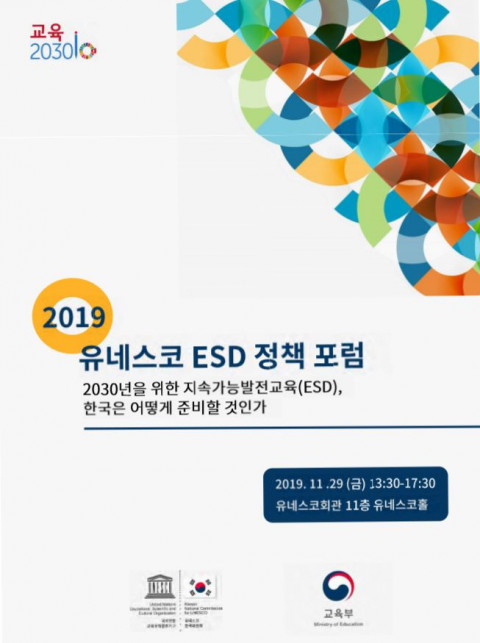 2019 유네스코 ESD 정책 포럼: 2030년을 위한 지속가능발전교육(ESD), 한국은 어떻게 준비할 것인가 Año de publicación: 2019 Autor corporativo: 대한민국 교육부 | 유네스코한국위원회 2019년 11월에 유네스코한국위원회(ESD한국위원회)에서 주최한 '2019 유네스코 지속가능발전교육 정책 포럼'의 자료집으로 행사개요와 토론자료, 지속가능발전교육에 대한 부록을 수록하고 있다.2030년을 위한 지속가능발전교육(ESD), 한국은 어떻게 준비할 것인가를 주제로 ESD for 2030 체계 수립 및 이행 준비에 대한 국제사회 최신 동향 공유, 국가 이니셔티브 구축 관련 한국 차원의 정책적 준비 및 운영 체계 수립 방안 논의, GAP 참여기관 등 국내 ESD 이행 핵심 주체별 활동 내용 공유 및 제언 등이 주요 내용이다.
  Neuroscience Applied to Everyday Life: David del Rosario, Neuroscience Researcher (Full Version) Año de publicación: 2022 Autor: David del Rosario Autor corporativo: Banco Bilbao Vizcaya Argentaria (BBVA) Why are we unhappy even when everything is going well? What is thought? Do we know how our mind and body works? "Knowledge, if not applied, is useless," says scientist David del Rosario. In this video, the researcher analyzes different experiments and questions our relationship with what we think to address what he calls "everyday neuroscience". Neurociencia aplicada al día a día: David del Rosario, investigador en neurociencia (Versión Completa) Año de publicación: 2022 Autor: David del Rosario Autor corporativo: Banco Bilbao Vizcaya Argentaria (BBVA) ¿Por qué somos infelices incluso cuando todo va bien? ¿Qué es el pensamiento? ¿Conocemos cómo funciona nuestra mente y nuestro organismo? "El conocimiento, si no se aplica, no sirve para nada", asegura el científico David del Rosario. En este vídeo, el investigador analiza diferentes experimentos y cuestiona nuestra relación con lo que pensamos para abordar lo que él llama "neurociencia del día a día".
 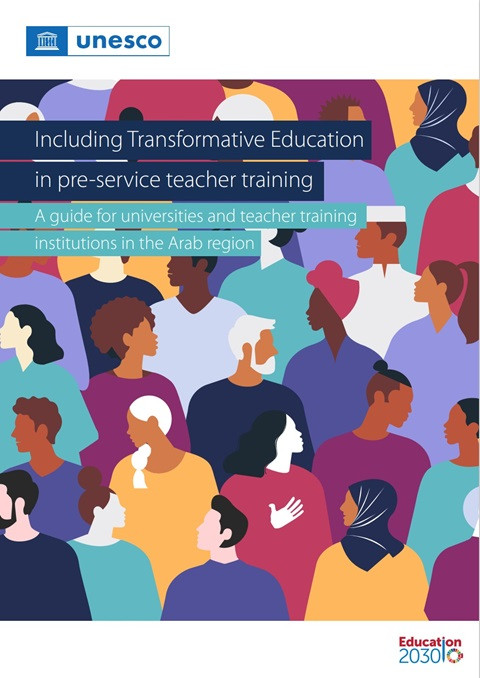 Including Transformative Education in Pre-service Teacher Training: A Guide for Universities and Teacher Training Institutions in the Arab Region Año de publicación: 2024 Autor: Khalaf Al Abri | Marco Pasqualini Autor corporativo: UNESCO Beirut Transformative Education (TE), which includes concepts such as Global Citizenship Education (GCED) and Education for Sustainable Development (ESD), is an essential approach to provide learners with the tools to act for more just, peaceful and sustainable societies. Between 2021 and 2023, the experts of the UNESCO Arab Transformative Education Network identified the creation of a course on Transformative Education for teachers’ pre-service training as a key step to (i) provide teachers with the needed skills to promote Transformative Education as part of the national curriculum as well as though their daily teaching practices, and (ii) to support the reform of pedagogies more broadly, by making them more interactive and focused on critical thinking, and thus positively contributing to improving learners’ overall learning outcomes. This guidance document is addressed to all entities in charge of pre-service teacher training (e.g. departments of education within higher education institutions and teacher training institutions) in the Arab region interested in including Transformative Education as part of their programmes. The guidance document particularly supports faculty deans and academia in defining the scope and the key parameters to consider while developing a course on Transformative Education, including defining course objectives, format, content, and pedagogy, as well as choosing the right facilitator(s) to deliver the course. The document also provides useful references to other guides and tools which can further support the reflections around Transformative Education and how it can be concretely applied and promoted at the higher education level.
  지속가능발전교육 지도자료: 초등학교 3~6학년 교사용 안내서 Año de publicación: 2020 Autor corporativo: 서울특별시교육청 교육혁신과 기후위기시대, 생태환경에 대한 인식을 제고하고 감수성을 기르기 위한 《2020 지속가능발전교육 초등학교 교사용 지도자료》로 교과, 동아리, 자유학기 활동 등 학교 생태전환교육에 활용가능하다. 또한 각 단원별로 지속가능발전목표 17개를 적용할 수 있는 내용으로 구성하였다.
  지속가능발전교육 지도자료: 중학교 1~3학년 교사용 안내서 Año de publicación: 2020 Autor corporativo: 서울특별시교육청 교육혁신과 기후위기시대, 생태환경에 대한 인식을 제고하고 감수성을 기르기 위한 《2020 지속가능발전교육 중학교 교사용 지도자료》로 교과, 동아리, 자유학기 활동 등 학교 생태전환교육에 활용가능하다. 또한 각 단원별로 지속가능발전목표 17개를 적용할 수 있는 내용으로 구성하였다.
  Green School Quality Standard: Greening Every Learning Environment Año de publicación: 2024 Autor corporativo: UNESCO Climate change threatens our planet and future. Schools and other learning institutions are central places for accelerating climate action among learners and local communities. By empowering teachers and students to understand climate change in their own context contribute to making societies more sustainable and climate resilient. This publication provides for the first time ever a quality standard for greening schools and other learning environments. It outlines four core areas for integrating sustainability principles and climate action: 1) school governance, 2) facilities and operation, 3) teaching and learning, and 4) community engagement. Through the Greening Education Partnership, this standard establishes a common language for all stakeholders to jointly reach the global target of greening at least 50% of schools in all countries by 2030. Policy-makers and ministries in charge of education accreditation schemes, as well as educators, learners and communities are encouraged to use the green school quality standard and join the climate-ready school movement to ensure that every learner is equipped to address climate challenges. Normes de qualité des écoles vertes: pour des cadres d’apprentissage verts Año de publicación: 2024 Autor corporativo: UNESCO Le changement climatique menace notre planète et notre avenir. Les écoles et autres institutions d'apprentissage sont des lieux centraux pour accélérer l'action climatique parmi les apprenants et les communautés locales. En donnant aux enseignants et aux élèves les moyens de comprendre le changement climatique dans leur propre contexte, ils contribuent à rendre les sociétés plus durables et plus résilientes face au climat. Cette publication fournit pour la première fois une norme de qualité pour la « vérdisation » des écoles et autres environnements d'apprentissage. Elle présente quatre domaines clés pour intégrer les principes de durabilité et l'action climatique : 1) la gouvernance scolaire, 2) les infrastructures et l'exploitation, 3) l'enseignement et l'apprentissage, et 4) l'engagement communautaire. Grâce au Partenariat pour une éducation verte, cette norme établit un langage commun pour tous les acteurs afin d'atteindre ensemble l'objectif mondial de verdir au moins 50 % des écoles dans tous les pays d'ici 2030. Les décideurs politiques et les ministères responsables des schémas d'accréditation éducatifs, ainsi que les éducateurs, les apprenants et les communautés, sont encouragés à utiliser la norme de qualité des écoles vertes et à rejoindre le mouvement des écoles prêtes pour le climat, afin de garantir que chaque apprenant soit équipé pour relever les défis climatiques.
 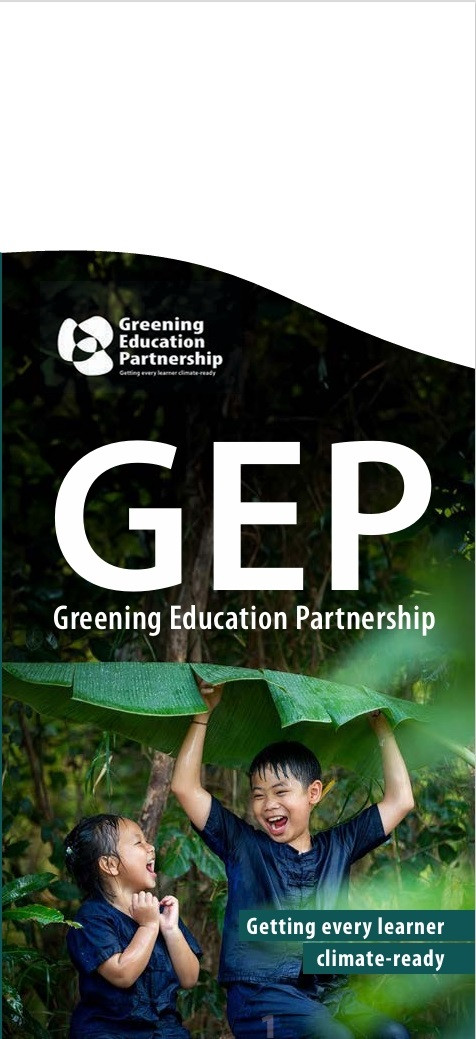 Greening Education Partnership: Getting Every Learner Climate-Ready Año de publicación: 2024 Autor corporativo: UNESCO Bangkok The UN Secretary-General calls the climate crisis ‘a battle for our lives’, as we still struggle to transform our societies to reach the 1.5°C-degree path recommended by the Paris Agreement. Rapid and radical transformation at all levels and in many aspects of our life is required, with education as a central and powerful means to support the adaptation and strengthening of the resilience of learners and societies. It is also important to ensure that education systems become more resilient to climate change to create safe and climate-proof schools. Building off of the knowledge and practice accumulated in Education for Sustainable Development (ESD), a new Greening Education Partnership aims to deliver strong, coordinated and comprehensive action which will prepare every learner to acquire the knowledge, skills, values, and attitudes to tackle climate change and to promote sustainable development.
 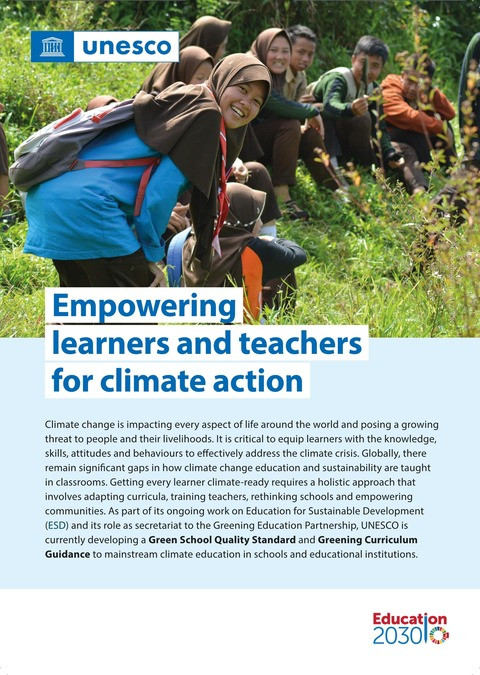 Empowering Learners and Teachers for Climate Action Año de publicación: 2023 Autor corporativo: UNESCO Climate change is impacting every aspect of life around the world and posing a growing threat to people and their livelihoods. It is critical to equip learners with the knowledge, skills, attitudes and behaviours to effectively address the climate crisis. Globally, there remain significant gaps in how climate change education and sustainability are taught in classrooms. Getting every learner climate-ready requires a holistic approach that involves adapting curricula, training teachers, rethinking schools and empowering communities. As part of its ongoing work on Education for Sustainable Development (ESD) and its role as secretariat to the Greening Education Partnership, UNESCO is currently developing a Green School Quality Standard and Greening Curriculum Guidance to mainstream climate education in schools and educational institutions.