
Recursos
Exploren una amplia gama de recursos valiosos en GCED para profundizar su comprensión y promover su búsqueda, incidencia, enseñanza y aprendizaje.
26 resultados encontrados
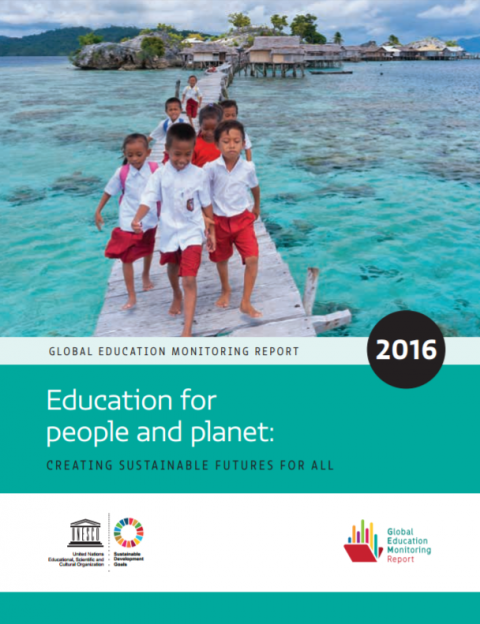 Informe de Seguimiento de la Educación en el Mundo, 2016: La Educación al servicio de los pueblos y el planeta: creación de futuros sostenibles para todos Año de publicación: 2016 Autor corporativo: UNESCO | Global Education Monitoring Report Team Education for People and Planet: Creating Sustainable Futures for All explores the complex relationship between education and the new 2030 Agenda for Sustainable Development, covering six fundamental pillars – Planet, Prosperity, People, Peace, Place and Partnerships. This report shows that education will not deliver its full potential unless participation rates increase dramatically and sustainable development guides education system reform. It also warns of the destructive impact that climate change, conflict, unsustainable consumption and the increasing gap between rich and poor have on education. A huge transformation is needed if we are to create sustainable futures for all.
  Buenas prácticas de educación para el desarrollo sostenible en materia de cambio climático Año de publicación: 2012 Autor corporativo: UNESCO Since the beginning of the UN Decade of Education for Sustainable Development (DESD, 2005-2014), the DESD Secretariat at UNESCO Headquarters in Paris has received numerous requests for case studies and descriptions of good practices in Education for Sustainable Development (ESD). These requests have increasingly included issues of providing an educational response to climate change. The increasing number of requests is only one indicator that climate change education is increasingly recognized in the broader education community as an essential part of ESD and life-long learning. ESD is a complex and evolving subject, and how it is applied and implemented is a challenge for all countries. The Decade aims to see ESD implemented in thousands of local situations on the ground, involving its integration into a multitude of different learning situations. These initiatives can be catalysts for action and contribute to the goals and objectives of the Decade. In such ways, organizations, local communities and individuals can be actors within the global movement for sustainable development. To support the growing interest in climate change issues and ESD, UNESCO is publishing this volume containing 17 examples of programmes addressing climate change in ESD settings and practices. These good practices and shared experiences, which were provided by a range of different stakeholders, are concrete examples of successful implementation of ESD in different fields and sectors, from the political to the school level, and including formal, nonformal and informal learning situations. Promover una asociación mundial con miras al Decenio de las Naciones Unidas de la educación para el desarrollo sostenible (2005-2014): el plan de aplicación internacional del decenio en pocas palabras Año de publicación: 2006 Autor corporativo: UNESCO Through the International Implementation Scheme governments and other partners, especially potential donors, are urged to assess existing ESD resources and needs in countries, reallocate existing resources and find means of mobilizing new resources to ensure that ESD will not be a mere slogan but actual reality. Inclusión, educación para el desarrollo sostenible, aprendizaje de adultos, educación superior e investigación: cuatro conferencias internacionales para promover la equidad, la calidad, la pertinencia y la responsabilidad social en materia de educación Año de publicación: 2008 Autor corporativo: UNESCO This cycle of conferences brings together a wide array of influential stakeholders in the common interest of creating education systems that serve the needs of all learners, address the challenges of today's world and make learning a springboard of development. Material educativo para los países situados en zonas montañosas: una manera creativa de educar sobre el medio ambiente Año de publicación: 2011 Autor: Thomas Schaaf Autor corporativo: UNESCO Entitled: A Teaching Resource Kit for Mountain Countries, it is a new environmental education kit similar to the Teaching Resource Kit for Dryland Countries published by UNESCO in 2008. It is based on the same innovative approach appealing to the creativity and artistic sensibility of pupils aged around 10 to 15, and is intended for secondary-school (and late primary-school) teachers and their pupils, this time living in mountain ecosystems, where climate and environmental conditions are harsh, often varying between extremes, and which are subject to the problems of erosion. As an educational tool, the kit offers a practical and attractive way of helping teachers and their pupils towards a better understanding of the environmental problems of their region and to stimulate their quest for possible solutions. In this respect, its content is a further contribution to the United Nations General Assembly’s resolution proclaiming 2002 the International Year of Mountains and is also consistent with the activities developed as part of the United Nations Decade of Education for Sustainable Development (2005-2014), the promotion of which is UNESCO’s responsibility. Material educativo para los países situados en zonas secas: una manera creativa de educar sobre el medio ambiente Año de publicación: 2008 Autor: Thomas Schaaf Autor corporativo: Organización de las Naciones Unidas para la Educación, la Ciencia y la Cultura (UNESCO) Entitled A Creative Approach to Environmental Education/Teaching Resource Kitfor Dryland Countries, the kit is intended for secondary-school teachers in countries affected by desertification and is based on an innovative approach appealing to the creativity and artistic sensibility of pupils aged 10 to 15 years. This approach favours discovery of the environment through the senses, and emphasizes the visual and exploratory aspects of environmental study. The idea of using creativity and artistic sensibility to promote ecological awareness may in the future become a source of collaboration to be explored in detail by the different sectors of UNESCO.