
Recursos
Exploren una amplia gama de recursos valiosos en GCED para profundizar su comprensión y promover su búsqueda, incidencia, enseñanza y aprendizaje.
54 resultados encontrados
 Segundo compendio de prácticas ejemplares en materia de educación para el desarrollo sostenible Año de publicación: 2009 Autor corporativo: UNESCO Associated Schools Project Network (ASPnet) This second collection of ASPnet good practices for quality education takes stock of some of the contributions being made by UNESCO Associated Schools in support of the United Nations Decade of Education for Sustainable Development (DESD).
 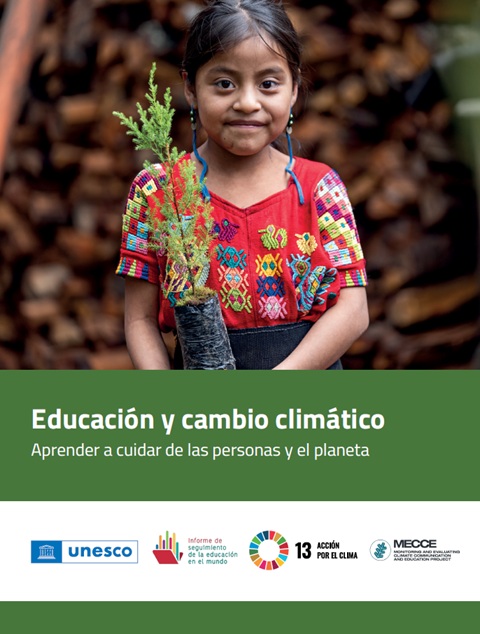 Educación y cambio climático: aprender a cuidar de las personas y el planeta Año de publicación: 2024 Autor corporativo: Global Education Monitoring Report Team | Monitoring and Evaluating Climate Communication and Education Project (MECCE) | University of Sakatchewan ¿Cómo puede la educación conducir a la acción contra el cambio climático?A pesar de las sólidas pruebas existentes sobre la repercusión de la educación en el logro de otros objetivos de desarrollo y la función que desempeña en el desarrollo de la capacidad profesional para las transiciones hacia el desarrollo sostenible, la educación suele estar ausente de las consideraciones estratégicas, políticas, de planificación y de financiación de otros sectores.El Informe de seguimiento de la educación en el mundo presenta una nueva serie destinada a fomentar el diálogo sobre la interrelación de la educación con los demás Objetivos de Desarrollo Sostenible. El primer documento de la serie se centra en el cambio climático, y empieza por analizar el creciente impacto del cambio climático en la educación antes de pasar a abordar la función de la educación en la acción climática.La contribución de la educación al desarrollo de capacidades profesionales para la transición a una economía verde está en cierta medida infravalorada. Al mismo tiempo, existe la conciencia de que el aprendizaje, tanto formal como no formal e informal, desempeña una función esencial a la hora de motivar la acción en materia de mitigación del cambio climático y adaptación a sus efectos.Sin embargo, la existencia de una correlación positiva entre el nivel de educación y los niveles de consumo insostenibles, así como la falta de conclusiones de muchas investigaciones sobre la repercusión directa de la educación en la mitigación del cambio climático y la adaptación a sus efectos, han contribuido en parte a que se otorgue escasa prioridad a la educación en las agendas mundiales y nacionales sobre el cambio climático.En este documento se sostiene que es necesario adaptar la educación sobre el cambio climático para que desarrolle todo su potencial. El paradigma educativo no puede basarse únicamente en la transferencia de conocimientos, sino que debe centrarse en el aprendizaje socioemocional y orientado a la acción. Gran parte de la investigación se ha centrado en analizar el logro educativo y los resultados que se alcanzan mediante el aprendizaje cognitivo. Por ello, es necesario seguir investigando para evaluar otros factores mediante los cuales la educación puede influir en los comportamientos y motivar la acción contra el cambio climático. Estas investigaciones son necesarias para formular paquetes de reformas educativas viables que mejoren los planes de estudios, refuercen la preparación de las escuelas y los sistemas educativos para el cambio climático, impliquen a los educandos y preparen a los educadores en consecuencia. Estrategia de la UNESCO para la segunda mitad del decenio de las Naciones Unidas de la educación para el desarrollo sostenible Año de publicación: 2010 Autor corporativo: Organización de las Naciones Unidas para la Educación, la Ciencia y la Cultura (UNESCO) The UNESCO Strategy for the Second Half of the United Nations (UN) Decade of Education for Sustainable Development (DESD) draws on the findings and lessons learnt from the first phase of the DESD monitoring and evaluation (M&E) process (as reflected in the 2009 DESD M&E report Learning for a Sustainable World: Review of Contexts and Structures for Education for Sustainable Development. It also builds on the UNESCO World Conference on ESD and the Bonn Declaration as well as on the outcomes of other key international ESD meetings. The Bonn Declaration gives particular emphasis to the importance of education for the global development agenda and underlines the essential contribution of ESD to shaping the purpose, content and quality of all education. The UNESCO strategy will be implemented in line with the International Implementation Scheme (IIS), which, along with the Bonn Declaration, will provide the global strategic framework for UNESCO and its DESD partners during the second half of the Decade. The Strategy takes into account key DESD regional challenges and opportunities. It is also shaped by the shared vision of education emerging from the four 2008-2009 UNESCO international education conferences: one of education systems that encourage equity and inclusion, quality learning, flexibility and innovation. While UNESCO puts highest emphasis on achieving Education for All (EFA), the Organization’s actions in education extend beyond this, to pay explicit attention to inclusion, social cohesion and social justice, to lifelong learning and to the crucial role of higher education and research. The overall goal of the UNESCO Strategy for the Second Half of the DESD is to support Member States and other stakeholders in addressing global sustainable development challenges at regional, national and global level through ESD, thus addressing the challenges of learning for bringing about a more sustainable world. La Lente de la educación para el desarollo sostenible: una herramienta para examinar las políticas y la práctica Año de publicación: 2010 Autor corporativo: Organización de las Naciones Unidas para la Educación, la Ciencia y la Cultura (UNESCO) The Education for Sustainable Development (ESD) Lens has been prepared to support UN Member States to respond to these challenges through implementation of the United Nations Decade of Education for Sustainable Development (DESD, 2005- 2014). The ESD Lens supports the goals of the DESD, and encourages policy-makers and practitioners in Member States to initiate the process of re-orienting education, particularly the formal education system, towards sustainable development. The overall goal of the UN Decade of Education for Sustainable Development (DESD) is for countries to integrate the understandings, skills and values inherent in sustainable development into all aspects of national education plans to encourage changes in lifestyles and behaviour that allow for a more sustainable and just society for all. This complements existing Education for All initiatives, and strengthens the objectives of the Millennium Development Goals. Education for Sustainable Development has the potential to improve the quality and relevance of education everywhere. Forjar la educación del mañana: decenio de las Naciones Unidas de la educación para el dessarollo sostenible: informe 2012, abreviado Año de publicación: 2012 Autor corporativo: Organización de las Naciones Unidas para la Educación, la Ciencia y la Cultura (UNESCO) As the lead agency for the UN Decade of Education for Sustainable Development (DESD, 2005 – 2014), UNESCO is responsible for monitoring and evaluating progress during the DESD. UNESCO is publishing three reports during the DESD – in 2009, 2012 and 2014. This second report focuses specifically on processes and learning in the context of Education for Sustainable Development (ESD). What kinds of learning processes have emerged in the course of the DESD? What is the role of ESD in supporting them? What changes in ESD have occurred since the early years of the Decade? The report is informed by a broad consultation process that includes input from hundreds of policy makers, scholars and practitioners engaged in ESD around the world. Decenio de las Naciones Unidas de la Educación para el Desarrollo Sostenible, 2005-2014: el Decenio en pocas palabras Año de publicación: 2005 Autor corporativo: UNESCO This document briefs on the Decade of Education for Sustainable Development (DESD), detailing its objectives, the implementation plans, good practices, and challenges that DESD faces. Buenas prácticas de educación para el desarrollo sostenible en la primera infancia Año de publicación: 2012 Autor corporativo: UNESCO To support the growing interest in early childhood issues and ESD, UNESCO is publishing this volume containing 12 examples of programmes addressing ESD in early childhood settings and practices. These good practices and shared experiences, which were provided by a range of different stakeholders, are concrete examples of successful implementation of ESD in different fields and sectors, from the political to the school level, and including formal, nonformal and informal learning situations. Guardarenas Sandwatch: adaptarse al cambio climático y educar para el desarollo sostenible Año de publicación: 2012 Autor: Gillian Cambers | Paul Diamond Autor corporativo: UNESCO Sandwatch provides a framework for children, youth and adults, with the help of teachers and local communities, to work together to critically evaluate the problems and conflicts facing their beach environments, and to develop sustainable approaches to address these issues. It also helps beaches become more resilient to climate change. The preliminary chapters of this publication focus on how to get started with Sandwatch activities and examine ways to address climate change impacts. The principle aim of this publication is to document the Sandwatch methodology: monitoring, analysing, sharing and taking action. An activities-orientated approach is used to provide step-by-step instructions to cover monitoring methods and data analysis, including observation and recording, erosion and accretion, beach composition, human activities, beach debris, water quality, waves, longshore currents, plants and animals. The activities are related to (a) sustainable development issues, including: beach ownership, mining beaches for construction material, conflict resolution between different beach users, pollution, conservation of endangered species, and (b) climate change adaptation issues: sea level rise, rising temperatures, ocean acidification and increased extreme events. Ways to share findings and create a Sandwatch network are detailed including methods such as the use of local media, websites, social networking and video production. Finally, ways are discussed to design, plan and implement a Sandwatch project to fulfill one or all of the following criteria: (a) addressing a particular beach-related issue, (b) enhancing the beach, and (c) promoting climate change adaptation. Sandwatch stands as an example of Education for Sustainable Development in action, and is being targeted as one of several flagship projects for the United Nations Decade of Education for Sustainable Development (2005–2014). As the world confronts the growing threat of climate change, Sandwatch presents an opportunity to help people and ecosystems respond to present and future changes in a practical manner. Beaches are among the ecosystems most at risk from climate change as they face rising sea levels and increased more intense storms. By contributing to ecosystem health and resilience, Sandwatch can help people from all walks of life learn about climate change and how their actions can contribute to the adaptation process.
  [Vídeo] Descubre las Diez Metas del Objetivo de Desarrollo Sostenible 4... ¡con Elyx! Año de publicación: 2017 Autor corporativo: UNESCO La UNESCO presenta su nuevo vídeo para explicar las diez metas del Objetivo de Desarrollo 4. Junto a Elyx, la primera embajadora digital de la UNESCO, descubre como garantizar una educación inclusiva, equitativa y de calidad y promover oportunidades de aprendizaje durante toda la vida para todos.
 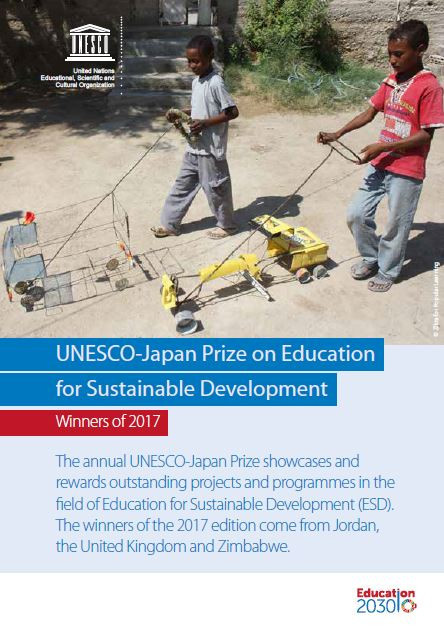 Premio UNESCO-Japon de Educacion para el Desarrollo Sostenible: Galardonados de 2017 Año de publicación: 2017 Autor corporativo: UNESCO En 2017 el Premio UNESCO-Japon llegaba a su tercera edicion. Los galardonados fueron elegidos de entre las mas de 100 candidaturas presentadas por gobiernos de Estados Miembros de la UNESCO y organizaciones no gubernamentales quecolaboran oficialmente con la Organizacion. Tras examinar las candidaturas, un jurado independiente formado por cinco especialistas internacionales en EDS recomendo los tres galardonados a la Directora General de la UNESCO.Este ano se ha concedido el premio a una escuela, una empresa y una organizacion sin animo de lucro que promueven la EDS a escala local, regional y mundial respectivamente: la escuela de primaria Sihlengeni, de la Republica de Zimbabwe; Zikra por el Aprendizaje Popular, del Reino Hachemita de Jordania; y el Proyecto Hard Rain, del Reino Unido de Gran Bretana e Irlanda del Norte. Cada una de estas entidades recibira un premio en metalico de 50,000 dolares estadounidenses.La Directora General de la UNESCO y el Ministro de Educacion del Japon haran entrega del Premio a los tres galardonados en el curso de una ceremonia que tendra lugar en la Sede de la UNESCO (Paris) el 3 de noviembre de 2017, coincidiendo con la celebracion de la 39ª reunion de la Conferencia General.