
Recursos
Exploren una amplia gama de recursos valiosos en GCED para profundizar su comprensión y promover su búsqueda, incidencia, enseñanza y aprendizaje.
54 resultados encontrados
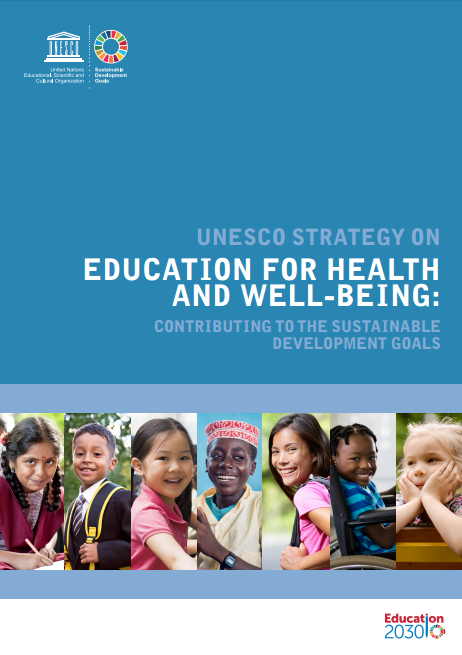 Proyecto de estrategia de la UNESCO sobre la educación para la salud y el bienestar: contribución a los Objetivos de Desarrollo Sostenible Año de publicación: 2016 Autor corporativo: UNESCO This strategy builds on UNESCO’s longstanding commitment to strengthen the links between education and health, reflecting international recognition that a more comprehensive approach to school health and coordinated action across sectors is needed. As stated in the 2015 Incheon Declaration, education develops the skills, values and attitudes that enable citizens to lead healthy and fulfilled lives, make informed decisions, and respond to local and global challenges. It updates previous UNESCO strategies and expands on UNESCO’s work on HIV and on promoting comprehensive sexuality education and safe and inclusive learning environments, placing more emphasis on the role of schools in promoting health. More specifically, it reflects recent developments in the global education, HIV and health agendas, and is aligned with the new UNAIDS 2016-2021 Strategy and the Sustainable Development Goals, in particular SDG 3 Health, SDG 4 Education and SDG 5 Gender Equality.
 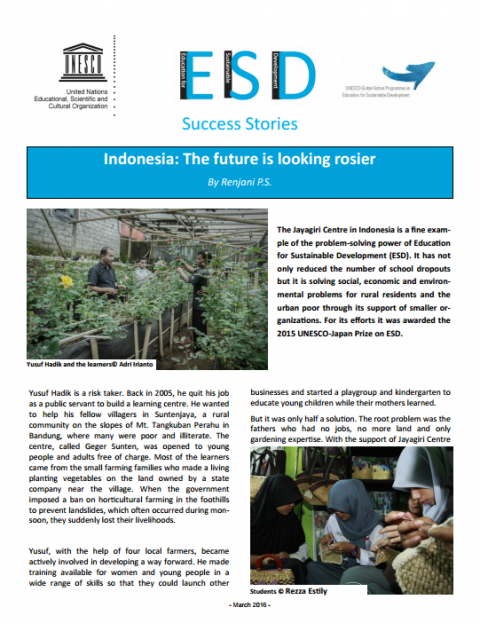 Indonesia: hacia un futuro más prometedor Año de publicación: 2016 Autor: P.S. Renjani Autor corporativo: UNESCO ESD Success Stories are showcasing compelling stories with a personal/human dimension from all five UNESCO regions (Africa, Arab States, Asia and Pacific, Europe & North America and Latin America & the Caribbean). The stories illustrate the wide diversity of ESD approaches and initiatives taking place in different parts of the world. They show how involvement with ESD has changed the lives of specific individual persons and how they have become more active in their community. Each story centers on one individual or a group of individuals.The Jayagiri Centre in Indonesia teaches environment-friendly business skills. It helps reduce the number of school dropouts and supports rural residents.
 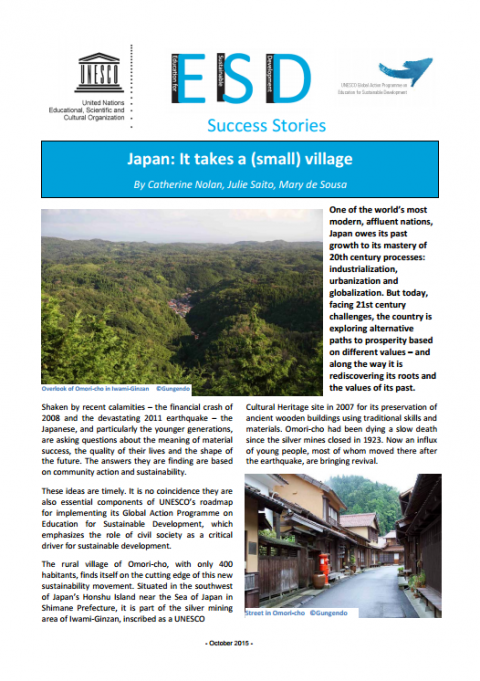 Japón: se necesita una (pequeña) aldea Año de publicación: 2015 Autor: Catherine Nolan | Julie Saito | Mary de Sousa Autor corporativo: UNESCO ESD Success Stories are showcasing compelling stories with a personal/human dimension from all five UNESCO regions (Africa, Arab States, Asia and Pacific, Europe & North America and Latin America & the Caribbean). The stories illustrate the wide diversity of ESD approaches and initiatives taking place in different parts of the world. They show how involvement with ESD has changed the lives of specific individual persons and how they have become more active in their community. Each story centers on one individual or a group of individuals.The small village of Omori-cho in Japan explores alternative paths to prosperity based on community action and sustainability.
 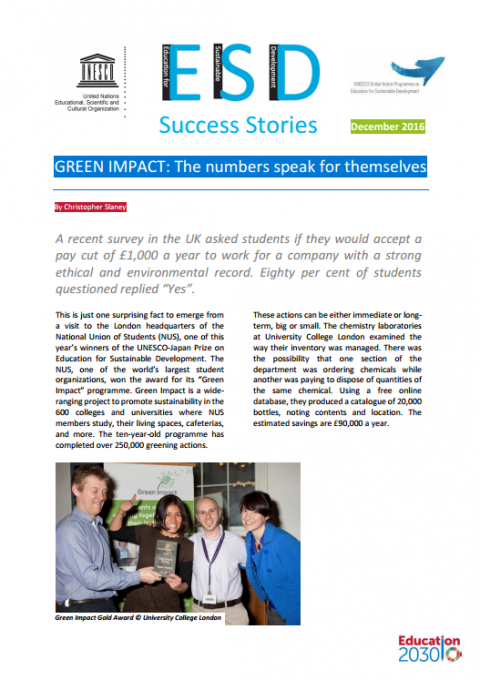 Green impact: las cifras hablan por sí solas Año de publicación: 2015 Autor: Christopher Slaney Autor corporativo: UNESCO ESD Success Stories are showcasing compelling stories with a personal/human dimension from all five UNESCO regions (Africa, Arab States, Asia and Pacific, Europe & North America and Latin America & the Caribbean). The stories illustrate the wide diversity of ESD approaches and initiatives taking place in different parts of the world. They show how involvement with ESD has changed the lives of specific individual persons and how they have become more active in their community. Each story centers on one individual or a group of individuals.The National Union of Students (NUS) UK enables, accredits and awards university departments for sustainability efforts through its "Green Impact" scheme.
 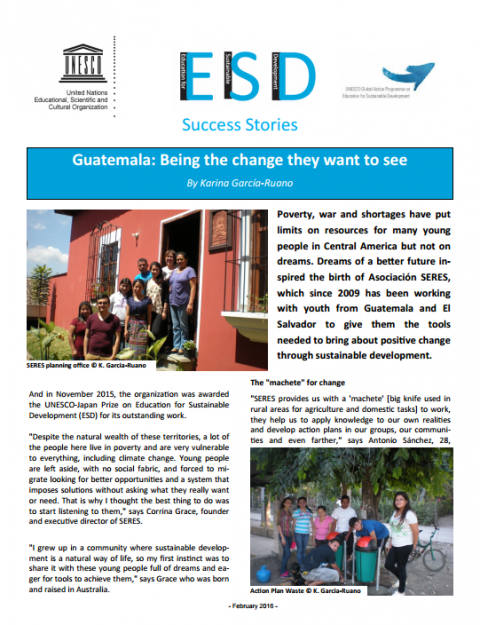 Guatemala: se el cambio que quieres ver Año de publicación: 2016 Autor: Karina García-Ruano Autor corporativo: UNESCO ESD Success Stories are showcasing compelling stories with a personal/human dimension from all five UNESCO regions (Africa, Arab States, Asia and Pacific, Europe & North America and Latin America & the Caribbean). The stories illustrate the wide diversity of ESD approaches and initiatives taking place in different parts of the world. They show how involvement with ESD has changed the lives of specific individual persons and how they have become more active in their community. Each story centers on one individual or a group of individuals.Asociación SERES, from Guatemala and El Salvador, works with youth to give them the skills needed to bring about positive change through sustainable development.
 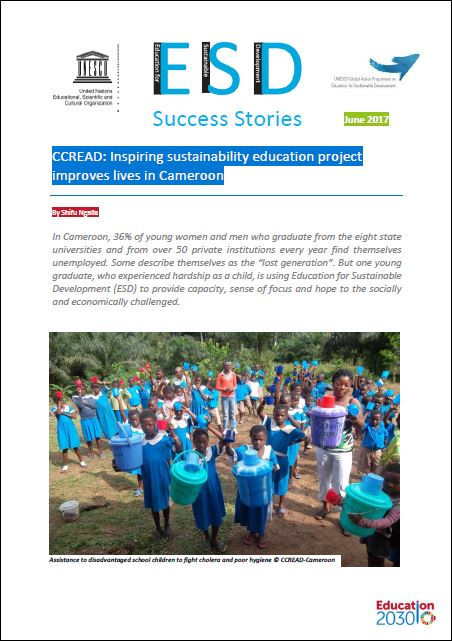 CCREAD: Un Estimulante Proyecto Sobre Educación para la Sostenibilidad Mejora la Vida en el Camerún Año de publicación: 2017 Autor: Shifu Ngalla Autor corporativo: UNESCO Este es un artículo acerca de proyecto sobre el educación para la sostenibilidad en Camerún.En el Camerún, 36% de las mujeres y de los hombres jóvenes que se gradúan anualmente en alguna de las ocho universidades estatales o en alguna de las 50 instituciones privadas se encuentran sin empleo. Algunos se describen a sí mismos como la “generación perdida”. Pero un joven diplomado que experimentó dificultades cuando era niño está utilizando la educación para el desarrollo sostenible (EDS) como un medio para proporcionar capacidades, centrar mejor las prioridades y dar esperanza a las personas social y económicamente desfavorecidas.
  Educación para el desarollo sostenible: libro de consulta Año de publicación: 2012 Autor corporativo: UNESCO The target audiences for the Education for Sustainable Development Sourcebook are primary and secondary teachers and mid-level decision-makers, who have responsibility for primary and secondary education. Another primary audience is teacher educators who work with pre-service and in-service primary and secondary school teachers. The purpose of the publication is to describe ways in which education for sustainable development (ESD) can be integrated into primary and secondary schooling. This collection of briefs is designed to complement other ESD materials published by UNESCO. The topics for the briefs were selected in consultation with UNESCO Field Offices and Institutes. The briefs for primary and secondary teachers are specifically written for professional educators who work in formal education settings. The briefs for teachers as well as those for decision-makers address “gaps” in the UNESCO ESD literature. Buenas prácticas de educación para el desarrollo sostenible en materia de cambio climático Año de publicación: 2012 Autor corporativo: UNESCO Since the beginning of the UN Decade of Education for Sustainable Development (DESD, 2005-2014), the DESD Secretariat at UNESCO Headquarters in Paris has received numerous requests for case studies and descriptions of good practices in Education for Sustainable Development (ESD). These requests have increasingly included issues of providing an educational response to climate change. The increasing number of requests is only one indicator that climate change education is increasingly recognized in the broader education community as an essential part of ESD and life-long learning. ESD is a complex and evolving subject, and how it is applied and implemented is a challenge for all countries. The Decade aims to see ESD implemented in thousands of local situations on the ground, involving its integration into a multitude of different learning situations. These initiatives can be catalysts for action and contribute to the goals and objectives of the Decade. In such ways, organizations, local communities and individuals can be actors within the global movement for sustainable development. To support the growing interest in climate change issues and ESD, UNESCO is publishing this volume containing 17 examples of programmes addressing climate change in ESD settings and practices. These good practices and shared experiences, which were provided by a range of different stakeholders, are concrete examples of successful implementation of ESD in different fields and sectors, from the political to the school level, and including formal, nonformal and informal learning situations. Decenio de las Naciones Unidas de la educación para el desarrollo sostenible (2005-2014): plan de aplicación internacional Año de publicación: 2005 Autor corporativo: UNESCO The International Implementation Scheme (IIS) sets out a broad framework for all partners to contribute to the Decade. It is a strategic document that focuses primarily on what nations have committed to achieve through the DESD and under UNESCO’s leadership. It summarizes the goals and objectives of the Decade, and its relationship to other key education movements. It emphasizes the importance of partnership in the eventual success of the Decade and outlines how these might contribute at all levels – community, national, regional, and international. It outlines UNESCO’s leadership tasks. The IIS also lists key milestones for the DESD. It then lays out seven strategies for moving forward with ESD and describes how this wide range of partners can develop contributions based on their particular contexts. Those not familiar with the background of the Decade or Education for Sustainable Development are referred to Annex I of this document, which provides a succinct summary of key trends as well as other important background information. The IIS should foster collective ownership of the DESD. The IIS describes pathways forward in the hope that it will stimulate imagination, creativity, and energy to make the DESD a success. It is envisaged that regions and nations will create plans, strategic approaches, and timetables on the basis of the framework provided by this International Implementation Scheme. Promover una asociación mundial con miras al Decenio de las Naciones Unidas de la educación para el desarrollo sostenible (2005-2014): el plan de aplicación internacional del decenio en pocas palabras Año de publicación: 2006 Autor corporativo: UNESCO Through the International Implementation Scheme governments and other partners, especially potential donors, are urged to assess existing ESD resources and needs in countries, reallocate existing resources and find means of mobilizing new resources to ensure that ESD will not be a mere slogan but actual reality.