
Recursos
Exploren una amplia gama de recursos valiosos en GCED para profundizar su comprensión y promover su búsqueda, incidencia, enseñanza y aprendizaje.
9 resultados encontrados
 L'enseignement supérieur face au défi de la transition écologique Año de publicación: 2023 Autor corporativo: Cour des Comptes Les établissements d’enseignement supérieur occupent une place spécifique dans la transition écologique. Représentant près de la moitié des opérateurs de l’État et accueillant un large public, ils ont un impact environnemental substantiel. De nombreuses initiatives ont été prises ces dernières années en la matière et les politiques menées dans les établissements commencent à se mettre en place. Elles sont cependant encore insuffisantes pour atteindre les objectifs affichés, manquant en particulier de nombreux outils pour développer une démarche rigoureuse, cohérente et efficace. L’enseignement supérieur a pourtant un rôle majeur à jouer, non seulement pour réduire sa propre empreinte écologique, mais aussi pour produire, adapter et diffuser les connaissances nécessaires à la réussite de la transition écologique.Higher education institution occupy a specific place in the ecological transition. Representing nearly half of the state operators and catering to a diverse audience, they have a substantial environmental impact. Numerous initiatives have been undertaken in recent years, and policies within these institutions are beginning to take shae. However, they are still insufficient to achieve the stated objectives, notably lacking many tools to develop a rigorous, coherent and effective approach. Higher education has a crucial role to play, not only in reducing its own ecological footprint but also in generating, adapting, and disseminating th knowledge necessary for the success of the ecological transition.
  So That Nature Lives Año de publicación: 2020 Autor: Enky Wave Autor corporativo: National Museum of Natural History | Création Collective In the face of growing environmental collapse, the National History Museum's scientists are speaking out to alert people. The central theme of So that nature lives on is nature: understanding it better to preserve it more effectively. In each 30-minute episode, a researcher shares his or her knowledge and solutions to help us better understand living things and the world around us. Pour que la nature vive Año de publicación: 2020 Autor: Enky Wave Autor corporativo: National Museum of Natural History | Création Collective Face à l’effondrement environnemental croissant, les scientifiques du Muséum National d'Histoire Naturelle prennent la parole pour alerter. Pour que nature vive a pour thème central la nature : mieux la connaître pour mieux la préserver. Dans chaque épisode de 30 minutes, une chercheuse ou un chercheur partage ses connaissances et solutions, pour mieux comprendre le vivant et le monde qui nous entoure.
  How Can We Talk About Climate Without Turning It Into a Contentious Issue? Año de publicación: 2023 Autor: Laurent Cordonier Autor corporativo: Le Monde How can we tackle the climate issue without talking only to the convinced? Debates on the climate issue run the risk of becoming a highly divisive political issue, hampering much-needed action, warns sociologist Laurent Cordonier in a new episode of “Chaleur humaine”, a weekly podcast for reflection and debate on ways of tackling the climate challenge. Comment parler du climat sans en faire un sujet d'affrontement ? Año de publicación: 2023 Autor: Laurent Cordonier Autor corporativo: Le Monde Comment aborder le sujet du climat sans parler seulement aux convaincus ? Les débats sur la question climatique risquent de devenir un sujet de clivage politique très fort, ce qui entraverait l’indispensable action, prévient le sociologue Laurent Cordonier dans un nouvel épisode du podcast « Chaleur humaine », podcast hebdomadaire de réflexion et de débat sur les manières de faire face au défi climatique.
 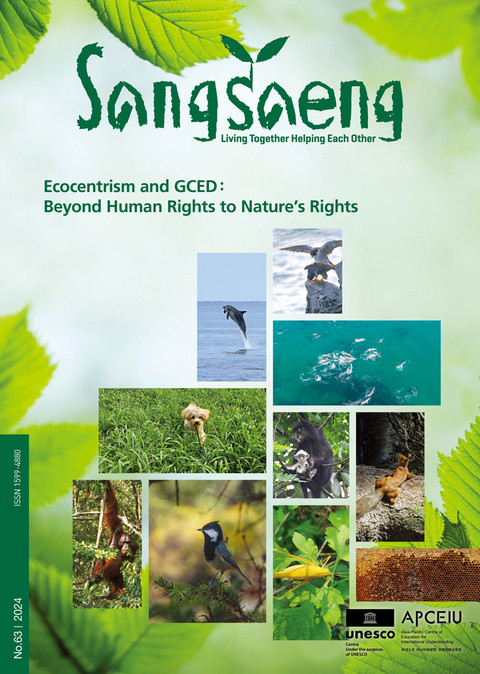 Ecocentrism and GCED : Beyond Human Rights to Nature’s Rights (SangSaeng; No.63, 2024) Año de publicación: 2024 Autor corporativo: APCEIU In the context of Sustainable Development Goal (SDG) 4, global citizenship and sustainability are spotlighted through SDG Target 4.7, which underscores the importance of harmonising cultural and biological diversity.To address the urgent need for harmony between humanity and the nature, ecocentrism needs to be explored as a guiding principle for fostering ethical and sustainable coexistence.In this light, Issue 63 of SangSaeng delves into Ecocentrism—a perspective advocating for the ethical treatment of all beings and recognising their intrinsic value—alongside Global Citizenship Education (GCED). Contents 03 Editor's Note 04 Special Column- Creating Respectful, Valued Society — Strengthening Global Citizenship Education (GCED) to Combat Hate, Racism, and Discrimination Worldwide / Peter K. Ngure 08 FOCUS Ecocentrism and GCED: Beyond Human Rights to Nature’s Rights- Getting Over Ourselves — Ecocentrism: The Importance of Earth Jurisprudence, Compassionate Conservation, and Personal Rewilding / Marc Bekoff- Combating Decline of Nature’s Diversity — Global Citizenship Education for Geodiversity, Biodiversity Conservation / Eunhee Lee- Ecocentrism and Global Citizenship Education — Fostering Coexistence with Critically Endangered Primates through Citizen Science / Andie Ang- Dolphins Dream of Peace: Beyond Human Rights to Nature’s Rights / Interview with Seungmok Oh 23 Special Report- Small Actions, Global Ripples — How GCED is Revitalizing Peace / Micha Aime 26 Best Practices- What’s Good for the Community — GCED in Action Fosters Culture of Bulungi Bwansi in Uganda / Barbara Nakijoba- Sharing Emotional Sensibility in Education — Practicing Arts Opens up the Spirit of Global Citizenship / Seoyoung Bae - Teaching GCED through Liberation History — Working to Eradicate Entrenched Racism, Intolerance, Xenophobia / Charles Chikunda 36 GCED YOUTH NETWORK- How Youth Leaders Redefine Advocacy, Leading Global Change to Shape our Future — Deep Dive into South Asian Youth Declaration on GCED, Facilitation Techniques for Empowered Youth / Noora Elkenawi 39 Peace in My Memory- Pathway to Inner Peace — Journey is Interconnected with Relationships and Environment / Itseng Kwelagobe 42 Story Time- From Drops to Waves — Power of Poetry-telling in Times of Crisis / Kalpani Dambagolla & Alessia Marzano 45 Understanding the Asia Pacific Region- Central Asian Heart of Culture — Legacy of Horsemanship from Tradition to Modernity / Gulzhan Kabysheva 48 Letter- Raising a Global Citizen / Nelly Aluanga Omino 50 APCEIU in Action
  The Impact of Climate Displacement on the Right to Education Año de publicación: 2020 Autor corporativo: UNESCO Ce rapport tente d'expliquer les conséquences du réchauffement climatique sur l'éducation des populations, vouées à se déplacer pour fuir la dégradation de leur environnement, ce qui empêche les enfants de suivre une scolarisation complète et de qualité. This report attempts to explain the consequences of global warming on the education of populations, who are forced to move to escape the degradation of their environment, preventing children from receiving a complete, quality education. Los efectos del desplazamiento climático sobre el derecho a la educación Año de publicación: 2020 Autor corporativo: UNESCO Ce rapport tente d'expliquer les conséquences du réchauffement climatique sur l'éducation des populations, vouées à se déplacer pour fuir la dégradation de leur environnement, ce qui empêche les enfants de suivre une scolarisation complète et de qualité. This report attempts to explain the consequences of global warming on the education of populations, who are forced to move to escape the degradation of their environment, preventing children from receiving a complete, quality education. L’impact du déplacement climatique sur le droit à l’éducation Año de publicación: 2020 Autor corporativo: UNESCO Ce rapport tente d'expliquer les conséquences du réchauffement climatique sur l'éducation des populations, vouées à se déplacer pour fuir la dégradation de leur environnement, ce qui empêche les enfants de suivre une scolarisation complète et de qualité. This report attempts to explain the consequences of global warming on the education of populations, who are forced to move to escape the degradation of their environment, preventing children from receiving a complete, quality education.