
Recursos
Exploren una amplia gama de recursos valiosos en GCED para profundizar su comprensión y promover su búsqueda, incidencia, enseñanza y aprendizaje.
237 resultados encontrados
 UNESCO associated schools news infos: climate change education Año de publicación: 2009 Autor corporativo: UNESCO As the United Nations Climate Change Conference takes place on December 7 to 18 2009 in Copenhagen, Denmark, this special issue will focus on selected climate change education activities carried out by the ASP network around the globe. Climate change is one of the most urgent challenges of sustainable development and a key action theme in the UN Decade of Education for Sustainable Development (DESD). ASPnet schools around the world work on Climate Change Education in order to enable students to make informed and responsible decisions, turn passive awareness into behaviour change and make sustainable behaviours a daily habit. The development of good practices and innovative educational materials in climate change education is a key element in ASPnet’s strategy to meet the pressing educational needs of the future generation. This newsletter highlights only a few of the large number of activities of ASPnet worldwide. إعلان آيشي - ناغويا بشأن التعليم من أجل التنمية المستدامة Año de publicación: 2014 Autor corporativo: UNESCO We, the participants of the UNESCO World Conference on Education for Sustainable Development held in AichiNagoya, Japan, from 10 to 12 November 2014, adopt this Declaration and call for urgent action to further strengthen and scale up Education for Sustainable Development (ESD), in order to enable current generations to meet their needs while allowing future generations to meet their own, with a balanced and integrated approach regarding the economic, social and environmental dimensions of sustainable development. This Declaration recognises that people are at the centre of sustainable development and builds on the achievements of the United Nations (UN) Decade of ESD (2005-2014); the deliberations of the UNESCO World Conference on ESD in Aichi-Nagoya; and the Stakeholder Meetings held in Okayama, Japan, from 4 to 8 November 2014, namely, UNESCO ASPnet International ESD events, the UNESCO ESD Youth Conference, the Global Regional Centres of Expertise Conference, and other relevant events and consultation processes, including regional ministerial meetings. We express our sincere gratitude to the Government of Japan for hosting the UNESCO World Conference on ESD. Айти-Нагойская декларация по образованию в интересах устойчивого развития Año de publicación: 2014 Autor corporativo: UNESCO We, the participants of the UNESCO World Conference on Education for Sustainable Development held in AichiNagoya, Japan, from 10 to 12 November 2014, adopt this Declaration and call for urgent action to further strengthen and scale up Education for Sustainable Development (ESD), in order to enable current generations to meet their needs while allowing future generations to meet their own, with a balanced and integrated approach regarding the economic, social and environmental dimensions of sustainable development. This Declaration recognises that people are at the centre of sustainable development and builds on the achievements of the United Nations (UN) Decade of ESD (2005-2014); the deliberations of the UNESCO World Conference on ESD in Aichi-Nagoya; and the Stakeholder Meetings held in Okayama, Japan, from 4 to 8 November 2014, namely, UNESCO ASPnet International ESD events, the UNESCO ESD Youth Conference, the Global Regional Centres of Expertise Conference, and other relevant events and consultation processes, including regional ministerial meetings. We express our sincere gratitude to the Government of Japan for hosting the UNESCO World Conference on ESD.
 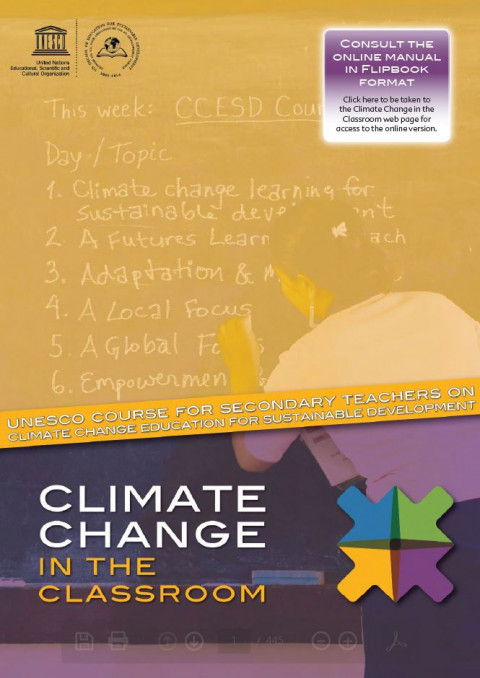 Climate change in the classroom: UNESCO course for secondary teachers on climate change education for sustainable development Año de publicación: 2013 Autor: David Selby | Fumiyo Kagawa Autor corporativo: UNESCO This course has been created with the goal of bringing climate change education outside the science classroom into the many other subject areas upon which climate change now has an impact, or will impact in the future, such as ethics, social studies, economics, political science, among others. The course materials are organized into four parts: 1. Course Framework and Overview, 2. Teachers’ Education Course daily materials, 3. Regional Resource Packs, 4. Daily Classroom Materials for teachers. These materials are all described in more detail and can be accessed from the Start Menu found on the following pages. This course is designed to enable teachers at the secondary level from diverse subject areas to introduce climate change education for sustainable development (CCESD) across the curriculum. UNESCO has identified the professional development of teachers in education for sustainable development as the top priority in recognition of the transformative role that teachers and teacher educators need to play in re-orienting education to help realize a sustainable future (UNESCO, 2005, p. 19). But good intentions for the professional development of teachers have fallen short in practice. Although taken up by enthusiasts, teacher education for sustainable development has rarely been mainstreamed, and, where there are courses, is often approached within a disciplinary as opposed to an interdisciplinary frame (Wals, A., 2009). If professional development in education for sustainable development is at an adolescent stage, teacher education in climate change education for sustainable development is in its infancy. For instance, according to a 2009 international comparative study on climate change education and sustainable development in ten countries, climate change education has peripheral status in educational research and practice, and when it is addressed it is only within science education (Læssøe,J. Schnack, K., Breiting, S. & Rolls, S., 2009). There is a clear and present need to respond to climate change challenges through systematic teacher education programmes that are not restricted to a single subject area. This teacher education course is an attempt to fill the current gap and is in line with one of UNESCO’s key objectives for climate change education for sustainable development, that is, to support teacher training on climate change for sustainable development (UNESCO, 2010, p. 9). The programme has four distinctive features: 1. It helps teachers to understand the causes, dynamics and impacts of climate change through a holistic approach. 2. Teachers are exposed to, and experience, a range of pedagogical approaches and techniques, that they can use in their own school environment. This includes engagement of themselves and their students in whole school and school-in-community approaches. 3. Teachers will develop their capacities to facilitate students’ community based learning. 4. Teachers will develop future-oriented and transformative capacities in facilitating climate change mitigation, adaptation, and disaster risk reduction learning. Les changements climatiques dans la salle de classe: Cours de l'UNESCO pour les enseignants du secondaire sur le changement climatique éducation au développement durable Año de publicación: 2013 Autor: David Selby | Fumiyo Kagawa Autor corporativo: UNESCO Ce cours a été créé avec l'objectif d'amener le changement climatique l'éducation en dehors de la salle de classe de la science dans les nombreux autres domaines sur lesquels le changement climatique a maintenant un impact, ou aura un impact à l'avenir, comme l'éthique, les études sociales, l'économie, la science politique , parmi d'autres. Les supports de cours sont organisés en quatre parties: 1. Structure du cours et aperçu, cours d'éducation matières quotidiennes 2. Enseignants, Packs 3. Ressources régionales, 4. Quotidiennes Matériel didactique pour les enseignants. Ces matériaux sont décrits plus en détail et sont accessibles à partir du menu démarrer trouvé dans les pages suivantes. Ce cours est conçu pour permettre aux enseignants au niveau secondaire de domaines divers pour introduire l'éducation sur le changement climatique pour le développement durable (ECCDD) à travers le curriculum. L'UNESCO a identifié le développement professionnel des enseignants dans l'éducation pour le développement durable comme priorité absolue dans la reconnaissance du rôle transformateur que les enseignants et les formateurs d'enseignants doivent jouer dans l'éducation de réorientation pour aider à réaliser un avenir durable (UNESCO, 2005, p. 19 ). Mais les bonnes intentions pour le développement professionnel des enseignants sont tombés à court dans la pratique. Bien pris par les amateurs, la formation des enseignants pour le développement durable a rarement été intégré, et où il y a des cours, est souvent abordé dans une discipline, par opposition à un cadre interdisciplinaire (Wals, A., 2009). Si le développement professionnel en éducation pour le développement durable est à un stade adolescent, la formation des enseignants en éducation au changement climatique pour le développement durable est à ses débuts. Par exemple, selon une étude comparative internationale 2009 sur le changement climatique l'éducation et le développement durable dans dix pays, éducation au changement climatique a un statut périphérique dans la recherche et la pratique éducative, et quand elle est adressée, il est seulement dans l'enseignement des sciences (Laessoe, J. Schnack , K., Breiting, S. & Rolls, S., 2009). Il y a un besoin clair et présent pour répondre aux défis du changement climatique par le biais de programmes de formation des enseignants systématiques qui ne se limitent pas à une seule matière. Ce cours de formation des enseignants est une tentative de combler le vide actuel et est en ligne avec l'un des principaux objectifs de l'UNESCO pour le changement climatique éducation pour le développement durable, qui est, pour soutenir la formation des enseignants sur le changement climatique pour le développement durable (UNESCO, 2010, p. 9). Le programme comporte quatre traits distinctifs: 1.Il aide les enseignants à comprendre les causes, la dynamique et les impacts du changement climatique à travers une approche holistique. 2.Les enseignants sont exposés, et de l'expérience, une gamme d'approches et de techniques pédagogiques, qu'ils peuvent utiliser dans leur propre milieu scolaire. Cela comprend l'engagement d'eux-mêmes et de leurs élèves à l'école ensemble et approches écoles en communauté. 3.Les enseignants développeront leurs capacités pour faciliter base communautaire d'apprentissage des élèves. 4. Les enseignants développeront les capacités de tournées vers l'avenir et de transformation pour faciliter l'atténuation des changements climatiques, l'adaptation et l'apprentissage de la réduction des risques de catastrophe.
 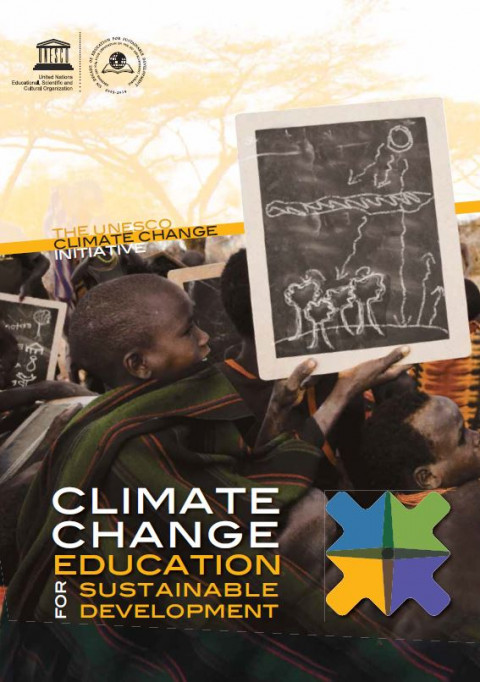 Climate Change Education for Sustainable Development: the UNESCO Climate Change Initiative Año de publicación: 2010 Autor corporativo: UNESCO The UNESCO Climate Change Initiative was launched by Director-General Irina Bokova in Copenhagen during the 15th Conference of the Parties to the UN Framework Convention on Climate Change (UNFCCC COP15). It seeks to reinforce the scientific, mitigation and adaptation capacities of countries and communities that are most vulnerable to the effects of climate change. It focuses on a select number of strategic issues in line with The UN System Delivering as One on Climate Change action plan and The UNESCO Strategy for Action on Climate Change. The Initiative is based on four thematic areas: scientific, educational, environmental and ethical. Key objectives will be achieved through intersectoral and interdisciplinary cooperation, coordinated field activities, and networking. Special attention is given to UNESCO’s two global priorities, Africa and gender equality, as well as to the increased vulnerability of Small Island Developing States (SIDS).The UN System “Delivering as One” on Climate Change During the 13th session of the Conference of Parties to the UNFCCC in Bali, Indonesia, UN Secretary General Ban Ki-Moon presented an unprecedented coordination effort to bring together all the diverse perspectives, expertise and strengths of the UN system so as to deliver as one in the critical area of climate change. The initiative brings together expertise and ongoing work in diverse areas ranging from science and technology to agriculture, transport, forestry and disaster risk reduction, to address both mitigation and adaptation. It brings together the normative, standard setting and knowledge sharing capacities of the system with its operational reach in order to support the most vulnerable. The overall objective is to maximize existing synergies, eliminate duplication and overlap, and optimize the impact of the collective effort of the UN system.To ensure better coordination, convening responsibilities were assigned to UN system entities with a large volume of activities in the five focus areas and four cross-cutting areas. Focus areas ㆍAdaptation – High-Level Committee on Programmes collectively ㆍ Technology transfer – UNIDO, UN-DESA ㆍReduction of emissions from deforestation and degradation (REDD) – UNDP, FAO, UNEP ㆍ Financing mitigation and adaptation action – UNDP, World Bank Group ㆍCapacity building – UNDP, UNEP Cross-cutting areas ㆍClimate knowledge: science, assessment, monitoring and early warning – WMO, UNESCO ㆍSupporting global, regional and national action – UN-DESA, UN Regional Commissions, UNDP ㆍClimate-neutral UN – UNEP ㆍPublic awareness – UNCG, UNEP. Education pour le développement durable: bonnes pratiques en matière de changement climatique Año de publicación: 2012 Autor corporativo: UNESCO Since the beginning of the UN Decade of Education for Sustainable Development (DESD, 2005-2014), the DESD Secretariat at UNESCO Headquarters in Paris has received numerous requests for case studies and descriptions of good practices in Education for Sustainable Development (ESD). These requests have increasingly included issues of providing an educational response to climate change. The increasing number of requests is only one indicator that climate change education is increasingly recognized in the broader education community as an essential part of ESD and life-long learning. ESD is a complex and evolving subject, and how it is applied and implemented is a challenge for all countries. The Decade aims to see ESD implemented in thousands of local situations on the ground, involving its integration into a multitude of different learning situations. These initiatives can be catalysts for action and contribute to the goals and objectives of the Decade. In such ways, organizations, local communities and individuals can be actors within the global movement for sustainable development. To support the growing interest in climate change issues and ESD, UNESCO is publishing this volume containing 17 examples of programmes addressing climate change in ESD settings and practices. These good practices and shared experiences, which were provided by a range of different stakeholders, are concrete examples of successful implementation of ESD in different fields and sectors, from the political to the school level, and including formal, nonformal and informal learning situations. Education for sustainable development: good practices in addressing climate change Año de publicación: 2012 Autor corporativo: UNESCO Since the beginning of the UN Decade of Education for Sustainable Development (DESD, 2005-2014), the DESD Secretariat at UNESCO Headquarters in Paris has received numerous requests for case studies and descriptions of good practices in Education for Sustainable Development (ESD). These requests have increasingly included issues of providing an educational response to climate change. The increasing number of requests is only one indicator that climate change education is increasingly recognized in the broader education community as an essential part of ESD and life-long learning. ESD is a complex and evolving subject, and how it is applied and implemented is a challenge for all countries. The Decade aims to see ESD implemented in thousands of local situations on the ground, involving its integration into a multitude of different learning situations. These initiatives can be catalysts for action and contribute to the goals and objectives of the Decade. In such ways, organizations, local communities and individuals can be actors within the global movement for sustainable development. To support the growing interest in climate change issues and ESD, UNESCO is publishing this volume containing 17 examples of programmes addressing climate change in ESD settings and practices. These good practices and shared experiences, which were provided by a range of different stakeholders, are concrete examples of successful implementation of ESD in different fields and sectors, from the political to the school level, and including formal, nonformal and informal learning situations. Mudança climática em sala de aula: curso da UNESCO para professores secundários (fundamental II e ensino médio) sobre educação em mudança climática e desenvolvimento sustentável (EMCDS) Año de publicación: 2014 Autor: David Selby | Fumiyo Kagawa Autor corporativo: UNESCO Brasilia This course has been created with the goal of bringing climate change education outside the science classroom into the many other subject areas upon which climate change now has an impact, or will impact in the future, such as ethics, social studies, economics, political science, among others. The course materials are organized into four parts: 1. Course Framework and Overview, 2. Teachers’ Education Course daily materials, 3. Regional Resource Packs, 4. Daily Classroom Materials for teachers. These materials are all described in more detail and can be accessed from the Start Menu found on the following pages. This course is designed to enable teachers at the secondary level from diverse subject areas to introduce climate change education for sustainable development (CCESD) across the curriculum. UNESCO has identified the professional development of teachers in education for sustainable development as the top priority in recognition of the transformative role that teachers and teacher educators need to play in re-orienting education to help realize a sustainable future (UNESCO, 2005, p. 19). But good intentions for the professional development of teachers have fallen short in practice. Although taken up by enthusiasts, teacher education for sustainable development has rarely been mainstreamed, and, where there are courses, is often approached within a disciplinary as opposed to an interdisciplinary frame (Wals, A., 2009). If professional development in education for sustainable development is at an adolescent stage, teacher education in climate change education for sustainable development is in its infancy. For instance, according to a 2009 international comparative study on climate change education and sustainable development in ten countries, climate change education has peripheral status in educational research and practice, and when it is addressed it is only within science education (Læssøe,J. Schnack, K., Breiting, S. & Rolls, S., 2009). There is a clear and present need to respond to climate change challenges through systematic teacher education programmes that are not restricted to a single subject area. This teacher education course is an attempt to fill the current gap and is in line with one of UNESCO’s key objectives for climate change education for sustainable development, that is, to support teacher training on climate change for sustainable development (UNESCO, 2010, p. 9). The programme has four distinctive features: 1. It helps teachers to understand the causes, dynamics and impacts of climate change through a holistic approach. 2. Teachers are exposed to, and experience, a range of pedagogical approaches and techniques, that they can use in their own school environment. This includes engagement of themselves and their students in whole school and school-in-community approaches. 3. Teachers will develop their capacities to facilitate students’ community based learning. 4. Teachers will develop future-oriented and transformative capacities in facilitating climate change mitigation, adaptation, and disaster risk reduction learning. International conference: reorienting TVET policy towards education for sustainable development: final report Año de publicación: 2010 Autor corporativo: UNESCO International Centre for Technical and Vocational Education and Training (UNEVOC) | Internationale Weiterbildung und Entwicklung | Colombo Plan Staff College for Technician Education This publication reports on the ESD review-responsive and future-oriented programme on “Reorienting TVET Policy Towards Education for Sustainable Development”, jointly organized by the UNESCO-UNEVOC International Centre in Bonn, Germany, InWEnt – Capacity Building International, Germany and Colombo Plan Staff College for Technician Education in Manila, Philippines.