
Recursos
Exploren una amplia gama de recursos valiosos en GCED para profundizar su comprensión y promover su búsqueda, incidencia, enseñanza y aprendizaje.
82 resultados encontrados
 School Online Safety - Self review tool Año de publicación: 2016 Autor corporativo: South West Grid for Learning Trust (SWGfL) The Self Review Tool is intended to help schools to review their current online safety policy and practice. It provides management information and stimulus that can influence the production or review of online safety policies and develop good practice and process for identifying strengths and weaknesses. It also focuses on opportunities for commitment and involvement from the whole school as well as a continuum for schools to discuss how they might move from a basic level provision for online safety to practice that is aspirational and innovative. School Online Safety - Self review tool Año de publicación: 2016 Autor corporativo: South West Grid for Learning Trust (SWGfL) Le Self Review Tool a pour objectif d'aider les écoles à réviser leurs politiques de sécurité en ligne et leurs pratiques actuelles. Cet outil contient des informations et des conseils de gestion qui peuvent influer sur la production ou la révision des politiques de sécurité en ligne et sur le développement de bonnes pratiques et processus permettant d’identifier les points forts et les faiblesses de ces systèmes. Il étudie également les possibilités d’engagement et d’implication pour l’ensemble de l’école, et la mise en place d’un espace de discussion en vue de passer d’une politique basique à des pratiques ambitieuses et innovantes.
 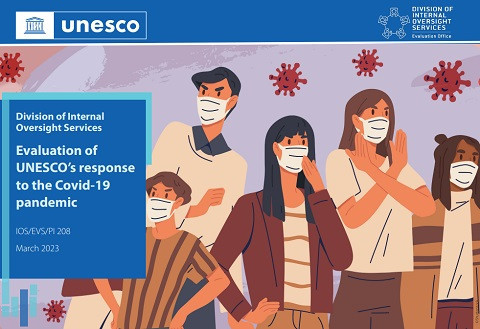 Evaluation of UNESCO’s response to the Covid-19 pandemic Año de publicación: 2023 Autor corporativo: UNESCO This evaluation report summarises the findings of a comprehensive evaluation on how UNESCO has adapted and responded to the Covid-19 pandemic. It describes and assesses the relevance and effectiveness of UNESCO’s programmatic response across all of its Sectors, and reviews how efficiently the Organization adapted itself to ensure business continuity during the pandemic. With an overall focus on learning, the evaluation identified a series of lessons and useful innovations made during the pandemic. The report’s five recommendations aim to guide UNESCO towards sustaining useful innovations and further increasing the crisis resilience of its operations and programme. Evaluation de la riposte de l’UNESCO à la pandémie de COVID-19 Año de publicación: 2023 Autor corporativo: UNESCO Le présent rapport d’évaluation contient les conclusions tirées d’une évaluation complète de la manière dont l’Organisation des Nations Unies pour l’éducation, la science et la culture (UNESCO) s’est adaptée et a répondu à la pandémie de coronavirus 2019 (COVID-19). Il rend compte de la réponse programmatique de l’UNESCO dans tous ses secteurs, et en évalue la pertinence et l’efficacité. Il examine également l’efficacité avec laquelle l’Organisation s’est adaptée pour assurer la continuité de ses opérations tout au long de la pandémie. Axée sur l’apprentissage, l’évaluation a permis de dégager une série d’enseignements et de mettre en évidence les innovations les plus précieuses apportées durant la pandémie. Le présent rapport énonce cinq recommandations visant à guider l’UNESCO vers la pérennisation des innovations les plus efficaces et le renforcement de la résilience de ses activités et de ses programmes en cas de crise.
 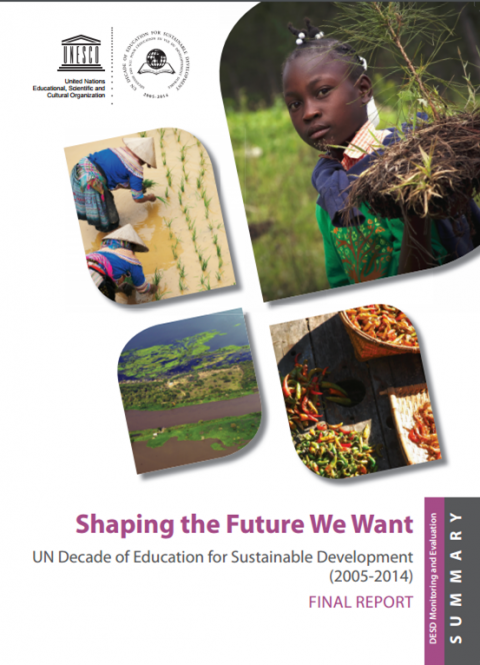 Shaping the future we want: UN decade of education for sustainable development (2005-2014); final report; summary Año de publicación: 2014 Autor: Carolee Buckler | Heather Creech Autor corporativo: UNESCO This summary for policy- and decision-makers provides a brief overview of the key findings and trends, a synopsis of highlights, challenges and actions across all levels and areas of education, and steps for scaling up actions presented in the UNESCO 2014 Global Monitoring and Evaluation Final Report, Shaping the Future We Want – UN Decade of Education for Sustainable Development (2005-2014). The Final Report provides an assessment of progress towards embedding education for sustainable development (ESD) into education systems and into sustainable development efforts. Building on the findings of the past two DESD Global Monitoring and Evaluation reports, and based upon Member States’ and other stakeholders’ assessments of the current state of ESD, the Final Report maps the achievements and challenges of a decade of progress and action on ESD at the global, national, regional and local levels, and within all areas and levels of education. The Final Report concludes that a solid foundation has been laid for ESD at the end of the DESD, achieved by raising awareness, influencing policies and generating significant numbers of good practice projects in all areas of education and learning. At the end of 10 years of work, 10 key findings and trends have emerged that will guide ESD into the future. The report also shows that despite the successes, a full integration of ESD into education systems has yet to take place in most countries. Façonner l’avenir que nous voulons: Décennie des Nations Unies pour l’éducation au service du développement durable (2005-2014) RAPPORT FINAL Año de publicación: 2014 Autor: Carolee Buckler | Heather Creech Autor corporativo: UNESCO Destiné aux responsables politiques et aux décideurs, ce document résume les principales conclusions et les grandes tendances, présente une synthèse des points clés, des défis et des initiatives à tous les niveaux et dans tous les domaines de l’éducation, ainsi que les mesures à adopter pour intensifier les actions décrites dans le Rapport final de suivi et d’évaluation 2014, Façonner l’avenir que nous voulons − Décennie des Nations Unies pour l’éducation au service du développement durable (2005-2014). Le Rapport final de suivi et d’évaluation examine les progrès qui ont été accomplis afin d’intégrer l’Éducation au développement durable (EDD) aux systèmes éducatifs et aux efforts déployés en faveur du développement durable. À partir des conclusions des deux précédents rapports mondiaux de suivi et d’évaluation de la Décennie et de l’évaluation de l’état actuel de l’EDD par les États membres et autres parties prenantes, ce rapport final décrit les résultats obtenus et les problèmes rencontrés au terme de dix années de progrès et d’action sur le plan de l’EDD aux niveaux mondial, national, régional et local, ainsi que dans tous les domaines et à tous les niveaux de l’éducation. Le rapport note en conclusion qu’au terme de la Décennie, l’EDD repose désormais sur des fondements solides et ce, grâce à une prise de conscience renforcée, à l’influence exercée sur les politiques et à la réalisation d’un grand nombre de projets respectueux des bonnes pratiques dans tous les domaines de l’éducation et de l’apprentissage. Les dix conclusions et tendances clés qui se dégagent à l’issue de ces dix années de travail serviront à l’avenir de guide à l’EDD. Le rapport montre également qu’en dépit des progrès accomplis, dans la plupart des pays, l’EDD n’a toujours pas été pleinement intégrée aux systèmes éducatifs.
  Batir l'éducation de demain: rapport 2012 sur la décennie des Nations Unies pour l'éducation au service du développement durable, version abrégée Año de publicación: 2013 Autor corporativo: UNESCO As the lead agency for the UN Decade of Education for Sustainable Development (DESD, 2005 – 2014), UNESCO is responsible for monitoring and evaluating progress during the DESD. UNESCO is publishing three reports during the DESD – in 2009, 2012 and 2014. This second report focuses specifically on processes and learning in the context of Education for Sustainable Development (ESD). What kinds of learning processes have emerged in the course of the DESD? What is the role of ESD in supporting them? What changes in ESD have occurred since the early years of the Decade? The report is informed by a broad consultation process that includes input from hundreds of policy makers, scholars and practitioners engaged in ESD around the world.
  Tool for quality assuarance of education for democratic citizenship in schools Año de publicación: 2005 Autor corporativo: Council of Europe This Tool for Quality Assurance of Education for Democratic Citizenship (EDC) in Schools was prepared as a response to the compliance gap between policies and practices of EDC in various countries. While EDC policies are well developed, EDC practices in schools present significant weaknesses. The Tool was also prepared as part of the current interest and implementation of quality assurance in education. This Tool is designed as a reference document. It focuses on education for democratic citizenship and applies the principles and processes of quality assurance to EDC. Shaping the future we want: UN decade of education for sustainable development; final report Año de publicación: 2014 Autor: Carolee Buckler | Heather Creech Autor corporativo: UNESCO La Décennie de l’ONU pour l'Éducation pour le Développement Durable (2005 -2014) (DEDD) visant à intégrer les principes et pratiques du développement durable dans tous les aspects de l'éducation et de l'apprentissage, afin d'encourager les changements dans les connaissances, les valeurs et les attitudes avec la vision de permettre à un plus durable et plus juste pour tous. Le mandat de la DEDD a stimulé un grand nombre de parties prenantes - dans tous les États Membres, les organismes de l’ONU, le secteur de l'éducation, le secteur privé et la société civile – pour travailler en partenariat afin de réorienter les systèmes d'éducation vers un développement durable. Cette dernière DEDD Suivi Mondiale et le Rapport d'Évaluation (SME) fournit une évaluation des progrès accomplis vers l'intégration Éducation pour le Développement Durable (EDD) dans les systèmes d'éducation et dans les efforts de développement durable. Se fondant sur les conclusions des deux dernières DEDD SME rapports, et basées sur des États membres et d'autres parties prenantes et les évaluations de l'état actuel de l'EDD, ce rapport maps les réalisations et les défis d'une décennie de progrès et d'action sur l'EDD à l'échelle mondiale, niveaux régional, national et local - et dans tous les domaines et niveaux d'éducation. 우리가 원하는 미래를 조성하자: 유엔 지속가능 발전교육 10년 최종 보고서 Año de publicación: 2014 Autor: Carolee Buckler | Heather Creech Autor corporativo: UNESCO 유엔 지속가능 발전교육10년은(2005-2014, 이하DESD) 교육과 학습의 모든 측면에서 지속가능한 발전의 원칙과 관행의 통합, 모두를 위한 정의로운 사회, 보다 지속가능한 비전을 가지고 지식과 가치와 태도의 변화를 독려하는 것을 그 목적으로 한다. 지속가능 발전교육의 권한은 지속가능한 교육 시스템에 새로운 방향을 제시함으로 파트너십을 발휘하는 다수의 이해 당사자당들- UN 회원국, UN 기관, 교육분과, 민간 부문 및 시민 사회-에 동력을 공급한다. 이 최종 지속가능 발전교육 글로벌 모니터링 및 평가 보고서(이하GME)는 지속가능한 발전 노력과 교육 시스템으로 지속가능 발전교육(이하 ESD)을 포함한 진행 평가를 제공한다.지난 DESD, GME, 이 두 개의 보고서는 회원국과 ESD현상황에 대한 평가를 하는 이해 당사자들에 의존하여 세계, 국가 및 모든 지역과 교육 수준에서의 ESD 성과와 10년의 진행 경과에 대해서 그 지도를 그리고 있다.