
Recursos
Exploren una amplia gama de recursos valiosos en GCED para profundizar su comprensión y promover su búsqueda, incidencia, enseñanza y aprendizaje.
33 resultados encontrados
 التمييز على أساس الجنس.. هل المرأة هي الضحية دوماً؟ Año de publicación: 2017 Autor corporativo: DW TV بعد سنوات طويلة من الصمت أقدمت ممثلات وعارضات أزياء شهيرات على كسر حاجز الخوف وكشفن عن انتهاكات المنتج الشهير هارفي واينستين بحقهن. هذه الفضيحة دفعت بمئات الآلاف من النساء إلى نشر قصصهن المؤلمة في شبكات التواصل. فأين يبدأ التمييز الجنسي؟ وما مدى تفشي هذه الظاهرة في الواقع؟ وهل المرأة هي دائماً الضحية؟ هذه الأسئلة يتم مناقشها في هذا البرنامج. Discrimination on the Basis of Sex.. Is the Woman Always the Victim? Año de publicación: 2017 Autor corporativo: DW TV After many years of silence, famous actresses and models broke the barrier of fear and revealed the violations of the famous producer Harvey Weinstein against them. This scandal prompted hundreds of thousands of women to publish their painful stories in social networks. Where does gender discrimination begin? And how widespread is this phenomenon in reality? Is the woman always the victim? These questions are discussed in this program.
 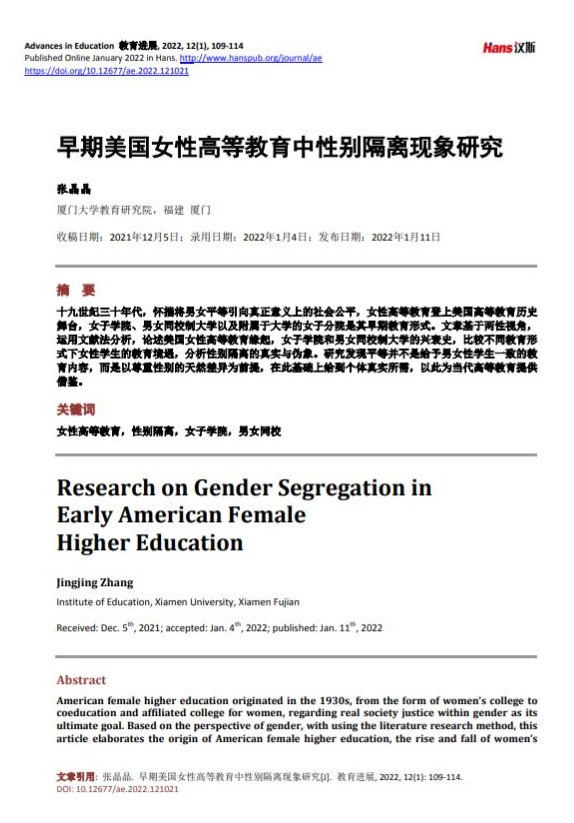 Research on Gender Segregation in Early American Female Higher Education Año de publicación: 2022 Autor: 张晶晶 This article explores the issue of gender equality in the higher education institutions by reviewing the development of women's higher education in the United States. 早期美国女性高等教育中性别隔离现象研究 Año de publicación: 2022 Autor: 张晶晶 本文通过回顾美国女子高等教育的发展历程,探讨高等教育环境中的男女平等议题。
  Connet with respect: preventing-gender based violence in schools; classroom programme for students in early secondary school Año de publicación: 2016 Autor corporativo: UNESCO Bangkok Students learn best in schools that provide safety and social support. However, some young people experience violence and harassment in, around, and on the way to school. This includes gender-based violence (GBV), which can take many different forms.As a teacher, you can play an important role in preventing the expression of gender-based violence in the school setting. Teachers, school principals and the broader education system can provide positive role models, empower children and youth to have healthy and respectful relationships, and deliver a violence prevention programme within their curriculum.This tool has been created to help schools in Asia and the Pacific to do all of these things.
 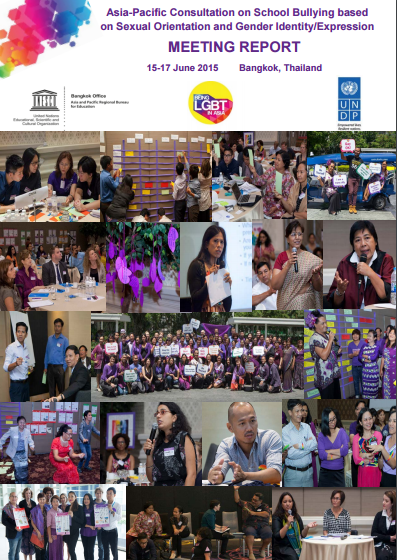 Asia-Pacific Consultation on School Bullying Based on Sexual Orientation and Gender Identity/Expression Año de publicación: 2015 Autor corporativo: UNESCO Bangkok This report documents the presentations and discussions made during the Asia-Pacific Consultation on School Bullying based on Sexual Orientation and Gender Identity/Expression held from 15-17 June 2015 at the Pullman King Power Hotel in Bangkok, Thailand.
 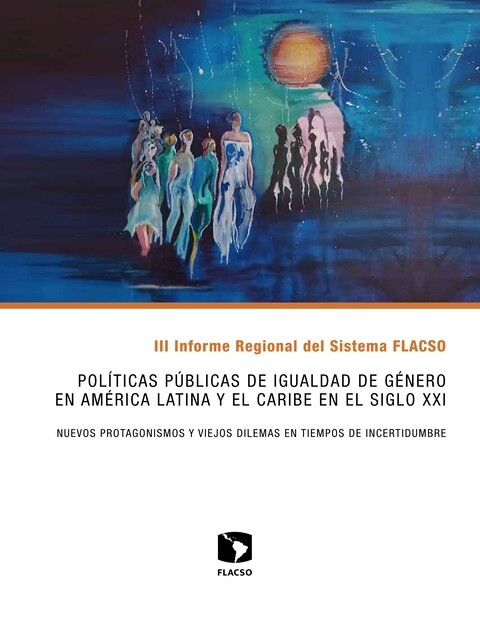 Public Policies on Gender Equality in Latin America and the Caribbean in the 21st Century: New Protagonisms and Old Dilemmas in Times of Uncertainty Año de publicación: 2023 Autor: Cinthya Fernández Lépiz | Esteban Zolezzi Autor corporativo: Latin American Council of Social Sciences (CLACSO) The III Report of FLACSO on Gender Issues is the result of a collaborative process among the Academic Units of FLACSO. Its chapters aim to identify the main challenges in each country regarding gender equality in the early 21st century and engage them in a dialogue with contributions from the academic community of FLACSO. They seek to provide a general characterization of each country, analyze the main challenges in terms of gender equality, as well as the critical contributions and limitations raised by gender and feminist studies in conjunction with the contributions made by FLACSO. Políticas públicas de igualdad de género en América Latina y el caribe en el siglo XXI: Nuevos protagonismos y viejos dilemas en tiempos de incertidumbre. Año de publicación: 2023 Autor: Cinthya Fernández Lépiz | Esteban Zolezzi Autor corporativo: Latin American Council of Social Sciences (CLACSO) El III Informe Regional de la FLACSO sobre el tema de Género es el resultado de un proceso colaborativo entre las Unidades Académicas de la FLACSO. Sus capítulos se proponen identificar cuáles son las principales problemáticas en cada país en materia de igualdad en el comienzo del siglo XXI y ponerlas en diálogo con los aportes que se vienen realizando desde la comunidad académica de FLACSO. Procuran dar cuenta de una caracterización general de cada uno de los países, el análisis de las principales problemáticas que se presentan en materia de igualdad de género, así como los aportes críticos y limitaciones que se plantean desde los estudios de género y feministas con los aportes realizados desde la FLACSO.
  Artificial Intelligence and Gender Equality: Key Findings of UNESCO’s Global Dialogue Año de publicación: 2020 Autor corporativo: UNESCO The purpose of the UNESCO’s Dialogue on Gender Equality and AI was to identify issues, challenges, and good practices to help: Overcome the built-in gender biases found in AI devices, data sets and algorithms; Improve the global representation of women in technical roles and in boardrooms in the technology sector; and Create robust and gender-inclusive AI principles, guidelines and codes of ethics within the industry. This Summary Report sets forth proposed elements of a Framework on Gender Equality and AI for further consideration, discussion and elaboration amongst various stakeholders. It reflects experts’ inputs to the UNESCO Dialogue on Gender Equality and AI, as well as additional research and analysis. This is not a comprehensive exploration of the complexities of the AI ecosystem in all its manifestations and all its intersections with gender equality. Rather, this is a starting point for conversation and action and has a particular focus on the private sector. It argues for the need to 1. Establish a whole society view and mapping of the broader goals we seek to achieve in terms of gender equality;2. Generate an understanding of AI Ethics Principles and how to position gender equality within them; 3. Reflect on possible approaches for operationalizing AI and Gender Equality Principles; and4. Identify and develop a funded multi-stakeholder action plan and coalition as a critical next step.
  Gender-Based Violence in Education Año de publicación: 2015 Autor: Jenny Perkes This paper examines how policies and strategies to address school-related gender-based violence have evolved since 2000, when gender-based violence within education was largely invisible. It traces remarkable progress in research, policy and programmes, particularly since the mid-2000s when evidence around the globe exposed high levels of many forms of violence. However, there is still insufficient knowledge about what works to reduce violence, and weaknesses in processes of policy enactment which inhibit effective action. Through four country case studies, in South Africa, Brazil, India and Liberia, this paper explores how different forms of violence are being addressed in varying contexts. It concludes that more attention is needed to the space between national and local policy enactments, and to tackling at national, district, school and community levels the norms and inequalities at the heart of gender-based violence.