
Recursos
Exploren una amplia gama de recursos valiosos en GCED para profundizar su comprensión y promover su búsqueda, incidencia, enseñanza y aprendizaje.
170 resultados encontrados
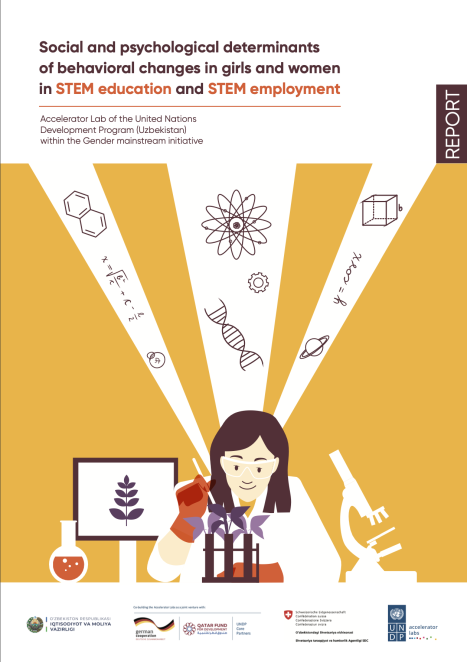 Social and Psychological Determinants of Behavioral Changes in Girls and Women in STEM Education and STEM Employment Año de publicación: 2023 Autor: Victoria Alekseeva | Marietta Karamyan The objective of the research presented in the report is to examine the social and psychological determinants of behavioral change in girls and women in STEM professions to develop recommendations for engaging them in the professional field. Социальные и психологические детерминанты поведенческих изменений у девушек и женщин в STEM-образовании и STEM-занятости Año de publicación: 2023 Autor: Victoria Alekseeva | Marietta Karamyan The objective of the research presented in the report is to examine the social and psychological determinants of behavioral change in girls and women in STEM professions to develop recommendations for engaging them in the professional field.
 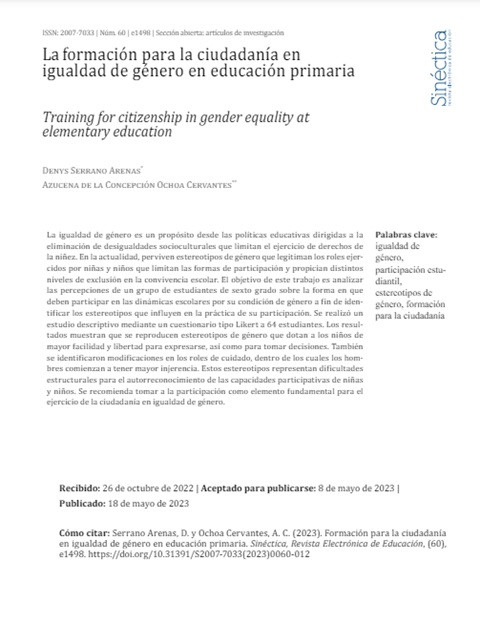 Training for Citizenship in Gender Equality at Elementary Education(Sinéctica, Revista electrónica de educación; no. 60) Año de publicación: 2023 Autor: Denys Serrano Arenas | Azucena de la Concepción Ochoa Cervantes Autor corporativo: Sinéctica, Revista Electrónica de Educación Gender equality is a purpose from educational policies aimed to eliminating sociocultu-ral inequalities that limit the exercise of children's rights. At present, gender stereotypes that legitimize the roles exercised by girls and boys that limit the forms of participation persist, promoting different levels of exclusion in school life. The objective of this work is to analyze the perceptions of a group of sixth grade students, about how they consider they should participate in school dynamics due to their gender condition, to detect tho-se stereotypes that influence the practice of their participation. A descriptive study was carried out using a Likert-type questionnaire to 64 students. The results show that gen-der stereotypes are reproduced that provide children with greater ease and freedom to express themselves, as well as to make decisions. Modifications in the care roles were also identified, within which, they begin to have greater interference. In parallel, it was found that these stereotypes represent structural difficulties for the self-recognition of the par-ticipatory capacities of girls. It is recommended to take participation as a fundamental element for the exercise of citizenship in gender equality. La formación para la ciudadanía en igualdad de género en educación primaria(Sinéctica, Revista electrónica de educación; núm. 60) Año de publicación: 2023 Autor: Denys Serrano Arenas | Azucena de la Concepción Ochoa Cervantes Autor corporativo: Sinéctica, Revista Electrónica de Educación La igualdad de género es un propósito desde las políticas educativas dirigidas a la eliminación de desigualdades socioculturales que limitan el ejercicio de derechos de la niñez. En la actualidad, perviven estereotipos de género que legitiman los roles ejercidos por niñas y niños que limitan las formas de participación y propician distintos niveles de exclusión en la convivencia escolar. El objetivo de este trabajo es analizar las percepciones de un grupo de estudiantes de sexto grado sobre la forma en que deben participar en las dinámicas escolares por su condición de género a fin de identificar los estereotipos que influyen en la práctica de su participación. Se realizó un estudio descriptivo mediante un cuestionario tipo Likert a 64 estudiantes. Los resultados muestran que se reproducen estereotipos de género que dotan a los niños de mayor facilidad y libertad para expresarse, así como para tomar decisiones. También se identificaron modificaciones en los roles de cuidado, dentro de los cuales los hombres comienzan a tener mayor injerencia. Estos estereotipos representan dificultades estructurales para el autorreconocimiento de las capacidades participativas de niñas y niños. Se recomienda tomar a la participación como elemento fundamental para el ejercicio de la ciudadanía en igualdad de género.
 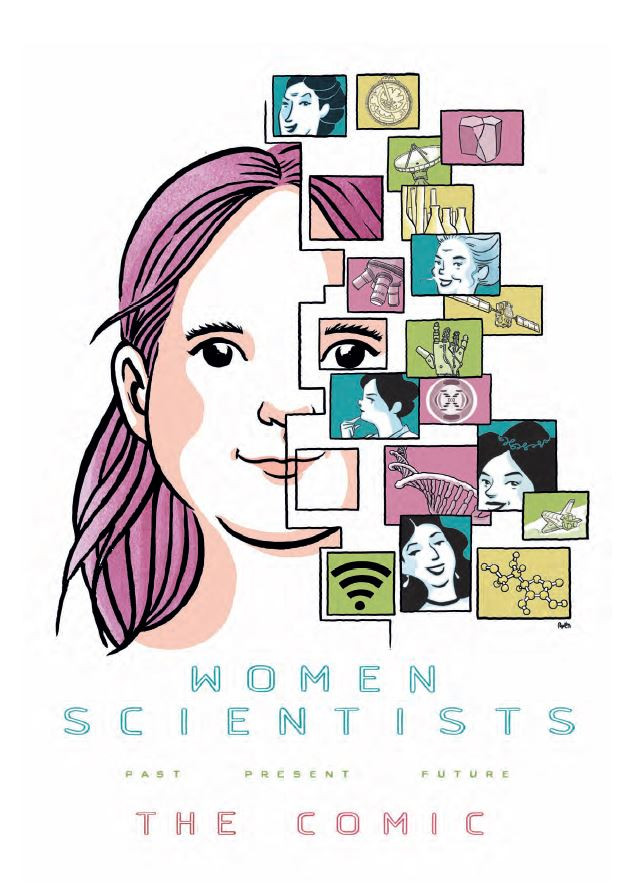 Women Scientists: Past, Present and Future Año de publicación: 2019 Autor: Raquel Gu | Francisco Vega Narváez Autor corporativo: ONCE Foundation This comic is the adaptation of the play Women scientists: past, present and future, an original idea by Francisco Vega Narváez with an original script by Isabel Fernández Delgado, Clara Grima Ruiz, maría José Jiménez Rodríguez, Adela muñoz Páez, maría del Carmen Romero Ternero and Francisco Vega Narváez. Both in the play and in the comic, female references are presented in the world of science so that girls do not feel that something is foreign to them simply because they are women and also so that boys have those same references. Achievements in science are made by people, it doesn't matter if they are women or men, their age, nationality... Científicas: pasado, presente y futuro Año de publicación: 2019 Autor: Raquel Gu | Francisco Vega Narváez Autor corporativo: ONCE Foundation Este cómic es la Adaptación de la obra de teatro Científicas: pasado, presente y futuro, una Idea original de Francisco Vega Narváez con Guion original de Isabel Fernández Delgado, Clara Grima Ruiz, maría José Jiménez Rodríguez, Adela muñoz Páez, maría del Carmen Romero Ternero y Francisco Vega Narváez. Tanto en la obra como en el cómic se presentan referentes femeninos en el mundo de la ciencia para que las niñas no sientan que algo les es ajeno por el mero hecho de ser mujeres y también para que los niños tengan esos mismos referentes. Los logros en ciencia los hacen personas, da igual que sean mujeres u hombres, su edad, nacionalidad..
  International Day of Women and Girls in Science Autor corporativo: Global Citizenship (Buenos Aires) Regarding the International Day of Women and Girls in Science, this infographic presents relevant information about the gaps in female participation in research and work on scientific topics. Includes links to support materials. Día Internacional de la mujer y la niña en la ciencia Autor corporativo: Global Citizenship, Buenos Aires A propósito del día internacional de la mujer y la niña en la cencia, esta infografía presenta información relevante sobre las brechas de participación femenina en investigación y trabajos en temas científicos. Incluye vínculos a materiales de apoyo.
  Generation Equality Accountability Report 2022 Año de publicación: 2022 Autor corporativo: United Nations Entity for Gender Equality and the Empowerment of Women (UN Women) In the UN Decade for Action on Gender Equality, people around the world have pledged to move from rhetoric to action and to work together to drive lasting change, starting now. Through the 2021 Generation Equality Forum in Mexico and France, world leaders and partners committed to eliminating gender inequalities and to financing and implementing laws, policies, and programmes to meet priority actions and targets in a Global Acceleration Plan for Gender Equality. The aim is simple but profound: deliver irreversible, quantifiable results for women and girls in all their diversity.Together, commitment makers and signatories of a series of Action Coalitions, along with the Compact for Women, Peace and Security and Humanitarian Action have begun to build an ambitious global movement. It unites diverse partners committed to collective accountability for women and girls. This accountability is the driving force of this report, which takes stock of the bold commitments made at the Forum one year into implementation. Through a survey of commitment-makers, the report sheds light on the nature of the commitments and assesses measurable progress. It highlights trends and notes where more work is needed.Generation Equality was born from the idea that the world could make catalytic progress on gender equality if a wide range of stakeholders united around a transformative vision and worked together to achieve it. These preliminary findings demonstrate that, while more remains to be done, collective action is powerful in making commitments real in the lives of women and girls.
  Progress on the Sustainable Development Goals: The Gender Snapshot 2022 Año de publicación: 2022 Autor: Ginette Azcona | Antra Bhatt | Julia Brauchle | Guillem Fortuny Fillo | Yongyi Min | Heather Page | Yuxi Zhang Autor corporativo: United Nations Entity for Gender Equality and the Empowerment of Women (UN Women) | UN. Department of Economic and Social Affairs (UN. DESA) The latest available Sustainable Development Goal (SDG) 5 data show that the world is not on track to achieve gender equality by 2030. COVID-19 and the backlash against women’s sexual and reproductive health and rights are further diminishing the outlook for gender equality. Violence against women remains high; global health, climate, and humanitarian crises have further increased risks of violence, especially for the most vulnerable women and girls; and women feel more unsafe than they did before the pandemic. Women’s representation in positions of power and decision-making remains below parity. Only 47 per cent of data required to track progress on SDG 5 are currently available, rendering women and girls effectively invisible.Nearly halfway to the 2030 endpoint for the SDGs, the time to act and invest in women and girls is now.“Progress on the Sustainable Development Goals: The gender snapshot 2022” presents the latest evidence on gender equality across all 17 Goals, calling out the long road ahead to achieve gender equality. It emphasizes the interlinkages among the goals, the pivotal force gender equality plays in driving progress across the SDGs, and women and girls’ central role in leading the way forward.