
Recursos
Exploren una amplia gama de recursos valiosos en GCED para profundizar su comprensión y promover su búsqueda, incidencia, enseñanza y aprendizaje.
72 resultados encontrados
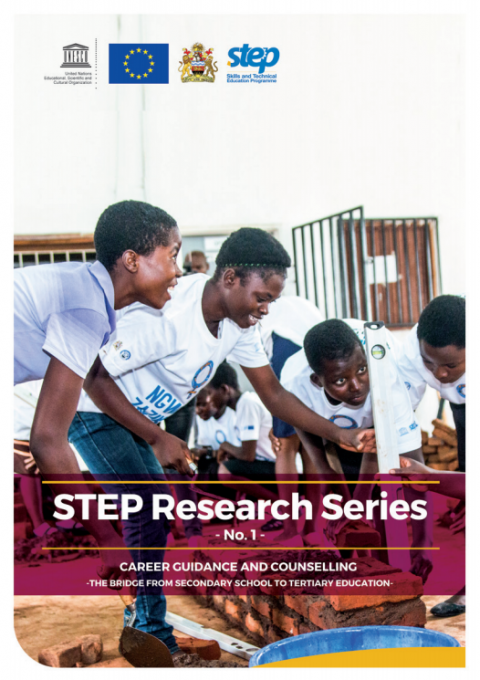 Career guidance and counselling: the bridge from secondary school to tertiary education; a review of current guidance and counselling programmes and practices in Malawi and their support in promoting technical and vocational training for girls Año de publicación: 2017 Autor corporativo: 联合国教科文组织 (UNESCO) The objective of this report is to identify and review existing career G&C programmes and practices in secondary schools in Malawi. The review assesses to what extent such programmes and practices create an awareness of the importance of technical careers and how graduates from the secondary schools can access TEVET. Additionally, it assesses whether any affirmative action measures or approaches are used to increase girls’ interest in and applications to enter technical colleges.
  School-related gender-based violence: global guidance (Infographic) Año de publicación: 2016 Autor corporativo: UNESCO | United Nations Entity for Gender Equality and the Empowerment of Women (UN Women) School-related gender-based violence: global guidance (Infographic)
 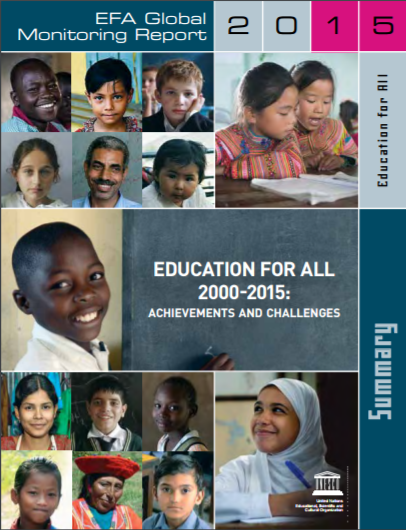 Education for All 2000-2015: Achievements and Challenges; EFA Global Monitoring Report, 2015; Summary Año de publicación: 2015 Autor corporativo: UNESCO At the World Education Forum in Dakar, Senegal, in 2000, governments from 164 countries, together with representatives of regional groups, international organizations, donor agencies, non-government organizations (NGOs) and civil society, adopted a Framework for Action to deliver Education for All (EFA) commitments. The Dakar Framework comprised 6 goals and their associated targets to be achieved by 2015, and 12 strategies to which all stakeholders would contribute. The EFA Global Monitoring Report (GMR) has monitored progress on an almost annual basis towards the EFA goals and the two education-related Millennium Development Goals (MDGs). The 2015 GMR provides a complete assessment of progress since 2000 towards the target date for reaching the Dakar Framework’s goals. It takes stock of whether the world achieved the EFA goals and stakeholders upheld their commitments. It explains possible determinants of the pace of progress. Finally, it identifies key lessons for shaping the post-2015 global education agenda.
 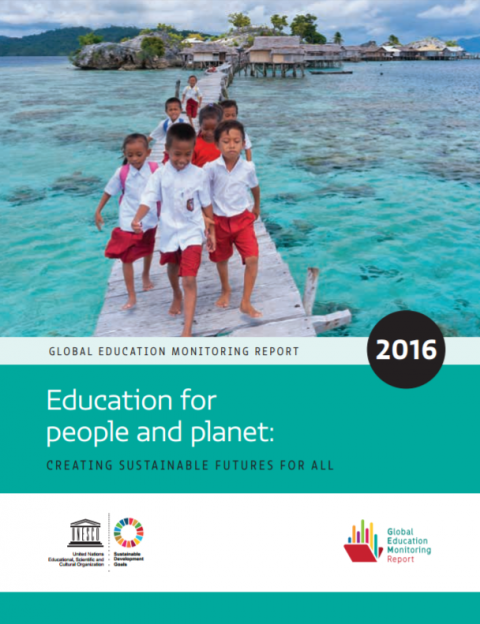 Education for People and Planet: Creating Sustainable Futures for All, Global Education Monitoring Report, 2016 Año de publicación: 2016 Autor corporativo: UNESCO | Global Education Monitoring Report Team Education for People and Planet: Creating Sustainable Futures for All explores the complex relationship between education and the new 2030 Agenda for Sustainable Development, covering six fundamental pillars – Planet, Prosperity, People, Peace, Place and Partnerships. This report shows that education will not deliver its full potential unless participation rates increase dramatically and sustainable development guides education system reform. It also warns of the destructive impact that climate change, conflict, unsustainable consumption and the increasing gap between rich and poor have on education. A huge transformation is needed if we are to create sustainable futures for all.
  [Summary] Education for People and Planet: Creating sustainable Futures for All, Global Education Monitoring Report, 2016; Summary Año de publicación: 2016 Autor corporativo: UNESCO Education for People and Planet: Creating Sustainable Futures for All explores the complex relationship between education and the new 2030 Agenda for Sustainable Development, covering six fundamental pillars – Planet, Prosperity, People, Peace, Place and Partnerships. This report shows that education will not deliver its full potential unless participation rates increase dramatically and sustainable development guides education system reform. It also warns of the destructive impact that climate change, conflict, unsustainable consumption and the increasing gap between rich and poor have on education. A huge transformation is needed if we are to create sustainable futures for all.
  Final Report: 2016 UNESCO/KOICA Joint Fellowship Programme Año de publicación: 2016 Autor corporativo: APCEIU This report provides an overview of the activities carried out during the 2016 UNESCO/KOICA Joint Fellowship Programme held in Republic of Korea from 1 September - 31 October, 2016.In its 10th year of implementation, UNESCO/KOICA Joint Fellowship Programme 2016 invited 25 educators from 17 countries in Africa and the Asia-Pacific region for two months; from September 1st to October 31st. The overarching goal of the Programme was to enhance the capacities of participating educators under the themes of “Teacher Training for Basic Education,” “Use of ICT for Education (or e-Learning),” “Leadership in Global Education” and “Girls’ Education.” Composed of various segments such as lectures, workshops, hands-on activities, and seminars, which were closely interlinked with each module, the modules were designed to enable the participants to reorient their perspectives on educational development, to gain essential knowledge and skills, and furthermore to produce meaningful and relevant outputs that could be widely applied in their local contexts.For more information, please contact APCEIU's Office of Education and Training at ent@unescoapceiu.org.
 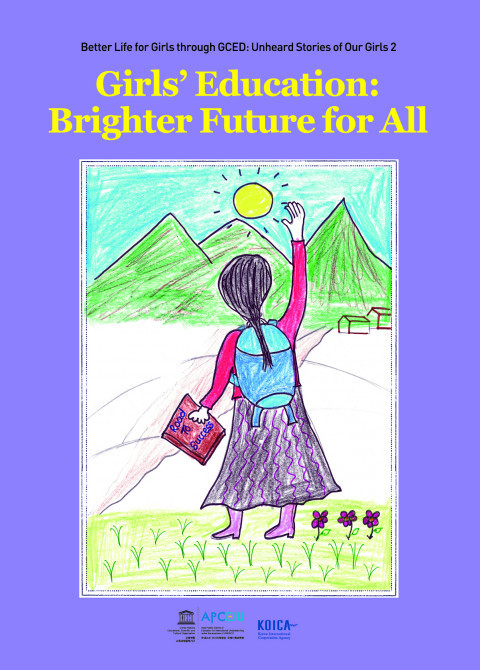 Better Life for Girls through GCED: Unheard Stories of Our Girls 2: Girl's Education: Brighter Future for All Año de publicación: 2016 Autor corporativo: APCEIU The "Better Life for Girls through GCED: Unheard Stories of Our Girls" series depict stories of girls from different parts of the world. Coming from Africa and Asia, 25 educators have written stories about their girls during the programme to share with readers all over the world. As the title implies, these series are about real people living on the fringes of society especially girls in their neighbor having challenges on their way to access quality education.
 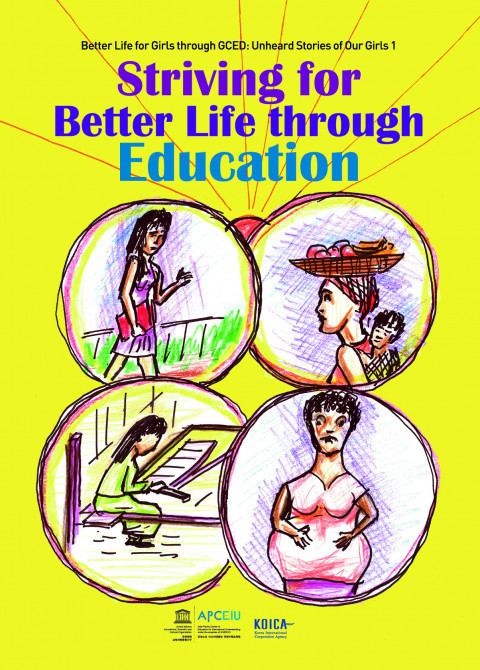 Better Life for Girls through GCED: Unheard Stories of Our Girls 1: Striving for Better Life through Education Año de publicación: 2016 Autor corporativo: APCEIU 2016 UNESCO/KOICA Fellowship Programme Better Life for Girls through GCED: Unheard Stories of Our Girls The "Better Life for Girls through GCED: Unheard Stories of Our Girls" series depict stories of girls from different parts of the world. Coming from Africa and Asia, 25 educators have written stories about their girls during the programme to share with readers all over the world. As the title implies, these series are about real people living on the fringes of society especially girls in their neighbor having challenges on their way to access quality education.
 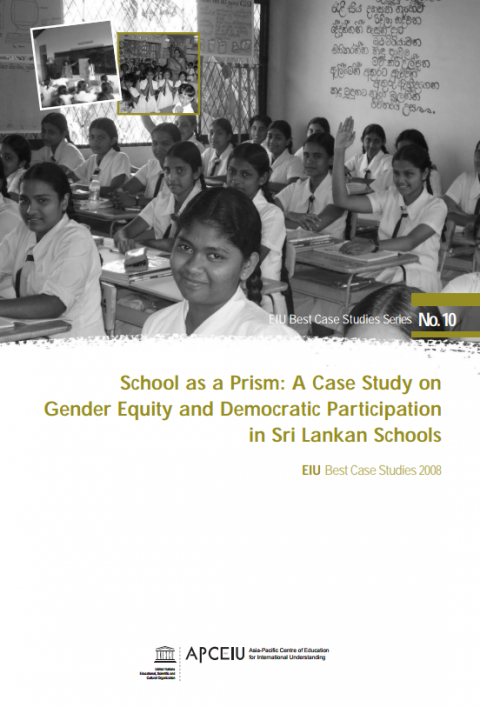 EIU Best Practices Series No. 10: School as a Prism: A Case Study on Gender Equity and Democratic Participation in Sri Lanka Schools Año de publicación: 2008 Autor corporativo: APCEIU This report is one of the APCEIU's EIU Best Practices Series, which aims to encourage educators, scholars, and activists to implement and share local initiatives on EIU. The Series No.10 introduces a study of nine schools in Sri Lanka, which has been conducted to analyze current practices of gender education and provide suggestions for improvement. Upon careful assessment of documentary surveys, interviews, self-reports, and historical data analysis, the result indicates that gender equality and democratic participation are substantially provided and prioritized in Sri Lankan schools, in lieu of EIU theme of social justice. As common challenges still exist, the research notes the need to further examine learning patterns of boys and girls, classroom-specific gender issues, and good practices that promote role of women in democratic participation.
 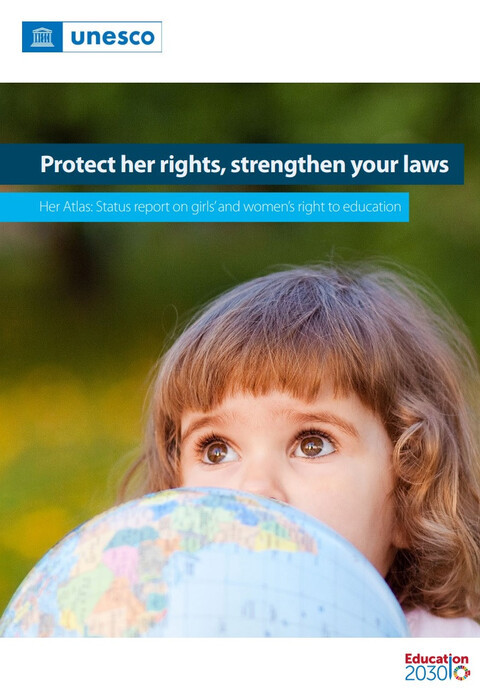 Protect Her Rights, Strengthen Your Laws: Her Atlas; Status Report on Girls’ and Women’s Right to Education Año de publicación: 2022 Autor corporativo: UNESCO UNESCO’s Her Education, our future initiative, Her Atlas was launched in 2019 with the aim to enhance public knowledge and monitor the status of national constitutions, legislation and regulations related to girls’ and women’s education rights in order to encourage countries to take actions to improve their legal frameworks. Three years after its launch, the research phase has been completed: overall, the legal frameworks of 196 countries have been thoroughly analyzed to evaluate the level of protection of girls’ and women’s right to education around the world. In an interactive world map format, Her Atlas uses a color-coded scoring system to monitor 12 indicators of legal progress towards gender equality in the right to education. This report marks the completion of the first research phase and intends to highlight some key trends outlined by the research work, and to emphasize examples of legal provisions regarding some aspects of girls’ and women’s right to education guaranteed by States’ domestic laws.