
Recursos
Exploren una amplia gama de recursos valiosos en GCED para profundizar su comprensión y promover su búsqueda, incidencia, enseñanza y aprendizaje.
220 resultados encontrados
 Education and Conflict: Complexity and Chaos Año de publicación: 2003 Autor: Lynn Davies Based on the author's extensive research and experience of education in several areas afflicted by conflict, the book explores the relationship between schooling and social conflict and looks at conflict internal to schools. It posits a direct link between the ethos of a school and the attitudes of future citizens towards 'others'. It also looks at the nature and purpose of peace education and war education, and addresses the role of gender and masculinity.
  Schools and war: urgent agendas for comparative and international education Año de publicación: 2005 Autor: Lynn Davies Autor corporativo: Taylor & Francis This paper looks first at the contributions that education makes to conflict, through the reproduction of inequality and exclusion, through perpetuation of ethnic or religious divisions, through its acceptance of dominant aggressive masculinities, through selection, competition and fear, and through distorted curricular emphases on narrow cognitive areas of learning. However, the paper also outlines some ‘possibilities for hope’, such as resilient schools, the impact of peace education initiatives and the rise of global citizenship education.
  Education Reform in Pakistan Año de publicación: 2014 Autor corporativo: International Crisis Group In April 2010, the eighteenth constitutional amendment committed Pakistan to free and compulsory education for all children between the ages of five and sixteen. Yet millions are still out of school, and the education system remains alarmingly impoverished. The madrasa (religious school) sector flourishes, with no meaningful efforts made to regulate the seminaries, many of which propagate religious and sectarian hatred. Militant violence and natural disasters have exacerbated the dismal state of education. The public education system needs to foster a tolerant citizenry, capable of competing in the labour market and supportive of democratic norms within the country and peace with the outside world.
 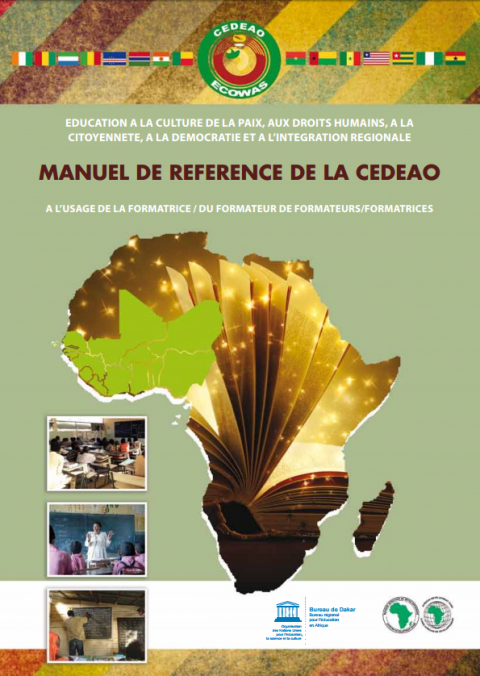 EDUCATION A LA CULTURE DE LA PAIX, AUX DROITS HUMAINS, A LA CITOYENNETE, A LA DEMOCRATIE ET A L’INTEGRATION REGIONALE MANUEL DE REFERENCE DE LA CEDEAO A L’USAGE DE LA FORMATRICE / DU FORMATEUR DE FORMATEURS/FORMATRICES Año de publicación: 2013 Autor corporativo: UNESCO Dakar | Economic Community of West African States (ECOWAS) The manual comprises seven modules dealing with the Culture of Peace and Conflict Management; Human Rights; Civism and Citizenship; Democracy and Good Governance; Gender and Development; Public Health, Environment and Sustainable Development; and Regional Integration. Each module has sub-themes with introductions, reference materials, general objectives to guide the trainer and generic pedagogical tables that are flexible enough to be adapted to available teaching resources in the different ECOWAS countries. It is also suitable and adaptable to the training of teachers involved in both formal and non-formal education delivery at different levels of teaching and learning. The ultimate goal of the Manual is to build a critical mass of ECOWAS citizens equipped with competent skills, not only for cognitive and psycho-motor domains of education, but also affective skills for positive values, attitudes and behaviors that promote peace, tolerance and peaceful co-existence of community citizens.
 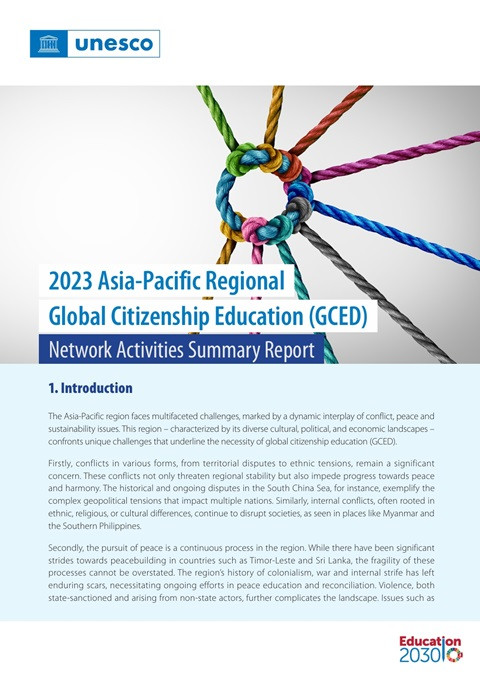 2023 Asia-Pacific Regional Global Citizenship Education (GCED): Network Activities Summary Report Año de publicación: 2023 Autor: Seek Ling Tan Autor corporativo: UNESCO Bangkok This is a summary report from the Global Citizenship Education (GCED) network activities in Asia-Pacific in 2023. The Asia-Pacific Regional Global Citizenship Education Network, spearheaded by UNESCO Bangkok and the Asia-Pacific Centre of Education for International Understanding (APCEIU), has illuminated the path to empower learners to become global citizens since its inception in 2018. In 2023, their journey was punctuated by significant milestones and a revitalized commitment to propel GCED across the region. This commitment is particularly evident in the key priority areas of advocacy, capacity building, learning/teaching materials, policy and research and the synergizing of regional collaboration towards Education 2030.
  جهانی شدن و ضرورت آموزشهای شهروندی جهانی Año de publicación: 2012 Autor: Yousef Keshavarz Autor corporativo: Center for Strategic Studies of the Presidency Today, due to “Globalization”, the fate of all individuals, organizations and governments are more tied together and effects of this process in all areas of human activity is undeniable. By looking at the concept of “Global Citizenship” new expectations of education as a meaningful factor to people’s lives and a tool to develop human character and supplying the social needs, is formed. This paper aims to examine and discuss the characteristics and components of global citizenship, the role, importance and necessity of global citizenship education. If we accept that the current use of existing resources in the world is unfair and unacceptable and the gap between rich and poor (in all aspects) wide and widens, should ponder choice. Training and education of global citizens (especially children and young people) who wish the world as a place full of justice, equality, peace and sustainable development, respect and protection of racial diversity, religious etc… and also possess other characteristic features addressed in this paper seems to be a powerful tool and solution. In this frame work, poverty and identity crisis of Iranian youth and in the other hand being attracted to the Globalization culture of outsiders, are two points that reveal the necessity for paying more attention to the training of global citizens, to adopt a broad and enormous prospective to the global issues. Therefore, according to the valuable Islamic texts and outlined prominent place for human beings and human values, also with consideration to the rich Iranian culture and civilization in direction with an active role in global co-management, living such training in formal and informal education system and also establishment of a center as such in partnership and cooperation with other educational institutions in the country is suggested.
  Education for global citizenship Año de publicación: 2004 Autor: Audrey Osler Cosmopolitan Citizenship is described as a concept of Global learning based on international agreements of UNESCO and the Council of Europe. To live in a global world people would need – besides basic education – different social skills as competencies of political literacy.
  Global Citizenship Education in Canada and the U.S.: From Nation-Centric Multiculturalism to Youth Engagement Año de publicación: 2020 Autor: Sarah Ranco | Alexis Gilmer | Colleen Loomis Autor corporativo: Cham Springer This chapter examines the historical and current uses of global citizenship education (GCE) in Canada and the U.S. in public schools from primary through secondary levels, with attention to Canada as well as similarities and differences within and across the two countries. The authors assess how social and political contexts have influenced the definition and operationalization of multiculturalism, civic studies, and global studies in curricula, noting that the neo-liberal perspective has focused on making people an economic powerhouse rather than socially concerned global citizens. In their examination of educational approaches that relate to GCE, the authors present decolonizing pedagogies, the multiculturalism approach in Canada, as well as culturally responsive and anti-racist pedagogies. To illustrate these issues, the authors offer an example in the Canadian context and raise the need to prevent GCE from becoming yet another tool for hegemony by the Global North on the Global South, as dominant groups have long defined citizenship. They conclude by proposing that to realize GCE in these two countries, teacher/practitioner and local, national, and international actors must engage youth, and in doing so, power imbalances that prohibit becoming global citizens will be addressed.
  Rethinking Schooling for the 21st Century: The State of Education for Peace, Sustainable Development and Global Citizenship in Asia Año de publicación: 2017 Autor corporativo: Mahatma Gandhi Institute of Education for Peace and Sustainable Development (MGIEP) Calls to gear up schools for the 21st century are ubiquitous today. Dominant international educational discourse hails the potential of 'the youth dividend' and digital technology for enhancing growth. Some Asian education systems are held up as models for an innovation-led utopian future. But across much of Asia, neither the reality of schooling nor the patterns of development with which it is associated give cause for blithe optimism.This study is informed by UNESCO’s commitment to realising the Sustainable Development Goals (SDGs) through educational reform worldwide. Since its inception, UNESCO has championed a humanistic vision of education — a vision today encapsulated in SDG 4.7. These ideals need to be strongly restated and defended in an era when educational debate worldwide has come to be framed by a narrowly economistic and instrumentalist agenda.Deriving urgent significance from this broader context, the present report analyses how far the ideals of SDG 4.7 – of 'education for peace, sustainable development and global citizenship' - are embodied in policies and curricula across 22 Asian societies. At one level, it seeks to develop benchmarks against which future progress can be assessed. It also argues forcefully that conceptions of the fundamental purposes of schooling need to be reconfigured, if the ideals to which the global community has subscribed are actually to be realised.
  Building Back Better: Youth, Power and Planet Año de publicación: 2020 Autor: Valerie Duffy | Leo Gilmartin | Eva Janssens | Dermot O’Brien Autor corporativo: National Youth Council of Ireland (NYCI) Building Back Better: Youth, Power and Planet is about power. The understanding of power in youth work is vitally important for the development of young people as they navigate through their lives and society.The aim of this resource is to support young people and youth workers in understanding power, seeing power, claiming power, and activating power. It includes a wealth of background information on concepts around power and terminology, as well as a guide on ‘How to Use this Resource’, activities, stimulus sheets. This toolkit explores the issue of power and helps you make links to the Sustainable Development Goals.It is designed for global educators, youth workers, development education practitioners, trainers, climate activists, changemakers of all shapes and sizes but in particular those working with the current generation of young people.Building Back Better contains 4 main sections:Section 1. Defining PowerSection 2. Seeing PowerSection 3. Claiming PowerSection 4. Activating PowerIt also contains:an introduction to power in theory and in practice 10 activities with interactive exercisesaction power templates for planningstriking visuals, case studies on human development for adapting This was resource was created by the NYCI Youth 2030 programme.