
Recursos
Exploren una amplia gama de recursos valiosos en GCED para profundizar su comprensión y promover su búsqueda, incidencia, enseñanza y aprendizaje.
56 resultados encontrados
 Address by Irina Bokova, Director-General of UNESCO, on the occasion of Seminar on Global Citizenship Education, UNHQ; New York, 6 March 2015 Año de publicación: 2015 Autor corporativo: UNESCO. Director-General, 2009-2017 (Bokova, I.G.) This document is an address by Irina Bokova, Director-General of UNESCO on the occasion of "Seminar on Global Citizenship Education" in New York, 6 March 2015. She highlights the importance of GCED for education in the 21st century. جهانی شدن و ضرورت آموزشهای شهروندی جهانی Año de publicación: 2012 Autor: Yousef Keshavarz Autor corporativo: Center for Strategic Studies of the Presidency Today, due to “Globalization”, the fate of all individuals, organizations and governments are more tied together and effects of this process in all areas of human activity is undeniable. By looking at the concept of “Global Citizenship” new expectations of education as a meaningful factor to people’s lives and a tool to develop human character and supplying the social needs, is formed. This paper aims to examine and discuss the characteristics and components of global citizenship, the role, importance and necessity of global citizenship education. If we accept that the current use of existing resources in the world is unfair and unacceptable and the gap between rich and poor (in all aspects) wide and widens, should ponder choice. Training and education of global citizens (especially children and young people) who wish the world as a place full of justice, equality, peace and sustainable development, respect and protection of racial diversity, religious etc… and also possess other characteristic features addressed in this paper seems to be a powerful tool and solution. In this frame work, poverty and identity crisis of Iranian youth and in the other hand being attracted to the Globalization culture of outsiders, are two points that reveal the necessity for paying more attention to the training of global citizens, to adopt a broad and enormous prospective to the global issues. Therefore, according to the valuable Islamic texts and outlined prominent place for human beings and human values, also with consideration to the rich Iranian culture and civilization in direction with an active role in global co-management, living such training in formal and informal education system and also establishment of a center as such in partnership and cooperation with other educational institutions in the country is suggested. Democracy and diversity: principles and concepts for educating citizens in a global age Año de publicación: 2005 Autor: James A. Banks | Cherry A. McGee Banks | Carlos E. Cortes | Carole L. Hahn | Merry M. Merryfield | Kogila A. Moodley | Stephen Murphy-Shigematsu | Audrey Osler | Caryn Park | Walter C. Parker Autor corporativo: Center of Multicultural Education, University of Washington The Center for Multicultural Education at the University of Washington convened—with support from the Spencer Foundation—a Diversity, Citizenship, and Global Education Consensus Panel. The Panel’s goal was to develop a set of principles, concepts, and guidelines that school practitioners can use to build or renew citizenship education programs that balance diversity and unity and prepare students to become effective citizens in a global context. An important resource for the Panel’s work was the book that resulted from an earlier conference sponsored by the Center, Diversity and Citizenship Education: Global Perspectives (Banks, 2004a).The Consensus Panel developed four principles and identified ten concepts, which are detailed in this publication. The Panel also developed a checklist that is designed for use by educators who want to consider the extent to which the principles and concepts identified by the Panel are reflected in their classrooms and schools.PRINCIPLESSection I Diversity, Unity, Global Interconnectedness, and Human Rights1. Students should learn about the complex relationships between unity and diversity in their local communities, the nation, and the world.2. Students should learn about the ways in which people in their community, nation, and region are increasingly interdependent with other people around the world and are connected to the economic, political, cultural, environmental, and technological changes taking place across the planet.3. The teaching of human rights should underpin citizenship education courses and programs in multicultural nation-states.Section II Experience and Participation4. Students should be taught knowledge about democracy and democratic institutions and provided opportunities to practice democracy. Are we all global citizens now? Reflections on citizenship and citizenship education in a globalising world (with special reference to Singapore) Año de publicación: 2012 Autor: Saravanan Gopinathan Autor corporativo: Centre for Governance and Citizenship | Hong Kong Institute of Education Research into citizenship education has traditionally focused on citizenship curricula within the context of the nation-state. More recently, as a response to globalization trends, it has been suggested that citizenship research must embrace the concept of the 'global citizen.' Such perspectives draw principally on Anglo-Saxon perspectives on the evolution of the nation-state and citizen-state relations. This perspective is critiqued from the context of a post-colonial developing state, Singapore, and an argument made that a nation-centric perspective is still viable. Citizenship, identity and education: examining the public purposes of schools in an age of globalization Año de publicación: 2006 Autor: Fernando Reimers Autor corporativo: UNESCO International Bureau of Education (IBE) Educational institutions exist to achieve public purposes. One of those purposes is to develop citizenship. In the 21st century, citizenship includes global citizenship. In an era of globalization effective citizenship includes the knowledge, ability and disposition to engage peacefully and constructively across cultural differences for purposes of addressing personal and collective needs and of achieving sustainable human–environmental interactions, this requires internalizing global values. Addressing these challenges of globalization will require making citizenship education and the development of global values an explicit objective of efforts to improve quality throughout the world, critically examining theories and evidence about the effectiveness of various approaches to developing citizenship and global citizenship and supporting activities aligned with this public purpose. This public purpose should support the development of a political culture that fosters the rule of national and international law and respect of human rights, the development of understanding to support trade and economic and peaceful bilateral and international diplomacy as the preferred means to solve international disputes, the development of the capability to understand and address the serious environmental challenges facing humanity and to collaborate across national boundaries in the creation of sustainable forms of human–environmental interactions and in the development of the skills to promote rationality in deliberation and action, and to advance science and technology as means to improve human health and well-being. At present, however, many education systems and reforms are insufficiently focused on quality, or focus instead on a very narrow and self-referenced definition of quality. It is possible to educate people to understand and appreciate cultural differences and to understand and accept human rights in a framework of global values that includes compassion and caring, concern for others, respect and reciprocity. These values, dispositions, knowledge and skills can be developed in a range of institutions that societies have to pass on what they value to the young, and to re-create culture: families, religious institutions, the media, workplaces, political institutions and also schools. While there is no reason to assume that schools can be more effective in this task than any of these other institutions, they have greater potential to be aligned with transnational efforts to promote global civility. They are a public space, and consequently also a globally public space, in ways in which families and religious institutions are not. If schools actively engage in teaching hatred or intolerance, or if they fail to prepare students adequately for global civility, these failures can be noted by international institutions that can potentially mobilize resources to support national and local efforts to prepare students for global citizenship. There is not a similar network linking national and transnational institutions, public and private, governmental and non-governmental, that attends to the dynamics of families and other ‘‘private’’ spaces.
 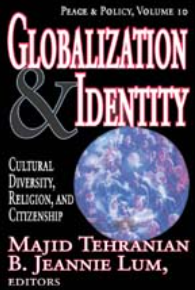 Globalization and Identity: Cultural Diversity, Religion and Citizenship Año de publicación: 2006 Autor: Majid Tehranian | B. Jeannie Lum Autor corporativo: Transaction Publishers In the first decade of the twenty-first century, globalization and identity have emerged as the most critical challenges to world peace. This volume of Peace & Policy addresses the overarching question, "What are the effects of globalization in the areas of culture, ethnic diversity, religion, and citizenship, and how does terrorism help groups attain a sense of global identity?"Part I, "Citizenship in a Globalizing World," reexamines globalization in light of the traditions from which human civilizations have evolved. Linda Groff focuses on Samuel R. Huntington's thesis that the Cold War would be followed by a clash of civilizations. Joseph A. Camilleri traces the history of the concept of citizenship and its transformation through the ages to modern times. Kamran Mofid argues that the marketplace is not just an economic sphere but one where economic and business interests must embrace the spiritual assets of the community. Majid Tehranian raises the problem of identity and advocates the assumption of global identity, responsibility, and citizenship. Part II, "Convergence in Global Cultures," explores the complex issues of diversity in religions. Christopher Leeds, Vladimir Korobov, and Bharapt Gupt show how the reconceptualization of the world both geographically and regionally can recreate new sensibilities needed to overcome differences. Part III, "Divergence in Global Conflicts," discusses the multiple dimensions of the globalizing effects of economic expansion and political strife experienced by different cultures at local and regional levels. Audrey Kitigawa and Ade Ogunrinade use Nigeria as an example of political manipulation of religious and ethnic groups to divert attention from the real problems of social and economic marginalization. Fred Riggs looks at how the Web has become a medium in the globalization of religious movements.The authors maintain that continuing efforts for dialogue across cultural and religious boundaries in today's interreligious and interfaith organizations can become a force for healing.
  One World, One People, One Future: Imagine a World that Understands, Embraces & Practices Peace and Sustainable Development Año de publicación: 2014 Autor corporativo: Mahatma Gandhi Institute of Education for Peace and Sustainable Development (MGIEP) One World, One People, One Future: Imagine a World that Understands, Embraces & Practices Peace and Sustainable Development
  Address by Irina Bokova, Director-General of UNESCO, on the occasion of the Global Citizen Forum; Monaco, 8 October 2015 Autor corporativo: UNESCO. Director-General, 2009-2017 (Bokova, I.G.) This address was delivered by Irina Bokova, Director-General of UNESCO, on the occasion of the Global Citizen Forum.
  Education for global citizenship Año de publicación: 2004 Autor: Audrey Osler Cosmopolitan Citizenship is described as a concept of Global learning based on international agreements of UNESCO and the Council of Europe. To live in a global world people would need – besides basic education – different social skills as competencies of political literacy.
  Translating globalization theories into educational research : thoughts on recent shifts in Holocaust education Much educational research on globalization aims to prepare students to be successful citizens in a global society. We propose a set of three concepts, drawing on systems theory (Nassehi, Stichweh) and theories of the subject (Butler, Foucault), to think the global which enables educational research to step back from hegemonic discourses and reflect on current practices. Globalization is understood in this approach as referring to: (1) a cognitive shift; (2) expanding relevancy spaces; and (3) new forms of subjectivation. The framework is illustrated with examples from educational policy and learning materials, with an extended look at how globalization is articulated in recent shifts in Holocaust education. (By the author)