
Recursos
Exploren una amplia gama de recursos valiosos en GCED para profundizar su comprensión y promover su búsqueda, incidencia, enseñanza y aprendizaje.
57 resultados encontrados
 The Elusive and Exclusive Global Citizen Año de publicación: 2015 Autor: Jill Koyama Autor corporativo: Mahatma Gandhi Institute of Education for Peace and Sustainable Development (MGIEP) In this paper, the author interrogate the notion of global citizenship, both as an aspiration and an improbable practice, by situating it within contemporary understandings of citizenship and globalization.It is a conceptualization that suffers from the dangers inherent in the term “citizenship” and misconceptions of the terms “global,” and it is rooted in the West’s long engagement in normative undertakings in non-Western countries. The writer refute ideas of the autonomous and agentic global citizen. he encourage a rethinking of global citizenship and global citizenship education (GCE) and offer recommendations for redirecting attention to contemporary global stratifications and issues of human rights to address the issues of social justice and inequality that, due to the problematic definition of global citizenship, are currently inadequately covered in existing GCE curricula.
  Building Citizenship from Universities; University Social Responsibility and Challenges in the XXI century Año de publicación: 2011 Autor: Eduardo Gasca-Pliego | Julio César Olvera-García Autor corporativo: Universidad Autónoma del Estado de México The present essay contributes with a reflection on the role universities must take as agents of transformation and consolidation of the democratic model, mainly before the challenge of building full citizens, interested in the need of the physical and social environment, in collective decision making, who think of themselves as participant citizens and not only voters with their own interests in view. Distinguishable is the primordial role of university social responsibility to promote the social management of knowledge for everyone, which has as an end the construction of informed, responsible and participant citizenship, which responds to injustice, non-sustainability, violence and corruption. Rethinking the social function of the university requires defending the values proper to public education, in the sense that every citizen has equal opportunities to develop their capabilities, eliminating obstacles of social and economic nature, as well as the cultural and political that affect and hinder said development.
  Public Universities and Neoliberal Common Sense: Seven Iconoclastic Thesis Año de publicación: 2014 Autor: Carlos Alberto Torres Autor corporativo: Universidad Nacional de Tres de Febrero (UNTREF) Neoliberalism has utterly failed as a viable model of economic development, yet the politics of culture associated with neoliberalism is still in force, becoming the new common sense shaping the role of government and education. This ‘common sense’ has become an ideology playing a major role in constructing hegemony as moral and intellectual leadership in contemporary societies. Neoliberal globalisation, predicated on the dominance of the market over the state and on deregulatory models of governance, has deeply affected the university in the context of ‘academic capitalism’. The resulting reforms, rationalised as advancing international competitiveness, have affected public universities in four primary areas: efficiency and accountability, accreditation and universalisation, international competitiveness and privatisation. There is also growing resistance to globalisation as top-down-imposed reforms reflected in the public debates about schooling reform, curriculum and instruction, teacher training and school governance. Many question whether neoliberal reforms attempt to limit the effectiveness of universities as sites of contestation of the national and global order and thus undermine the broader goals of education. Neoliberal reforms have limited access and opportunity along class and racial lines, including limiting access to higher education through the imposition of higher tuition and reduced government support to institutions and individuals.
  Citizenship, Identity, and Education: Examining the Public Purposes of Schools in an Age of Globalization Año de publicación: 2006 Autor: Fernando Reimers Autor corporativo: UNESCO International Bureau of Education (IBE) One of the purposes of educational institutions is to develop citizenship. In the 21st century, citizenship includes global citizenship. Addressing the challenges of globalization will require making citizenship education and the development of global values an explicit objective of efforts to improve quality throughout the world, critically examining theories and evidence about the effectiveness of various approaches to developing citizenship and global citizenship and supporting activities aligned with this public purpose. In this article, the author does not argue for an exclusive effort to focus schools on civic education, but rather for a balanced effort to elevate educational quality making it more relevant to address global challenges and opportunities, of which civic education and global education are components, much neglected at present. The author also does not suggest making civic education the only purpose of the curriculum or making it a priority to the expense of science, math, arts or physical and health education, but he thinks that helping students develop a sense of purpose, situated within broader civic and global purposes, would also facilitate high level engagement with science, mathematical and artistic pursuits.
  The Contribution of University Education to Instilling the Concept of Citizenship among Students at the Algerian University (vol.17, no.3; Journal of human resources development) Año de publicación: 2022 Autor: Maarcha Dalila Autor corporativo: University Mohamed Lamine Debaghine - Setif2 University education endeavors to equip students with the necessary skills and knowledge in scientific research and various disciplines, enabling them to confront the economic, social, and cultural challenges of life. The primary objective of university education is to fulfill societal needs for skilled human resources capable of contributing to societal development and keeping pace with global advancements in education and knowledge. In alignment with this, the University of Algeria aims to instill principles and values of citizenship among its students through its curricula and programs. It aims to foster a sense of belonging and patriotism, as well as to nurture national identity, thereby facilitating the holistic development of students across all dimensions.
 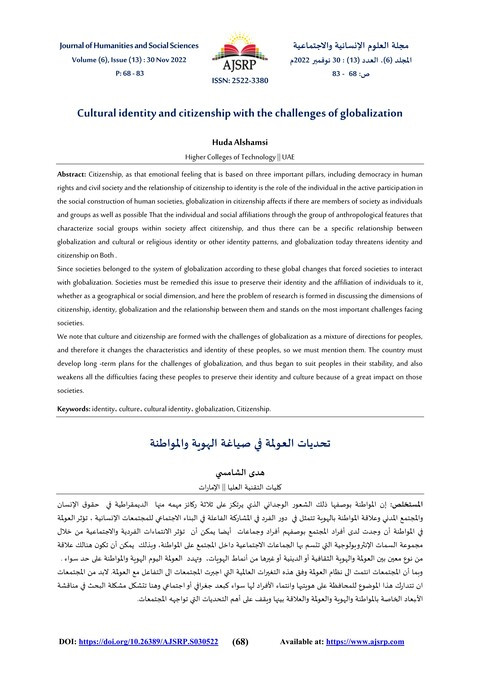 Cultural Identity and Citizenship With the Challenges of Globalization (Journal of Humanities and Social Sciences; Vol.6, No.13) Año de publicación: 2022 Autor: Huda Alshamsi Autor corporativo: Arab Institute of Science and Research Publishing (AISRP) Citizenship is the emotional feeling that is based on three important pillars, including democracy in human rights, civil society, and the relationship between citizenship and identity, is manifested in the active role of individuals in social construction within human societies. Globalization affects citizenship when it exists among individuals and groups in society. Individual and social affiliations, characterized by anthropological features within social groups, can also impact citizenship. Thus, there may be a specific relationship between globalization and cultural, religious, or other identity patterns. Today, globalization threatens both identity and citizenship. As societies adapt to the global system through these global changes that force interaction with globalization, it becomes essential for communities to address this issue to preserve their identity and individual belonging, whether geographically or socially. This forms the basis for researching the dimensions related to citizenship, identity, globalization, and their interrelationships, which pose significant challenges for societies.
 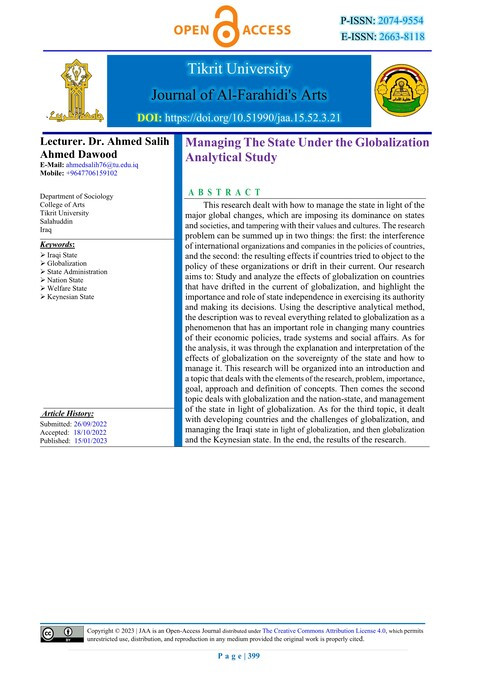 Managing the State Under the Globalization Analytical Study (Journal of Al Farahidi's Arts; Vol.15, Issue 52-3) Año de publicación: 2023 Autor: Ahmed Saleh Ahmed Dawood Autor corporativo: Tikrit University This research dealt with how to manage the state in light of the major global changes, which are imposing its dominance on states and societies, and tampering with their values and cultures. The research problem can be summed up in two things: the first: the interference of international organizations and companies in the policies of countries, and the second: the resulting effects if countries tried to object to the policy of these organizations or drift in their current. Our research aims to: Study and analyze the effects of globalization on countries that have drifted in the current of globalization, and highlight the importance and role of state independence in exercising its authority and making its decisions. Using the descriptive analytical method, the description was to reveal everything related to globalization as a phenomenon that has an important role in changing many countries of their economic policies, trade systems and social affairs. As for the analysis, it was through the explanation and interpretation of the effects of globalization on the sovereignty of the state and how to manage it. This research will be organized into an introduction and a topic that deals with the elements of the research, problem, importance, goal, approach and definition of concepts. Then comes the second topic deals with globalization and the nation-state, and management of the state in light of globalization. As for the third topic, it dealt with developing countries and the challenges of globalization, and managing the Iraqi state in light of globalization, and then globalization and the Keynesian state. In the end of the research, resuls will be presented and recommendations will be made.
  An Analysis of Global Citizenship Education Año de publicación: 2011 Autor: He Xiaofang The nation-state has always been the basic unit of modern civic education research. However, with the continuos advancement of the globalization process, there are an increasing more people participate in various global matters as a "global citizens". This is not only a useful complement to the modern civic education paradigm, but also a fundamental challenge of the civic education system in the nation-state.
  Five States and / or One Region? : National and Regional Dualism in Central Asia Año de publicación: 2015 Autor: Farkhod Tolipov | Abdugani Mamatazimov | Elmira Nogoibaeva | Sanat Kushkumbaev | Tamerlan Ibraimov | Galiya Ibragimova | Azina Kushkumbaeva Autor corporativo: Central Asian Studies The aim of the group of scientists and researchers of the Almaty Club, created with the support of the Friedrich Ebert Foundation, was to analyze and search for common solutions to intra-regional problems.This publication is the result of the work of researchers from 5 countries of the Central Asian region. It discusses issues of regional integration and cooperation, creating a platform for scientific research, overcoming geopolitical tensions and strategic uncertainty, as the main factors that impede regional evolutionary processes.
  Thoughts on Global Citizenship (Universal) Año de publicación: 2017 Autor: Nahla Abu Aliwa Autor corporativo: Arab Council for Childhood and Development (ACCD) This article addresses global citizenship as one of the hot topics the world currently. The researcher highlighted the difference between global citizenship and traditional citizenship. He also touched upon the concept of multiculturalism and its importance in this multicultural world. Emphasis was placed on the Education for Global Citizenship initiative proposed by UNESCO.