
Recursos
Exploren una amplia gama de recursos valiosos en GCED para profundizar su comprensión y promover su búsqueda, incidencia, enseñanza y aprendizaje.
57 resultados encontrados
 Universities: Increasingly Global Players Año de publicación: 2015 Autor: Patrick Aebischer Autor corporativo: UNESCO The role of science, technology and innovation has been explicitly recognized as a vital driver of sustainability. This paper addresses
 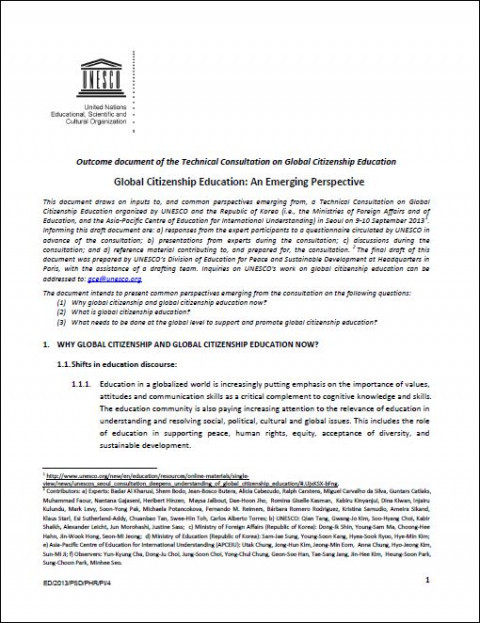 Outcome Document of the Technical Consultation on Global Citizenship Education: Global Citizenship Education: An Emerging Perspective Año de publicación: 2013 Autor corporativo: UNESCO This document draws on inputs to, and common perspectives emerging from, a Technical Consultation on Global Citizenship Education organized by UNESCO and the Republic of Korea (i.e., the Ministries of Foreign Affairs and of Education, and the Asia-Pacific Centre of Education for International Understanding) in Seoul on 9-10 September 2013 . Informing this draft document are: a) responses from the expert participants to a questionnaire circulated by UNESCO in advance of the consultation; b) presentations from experts during the consultation; c) discussions during the consultation; and d) reference material contributing to, and prepared for, the consultation. The final draft of this document was prepared by UNESCO’s Division of Education for Peace and Sustainable Development at Headquarters in Paris, with the assistance of a drafting team.
 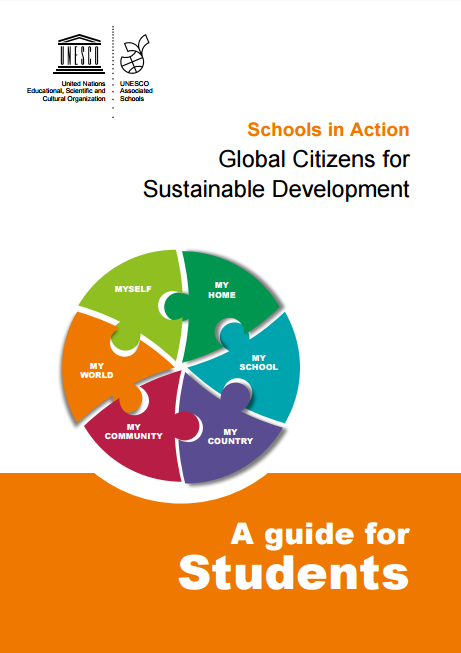 Schools in action, global citizens for sustainable development: a guide for students Año de publicación: 2016 Autor corporativo: UNESCO The UNESCO Associated Schools Project Network (ASPnet) in Action: Global Citizens for Sustainable Development student guide aims to introduce secondary school students to Global Citizenship Education (GCED) and Education for Sustainable Development (ESD) and provide them with ideas and activities to contribute proactively to a more peaceful and sustainable world. The guide draws on the discussions and activities of almost 1,100 participants from 104 countries, including ASPnet National Coordinators, school principals, teachers, students and experts who contributed to the ASPnet Online Collaborative Platform: Global Citizens Connected for Sustainable Development in 2014 and 2015 [http://en.unesco.org/aspnet/globalcitizens]. You will find in this student guide: An overview of what it means to be a global citizen and of how you can contribute to sustainable development. Ideas for getting active yourself, as part of your home, school, community, country and globally. Selected activities on GCED and ESD from ASPnet schools around the world.
 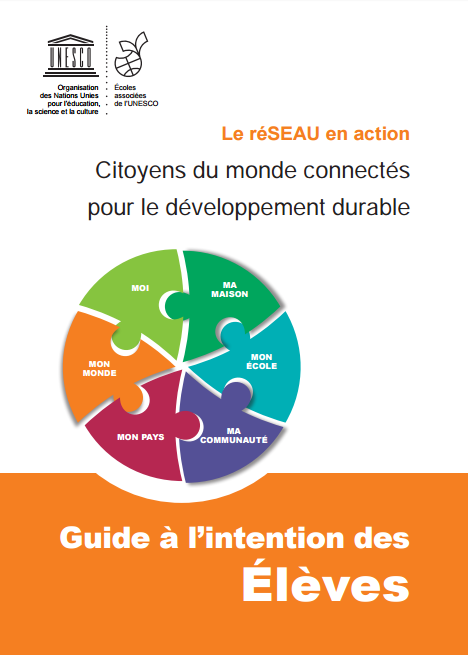 Le réSEAU en action: citoyens du monde connectés pour le développement durable: guide à l'intention des élèves Año de publicación: 2017 Autor corporativo: UNESCO Le guide « Le réSEAU en action : Citoyens du monde connectés pour le développement durable » à l’intention des élèves a pour but d’initier les élèves du secondaire à l’éducation à la citoyenneté mondiale (ECM) et à l’éducation en vue du développement durable (EDD), et de leur proposer des idées et des activités pour qu’ils contribuent activement à la construction d’un monde plus pacifique et durable. Le guide s’appuie sur les discussions et les activités de près de 1 100 participants originaires de 104 pays, notamment des coordinnateurs nationaux du réSEAU, des chefs d’établissement, des enseignants, des élèves et des experts qui ont contribué à la plateforme collaborative en ligne « Le réSEAU en action : Citoyens du monde connectés pour le développement durable » en 2014 et 2015 [http://fr.unesco.org/aspnet/globalcitizens/]. Le guide à l’intention des élèves : donne une idée de ce que signifie « être un citoyen du monde » ainsi que des suggestions pour contribuer au développement durable ; propose des idées pour agir vous-mêmes dans votre foyer, dans votre école, dans votre communauté, dans votre pays et dans le monde ; présente une sélection d’activités sur l’ECM et l’EDD mises en œuvre par des écoles du réSEAU du monde entier.
 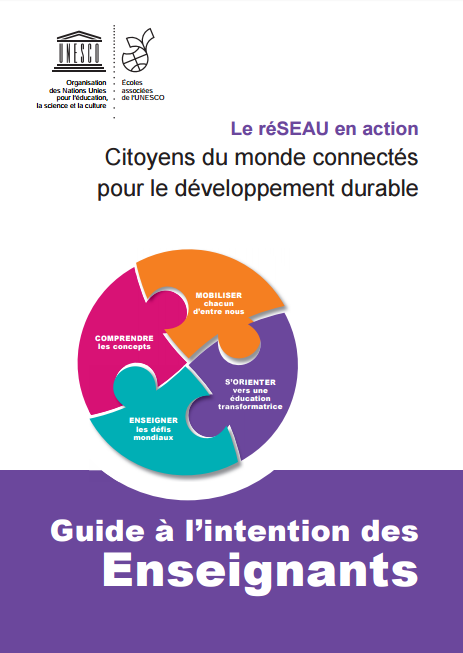 Le réSEAU en action: Citoyens du monde connectés pour le développement durable: guide à l'intention des enseignants Año de publicación: 2017 Autor corporativo: UNESCO Le guide à l’intention des enseignants : donne aux élèves une idée de ce que signifie pour eux « devenir des citoyens du monde » ainsi que des suggestions pour contribuer au développement durable ; propose des idées d’activités en classe pour aider les élèves du secondaire à développer des connaissances, des compétences, des valeurs, des attitudes et des comportements en faveur de l’ECM et de l’EDD ; présente une sélection d’activités sur l’ECM et l’EDD mises en œuvre par les écoles du réSEAU du monde entier.
 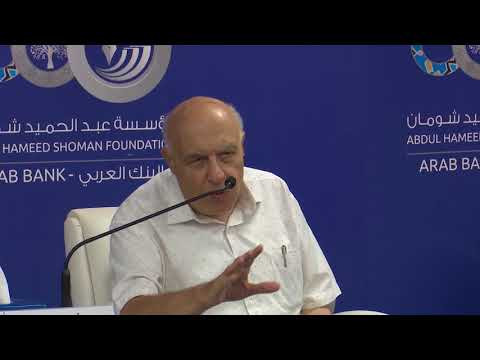 Globalization and Its Impact on the Concept of Identity Año de publicación: 2017 Autor: Hisham Ghassib Autor corporativo: Abdul Hameed Shoman Foundation The Abdul Hameed Shoman Cultural Foundation Forum, on 7/8/2017, hosted the Jordanian thinker, Dr. Hisham Ghosseb in a lecture entitled "Globalization and its Impact on the Concept of Identity", presented by Dr. Maher Al-Sarraf.This video is a lecture in which the lecturer talks about globalization and its impact. The lecturer discusses the concept of globalization, its ideologies, and the extent of its impact on identity.
  A Pedagogical Guide on Global Citizenship Education in Korean Context Año de publicación: 2015 Autor corporativo: APCEIU APCEIU has published a pedagogical guide on Global Citizenship Education (GCED) for Korean readers, which is the Korean adaptation of the UNESCO pedagogical guide, GCED: Topics and Learning Objectives (a.k.a. TLOs).Following the recently launched Korean translation of the TLOs, this Korean adaptation contextualizes the TLOs in Korean education, aligns its terminologies with Korean curriculum, and provides further explanations for Korean readers. This guide was developed by professors in the field of teacher education, primary and secondary school teachers, and curriculum developers with special expertise in GCED/EIU.It is hoped that this guide will help Korean educators and key stakeholders better understand GCED as a new pedagogy and also reflect on traditional teaching-learning experiences in various respects.
  Education for international understanding: a river flowing from the mountains (SangSaeng vol5. autumn 2002) Año de publicación: 2002 Autor: Swee-Hin Toh Autor corporativo: APCEIU EIU (Education for International Understanding) is a concept that has diverse sources and tributaries, much like a river that begins in the mountains and flows to the sea or ocean, enriched by innumerable ideas, perspectives and practices along its journey. However, unlike a river in one community or nation, this is a river that flows across the world encompassing the breadth and depth of civilizations, peoples and mother Earth. Although by designation EIU appears to have a “modern genealogy,” it is vital to recognize and to search for its roots in the ancient wisdoms of all civilizations, especially through the values and principles of well-being, dignity and good or virtuous relationships between and among all peoples, communities and societies. EIU has been catalyzed and developed by multiple individuals, organizations, agencies and movements, including educators, researchers, national/multilateral organizations (e.g. UN agencies), NGOs, people’s organizations (POs) and other civil society movements and advocates. EIU is simultaneously practiced in all modes of education (formal, non-formal and informal), but a challenge is to attain synergy across all the modes for optimal outcomes and sustainability.
 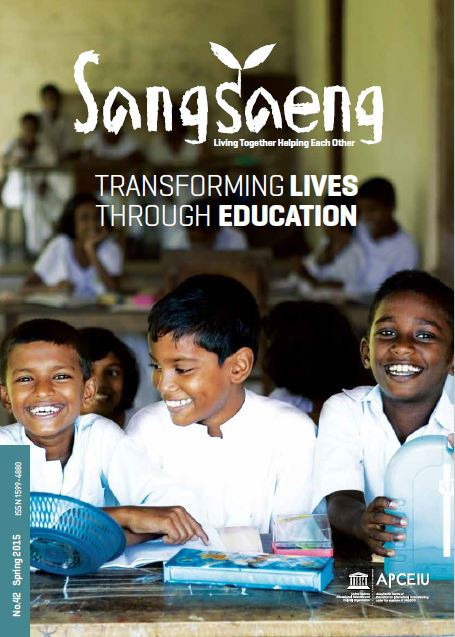 Transforming lives through education (SangSaeng no. 42 spring 2015) Año de publicación: 2015 Autor corporativo: APCEIU The 42nd issue of SangSaeng, ‘Transforming Lives Through Education’, has been published. This spring edition has been released prior to the World Education Forum 2015 to provide the context for the post-2015 education agenda. It contains compelling articles that underline the importance of Global Citizenship Education in building a more sustainable and peaceful society. 3 Director’s Message4 Special Column Every Child Deserves a Child-Friendly World8 Focus: Transforming Lives Through Education 8 Emergence of Global Citizenship Education in the Post-2015 Education Agenda13 Re-Visioning Education Beyond 201518 Global Citizenship Education for the 21st Century23 Young People Are Ready to Lead: The Education We Want26 Interview Education Beyond 201531 Special ReportGlobal UNESCO Clearinghouse on Global Citizenship Education Hosted by APCEIU34 Best Practices34 Citizenship Education in a Community Setting38 Pangaea42 Letter Unity in Diversity44 Peace in My MemoryPresenting a Message of Peace Through Music47 Understanding the Asia-Pacific Region Timeless Festivity of the Ancient World: Hidirellez50 APCEIU in Action
  Global citizenship education: goals and challenges in the new millennium Año de publicación: 2013 Autor: Soonyong Pak Autor corporativo: APCEIU The research report examines what issues are at stake in delivering global citizenship education, a new emerging education initiative. Revisiting the conceptual and operational framework of global citizenship education, readers can have a broad picture on the current status of global citizenship education and a way forward towards effective implementation of it.