
Recursos
Exploren una amplia gama de recursos valiosos en GCED para profundizar su comprensión y promover su búsqueda, incidencia, enseñanza y aprendizaje.
57 resultados encontrados
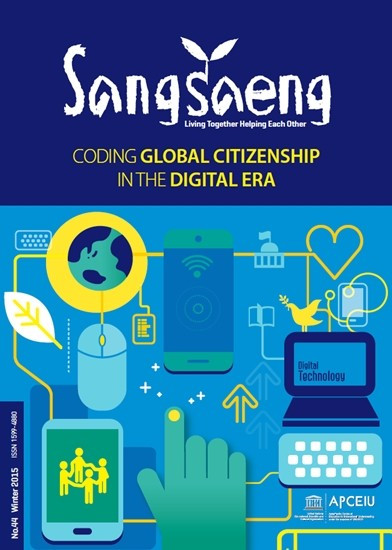 Coding global citizenship in the digital era (SangSaeng no. 44 winter 2015) Año de publicación: 2015 Autor corporativo: APCEIU Summary:The 44th issue of SangSaeng, “Coding Global Citizenship in the Digital Era,” has been released. The advancement of digital technology has connected the world, accelerating globalization. In this global digital age, Global Citizenship Education (GCED) is drawing enormous attention. Recognizing its significance, this Winter edition brings out the topic of GCED for digital citizens through the lens of education policymakers, children and youth, and corporations. In particular, the articles suggest actively participating in and contributing to the information society through ethical, safe, and responsible use of digital technology as the core competency for global citizens in the digital era.8 Striking a Balance Between Digital Opportunities & Related Risks12 Young People as Active Citizens in the Digital Age16 Empowering Children to Become Creative Digital Leaders20 Fostering Inclusive Innovation for a Better World38 Interview38 Understanding Culture through Media and Language40 Embracing Diversity to Live Together42 Peace in My MemoryTo achieve Peace, Must Understand Peace46 Understanding the Asia-Pacific RegionGlimpse into Ancient Healing Ritual of Ulik Mayang50 APCEIU in Action
 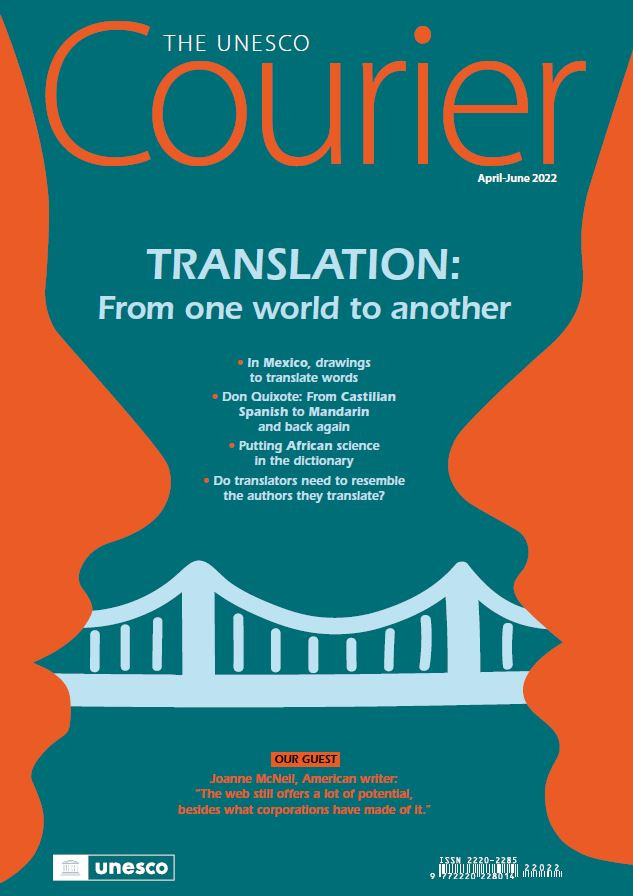 Translation: From One World to Another (The UNESCO Courier No. 2; April-June 2022) Año de publicación: 2022 Autor corporativo: UNESCO To translate is “to say almost the same thing”, in the words of the Italian writer Umberto Eco. A whole world is contained in this “almost”. To translate is to confront the other, the different, the unknown. It is often the essential prerequisite for those who want to access a universal, multiple, diverse culture. It is therefore no coincidence that the League of Nations took up the issue in the 1930s, envisaging the creation of an Index Translationum.Taken over by UNESCO in 1948, this Index allowed the first census of translated works in the world. Two years later, the Representative Works programme was launched to translate masterpieces of world literature. UNESCO’s support for the publication last year of a lexicon of words from indigenous languages of Mexico that are untranslatable into Spanish is a continuation of these efforts.Although their disappearance was predicted as early as the 1950s, translators – who are most often women – have never been as numerous as they are today. The machines developed in the aftermath of the war have not been able to outdo this behind-the-scenes profession. Nor have digital translation tools, which have become the standard feature of our globalized conversations, even if they have contributed to transforming the job.This is because language is more than just a means of communication. It is that, and much more. It is what written or oral works make of it, contributing to forge what is sometimes called the ‘genius of the language’, which the most powerful applications cannot restore.
  Global Citizenship Concepts in the Curricula of Four Countries Año de publicación: 2017 Autor: Natalie Browes Autor corporativo: UNESCO International Bureau of Education (IBE) | APCEIU This report details the presence of Global Citizenship Education (GCED) concepts in the education systems of four countries: Cambodia, Colombia, Mongolia and Uganda. It highlights the main findings of eight reports: four expert reports, which predominately analyse curriculum content, and four situational analysis reports, which take a broader view and detail some of the country-specific challenges and opportunities with regard to GCED. Findings reveal the presence of GCED concepts across the curricula of the four countries. In addition to cognitive content related to GCED, competency-based content is also found present within the curricula of these countries. However, the majority of this content can only be indirectly linked to GCED, and it is better interpreted as part of the more traditional civics or citizenship education approach. As such, it generally lacks a global perspective and does not engage with all key themes of GCED. Furthermore, this content is often concentrated at the lower and upper secondary levels, instead of being equally distributed across all grade levels. This is particularly true in the case of behaviour-based competencies. Findings also reveal challenges beyond the curriculum. These include lack of teacher training and lack of support to implement GCED, which are concerns expressed by stakeholders in all four countries. A lack of GCED content in textbooks and lack of supplementary materials were also found to be issues. The report concludes with recommendations regarding the effective implementation of GCED within curricula. Among others, the report suggests the transversal integration of GCED - across the curriculum at all grade levels, while at the same time, actors from all levels of the education system, ranging from central government to teachers, should be engaged to ensure the use of complementary learning materials, pedagogies and assessment techniques.
  Tenth Meeting of the High-level Group on Education for All (EFA), 22-24 March 2011, Jomtien, Thailand: Jomtien Statement Año de publicación: 2011 Autor corporativo: UNESCO This statement is the outcome of 10th meeting of the High-level Group on Education for All. The meeting was held from 22 to 24 March 2011 in Jomtien, Thailand to urge to progress towards the EFA goals.
 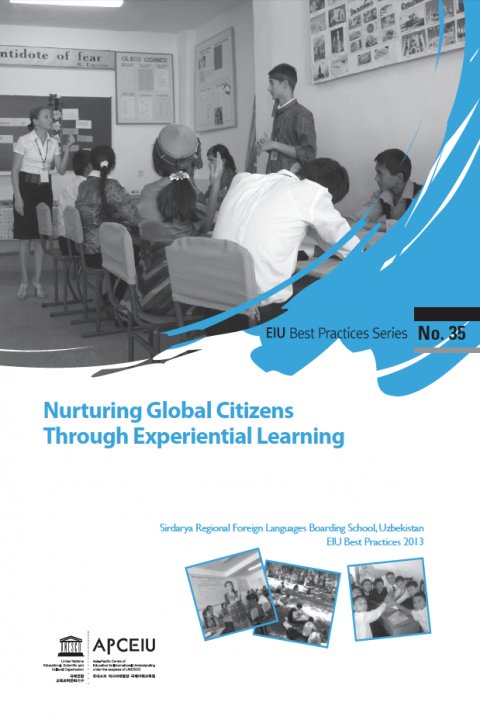 EIU Best Practice Series No. 35: Nurturing global citizens through experiential learning Año de publicación: 2013 Autor: Ildar Yusupov | Feruza Ahmedova Autor corporativo: APCEIU The following case is set in Uzbekistan where evidently diverse social groups live in harmony despite their differences. Among the schools in the country, the Sirdarya Regional Foreign Languages Boarding School in Gulistan City is arguably an exceptionally unique school due to the close engagement of parents with the boarding school’s EIU-themed activities. Activities range from extra-curricular activities including artwork and sports, to classroom-based activities such as role plays and international awareness events. Each activity is carefully designed to arouse the interest of the students in EIU-related themes such as tolerance, understanding and sustainable development. In the process, the students become highly motivated to take leading roles as responsible global citizens in creating a more peaceful world.
 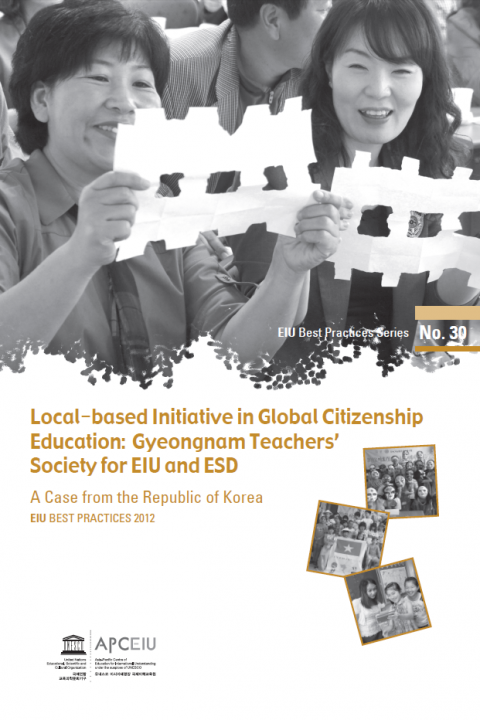 EIU Best Practice Series No.30: Local-based initiative in global citizenship education: Gyeongnam teachers’ society for EIU and ESD Año de publicación: 2012 Autor: Byeongseob Choi Autor corporativo: APCEIU Issue No. 30 introduces a case in the Republic of Korea on the local-based initiatives of school teachers to promote EIU and ESD in their local community. The case illustrates the taken steps and efforts made by the respective teachers when elaborating innovative approaches to promote EIU and ESD, led by the intention to create a more open and locally relevant educational setting for students as well as teachers in response to the growing globalization. Especially the Gyeongnam Province, where the teachers are based, is experiencing a rapid demographic change due to the high influx of foreigners, which calls upon the educators to prepare their students to effectively cope with these changes and become global citizens.
 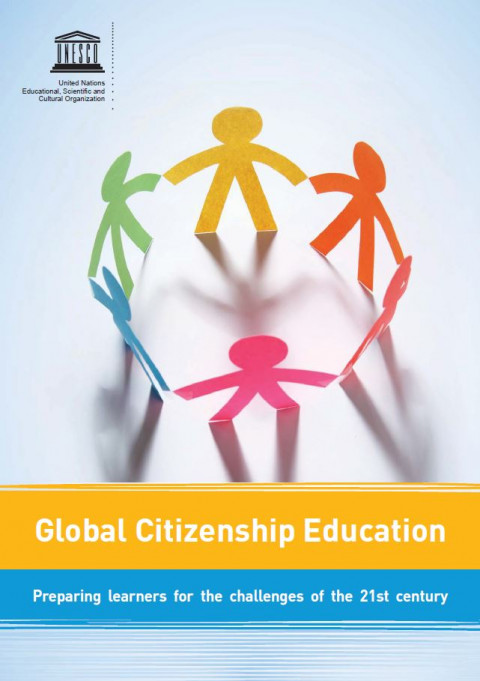 Global Citizenship Education: Preparing Learners for the Challenges of the 21st Century Año de publicación: 2014 Autor corporativo: UNESCO The United Nations Secretary-General’s Global Education First Initiative (GEFI) has established education as a means to ‘foster global citizenship’ – one of its three priority areas. To support this, UNESCO organized two landmark meetings on GCE in 2013. This publication aims to define the parameters of GCE by using the collective expertise, experience and wisdom of those participants who gathered at these landmark events, and to plan for future action in line with emerging thinking and other ongoing work. The review establishes that GCE has a critical role to play in equipping learners with competencies to deal with the dynamic and interdependent world of the twenty-first century. While GCE has been applied in different ways in different contexts, regions and communities, it has a number of common elements, which include fostering in learners. In formal settings, GCE can be delivered as an integral part of an existing subject (such as civic or citizenship education, social studies, environmental studies, geography or culture), or as an independent subject area. Integrated models appear to be more common. Some less traditional, but at least as effective, pathways for GCE have included the following: the use of information and communication technologies and social media, sport competitions and the use of art and music, and youth-led initiatives employing a wide variety of approaches. Both traditional and new horizons for GCE are profiled in this review. This publication also explores a number of enabling conditions for the promotion and implementation of GCE. These include: the existence of an open environment for universal values, the implementation of transformative pedagogy and support for youth-led initiatives.The review acknowledges that there are a number of ongoing tensions with the concepts of global citizenship and global citizenship education. While these tensions vary, they all point to the fundamental question of how to promote universality (e.g. common and collective identity, interest, participation, duty), while respecting singularity (e.g. individual rights, self-improvement). Some ways forward to resolve these tensions are suggested, whilst maintaining that challenges around theoretical elements of GCE should not undermine its practice. The processes documented in this publication have strengthened partnerships, built coalitions and contributed to improving the evidence base on the theory and practice of global citizenship education. While there are tasks that remain, this foundation bodes well for improving the enabling conditions and the practices highlighted in this review. By preparing learners to fulfil their potential in an increasingly globalized world, we are promoting transformed societies that are also better equipped to deal with the twenty-first century challenges and to seize twenty-first century opportunities.