
Recursos
Exploren una amplia gama de recursos valiosos en GCED para profundizar su comprensión y promover su búsqueda, incidencia, enseñanza y aprendizaje.
276 resultados encontrados
 Teaching the Shoah in History Classes in Israeli High Schools The Shoah is the only subject in the school curriculum that is anchored in the 1980 Compulsory State Educational Law, and is therefore an important integral part in the school history curriculum. Since the Shoah is part of the Israeli collective memory and has a substantial presence in its public discourse, it has been a didactic challenge for the composers of the curricula. This article examines the teaching of a curriculum set in 2000 to implement a new educational policy that emphasizes acquiring knowledge, disciplinary skills, and historical concepts rather than values and sentiments. It looks into teaching itself by studying official and unofficial textbooks, exams, and summaries in four subjects: central themes in former curricula (armed resistance, steadfastness, ghettos, and the participants), new themes in historical research (work, regional studies, the "other"), integration of Jewish and general history, and academic skills (processes, documents). (By the author) “What Happened to Their Pets?”: Third Graders Encounter the Holocaust Though widely believed to contain moral lessons of import for audiences of all ages, the Holocaust is often considered too complex, too appalling, too impenetrable, or too emotionally disturbing a subject to be taught to young children, even if taught only in its most “preparatory version,” to use Jerome Bruner’s famous phrasing. The subject matter, after all, deals at its core with human brutality, barbarous indifference, and industrialized mass murder. Nonetheless, a burgeoning market in materials designed to expose young children to the Holocaust implies that students are learning about the topic in earlier and earlier grades, a phenomenon that may be referred to as “curricular creep.” Such a trend raises the question of whether students should be exposed, purposefully and formally, to the horrors of the Holocaust, or, conversely, whether curricular creep should be somehow corralled. Although authors have weighed in on the ethics of Holocaust education, its history, practices, and materials, few have discussed its rightful place in the elementary school curriculum. Fewer still have empirically examined what the Holocaust looks like when taught to a young audience. (By the author) Una reflexión sobre la importancia de la enseñanza de la shoá en Argentina This paper intends to share some dilemmas encountered when drafting a bill for the incorporation of the Holocaust - Shoah in the content of school curricula in the province of Buenos Aires. (By the author)
 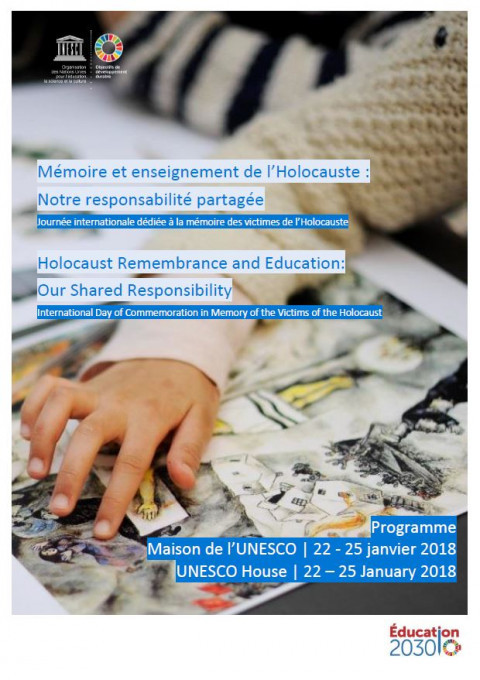 Holocaust Remembrance and Education: Our Shared Responsibility; International Day of Commemoration in Memory of the Victims of the Holocaust Año de publicación: 2018 Autor corporativo: 联合国教科文组织 (UNESCO) This brochure describes the occasion "International Day of Commemoration in Memory of the Victims of the Holocaust". For this occasion, from 22nd to 25th January, UNESCO, in partnership with the Shoah Memorial, has organised a series of events: a screening of Claude Lanzmann’s Four Sisters, a round table, an official ceremony, and exhibitions.
 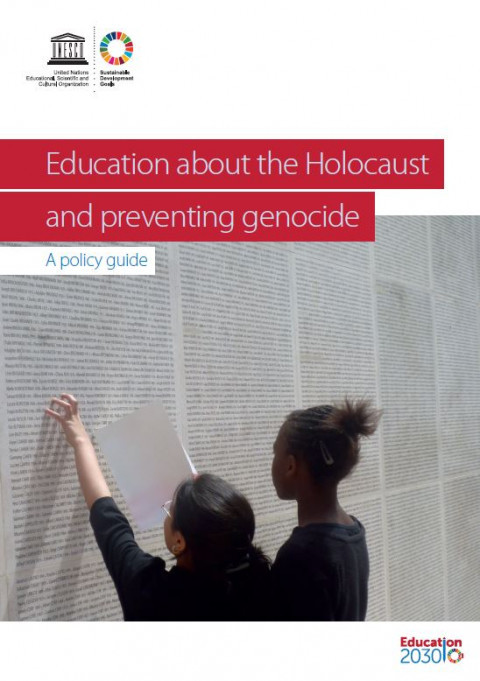 Education about the Holocaust and Preventing Genocide: A Policy Guide Año de publicación: 2017 Autor corporativo: UNESCO This Guide provides policy-makers with solutions to introduce education about the Holocaust, and possibly broader education about genocide and mass atrocities, into education systems and curricula. It is the first of its kind, focusing on matters that are relevant to policy, rather than on teaching practices alone.The publication addresses a wide range of essential questions, including: Why teach about the Holocaust? What learning outcomes can be expected from such educational endeavours? How do they relate to global education priorities? How to introduce the subject in the curriculum, train teachers, promote the most relevant pedagogies, and work with the non-formal sector of education?Based on UNESCO’s Global Citizenship Education work, the Guide draws on years of research and experience in the fields of Holocaust and genocide education. Numerous academics, educators and other experts offered insights and suggestions throughout the process. Multiple Holocaust and genocide related organizations – including the United States Holocaust Memorial Museum – contributed to the content. This creation benefited from the time and expertise of many. This Guide raises challenging questions for education stakeholders. It also provides concrete solutions regarding how educators can deal with deeply troubling histories, to build a better future for all. Enseignement de l'Holocauste et prévention du genocide: guide à l'intention des décideurs politiques Año de publicación: 2017 Autor corporativo: UNESCO Le present document a pour objectif de guider les responsables politiques qui souhaitent organiser ou renforcer l’etude de l’Holocauste et, plus generalement, du genocide et des crimes de masse, dans le systeme educatif de leur pays. Il y est explique pourquoi et comment l’enseignement et l’apprentissage relatifs a l’Holocauste peuvent contribuer a la realisation des priorites strategiques mondiales par l’education, notamment en cultivant la citoyennete mondiale, en promouvant les droits de l’homme et en instaurant une culture de paix et de prevention du genocide.Le document est principalement axe sur l’enseignement de l’Holocauste, et s’appuie sur des decennies de recherches, d’allocations de ressources et de pratiques pedagogiques qui en demontrent l’efficacite. Il prodigue des conseils sur la maniere de fixer des objectifs d’apprentissage clairs, realistes et adaptes au contexte, afin de promouvoir un enseignement de qualite dans ce domaine. Educación sobre el Holocausto y la prevención del genocidio: Una guía para la formulación de políticas Año de publicación: 2017 Autor corporativo: UNESCO La presente guía proporciona a los responsables de la formulación de políticas diversas soluciones para la introducción de la educación sobre el Holocausto, y posiblemente una educación más amplia sobre el genocidio y las atrocidades masivas, en los sistemas educativos y los planes de estudios. Es la primera obra de este tipo, al hacer hincapié en asuntos que atañen a las políticas, más que en la mera enseñanza de las prácticas. En la publicación se aborda una amplia gama de cuestiones, entre las que figuran: ¿Por qué conviene impartir enseñanza sobre el Holocausto? ¿Qué resultados de aprendizaje cabe esperar de estas iniciativas educativas? ¿Cuál es su relación con las prioridades educativas a escala global? ¿Cómo introducir el tema en los planes de estudios, formar a los profesores, promover las pedagogías más pertinentes, y trabajar con el sector no formal de la educación? La enseñanza del Holocausto en América Latina - Los desafios para los educadores y legisladores Año de publicación: 2015 Autor corporativo: UNESCO The Holocaust has become a point of reference worldwide to raise awareness about violations of human rights and state violence. What is the importance of Holocaust education in regions of the world that have no direct relation to the history of the Jewish people and the crimes of Nazism, especially in Latin America? Is there a rise of relevant educational practices internationally as a result of the expansion of education about the Holocaust ? How can educators address a subject so complex and emotionally charged in changing multicultural societies ? This UNESCO publication brings together the contributions of important historians and educators around the world and frames current debates in the field, emphasizing the issues that educators in Latin America are facing and revealing the reasons why it is vital to continue teaching Holocaust history in the world today, regardless of where we live. (By the publisher - Translation) La enseñanza del Holocausto en América Latina - Los desafios para los educadores y legisladores Año de publicación: 2015 Autor corporativo: Organisation des Nations Unies pour l'éducation, la science et la culture (UNESCO) L'Holocauste est devenu un point de référence dans le monde entier afin de sensibiliser sur les violations des droits de l'homme et de la violence de l'État. Quelle est l'importance de l'enseignement de l'Holocauste dans les régions du monde qui ont aucun rapport direct avec l'histoire du peuple juif et les crimes du nazisme, en particulier en Amérique latine? Y at-il une augmentation des pratiques éducatives pertinentes au niveau international en raison de l'expansion de l'éducation sur l'Holocauste? Comment les enseignants peuvent aborder un sujet si complexe et chargé d'émotion dans l'évolution des sociétés multiculturelles? Cette publication de l'UNESCO rassemble les contributions d'historiens et éducateurs du monde entier et les cadres débats actuels dans le domaine importants, en insistant sur les questions que les éducateurs en Amérique latine sont confrontés et révéler les raisons pour lesquelles il est essentiel de continuer à enseigner l'histoire de l'Holocauste dans le monde aujourd'hui , peu importe où nous vivons. (Par l'éditeur - traduction)
  The International status of education about the Holocaust : A global mapping of textbooks and curricula Año de publicación: 2015 Autor corporativo: UNESCO This publication by UNESCO and the Georg Eckert Institute documents ways in which the Holocaust is presented in secondary school level history and social studies curricula worldwide, and conceptualized and narrated in textbooks from twenty-six countries, with all continents represented. Historical understandings of the Holocaust are defined in terms of the spatial and temporal scales with which the event is portrayed, the protagonists involved, interpretative patterns (according to definitions, comprehensiveness, causes, relativization or banalization), narrative techniques and viewpoints, didactic methods, and national idiosyncrasies. The study is based on 272 currently valid curricula from 135 countries, and on 89 textbooks published in 26 countries since 2000. The aim of the study is primarily to document information in such a way that it reflects local understandings of the Holocaust, principally by recording concepts and narratives of the Holocaust found in educational media currently in use in schools. The findings show both convergence and divergence in the representations analysed. The Holocaust is subject to shared patterns of representation, which include selectivity, personalization, appropriation, screening and omission. It is also subject to narrative idiosyncrasies. One of the main trends worldwide is domestication, a process whereby countries place emphasis on the local significance of the event or appropriate them in the interests of local populations. Drawing on such national and international patterns of representation, the publication concludes by formulating recommendations for future curricula and textbook narratives about the Holocaust. These recommendations relate to such issues as the use of terms, the comprehensiveness of historical facts, the definition of causes, the combination of universal and local approaches, and the development of historical literacy. (By the publisher)