
Recursos
Exploren una amplia gama de recursos valiosos en GCED para profundizar su comprensión y promover su búsqueda, incidencia, enseñanza y aprendizaje.
232 resultados encontrados
 International Forum on AI and Education: Ensuring AI as a Common Good To Transform Education, 7–8 December 2021; Synthesis Report Año de publicación: 2022 Autor corporativo: UNESCO The ‘International Forum on AI and the Futures of Education: Ensuring AI as a Common Good to Transform Education’ was co-organized by UNESCO, the Ministry of Education of the People’s Republic of China, and the National Commission of the People’s Republic of China for UNESCO. Building on the previous ‘AI and the Futures of Education’ forums, held in 2019 and 2020, this 2021 forum set out to explore the importance and role of digital humanism in AI and education. With people and governments worldwide becoming increasingly aware of both the potential and the challenges of AI and education, the forum engaged participants in dialogue about how AI governance and innovation can be enhanced for the common good. Forum participants included government ministers and other high-level ministry officials from Member States, together with representatives of international organizations, NGOs and academic institutions.This synthesis report has been developed by drawing from the International Forum on AI and the Futures of Education held in Beijing and simultaneously online from 7 to 8 December 2021.
  World Programme for Human Rights Education, Fourth Phase: Plan of Action Año de publicación: 2022 Autor corporativo: Organización de las Naciones Unidas para la Educación, la Ciencia y la Cultura (UNESCO) | UN. Office of the Secretary-General’s Envoy on Youth | UN. Office of the United Nations High Commissioner for Human Rights (UN. OHCHR) Human rights education for youth, in both formal and non-formal settings, promotes a shared sense of humanity and fosters a common understanding that all human beings are equally deserving of dignity, respect and justice. It empowers youth to fulfil their role as active citizens, to take action and uphold their human rights and those of others, and to participate meaningfully in public affairs and democratic decision-making processes.In recognition of this, the United Nations Member States launched the fourth phase (2020–2024) of the World Programme for Human Rights Education to advance human rights education programming for youth at the national level. This focus also contributes to the achievement of the 2030 Agenda for Sustainable Development, particularly Goal 4 on Education and target 4.7, which touches upon the aims of education.
  Technical Note on the Implementation of the Convention on the Rights of Persons with Disabilities in Uzbekistan Año de publicación: 2023 Autor corporativo: World Bank This compilation of technical briefs lays out the key problems faced by persons with disabilities in Uzbekistan under all areas of life and formulates detailed recommendations, providing the evidence base for a Strategic Note that aims to guide Uzbekistan's next five-year National Action Plan (NAP) for implementing the United Nations Convention on the Rights of Persons with Disabilities (CRPD).
  Global Toolkit on AI and the Rule of Law for the Judiciary Año de publicación: 2023 Autor: Miriam Stankovich | Ivana Feldfeber | Yasmín Quiroga | Marianela Ciolfi Felice | Vukosi Marivate Autor corporativo: UNESCO What is Artificial Intelligence (AI)? How does it work? And more importantly, how does it find its way into the judicial context? Technologies such as AI have been around for decades, but only recently have they begun to be used in a variety of justice and law enforcement settings. While AI has immense potential for the justice system, helping judges make better decisions, improving efficiency, increasing access, and helping to detect and prevent crime, there are also some important issues that justice stakeholders should consider as they prepare for a future in which AI is increasingly used in justice systems.In 2022, UNESCO launched two needs assessments. First, through UNESCO’s Artificial Intelligence Needs Assessment Survey in Africa, 90% of the 32 countries surveyed requested capacity building support for the Judiciary on AI. At the same time, a second global survey of judicial actors in 100 countries underlined the need for better understanding the use of AI in the administration of justice and its wider legal implications on societies.The “Global Toolkit on AI and the Rule of Law” for the Judiciary responds to these needs and provides judicial actors (judges, prosecutors, state attorneys, public lawyers, law universities and judicial training institutions) with the knowledge and tools necessary to understand the benefits and risks of AI in their work. The toolkit will assist judicial actors in mitigating the potential human rights risks of AI by providing guidance on the relevant international human rights laws, principles, rules and emerging jurisprudence that underpin the ethical use of AI.
  The Effects of AI on the Working Lives of Women Año de publicación: 2022 Autor: Clementine Collett | Gina Neff | Livia Gouvea Gomes Autor corporativo: UNESCO | Inter-American Development Bank | Organisation for Economic Co-operation and Development (OECD) The use of AI technologies will affect women’s opportunities for work, and their position, status and treatment in the workplace. Around the globe, women in the labour force earn less than men, spend more time undertaking unpaid child- and elder-care jobs, hold fewer senior positions, participate less in science, technology, engineering and mathematics (STEM) fields, and tend to hold more precarious jobs overall. In harnessing AI, governments, institutions and companies must narrow gender gaps rather than perpetuate or exacerbate them. This report, by the IDB, OECD and UNESCO, outlines current knowledge of the impact that AI systems have on women’s opportunities for work, and their position, treatment and status in the workforce. It does so by exploring how AI is used within and outside the workplace, and how it could be used in the future. It looks at the potential impact of new and emerging AI technologies on the skills that employers will require, on how women look for and are hired for jobs, and on how jobs are structured through automated monitoring and oversight. The report maps the opportunities and challenges that AI presents for the working lives of women and highlights the complexities that varying national and regional contexts present for understanding the impact of AI on the work of women. The report also notes that current research does not offer a complete or definite picture of how AI impacts the working lives of women and calls for further research and analysis in this area.
  Recommendation on Education for Peace and Human Rights, International Understanding, Cooperation, Fundamental Freedoms, Global Citizenship and Sustainable Development Año de publicación: 2023 Autor corporativo: UNESCO Building more peaceful, just, and sustainable societies starts with education. It influences all aspects of our daily lives and our overall prospects while being impacted by our health and environment. In the global landscape of worsening climate change, democratic backsliding, persistent inequalities, rising discrimination, hate speech, violence and conflict, it can be a tool to address and prevent these problems in the future. And it can also be a long-term investment with increasing returns if shaped and deployed effectively. The new UNESCO Recommendation on Education for Peace and Human Rights, International Understanding, Cooperation, Fundamental Freedoms, Global Citizenship and Sustainable Development, which is commonly referred to as the Recommendation on Education for Peace, Human Rights and Sustainable Development is a landmark guidance document that defines what needs to evolve in and through education to accomplish these goals.
 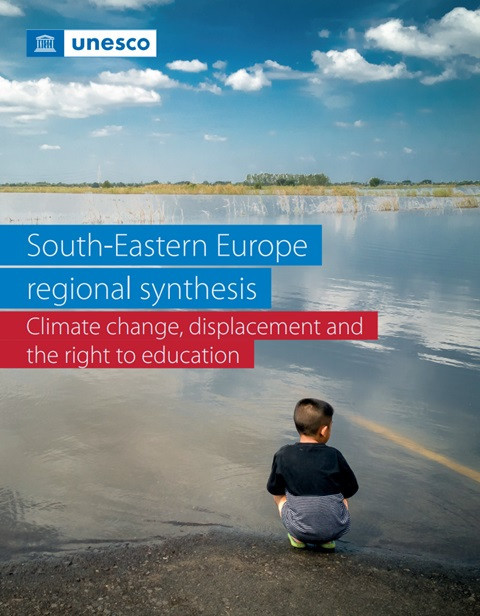 South-Eastern Europe regional synthesis: climate change, displacement and the right to education Año de publicación: 2023 Autor corporativo: UNESCO In 2021 alone, 23.7 million people were displaced in 137 countries and territories due to natural disasters, which the scientific community has recognized have become more frequent and intense due to climate change. Climate change and displacement is currently taking place in Europe, with particularly disastrous consequences in South-Eastern Europe due to regional specificities. Comparative country case studies were carried out in Bosnia and Herzegovina, the Republic of Moldova, and Serbia, as they exemplify clear, present patterns of climate displacement, to examine the impacts of climate change on the right to education in the region. The case studies show that climate change directly threatens education through the destruction of schools and property. It also indirectly puts learning in peril by leading people across borders where their legal residency nor right to education is ensured. This publication aims to guide policy-makers by providing recommendations on how to ensure the protection of the right to education in South-Eastern Europe in the face of climate change and displacement. It is one of four regional reports that will lead to the development of a global report providing global policy guidance.
 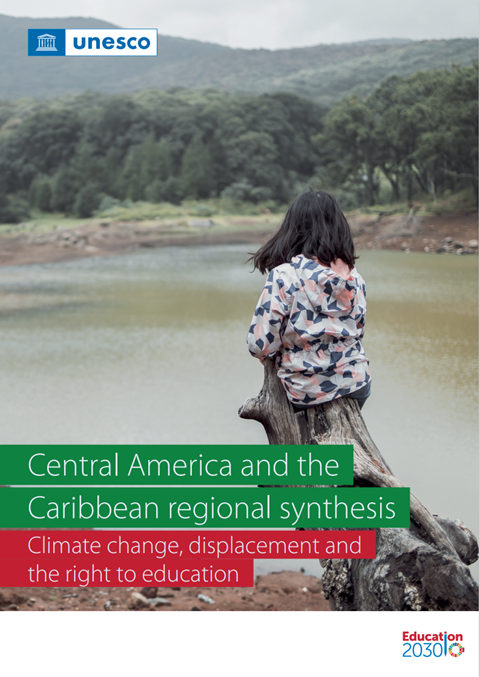 Central America and the Caribbean regional synthesis: climate change, displacement and the right to education Año de publicación: 2023 Autor corporativo: UNESCO From rising sea level to drought and increasingly frequent natural disasters - the effects of climate change are well-known today. However, its effect on human mobility is just coming to the forefront of the political discussion. In 2020 alone, 30.7 million people globally were displaced by natural disasters. Central America and the Caribbean region is prone to the effects of climate change and displacement due to its socioeconomic characteristics and geographic location. Country case studies were carried out in the Bahamas, Cuba, the Dominican Republic, Guatemala, and Jamaica to examine the impacts on the right to education in the region. The research shows that climate change directly threatens education through the destruction of schools and property. It also leads people across borders where their legal residency and right to education are not guaranteed. This report aims to guide policy-makers on how to ensure education is protected in the face of climate change and displacement. The report is one of four being developed and will contribute to UNESCO’s global initiative on climate change, displacement and the right to education. It will inform the development of a Global Report with policy recommendations.
 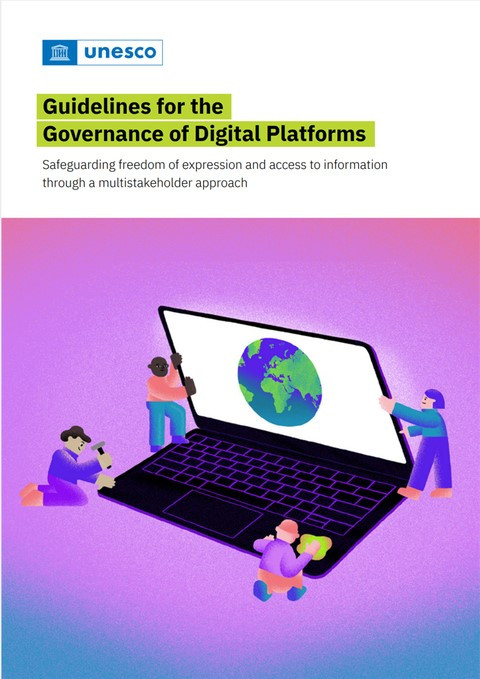 Guidelines for the governance of digital platforms: safeguarding freedom of expression and access to information through a multi-stakeholder approach Año de publicación: 2023 Autor corporativo: UNESCO Guidelines for an Internet for TrustSafeguarding freedom of expression and the right to information while dealing with dis- and misinformation, hate speech, and conspiracy theories requires a multistakeholder approach. This is the reason why UNESCO, the leading UN agency for the promotion and protection of freedom of expression and to information, is launching Guidelines for the Governance of Digital Platforms. The Guidelines outline a set of duties, responsibilities and roles for States, digital platforms, intergovernmental organizations, civil society, media, academia, the technical community and other stakeholders to enable the environment where freedom of expression and information are in the core of digital platforms governance processes. The Guidelines were produced through a multi-stakeholder consultation that gathered more than 10,000 comments from 134 countries. These global-scale consultations fostered inclusive participation, ensuring a diversity of voices to be heard, including those from groups in situation of marginalization and vulnerability. Cultivating an Internet of Trust is a shared responsibility among all stakeholders. It calls upon us all to sustain an enabling environment for freedom of expression and the right to information.
  3rd Global Forum Against Racism and Discrimination: Final Document Año de publicación: 2024 Autor corporativo: UNESCO The third edition of the Global Forum against Racism and Discrimination with the theme “Race to the top: putting racial equity and justice at the forefront of development agendas” was held in São Paulo, Brazil, on 29 November 2023 and 1 December 2023. At the invitation of Brazil, in partnership with the Ford Foundation, the Open Society Foundations, the Mover Foundation, Instituto Ibirapitanga, the Global Forum highlighted the importance of placing racial issues at the core of development and implementation strategies, with a view to socioeconomic development. The Global Forum welcomed Ministers, high-ranking officials of national bodies responsible for combating discrimination and promoting equality, mayors of the International Coalition of Inclusive and Sustainable Cities - ICCAR, academics, scientists, civil society actors, NGOs, artists and digital influencers to share good practices, strengthen commitments and discuss effective strategies to combat racism and various forms of discriminations, including recommendations on how to proceed. The Global Forum’s agenda covered several topics, such as co-creating inclusive policies with impacted communities’ inputs; increasing awareness-raising on historical systems such as transatlantic enslavement to better comprehend and dismantle their contemporary legacies such as racism; progress towards gender equality; enhancing the capacities of civil society to be an agent of change; addressing artificial intelligence and its role in perpetuating racism; protecting the rights of indigenous peoples; establishing legal and policy frameworks prioritizing anti-racism and anti-discrimination on a local and global scale; strengthening the roles of cities, civic spaces, artistic and academic communities; enhancing the importance of informed data baseline on equality for governments; and promoting social philanthropy to address racial inequality. The 2023 edition was also marked by the launch of new initiatives. One of the main outcomes of the Global Forum is the establishment of the UNESCO Network of Anti-Racism and Anti-Discrimination Officials aiming to strengthen the development of innovative and inclusive policy solutions for peace, equity and non-discrimination. UNESCO has launched the new UNESCO Anti-Racism Toolkit, the Gender-Based Resilience Framework, the ‘Let’s Talk‘ project with Harvard University to combat prejudice against migrants, and the development of a new joint OECD-UNESCO briefing on combating discrimination against migrants. Volume X of the UNESCO General History of Africa, entitled Africa and its Diasporas, was also launched during the Global Forum. The publication offers a mapping of African diasporas throughout the world, valorizing their contributions to modern societies.