
Recursos
Exploren una amplia gama de recursos valiosos en GCED para profundizar su comprensión y promover su búsqueda, incidencia, enseñanza y aprendizaje.
49 resultados encontrados
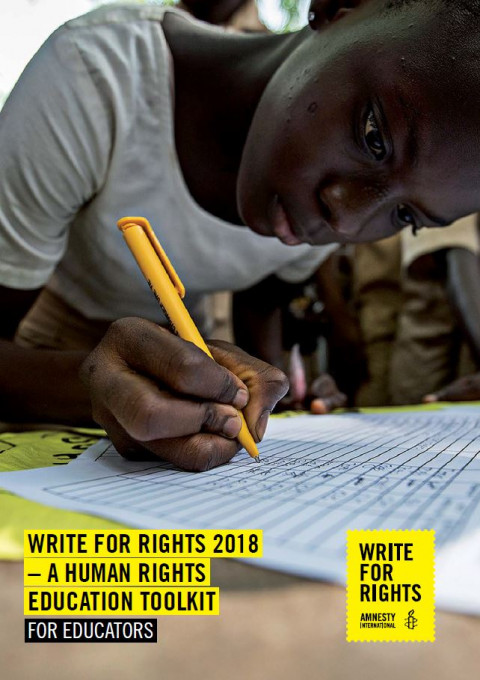 Write for Rights 2018: A Human Rights Education Toolkit for Educators Año de publicación: 2018 Autor corporativo: Amnesty International The annual Write for Rights (W4R) campaign is one of Amnesty International’s biggest human rights events. In 2018 the campaign focuses on women human rights defenders who have suffered human rights violations or are at great risk because of the positions they have taken on certain human rights issues.This Human Rights Education toolkit was created to support teachers’ participation with their students in the W4R campaign. It provides a broad perspective on human rights issues and offers the opportunity to open young people’s minds to global concerns. By learning about and writing persuasive letters to help end human rights violations and achieve justice, teachers and students contribute to the international human rights movement and see for themselves how words can make a difference in the world.This toolkit was created for students aged 13 and above and is primarily designed for use in a school setting: both inside the classroom as well as in clubs or school-wide events. Activities can also be adapted for use in other, non-formal education contexts such as youth groups and community settings. The toolkit contains general activities on human rights and highlights six women human rights defenders from the W4R campaign who have made extraordinary contributions to the advancement of human rights around the world.
  Guidelines on Human Rights Education for Secondary School Systems Año de publicación: 2012 Autor corporativo: OSCE. Office for Democratic Institutions and Human Rights (ODIHR) These guidelines, which focus on human rights education in secondary schools, aim to support systemic and effective human rights learning for all young people. They were prepared on the basis of broad consultations involving teachers, teachers’ unions, teacher trainers, educational administrators, NGO specialists, and representatives from intergovernmental agencies and national human rights institutions.The current document presents approaches to be adopted when planning or implementing human rights education for secondary schools related to six key structural areas: the human rights-based approach to human rights education; core competencies; curricula; teaching and learning processes; evaluation; and professional development and support of educational personnel. The guidelines also offer a list of key materials to assist in planning, implementing and evaluating human rights education in schools.
  Programa Mundial para Educação em Direitos Humanos: terceira fase, plano de ação Año de publicación: 2015 Autor corporativo: UNESCO Brasilia | UN. Office of the United Nations High Commissioner for Human Rights (UN. OHCHR) De acordo com a Resolução 24/15 do Conselho de Direitos Humanos, o Escritório do Alto Comissariado das Nações Unidas para os Direitos Humanos (ACNUDH) elaborou, no primeiro trimestre de 2014, um esboço de plano de ação para a terceira fase (2015-2019) do Programa Mundial para Educação em Direitos Humanos (PMEDH) tomando como base, entre outros, importantes instrumentos e documentos das Nações Unidas, os planos de ação da primeira (2005- 2009) e da segunda (2010-2014) fases do PMEDH e outros materiais publicados pelo ACNUDH e pelas Nações Unidas. Em abril e maio, o esboço de plano de ação foi submetido à análise dos Estados, organizações intergovernamentais relevantes, incluindo a Organização das Nações Unidas para a Educação, a Ciência e a Cultura (UNESCO), instituições nacionais de direitos humanos e sociedade civil. Em 4 de julho, o ACNUDH recebeu 30 respostas com os comentários, os quais foram levados em consideração no texto final e que constituem as Seções de II a V do presente relatório.
  Guide on Human Rights Education Curriculum Development Año de publicación: 2021 Autor: Cecilia Decara | Carol Rask | Felisa Tibbitts Autor corporativo: Danish Institute for Human Rights This document aims to bring conceptual clarity on human rights education and curriculum development and provide concrete suggestions on how to build human rights curricula ft for 21st century human rights challenges, while contributing to the realisation of the SDG goals and targets set by the international community.
  Citizenship, Identity, and Education: Examining the Public Purposes of Schools in an Age of Globalization Año de publicación: 2006 Autor: Fernando Reimers Autor corporativo: UNESCO International Bureau of Education (IBE) One of the purposes of educational institutions is to develop citizenship. In the 21st century, citizenship includes global citizenship. Addressing the challenges of globalization will require making citizenship education and the development of global values an explicit objective of efforts to improve quality throughout the world, critically examining theories and evidence about the effectiveness of various approaches to developing citizenship and global citizenship and supporting activities aligned with this public purpose. In this article, the author does not argue for an exclusive effort to focus schools on civic education, but rather for a balanced effort to elevate educational quality making it more relevant to address global challenges and opportunities, of which civic education and global education are components, much neglected at present. The author also does not suggest making civic education the only purpose of the curriculum or making it a priority to the expense of science, math, arts or physical and health education, but he thinks that helping students develop a sense of purpose, situated within broader civic and global purposes, would also facilitate high level engagement with science, mathematical and artistic pursuits.
 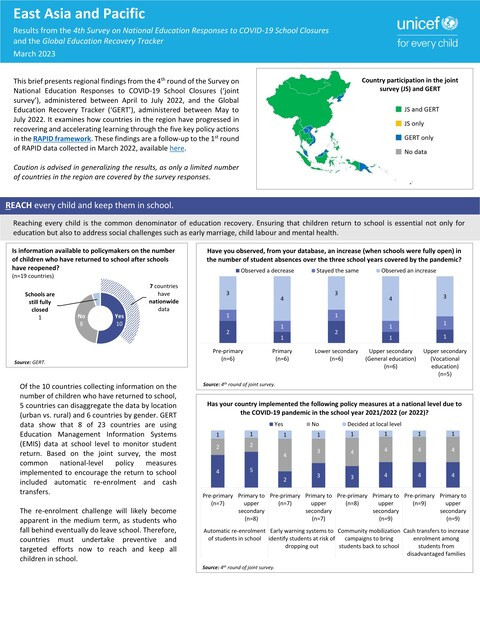 Education in a Post-COVID World: Towards a Rapid Transformation; East Asia and Pacific Regional Brief Año de publicación: 2023 Autor corporativo: United Nations Children's Fund (UNICEF) On March 11, 2020, the World Health Organization declared COVID-19 a global pandemic, resulting in disruptions to education at an unprecedented scale. In response to the urgent need to recover learning losses, countries worldwide have taken RAPID actions to: Reach every child and keep them in school; Assess learning levels regularly; Prioritize teaching the fundamentals; Increase the efficiency of instruction; and Develop psychosocial health and wellbeing. This brief presents regional findings from the 4th round of the Survey on National Education Responses to COVID-19 School Closures (‘joint survey’), administered between April to July 2022, and the Global Education Recovery Tracker (‘GERT’), administered between May to July 2022. It examines how countries in the region have progressed in recovering and accelerating learning through the five key policy actions in the RAPID framework. These findings are a follow-up to the 1st round of RAPID data collected in March 2022.
 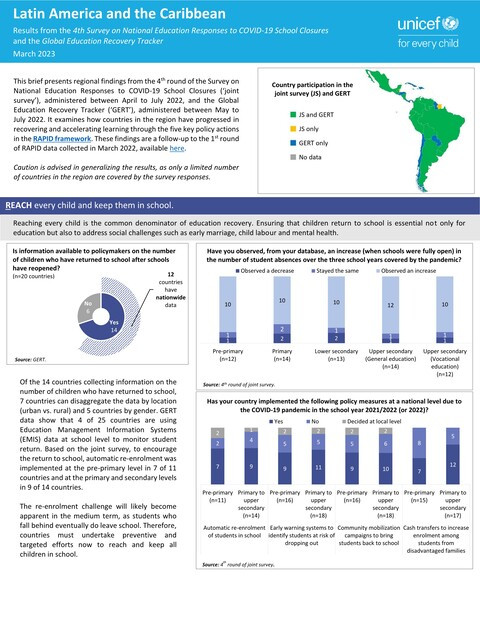 Education in a Post-COVID World: Towards a Rapid Transformation; Latin America and the Caribbean Regional Brief Año de publicación: 2023 Autor corporativo: United Nations Children's Fund (UNICEF) On March 11, 2020, the World Health Organization declared COVID-19 a global pandemic, resulting in disruptions to education at an unprecedented scale. In response to the urgent need to recover learning losses, countries worldwide have taken RAPID actions to: Reach every child and keep them in school; Assess learning levels regularly; Prioritize teaching the fundamentals; Increase the efficiency of instruction; and Develop psychosocial health and wellbeing. This brief presents regional findings from the 4th round of the Survey on National Education Responses to COVID-19 School Closures (‘joint survey’), administered between April to July 2022, and the Global Education Recovery Tracker (‘GERT’), administered between May to July 2022. It examines how countries in the region have progressed in recovering and accelerating learning through the five key policy actions in the RAPID framework. These findings are a follow-up to the 1st round of RAPID data collected in March 2022.
 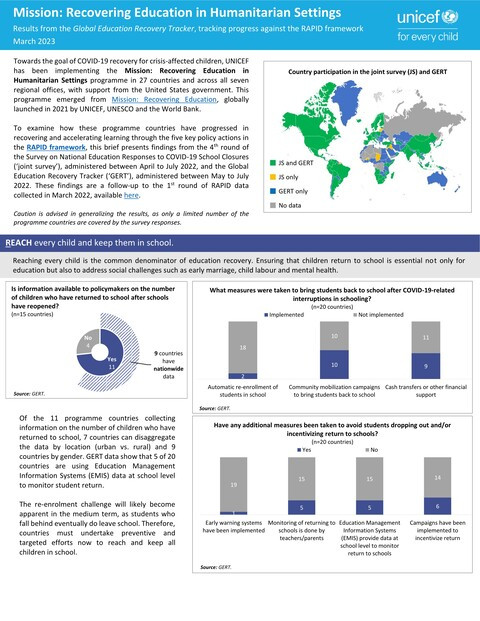 Education in a Post-COVID World: Towards a Rapid Transformation; Mission Recovering Education in Humanitarian Settings Brief Año de publicación: 2023 Autor corporativo: United Nations Children's Fund (UNICEF) Towards the goal of COVID-19 recovery for crisis-affected children, UNICEF has been implementing the Mission: Recovering Education in Humanitarian Settings programme in 27 countries and across all seven regional offices, with support from the United States government. This programme emerged from Mission: Recovering Education, globally launched in 2021 by UNICEF, UNESCO and the World Bank. To examine how these programme countries have progressed in recovering and accelerating learning through the five key policy actions in the RAPID framework, this brief presents findings from the 4th round of the Survey on National Education Responses to COVID-19 School Closures (‘joint survey’), administered between April to July 2022, and the Global Education Recovery Tracker (‘GERT’), administered between May to July 2022. These findings are a follow-up to the 1st round of RAPID data collected in March 2022.
 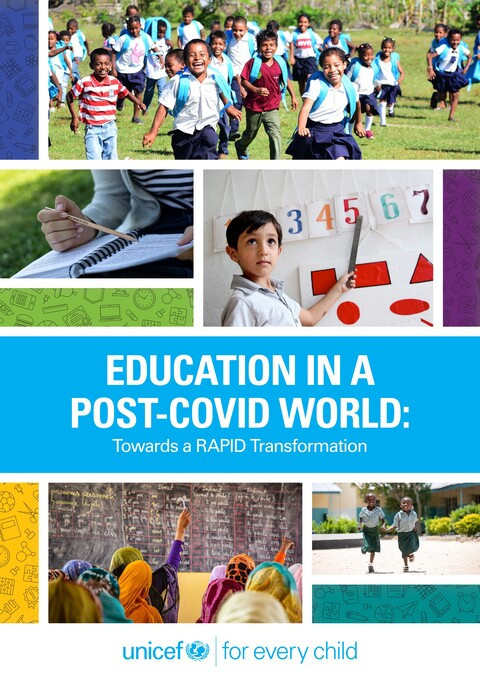 Education in a Post-COVID World: Towards a Rapid Transformation; Main Report Año de publicación: 2023 Autor corporativo: United Nations Children's Fund (UNICEF) On March 11, 2020, the World Health Organization declared COVID-19 a global pandemic, resulting in disruptions to education at an unprecedented scale. In response to the urgent need to recover learning losses, countries worldwide have taken RAPID actions to: Reach every child and keep them in school; Assess learning levels regularly; Prioritize teaching the fundamentals; Increase the efficiency of instruction; and Develop psychosocial health and wellbeing. Marking three years since the onset of the pandemic, this report looks back at policy measures taken during school closures and reopening based on country survey data, initiatives implemented by countries and regions to recover and accelerate learning, and their emerging lessons within each RAPID action. With schools now reopened worldwide, this report also looks ahead to longer-term education transformation, offering policy recommendations to build more resilient, effective and equitable education systems.
  Education in a Post-COVID World: Towards a Rapid Transformation; Advocacy Brief Año de publicación: 2023 Autor corporativo: United Nations Children's Fund (UNICEF) Around the world, a lack of support for foundational learning is depriving millions of children of their right to learn. But while this is a global challenge, it is not an impossible one. UNICEF and partners have developed an evidence-based solutions framework that clearly sets out what we know works to get children learning. This framework, known as RAPID, covers five key actions: Reach every child and keep them in school; Assess learning levels regularly; Prioritize teaching the fundamentals; Increase the efficiency of instruction, including through catch-up learning; and Develop psychosocial health and wellbeing. Using the latest results from the Global Education Recovery Tracker (GERT) (collected between May and July 2022), this brief sets out the global progress made under each RAPID action and highlights lessons learned from around the world. Finally, the brief points out areas for improvement so governments can take targeted action to reach every child.