
Recursos
Exploren una amplia gama de recursos valiosos en GCED para profundizar su comprensión y promover su búsqueda, incidencia, enseñanza y aprendizaje.
19 resultados encontrados
 Asia-Pacific guidelines for the development of national ESD indicators Año de publicación: 2007 Autor: Daniella Tilbury | Sonja Janousek | Derek Elias | Joel Bacha Autor corporativo: UNESCO Bangkok UNESCO Bangkok, with assistance from the Commission on Education and Communication (CEC) of the World Conservation Union (IUCN) in conjunction with Macquarie University in Australia, implemented a project to assist with the important task of monitoring and assessing progress during the UN Decade of Education for Sustainable Development (DESD). This process has been funded by the generous contribution of the Ministry of Education, Culture, Sports, Science and Technology under the Japanese Funds-In-Trust for Education for Sustainable Development (ESD). The DESD provides an important opportunity to enhance the profile of ESD in both formal and informal learning spaces which in turn assists UNESCO Member States with the transformation into sustainable societies. Efforts to promote and integrate ESD at all levels will be key to advancing the reach of the Decade.Responding to the DESD International Implementation Scheme’s (IIS) recommendation to develop indicators (see Appendix 1), the Asia-Pacific DESD Indicators Project commenced in March 2006. The first stage of the project has resulted in the publication of this Guidelines document which assists UNESCO Member States in the Asia-Pacific region with the development of ESD indicators and monitoring systems at the national level.The document is intended to provide an important practical resource for UNESCO National Commissions, in addition to other stakeholders, in the area of ESD indicator development. By outlining how to develop national ESD indicators, the Guidelines offers an effective way of building knowledge and increasing ownership of the Decade among stakeholders. Rather than deliver a pre-packaged set of ESD indicators, this document provides countries with a foundation for developing indicators that are relevant to their national contexts.The objectives of the Guidelines are:• To assist with understanding the nature of ESD indicators and the different approaches for their use;• To identify the different types of ESD indicators and what they may reveal about progress;• To identify important sources, methods and planning tools for both data collection and reporting;• To encourage UNESCO Member States in the Asia-Pacific region to work collaboratively, share experiences and learn about meaningful monitoring and assessment during and beyond the DESD; and• To build national capacity to develop ESD indicators and ESD data collection mechanisms at the national level Orientations Asie-Pacifique pour l'élaboration d'indicateurs nationaux Año de publicación: 2007 Autor: Daniella Tilbury | Sonja Janousek | Derek Elias | Joel Bacha Autor corporativo: UNESCO Bangkok L'UNESCO Bangkok, avec l'aide de la Commission de l'Éducation et de la Communication (CEC) de l'Union mondiale pour la nature (UICN) en collaboration avec l'Université Macquarie en Australie, a mis en œuvre un projet pour aider à la tâche importante de suivi et d'évaluation des progrès de la Décennie des Nations Unies. Éducation pour le développement durable (DEDD). Ce processus a été financé par la contribution généreuse du ministère de l'Éducation, de la Culture, des Sports, des Sciences et de la Technologie au Fonds fiduciaire japonais pour l'éducation pour le développement durable. Le DEDD offre une occasion importante de rehausser le profil de l'EDD dans les espaces d'apprentissage formels et informels, ce qui aide les États membres de l'UNESCO à se transformer en sociétés durables. Les efforts déployés pour promouvoir et intégrer l'EDD à tous les niveaux seront essentiels pour faire progresser la portée de la Décennie.Répondant à la recommandation du DEDD International Implementation Scheme (IIS) pour l'élaboration d'indicateurs (voir Annexe 1), le Projet d'Indicateurs DEDD de l'Asie-Pacifique a débuté en mars 2006. La première étape du projet a abouti à la publication du présent document qui aide l'UNESCO Les États membres de la région Asie-Pacifique, avec l'élaboration d'indicateurs et de systèmes de suivi au niveau national.Le document est destiné à fournir une ressource pratique importante aux Commissions nationales de l'UNESCO, en plus des autres parties prenantes, dans le domaine de l'élaboration d'indicateurs de développement durable. En définissant la manière d'élaborer des indicateurs nationaux de développement économique durable, les Lignes directrices offrent un moyen efficace de renforcer les connaissances et d'accroître l'appropriation de la Décennie par les parties prenantes. Plutôt que de fournir un ensemble pré-emballé d'indicateurs EDD, ce document fournit aux pays une base pour développer des indicateurs qui sont pertinents à leur contexte national.Les objectifs des lignes directrices sont les suivants:• Aider à comprendre la nature des indicateurs EDD et les différentes approches pour leur utilisation;• Identifier les différents types d'indicateurs EDD et ce qu'ils peuvent révéler sur les progrès;• Identifier les sources, les méthodes et les outils de planification importants pour la collecte et le compte rendu des données;• Encourager les États membres de l'UNESCO de la région Asie-Pacifique à travailler en collaboration, à échanger leurs expériences et à en apprendre davantage sur le suivi et l'évaluation significatifs pendant et après le DEDD; et• Renforcer la capacité nationale d'élaborer des indicateurs EDD et des mécanismes de collecte de données EDD au niveau national
 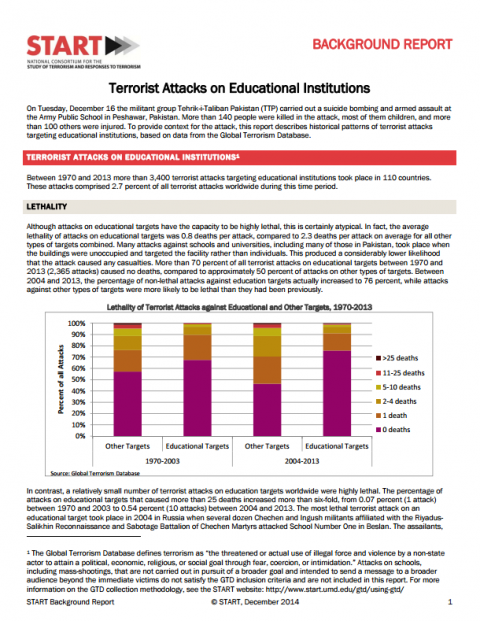 Terrorist Attacks on Educational Institutions Año de publicación: 2014 Autor: Erin Miller Autor corporativo: National Consortium for the Study of Terrorism and Responses to Terrorism (START) | Department of Homeland Security Science and Technology The report describes historical patterns of terrorist attacks targeting educations institutions dating back to 1970. Since that year, more than 3,400 terrorist attacks targeting educations institutions took place in 110 countries. These attacks comprised 2.7 percent of all terrorist attacks worldwide during this time period. Terrorist Attacks on Educational Institutions Año de publicación: 2014 Autor: Erin Miller Autor corporativo: National Consortium for the Study of Terrorism and Responses to Terrorism (START) | Department of Homeland Security Science and Technology Le rapport revient sur les attaques terroristes qui ont ciblé les institutions éducatives depuis 1970. A partir de cette année, on dénombre plus de 3.400 attaques terroristes qui avaient pour cible les institutions éducatives, dans 110 pays. Ces attaques représentent 2,7 % de l’ensemble des attaques terroristes perpétrées à travers le monde au cours de cette période. Philippine Education for All 2015 review report Año de publicación: 2015 A country's vision of inclusive growth and development entails investment in human capital, particularly through the provision of quality basic education, competitive technical vocational skills training, and relevant and responsive higher education as stated in the Philippine Development Plan 2011-2016. The current administration has placed a high regard for education and has pushed for educational reforms that promote inclusive education especially for the marginalized. Education, being the priority of the government, has produced active public-private partnerhsips over the years both at the national and the school levels. The fruits of the past and the current EFA-related programs and projects resulted in increased performance of the country in most of the EFA indicators. However, at this time, which require greater efforts to accelerate and reach national EFA targets by 2015. L'éducation philippine pour tous 2015 Rapport d'examen Año de publicación: 2015 La vision d'un pays de la croissance et le développement inclusif implique l'investissement dans le capital humain, en particulier grâce à la fourniture de l'éducation de base de qualité, la formation technique concurrentielle des compétences professionnelles et pertinentes, et l'enseignement supérieur répondant comme indiqué dans le Plan de développement 2011-2016. L'administration actuelle a placé une grande estime pour l'éducation et a poussé des réformes éducatives qui favorisent l'éducation inclusive en particulier pour les groupes marginalisés. L'éducation, étant la priorité du gouvernement, a produit partnerhsips public-privé actifs au cours des années, tant au niveau de l'école nationale et. Les fruits du passé et les programmes EPT liés actuels et les projets ont donné lieu à une performance accrue du pays dans la plupart des indicateurs de l'EPT. Cependant, à ce moment, ce qui nécessite davantage d'efforts pour accélérer et atteindre les objectifs de l'EPT nationaux d'ici à 2015. Monitoring education for global citizenship: a contribution to debate Año de publicación: 2015 Autor: Harm-Jan Fricke | Cathryn Gathercole | Amy Skinner Autor corporativo: DEEEP | CONCORD DARE Forum 1. This report aims to provide a stimulus for further thought, work and debate in the design of assessment frameworks for an education that supports people in leading fulfilling lives in a changing, globalised world, and in particular within the context of debates around post-2015 universal targets and indicators that are relevant to an education for global citizenship (EfGC). 2. In providing that stimulus the report addresses the following questions: a. What are the key differences and similarities between diverse forms of ‘adjectival educations’ that contribute to, or generally express themselves as allied to an ‘education for global citizenship’? b. What do they contribute to an education for global citizenship? c. How, if at all, do they interpret the notion of ‘transformation’? d. What do practitioners consider to be the major challenges and opportunities for monitoring (transformative) education for global citizenship? e. Which approaches and means of monitoring and assessing transformative education for global citizenship appear to be feasible? 3. The report is based on information obtained from: a. Literature reviews; b. Workshops, involving 65 educators in total, held in Brazil, Tanzania, Zimbabwe, and three locations in Europe; c. Responses to a questionnaire completed by 218 educators working in more than 50 countries, albeit with a predominance of respondents based in Europe. 4. The origins and key characteristics of development education, global education and global learning, human rights education, and education for sustainable development are explored, leading to statements about their commonalities and contributions to an education for global citizenship. These commonalties appear to be particularly in the areas of their shared global orientation, pursuit of personal and/or societal transformation, active and enquiry based teaching and learning methodologies, and overlapping content. 5. The commonalities which the discussed educations contribute to - and share with – education for global citizenship appear to be particularly around: a. values and dispositions which enable a response to, and advocacy for, change, b. engagement with diverse ideas, opinions and understandings, c. a stimulus to investigate and develop creativity by means of learning, d. building skills and capacities as part of a process of lifelong learning, e. a generic educational approach that aims at involvement in an explicit process of change. 6. Within such a context differences appear amongst practitioners and theoreticians in the use, meaning and function of the term ‘global citizenship’, with some seeing it primarily as a tool in advocacy while others view it primarily as a means of explanation of human relations globally. 7. Critique on the usefulness and use of the terms ‘global citizenship’ is outlined and the world-wide, universal, use of the term ‘education for global citizenship’ is questioned. However, its intentions as an approach of transformative education for critical and active engagement in a globalised society are seen as having universal relevance. 8. That approach is described as “a learning process for people’s critical and active engagement in and with global society, involving people in developing their capacities, capabilities and motivation to be actively engaged in personal and collective human development. It does this by drawing on a critical understanding and consideration of global processes and interdependencies, of other people’s perspectives and interests, of environmental opportunities and limitations, and of universal rights.” 9. The approach is further defined by a number of ‘core signifiers’ (which can form the basis for indicators of achievement) relating to: a. pedagogy – characteristics of the teaching process, b. capacities and capabilities – regarding the learner’s competence, c. values – as exhibited in the teaching and learning process, d. content – the learner’s acquisition of core understandings, e. outcome – regarding the learner’s dispositions, f. social transformation – regarding the learner’s contributions to community and wider society. 10. The report continues by providing a summary review of selected literature regarding the design of monitoring frameworks that appear pertinent to an education for global citizenship. It discusses work done in relation to universal targets and indicators, country based frameworks, education institutional monitoring, educator competence, and learner outcomes. It draws particular attention to the importance of quality assessment, the need to involve the range of education stakeholders in the design, application and interpretation of indicators, and the need to enable learning from experiences. 11. Further information about the challenges and opportunities for monitoring education for global citizenship is obtained from ideas and opinions given by workshop participants and questionnaire respondents. Respondents recognise that developing a universal monitoring framework can help to clarify the purpose and meaning of EfGC for both practitioners and policy makers. However, they also recognise that there is a risk that agreement might be reached around a lowest common denominator approach. The importance of participation by practitioners in, and their ownership of, the monitoring content and process is highlighted. The potential uses of monitoring data and analyses in demonstrating the impact of EfGC on broader cross-curricular outcomes and educational achievements, is seen by respondents as a means to gain further recognition of the value of EfGC. 12. Based on the foregoing, the final chapter of the report provides a number of suggestions as a stimulus for further work, thought and debate. These suggestions focus on: a. a monitoring framework that addresses the holistic nature of EfGC; b. an assessment framework to do with learning outcomes that exemplify the core signifiers mentioned in paragraph 9 above; c. indicators and a monitoring approach that is applicable at national levels, enabling monitoring of progress for specific sectoral aspects of EfGC (teacher education is given as an example of such a sectoral aspect); d. a universal target that builds on the description of EfGC given in paragraph 8 above; e. indicator groupings that can show progress against such a universal target. Suivi de l’ éducation à la citoyenneté mondiale: une contribution au débat Año de publicación: 2015 Autor: Harm-Jan Fricke | Cathryn Gathercole | Amy Skinner Autor corporativo: DEEEP | CONCORD DARE Forum 1. Le présent rapport vise à fournir un stimulus pour la pensée plus loin, le travail et le débat dans la conception de cadres d'évaluation pour une éducation qui prend en charge les gens à mener une vie épanouissante dans un monde changeant, globalisé, et en particulier dans le contexte des débats autour de l ' activités après 2015 des objectifs universels et les indicateurs qui sont pertinents pour une éducation à la citoyenneté mondiale (ECM). 2. En fournissant ce stimulus le rapport aborde les questions suivantes: a. Quelles sont les principales différences et similitudes entre les diverses formes de «éducations adjectivales» qui contribuent à, ou généralement eux-mêmes expriment comme allié à une «éducation à la citoyenneté mondiale»? b. Que contribuent-ils à l'éducation à la citoyenneté mondiale? c. Comment, le cas échéant, interprètent-ils la notion de «transformation»? ré. Qu'est-ce que les praticiens considèrent comme les principaux défis et opportunités pour l'éducation suivi (transformation) pour la citoyenneté mondiale? e. Quelles approches et des moyens de Suivi et évaluation de l'éducation transformatrice à la citoyenneté mondiale semblent être faisable? 3. Le rapport est basé sur des informations obtenues à partir de: a. Les revues littéraires; b. Ateliers, impliquant 65 enseignants au total, tenu au Brésil, en Tanzanie, au Zimbabwe, et trois sites en Europe; c. Les réponses à un questionnaire rempli par 218 éducateurs travaillant dans plus de 50 pays, mais avec une prédominance des répondants basés en Europe. 4. Les origines et les caractéristiques clés de l'éducation au développement, l'éducation globale et l'apprentissage global, l'éducation aux droits de l'homme, et de l'éducation pour le développement durable sont explorés, conduisant à des déclarations sur leurs points communs et des contributions à l'éducation à la citoyenneté mondiale. Ces points communs semblent particulièrement dans les domaines de leur orientation partagée globale, la poursuite de personnel et / ou transformation de la société, active et en fonction d'enseignement et d'apprentissage des méthodes d'enquête, et le contenu de chevauchement. 5. Les points communs qui les éducations discutées contribuent - et partagent avec - l'éducation à la citoyenneté mondiale semblent être particulièrement autour de: a. des valeurs et des dispositions qui permettent une réponse à, et le plaidoyer pour, changement, b. l'engagement avec des idées diverses, des opinions et interprétations, c. un stimulus pour étudier et développer la créativité au moyen d'apprentissage, d. le renforcement des compétences et des capacités dans le cadre d'un processus d'apprentissage continu, e. une approche éducative générique qui vise à la participation à un processus de changement explicite. 6. Dans un de ces différences de contexte apparaissent entre les praticiens et les théoriciens de l'utilisation, le sens et la fonction de la notion de «citoyenneté mondiale», avec certains le voir avant tout comme un outil de plaidoyer tandis que d'autres le considèrent principalement comme un moyen d'explication des relations humaines à l'échelle mondiale. 7. Critique sur l'utilité et l'utilisation des termes de citoyenneté mondiale »est définie et le monde entier, universel, l'utilisation du terme« éducation à la citoyenneté mondiale »est remise en question. Cependant, ses intentions comme une approche de l'éducation transformatrice pour l'engagement critique et active dans une société mondialisée sont considérés comme ayant une pertinence universelle. 8. Cette approche est décrite comme «un processus d'apprentissage pour l'engagement critique et active de la population et avec la société globale, impliquant des personnes à développer leurs capacités, les capacités et la motivation à participer activement dans le développement humain individuel et collectif. Elle le fait en appuyant sur une compréhension critique et l'examen des processus mondiaux et des interdépendances, des perspectives et des intérêts des autres, des opportunités et des contraintes environnementales et des droits universels. » 9. L'approche est en outre défini par un certain nombre de« signifiants de base '(qui peut constituer la base d'indicateurs de succès) concernant: a. pédagogie - les caractéristiques du processus d'enseignement, b. les capacités et les capacités - en ce qui concerne la compétence de l'apprenant, c. valeurs - comme exposé dans le processus d'enseignement et d'apprentissage, d. contenu - l'acquisition d'une compréhension de base de l'apprenant, e. résultat - en ce qui concerne les dispositions de l'apprenant, f. transformation sociale - en ce qui concerne les contributions de l'apprenant à la communauté et la société au sens large. 10. Le rapport poursuit en fournissant un examen sommaire de la littérature sélectionnée concernant la conception des cadres de Suivi qui semblent pertinents pour une éducation à la citoyenneté mondiale. Il examine le travail fait par rapport aux objectifs universels et les indicateurs, les cadres en fonction des pays, l'éducation, les compétences institutionnelles suivi des éducateurs, et les résultats d'apprentissage. Il attire particulièrement l'attention sur l'importance de l'évaluation de la qualité, la nécessité d'associer l'éventail des acteurs de l'éducation dans la conception, l'application et l'interprétation des indicateurs, et la nécessité de permettre l'apprentissage d'expériences. 11. Pour en savoir plus sur les défis et opportunités pour l'éducation de Suivi à la citoyenneté mondiale est obtenue à partir des idées et des opinions exprimées par les participants à l'atelier et les répondants au questionnaire. Les répondants reconnaissent que l'élaboration d'un cadre de suivi universel peut aider à clarifier le but et le sens de l'ECM pour les praticiens et les décideurs politiques. Cependant, ils reconnaissent aussi qu'il existe un risque que l'accord pourrait être atteint autour d'une approche du plus petit dénominateur commun. L'importance de la participation des praticiens dans, et de leur propriété, le contenu et le processus est mis en surbrillance Suivi. Les utilisations potentielles des données de suivi et analyse pour démontrer l'impact de l'ECM sur les résultats transversales plus larges et les résultats scolaires, est perçue par les répondants comme un moyen d'obtenir une plus grande reconnaissance de la valeur de l'ECM. 12. Sur la base de ce qui précède, le dernier chapitre du rapport fournit un certain nombre de suggestions comme un stimulant pour le travail plus loin, la pensée et le débat. Ces suggestions portent sur: a. un cadre de Suivi qui traite de la nature globale de l'ECM; b. un cadre d'évaluation à faire avec les résultats d'apprentissage qui illustrent les signifiants fondamentaux mentionnés au paragraphe 9 ci-dessus; c. indicateurs et une approche de suivi qui est applicable au niveau national, permettant Suivi des progrès des aspects sectoriels spécifiques des ECM (formation des enseignants est donnée à titre d'exemple d'un tel aspect sectoriel); d. une cible universelle qui repose sur la description de l'ECM donnée au paragraphe 8 ci-dessus; e. indicateurs groupements qui peuvent montrer des progrès contre une telle cible universelle.
  Measurement of global citizenship education Año de publicación: 2013 Autor: Vegard Skirbekk | Michaela Potančoková | Marcin Stonawski Autor corporativo: UNESCO In this study we provide an overview of Global Citizenship Education, focusing on definitions, methodological advances and data. We present an assessment of some of the existing initiatives for the measurement Global Citizenship Education, and make suggestions for how to move towards a globally consistent measure. Although there is some disagreement over how to measure global citizenship and global citizenship education, we also find consensus on parts of the concept. We are proposing to construct a composite indicator consisting of three complementary levels – the societal level (e.g., the level of democracy; macro level indicators of openness), the supplier level (e.g., provision of education; availability of training relevant for global citizenship); and the receiver level (civic identity, values, skills and knowledge). We conclude that one potential cost-effective approach could be to integrate evidence from several nationally representative surveys, providing us with world-wide coverage. We also discuss the feasibility and benefits of this measurement approach as well as its challenges. Measurement of global citizenship education Año de publicación: 2013 Autor: Vegard Skirbekk | Michaela Potančoková | Marcin Stonawski Autor corporativo: Organisation des Nations Unies pour l'éducation, la science et la culture (UNESCO) Dans cette étude, nous présentons un aperçu de l’Éducation à la Citoyenneté Mondiale, en se concentrant sur les définitions, les progrès méthodologiques et des données. Nous présentons une évaluation de quelques-unes des initiatives existantes pour la mesure d'éducation à la citoyenneté mondiale, et de faire des suggestions sur la façon de progresser vers une mesure cohérente au niveau mondial. Bien qu'il y ait un certain désaccord sur la façon de mesurer la citoyenneté mondiale et de l'éducation à la citoyenneté mondiale, on trouve aussi un consensus sur certaines parties du concept. Nous proposons de construire un indicateur composite constitué de trois niveaux complémentaires - le niveau de la société (par exemple, le niveau de la démocratie, les indicateurs macro-niveau d'ouverture), le niveau des fournisseurs (par exemple, la fourniture de l'éducation, la disponibilité de la formation pertinente à la citoyenneté mondiale) ; et le niveau du récepteur (identité civique, les valeurs, les compétences et les connaissances). Nous concluons qu'une approche potentielle rentable pourrait être d'intégrer des preuves de plusieurs enquêtes représentatives au niveau national, nous fournissant une couverture mondiale. Nous discutons aussi la faisabilité et les avantages de cette approche de mesures ainsi que ses défis.