
Recursos
Exploren una amplia gama de recursos valiosos en GCED para profundizar su comprensión y promover su búsqueda, incidencia, enseñanza y aprendizaje.
76 resultados encontrados
 Etnociencia Año de publicación: 2014 Autor: María del Carmen Ararat Córdoba | Alexandra Riveros Rueda | Andrés Eduardo González | Arturo Grueso Bonilla | Ángela Patricia Valencia Salas Autor corporativo: Bogotá. Secretaría de Educación del Distrito (SED) These materials contribute with contents and select activities to help teachers impart knowledge on the study of the Afro-Colombian culture, helping to include this knowledge into their curricular plans. The first material is a book written by the teacher Maria del Carmen Ararat Córdoba, which studies Afro-Colombian identities in Colombia. The second one is called ethno science, a pedagogical perspective of the Afro-Colombian studies for the teaching process of natural science, in which raises a science that recognizes that each group of people that have inhabited our world have made a meaningful explanation of their surroundings. The third one is called African Ethno mathematics, which seeks to recover the relation between mathematical knowledge and reality, making visible the human groups that made it possible and finding new pedagogical perspectives to make the experience of teaching mathematics as inclusive, intercultural and participative process. African etnomathematics Año de publicación: 2014 Autor: María del Carmen Ararat Córdoba | Alexandra Riveros Rueda | Andrés Eduardo González | Arturo Grueso Bonilla | Ángela Patricia Valencia Salas Autor corporativo: Bogotá. Secretaría de Educación del Distrito (SED) These materials contribute with contents and select activities help teachers get comfortable with the study of the Afro-Colombian culture, helping to include this knowledge into their curricular plans. The first material is a book written by the teacher Maria del Carmen Ararat Córdoba, which studies Afro-Colombian identities in Colombia. The second one is called ethno science, a pedagogical perspective of the Afro-Colombian studies for the teaching process of natural science, in which raises a science that recognizes that each group of people that has habited our world has made a meaningful explanation of their surroundings. The third one is called African Ethno mathematics, which seeks to recover the relation between mathematical knowledge and reality, making visible the human groups that made it possible and finding new pedagogical perspectives to make the experience of teaching mathematics as inclusive, intercultural and participative process. Etnomatemátic un Africain Año de publicación: 2014 Autor: María del Carmen Ararat Córdoba | Alexandra Riveros Rueda | Andrés Eduardo González | Arturo Grueso Bonilla | Ángela Patricia Valencia Salas Autor corporativo: Bogotá. Secretaría de Educación del Distrito (SED) Ces matériaux contribuent avec le contenu et choisir des activités pour approcher les enseignants à l'étude de la culture afro-colombienne, en aidant à inclure ces connaissances dans leurs plans curriculaires. Le premier matériau est un livre écrit par le professeur Maria del Carmen Ararat Córdoba, qui étudie les identités afro-colombiennes en Colombie. La seconde est appelée la science ethno, une perspective pédagogique des études afro-colombiennes pour le processus d'enseignement des sciences naturelles, en ce qui soulève une science qui reconnaît que chaque groupe de personnes qui a habité notre monde a fait une explication significative de leur environnement . Le troisième est appelé mathématiques africaine Ethno, qui cherche à récupérer la relation entre la connaissance mathématique et la réalité, ce qui rend visible les groupes humains qui ont permis et de trouver de nouvelles perspectives pédagogiques pour faire l'expérience de l'enseignement des mathématiques comme processus inclusif, interculturel et participative. Etnomatemática africana Año de publicación: 2014 Autor: María del Carmen Ararat Córdoba | Alexandra Riveros Rueda | Andrés Eduardo González | Arturo Grueso Bonilla | Ángela Patricia Valencia Salas Autor corporativo: Bogotá. Secretaría de Educación del Distrito (SED) These materials contribute with contents and select activities help teachers get comfortable with the study of the Afro-Colombian culture, helping to include this knowledge into their curricular plans. The first material is a book written by the teacher Maria del Carmen Ararat Córdoba, which studies Afro-Colombian identities in Colombia. The second one is called ethno science, a pedagogical perspective of the Afro-Colombian studies for the teaching process of natural science, in which raises a science that recognizes that each group of people that has habited our world has made a meaningful explanation of their surroundings. The third one is called African Ethno mathematics, which seeks to recover the relation between mathematical knowledge and reality, making visible the human groups that made it possible and finding new pedagogical perspectives to make the experience of teaching mathematics as inclusive, intercultural and participative process.
 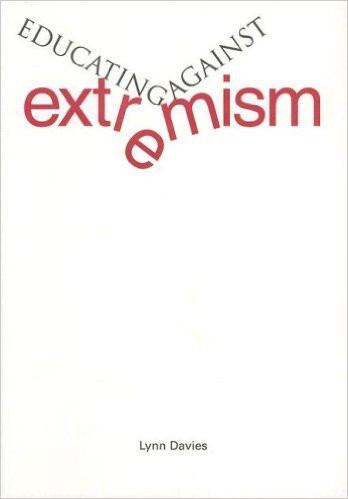 Educating Against Extremism Año de publicación: 2012 Autor: Dianne Gereluk Extremism is a huge concern across the world right now, fueled by its links to terrorism and religious fundamentalism. This book explores the relationship of education to extremism and examines how education could counter its more dangerous forms. Lynn Davies proposes a very different educational strategy to the conventional tolerant multiculturalism that pertains in the west. The task – a challenging one – is to politicize young people without cementing uncritical acceptance of single truths. Educating Against Extremism Año de publicación: 2012 Autor: Dianne Gereluk L'extrémisme constitue désormais un enjeu de premier ordre à travers le monde, alimenté par son lien avec le terrorisme et le fondamentalisme religieux. Ce livre analyse la relation entre l'éducation et l'extrémisme et s’interroge sur le rôle de l'éducation pour prévenir ses formes les plus dangereuses. Lynn Davies propose une stratégie éducative très différente du multiculturalisme tolérant conventionnel qui prévaut en Occident. L'objectif, qui s’avère être un véritable défi, est de politiser les jeunes tout en s’assurant qu’ils développent leur esprit critique et forgent leurs propres opinions.
  Intercultural Education : special issue on Holocaust Education in North America and Europe (Vol 14) Issue 2 "Intercultural Education is a global forum for the analysis of issues dealing with education in plural societies. It provides educational professionals with the knowledge and information that can assist them in contributing to the critical analysis and the implementation of intercultural education." This special issue concerns Holocaust Education in North America and Europe.
  Intercultural Education : Supplement 1 : Teaching the Holocaust in diverse classrooms : Opportunities and Challenges (Vol 21) Supplement 1 "Intercultural Education is a global forum for the analysis of issues dealing with education in plural societies. It provides educational professionals with the knowledge and information that can assist them in contributing to the critical analysis and the implementation of intercultural education." This special issue is about the opportunities and challenges about teaching the Holocaust in diverse classrooms. The contribution of "study abroad" programs to Japanese internationalization Año de publicación: 2009 Autor: Takako Asaoka | Jun Yano “Study abroad” needs promoting, as it is an effective alternative for many Japanese university students to enhance their international experience and cross-cultural understanding, thus contributing to the internationalization of Japanese universities. To consider what has to be done to promote “study abroad” programs, this research attempts to ascertain (a) the characteristics of the “study abroad” program of Japanese university students, (b) what Japanese university students think about the “study abroad” program, (c) the factors discouraging them from studying abroad, and (d) suggestions made by university staff to promote “study abroad” programs. Online survey results of 173 Japanese university students, interview answers and monthly reports of 20 Japanese university exchange students, opinions of 15 JAFSA members, and the JASSO symposium reports from 2005 to 2007 were used as data for this study. Suggestions are made to enable Japanese university staff to further promote “study abroad” programs among their students.
 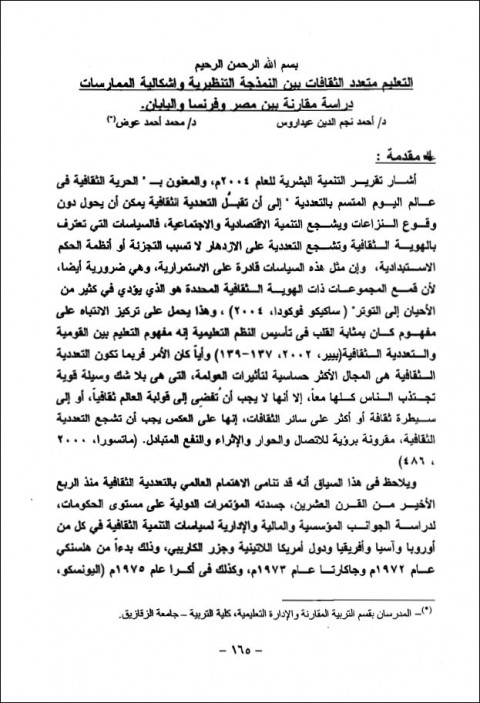 التعليم متعدد الثقافات بين النمذجة التنظيرية وإشكالية الممارسات : دراسة مقارنة بين مصر وفرنسا واليابان Año de publicación: 2006 Autor: Ahmed Aidrous | Mohammed Awad Autor corporativo: Zagazig University تركز هذه الورقة على دراسة التعددية الثقافية كمفهوم والنظريات والأطر والنماذج التطبيقية المرتبطة بها. وتستعرض الدراسة خبرة كلا من فرنسا واليابان ومصر، وتضع مقارنات بينها. تنتهي الدراسة بوضع تصور مقترح للتعليم متعدد الثقافات في ضوء الخبرات المعروضة.