
Recursos
Exploren una amplia gama de recursos valiosos en GCED para profundizar su comprensión y promover su búsqueda, incidencia, enseñanza y aprendizaje.
371 resultados encontrados
 Learning to live together: an intercultural and interfaith programme for ethics education; Good Practices Series 2; Learning to Play Together Año de publicación: 2014 Autor corporativo: United Nations Children's Fund (UNICEF) | Interfaith Council on Ethics Education for Children | Arigatou Foundation Learning to live together: an intercultural and interfaith programme for ethics education; Good Practices Series 2; Learning to Play Together Aprender a vivir juntos Un programa intercultural e interreligioso para la educación ética: Series de Buenas Prácticas 2; Aprender a jugar juntos Año de publicación: 2014 Autor corporativo: United Nations Children's Fund (UNICEF) | Interfaith Council on Ethics Education for Children | Arigatou Foundation Aprender a vivir juntos Un programa intercultural e interreligioso para la educación ética: Series de Buenas Prácticas 2; Aprender a jugar juntos
  Learning to live together: an intercultural and interfaith programme for ethics education: Traning guides series 1; international train the trainers course; a report Año de publicación: 2012 Autor corporativo: United Nations Children's Fund (UNICEF) | Interfaith Council on Ethics Education for Children | Arigatou Foundation In 2010, Arigatou International offered an International Train the Trainers course designed to help those providing training programmes on the use of the Learning to Live Together. The University of Edinburgh helped develop and evaluate the Train the Trainers as a pilot project.
  Learning to live together: an intercultural and interfaith programme for ethics education: Executive Summary Año de publicación: 2015 Autor corporativo: United Nations Children's Fund (UNICEF) | Interfaith Council on Ethics Education for Children | Arigatou Foundation What is the Learning to Live Together? How was it developed? Where and how can it be used? In the Executive Summary you can find answers to all these questions, as well as information about outstanding projects that show the potential of the programme. Apprendre à vivre ensemble: Un programme interculturel et interreligieux pour l’enseignement de l’éthique: Résumé Año de publicación: 2015 Autor corporativo: United Nations Children's Fund (UNICEF) | Interfaith Council on Ethics Education for Children | Arigatou Foundation What is the Learning to Live Together? How was it developed? Where and how can it be used? In the Executive Summary you can find answers to all these questions, as well as information about outstanding projects that show the potential of the programme. Aprender a vivir juntos: Un programa intercultural e interreligioso para la educación ética: Resumen Año de publicación: 2015 Autor corporativo: United Nations Children's Fund (UNICEF) | Interfaith Council on Ethics Education for Children | Arigatou Foundation What is the Learning to Live Together? How was it developed? Where and how can it be used? In the Executive Summary you can find answers to all these questions, as well as information about outstanding projects that show the potential of the programme. Learning to live together: an intercultural and interfaith programme for ethics education: Executive Summary Año de publicación: 2015 Autor corporativo: United Nations Children's Fund (UNICEF) | Interfaith Council on Ethics Education for Children | Arigatou Foundation What is the Learning to Live Together? How was it developed? Where and how can it be used? In the Executive Summary you can find answers to all these questions, as well as information about outstanding projects that show the potential of the programme.
 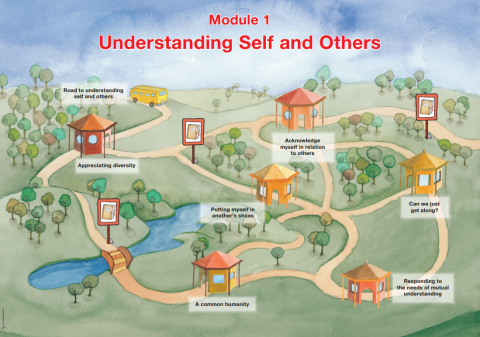 Learning to live together: poster Autor corporativo: United Nations Children's Fund (UNICEF) | Interfaith Council on Ethics Education for Children | Arigatou Foundation The poster is for the Learning to Live Together programme. The Learning to Live Together programme is built on two complementary learning modules, ‘Understanding Self and Others’ and ‘Transforming the World Together,’ based on four core ethical values: respect, empathy, responsibility and reconciliation.
  Education for intercultural understanding Año de publicación: 2010 Autor: Joy de Leo Autor corporativo: UNESCO Bangkok The theme of intercultural understanding and respect for cultural diversity falls within the social dimension of peace, equality and human rights, underpinned by the cultural context, within and through which learning occurs, and which forms the basis for inter-linkages between the various sustainability dimensions (i.e., socio-political, environmental and economic). Within the International Implementation Scheme, the value of respect is seen as central to all aspects of sustainable development: respect for self, for others and for all life on earth. L'éducation pour la compréhension interculturelle Año de publicación: 2010 Autor: Joy de Leo Autor corporativo: UNESCO Bangkok Le thème de la compréhension interculturelle et le respect de la diversité culturelle relève de la dimension sociale de la paix, l'égalité et les droits de l'homme, sous-tendue par le contexte culturel, à l'intérieur et à travers lequel l'apprentissage se produit, et qui constitue la base des liens entre les différentes dimensions de la durabilité (ie, socio-politique, environnemental et économique). Dans le cadre du programme d'application international, la valeur du respect est considérée comme essentielle à tous les aspects du développement durable: le respect de soi, des autres et de toute vie sur terre.