
Recursos
Exploren una amplia gama de recursos valiosos en GCED para profundizar su comprensión y promover su búsqueda, incidencia, enseñanza y aprendizaje.
65 resultados encontrados
 The “Hate Speech” Policies of Major Platforms during the COVID-19 Pandemic Año de publicación: 2021 Autor corporativo: UNESCO Montevideo This document reports an increase in so-called “hate speech” posts on Facebook, Twitter, and YouTube after the onset of the COVID-19 pandemic. Although dissimilar, such an increase can be observed in the transparency reports of the different platforms and the surge in content moderation since March 2020.During the same period—as a result of the lockdown measures adopted in most countries around the world—platforms increased the use of AI tools for content moderation. Therefore, we can’t fully say whether the interannual growth is linked to increased posts or changes in monitoring systems. Las políticas de las grandes plataformas sobre discurso de odio durante el Covid-19 Año de publicación: 2021 Autor corporativo: UNESCO Montevideo Este documento da cuenta de un aumento de posteos considerados discurso de odio a partir de la llegada de la pandemia COVID-19 en Facebook, Twitter y YouTube. Aunque dispar, ese aumento puede establecerse a partir de los informes de transparencia de las distintas plataformas y los crecimientos registrados en la moderación de esos contenidos a partir de marzo de 2020.Dado que en ese mismo período, y como consecuencia de las medidas de aislamiento tomadas ven la mayoría de los países del mundo, las plataformas tomaron la decisión de aumentar el uso de herramientas de inteligencia artificial en sus procesos de moderación no es posible asegurar a ciencia cierta que ese crecimiento se haya registrado por un aumento en la creación y publicación de mensajes o a partir de un cambio en los sistemas de detección que afectó los resultados entre un año y otro.
  School Closures and Regional Policies to Mitigate Learning Loss due to COVID-19: A Focus on the Asia-Pacific Año de publicación: 2021 Autor corporativo: UNESCO Institute for Statistics (UIS) Global school closures as a result of COVID-19 have caused learning losses for millions of children despite efforts to deploy remote learning options. Greater economic insecurity among families may also affect school enrolment as many struggle to pay school fees, or require children to work to supplement family income. Ultimately, this will lead to rising dropout rates, estimated to be as much as 4% in a region where 128 million children and young people were already out of school before COVID-19. The largest number of learners at risk reside in South and West Asia.Together, the education and economic fallout from the pandemic threaten progress toward the Sustainable Development Goal for education (SDG 4). Even prior to the COVID-19 disruptions, progress towards SDG 4 was lagging in many countries in the Asia-Pacific and without significant contributions to education finance, the pandemic threatens to push the region even further behind.This report breaks down the effects of school closures. It considers, for example, how many schools were closed, and when, across the Asia-Pacific, and the effects on different levels of education from early childhood education, through to primary and secondary school. The report analyses country efforts to implement remote learning, and strategies to mitigate learning losses as the proportion of students expected to fall below minimum proficiency levels is expected to rise.To achieve SDG 4, all children and young people, and especially those in marginalized groups, need support to get the education they need and deserve.
  Research Report: A Comparative Study on Hybrid Learning in Schools Año de publicación: 2024 Autor corporativo: UNESCO International Bureau of Education (IBE) During the COVID-19 lockdown, policymakers and educators faced an unprecedented challenge disrupting all levels of education. The initial optimism about replacing physical classes with virtual lessons diminished as complex interconnected issues emerged. To address the need for continuous and sustainable learning, school systems implemented variations of hybrid learning during the pandemic, seeking to integrate physical and virtual classes. These approaches prompted this comparative study led by UNESCO-IBE. The initial phase of this study involved collecting and analysing data on hybrid strategies from six countries. The research aimed to examine factors influencing hybrid learning implementation during the lockdown, with a subsequent focus on developing and validating a practical Hybrid Learning Framework for Schools. The cross-case analysis was designed not to rank or compare, but to understand and connect different scenarios and contexts. Phase I focuses on current hybrid learning practices and influencing factors, while Phases II and III will concentrate on using the information gathered to create and validate a Hybrid Learning Framework for Schools. Aligned with UNESCO-IBE’s overarching vision of a comprehensive, personalized, and democratized curriculum accessible to all, hybrid learning facilitates inclusive education across diverse regions, overcoming geographical and temporal limitations. The approach aims to unlock the unique potential of every learner, fostering a more flexible educational environment. Les politiques des grandes plateformes sur le discours de haine pendant la COVID-19 Año de publicación: 2021 Autor corporativo: UNESCO Montevideo Ce document fait état d’une augmentation des messages considérés comme des discours de haine sur Facebook, Twitter et YouTube, depuis l’avènement de la pandémie de COVID-19. Bien qu’inégale, cette augmentation peut être établie à partir des rapports de transparence des différentes plateformes et de la croissance enregistrée dans la modération de ces contenus à partir de mars 2020. Étant donné qu’au cours de la même période, et en conséquence des mesures d’isolement prises dans la plupart des pays du monde, les plateformes ont décidé d’accroître l’utilisation d’outils d’intelligence artificielle dans leurs processus de modération, il n’est pas possible d’être certain que cette croissance est due à une augmentation de la création et de la publication de messages ou à un changement dans les systèmes de détection qui a affecté les résultats d’une année à l’autre.
 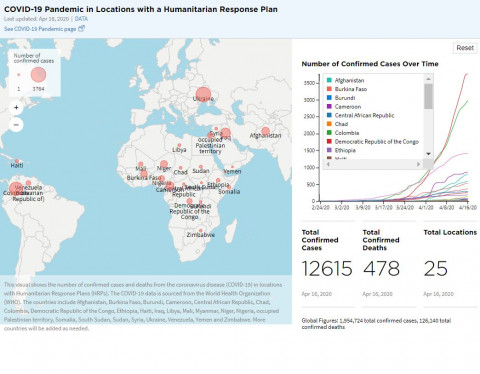 COVID-19 Pandemic in Locations with a Humanitarian Response Plans Año de publicación: 2020 Autor corporativo: United Nations Office for the Coordination of Humanitarian Affairs (OCHA) This visual shows the number of confirmed cases and deaths from the coronavirus disease (COVID-19) in locations with Humanitarian Response Plans (HRPs). The COVID-19 data is sourced from the World Health Organization (WHO). The countries include Afghanistan, Burkina Faso, Burundi, Cameroon, Сentral African Republic, Chad, Colombia, Democratic Republic of the Congo, Ethiopia, Haiti, Iraq, Libya, Mali, Myanmar, Niger, Nigeria, occupied Palestinian territory, Somalia, South Sudan, Sudan, Syria, Ukraine, Venezuela, Yemen and Zimbabwe. More countries will be added as needed.
 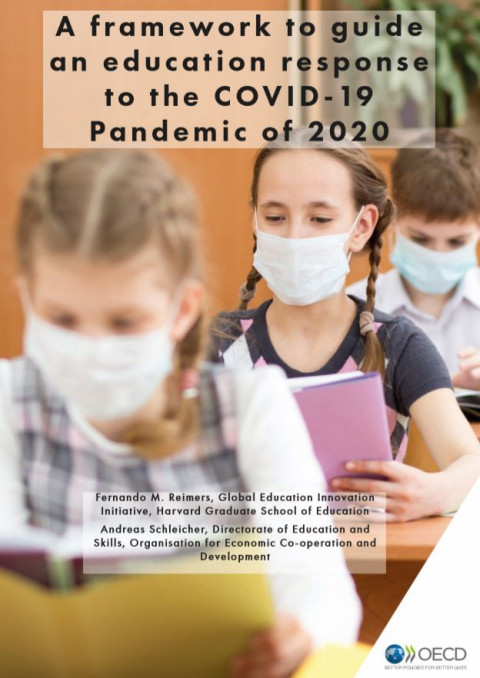 A Framework to Guide an Education Response to the COVID-19 Pandemic of 2020 Año de publicación: 2020 Autor: Fernando Reimers | Andreas Schleicher Autor corporativo: Organisation for Economic Co-operation and Development (OECD) This report aims at supporting education decision making to develop and implement effective education responses to the COVID-19 Pandemic. The report explains why the necessary social isolation measures will disrupt school-based education for several months in most countries around the world. Absent an intentional and effective strategy to protect opportunity to learn during this period, this disruption will cause severe learning losses for students.The report proposes that leaders of education systems and organizations develop plans for the continuation of education through alternate modalities, during the period of necessary social isolation. It offers a framework of areas to be covered by such plans. Un cadre pour guider une réponse éducative à la Covid-19 en cas de pandémie de 2020 Año de publicación: 2020 Autor: Fernando Reimers | Andreas Schleicher Autor corporativo: Organisation for Economic Co-operation and Development (OECD) Ce rapport vise à appuyer la décision de l'éducation faisant de développer et mettre en œuvre des réponses éducatives efficaces au Covid-19 en cas de pandémie. Le rapport explique pourquoi les mesures d'isolement social nécessaires perturberont l'éducation en milieu scolaire pendant plusieurs mois dans la plupart des pays à travers le monde. En l'absence d'une stratégie délibérée et efficace pour protéger l'occasion d'apprendre au cours de cette période, cette perturbation entraîne des pertes sévères d'apprentissage pour les étudiants.Le rapport propose que les dirigeants des systèmes d'éducation et les organisations à élaborer des plans pour la poursuite de l'éducation des modalités alternatives, au cours de la période d'isolement social nécessaire. Il offre un cadre de zones à couvrir par ces plans.
 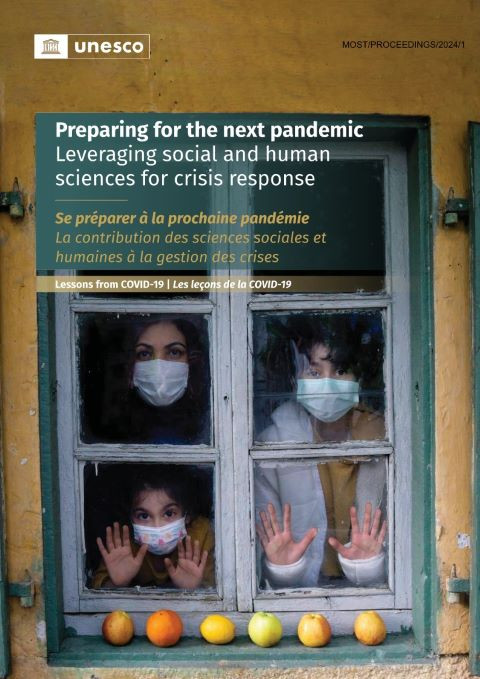 Preparing for the Next Pandemic Leveraging Social and Human Sciences for Crisis: Lessons from COVID-19 Año de publicación: 2024 Autor: Erwan Dianteill | N'Dri Thérèse Assié-Lumumba Autor corporativo: UNESCO The Social Sciences Response to COVID-19 Understanding the social impact of the COVID-19 pandemic is crucial for crafting effective and inclusive recovery policies. Prior to the pandemic, growing gaps in well-being were already undermining environmental sustainability, the social fabric, and progress worldwide. Fragile and unequal systems proved to be a pre-existing aggravating condition that fuelled the pandemic on a global scale. COVID-19 widened the gap between developed countries—which already had the financial means to respond to the crisis and had easy access to the vaccine—and the rest of humanity, resulting in devastating effects in the Global South, with more than 130 million people crossing the poverty line. Addressed to policymakers and scholars, this publication presents a comprehensive state of knowledge of the social science perspectives on the COVID-19 pandemic, covering a wide range of topics from its impact on mental health, education, climate change, economy, governance, migration, demography, digitalization, and more. The authors analyse the challenges faced by society during the pandemic and present actionable proposals for policymakers and practitioners. This publication is a reminder of the importance of Social Sciences and Humanities in addressing global challenges and provides a roadmap for future research and policy action to build more resilient societies.
 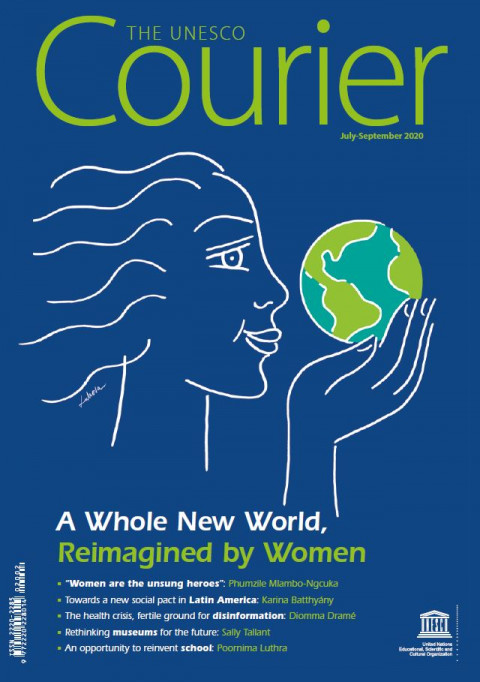 A Whole New World, Reimagined by Women (The UNESCO Courier no. 2, July-September 2020) Año de publicación: 2020 Autor corporativo: UNESCO In this issue, the UNESCO Courier gives women a voice. Political scientists, journalists, sociologists, researchers, writers, and teachers have drawn the contours of the post-pandemic era – whether it is the future of museums, changes in schools, the rise of disinformation, or the challenges of scientific research.This issue paints a sobering picture of our times – highlights the fault-lines exposed by the health crisis, and shows the magnitude of the challenges ahead. It also underlines the potential for scientific, cultural and educational co-operation that this unprecedented event has revealed. If the reflections, the desire for change, and the movements of mutual aid that have emerged are not short-lived, the world really could become a more united, more sustainable and more egalitarian place.