
Recursos
Exploren una amplia gama de recursos valiosos en GCED para profundizar su comprensión y promover su búsqueda, incidencia, enseñanza y aprendizaje.
102 resultados encontrados
 Message from Irina Bokova, Director-General of UNESCO on the occasion of the International Day of Peace, 21 September 2013 Año de publicación: 2013 Autor corporativo: UNESCO. Director-General, 2009-2017 (Bokova, I.G.) This is the message from Irina Bokova, Director-General of UNESCO on the occasion of the International Day of Peace, 21 September 2013. Message de la Directrice générale de l'UNESCO, Irina Bokova, à l'occasion de la Journée internationale de la paix, 21 septembre 2013 Año de publicación: 2013 Autor corporativo: UNESCO. Director-General, 2009-2017 (Bokova, I.G.) This is the message from Irina Bokova, Director-General of UNESCO on the occasion of the International Day of Peace, 21 September 2013. Mensaje de la Directora General de la UNESCO, Irina Bokova, con motivo del Día Internacional de la Paz, 21 de septiembre de 2013 Año de publicación: 2013 Autor corporativo: UNESCO. Director-General, 2009-2017 (Bokova, I.G.) This is the message from Irina Bokova, Director-General of UNESCO on the occasion of the International Day of Peace, 21 September 2013. Послание Генерального директора ЮНЕСКО г-жи Ирины Боковой по случаю Международного дня мира, 21 сентября 2013 г. Año de publicación: 2013 Autor corporativo: UNESCO. Director-General, 2009-2017 (Bokova, I.G.) This is the message from Irina Bokova, Director-General of UNESCO on the occasion of the International Day of Peace, 21 September 2013. رسالة من السيدة إيرينا بوكوفا، المديرة العامة لليونسكو، بمناسبة اليوم العالمي للسلام، ٢١ أيلول/سبتمبر٢٠١٣ Año de publicación: 2013 Autor corporativo: UNESCO. Director-General, 2009-2017 (Bokova, I.G.) This is the message from Irina Bokova, Director-General of UNESCO on the occasion of the International Day of Peace, 21 September 2013. 联合国教科文组织总干事伊琳娜•博科娃在国际和平日的致辞,2013年9月21日 Año de publicación: 2013 Autor corporativo: UNESCO. Director-General, 2009-2017 (Bokova, I.G.) This is the message from Irina Bokova, Director-General of UNESCO on the occasion of the International Day of Peace, 21 September 2013.
  Address by Irina Bokova, Director-General of UNESCO, on the occasion of the lecture: Preventing violent-extremism in the 21st century: fostering a new generation of global citizens at the Center for Conflict Resolution; Salisbury University, 4 April 2017 Año de publicación: 2017 Autor corporativo: UNESCO. Director-General, 2009-2017 (Bokova, I.G.) This address was given by Irina Bokova, Director-General of UNESCO on the occasion of the lecture “Preventing violent-extremism in the 21st century: fostering a new generation of global citizens” at the Center for Conflict Resolution.
 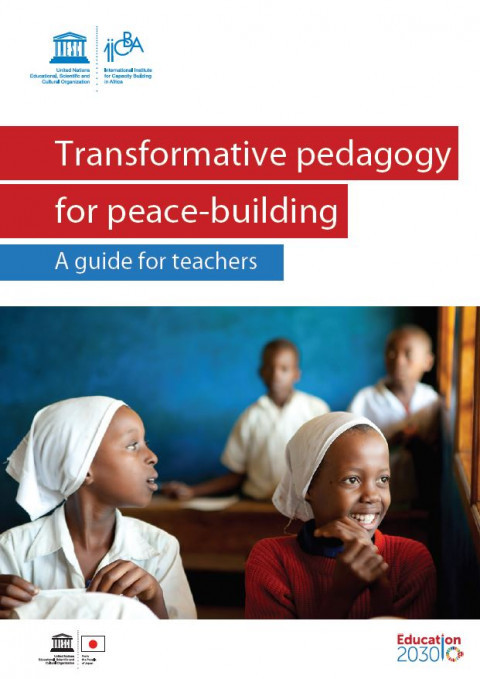 Transformative Pedagogy for Peace-building: A Guide for Teachers Año de publicación: 2017 Autor corporativo: UNESCO International Institute for Capacity-Building in Africa (IICBA) This publication is a guide for teachers and teacher trainers on transformative pedagogy so that they are able to empower youth with peace-building knowledge, skills and competencies necessary to develop into advocates and actors of peace.The guide particularly aims to introduce teachers to the foundation of conflict analysis and peace-building and to equip them with a learner-centered approach to peace education and community engagement.This guide is a resource for educators to engage and support youth in their journey to becoming active peace-builders and fostering transformation in the Horn of Africa and Surrounding Countries.
 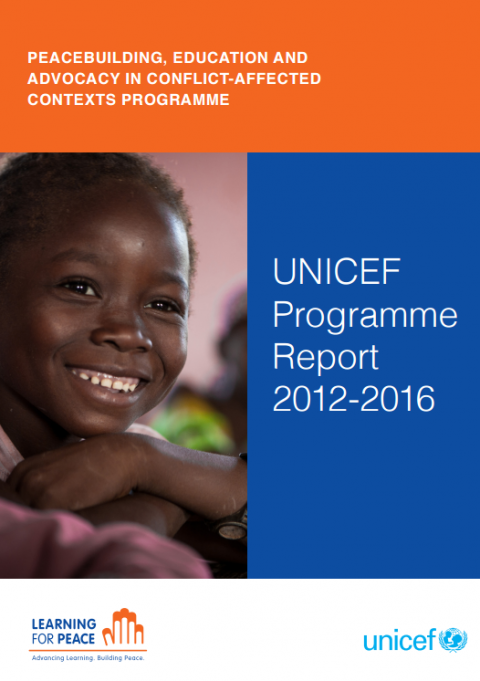 Peacebuilding, education and advocacy in conflict-affected contexts programme; UNICEF Programme Report 2012-2016 Año de publicación: 2016 Autor corporativo: United Nations Children's Fund (UNICEF) UNICEF’s Programme Report 2012–2016 is organized into two parts. Part 1 provides evidence of what works and does not work in peacebuilding efforts, situating the Learning for Peace programme as a case study within the larger global discussion around peace and security. Part 2 accounts for the activities implemented and results emerging from the programme against its results framework and financial input, and includes a description of support for gender-sensitive, responsive and transformative programmatic approaches.
  Higher Education, Peace & Security in the Eastern Africa Region Año de publicación: 2023 Autor: Sabiti Makara Autor corporativo: UNESCO Nairobi This paper stems from issues that were deliberated on at a regional conference titled, Emerging Issues in the Sciences, Climate Change, Peace and Security and Information and Communication Technologies (ICTs), organized in Djibouti, in May 2017 by UNESCO Regional Office for Eastern Africa. The paper examines the issues and challenges of peace and security in Eastern Africa region. It puts into perspective higher education in the region, in terms of assess, quality, relevance, knowledge and skill products, and capacity to solve social challenges of society. The May 2017 Djibouti Conference on Higher Education, Peace and Security aimed at placing higher education at the center of understanding the complex regional challenges with regard to peace and security in a broad context, including poverty, climate change and environment, intergenerational transfer of knowledge, colonial/neo-colonial heritage, regional integration, cultural resources, and unemployment. The centrality of education as a tool for social transformation in Africa, and elsewhere is a critical element of transforming society, however that very element is up for debate. Specifically, the impact of higher education as a means of accelerating the sciences (natural and social sciences) is due for robust debate, as to whether or not, it is leading to innovations, creativity, and research-led solutions to challenges of society. The critical issue for the Djibouti Conference deliberations was: could Science, technology and in more recent years, information and communications technology, lead to transformation of society in the region? The other issue was: is it only the natural sciences that have the greatest potential for that transformation, or that the social sciences and humanities are relevant in this context? Besides, since issues of peace and security are complex, could multidisciplinary approaches be appropriate? This paper is not a rapporteur's report of the Djibouti conference. It is a set of reflection and reframing of issues for further debate and discussion.