
Recursos
Exploren una amplia gama de recursos valiosos en GCED para profundizar su comprensión y promover su búsqueda, incidencia, enseñanza y aprendizaje.
40 resultados encontrados
 Региональный обзор: Центральная и Восточная Европа и Центральная Азия Año de publicación: 2015 Autor corporativo: UNESCO В настоящем региональном обзоре, где рассматривается прогресс, достигнутый с 2000 г., кратко излагаются ответы на важнейшие вопросы, которым посвящен Всемирный доклад по мониторингу (ВДМ) ОДВ за 2015 г. В ВДМ за 2015 г. показано, что, несмотря на прогресс, цели образования для всех еще не до конца достигнуты, в том числе в Центральной и Восточной Европе и Центральной Азии.
 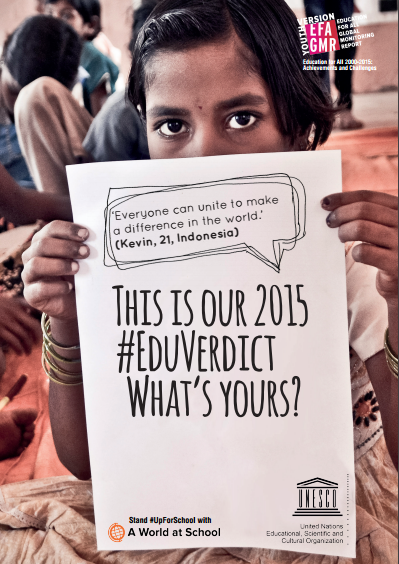 这是我们的2015 教育回望#EduVerdict 你的呢? Año de publicación: 2015 Autor corporativo: UNESCO This report highlights the progress and challenges that countries have faced over 15 years, brining together the voices of young people to show how Education for All (EFA) has affected their lives.
 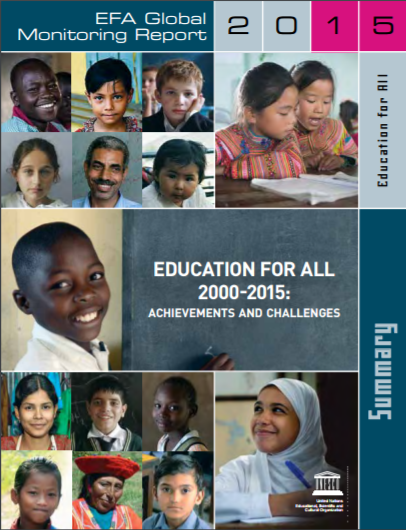 Other lang. title: L'Education pour tous 2000-2015: progrès et enjeux, rapport mondial de suivi sur l'EPT, 2015, résumé; La Educación para Todos, 2000-2015: logros y desafíos, informe de seguimiento de la EPT en el mundo, 2015, resumen Año de publicación: 2015 Autor corporativo: UNESCO At the World Education Forum in Dakar, Senegal, in 2000, governments from 164 countries, together with representatives of regional groups, international organizations, donor agencies, non-government organizations (NGOs) and civil society, adopted a Framework for Action to deliver Education for All (EFA) commitments. The Dakar Framework comprised 6 goals and their associated targets to be achieved by 2015, and 12 strategies to which all stakeholders would contribute. The EFA Global Monitoring Report (GMR) has monitored progress on an almost annual basis towards the EFA goals and the two education-related Millennium Development Goals (MDGs). The 2015 GMR provides a complete assessment of progress since 2000 towards the target date for reaching the Dakar Framework’s goals. It takes stock of whether the world achieved the EFA goals and stakeholders upheld their commitments. It explains possible determinants of the pace of progress. Finally, it identifies key lessons for shaping the post-2015 global education agenda. Образование для всех 2000-2015 гг.: достижения и вызовы, всемирный доклад по мониторингу ОДВ, 2015 г., резюме Año de publicación: 2015 Autor corporativo: Организация Объединенных Наций по вопросам образования, науки и культуры (UNESCO) At the World Education Forum in Dakar, Senegal, in 2000, governments from 164 countries, together with representatives of regional groups, international organizations, donor agencies, non-government organizations (NGOs) and civil society, adopted a Framework for Action to deliver Education for All (EFA) commitments. The Dakar Framework comprised 6 goals and their associated targets to be achieved by 2015, and 12 strategies to which all stakeholders would contribute. The EFA Global Monitoring Report (GMR) has monitored progress on an almost annual basis towards the EFA goals and the two education-related Millennium Development Goals (MDGs). The 2015 GMR provides a complete assessment of progress since 2000 towards the target date for reaching the Dakar Framework’s goals. It takes stock of whether the world achieved the EFA goals and stakeholders upheld their commitments. It explains possible determinants of the pace of progress. Finally, it identifies key lessons for shaping the post-2015 global education agenda. 2000-2015年 全民教育: 成就与挑战; 全民教育 全球监测报告, 2015; 摘 要 Año de publicación: 2015 Autor corporativo: UNESCO At the World Education Forum in Dakar, Senegal, in 2000, governments from 164 countries, together with representatives of regional groups, international organizations, donor agencies, non-government organizations (NGOs) and civil society, adopted a Framework for Action to deliver Education for All (EFA) commitments. The Dakar Framework comprised 6 goals and their associated targets to be achieved by 2015, and 12 strategies to which all stakeholders would contribute. The EFA Global Monitoring Report (GMR) has monitored progress on an almost annual basis towards the EFA goals and the two education-related Millennium Development Goals (MDGs). The 2015 GMR provides a complete assessment of progress since 2000 towards the target date for reaching the Dakar Framework’s goals. It takes stock of whether the world achieved the EFA goals and stakeholders upheld their commitments. It explains possible determinants of the pace of progress. Finally, it identifies key lessons for shaping the post-2015 global education agenda. Education for All 2000-2015: Achievements and Challenges; EFA Global Monitoring Report, 2015; Summary Año de publicación: 2015 Autor corporativo: UNESCO At the World Education Forum in Dakar, Senegal, in 2000, governments from 164 countries, together with representatives of regional groups, international organizations, donor agencies, non-government organizations (NGOs) and civil society, adopted a Framework for Action to deliver Education for All (EFA) commitments. The Dakar Framework comprised 6 goals and their associated targets to be achieved by 2015, and 12 strategies to which all stakeholders would contribute. The EFA Global Monitoring Report (GMR) has monitored progress on an almost annual basis towards the EFA goals and the two education-related Millennium Development Goals (MDGs). The 2015 GMR provides a complete assessment of progress since 2000 towards the target date for reaching the Dakar Framework’s goals. It takes stock of whether the world achieved the EFA goals and stakeholders upheld their commitments. It explains possible determinants of the pace of progress. Finally, it identifies key lessons for shaping the post-2015 global education agenda. L'Education pour tous 2000-2015: progrès et enjeux, rapport mondial de suivi sur l'EPT, 2015, résumé Año de publicación: 2015 Autor corporativo: Organisation des Nations Unies pour l'éducation, la science et la culture (UNESCO) At the World Education Forum in Dakar, Senegal, in 2000, governments from 164 countries, together with representatives of regional groups, international organizations, donor agencies, non-government organizations (NGOs) and civil society, adopted a Framework for Action to deliver Education for All (EFA) commitments. The Dakar Framework comprised 6 goals and their associated targets to be achieved by 2015, and 12 strategies to which all stakeholders would contribute. The EFA Global Monitoring Report (GMR) has monitored progress on an almost annual basis towards the EFA goals and the two education-related Millennium Development Goals (MDGs). The 2015 GMR provides a complete assessment of progress since 2000 towards the target date for reaching the Dakar Framework’s goals. It takes stock of whether the world achieved the EFA goals and stakeholders upheld their commitments. It explains possible determinants of the pace of progress. Finally, it identifies key lessons for shaping the post-2015 global education agenda.
 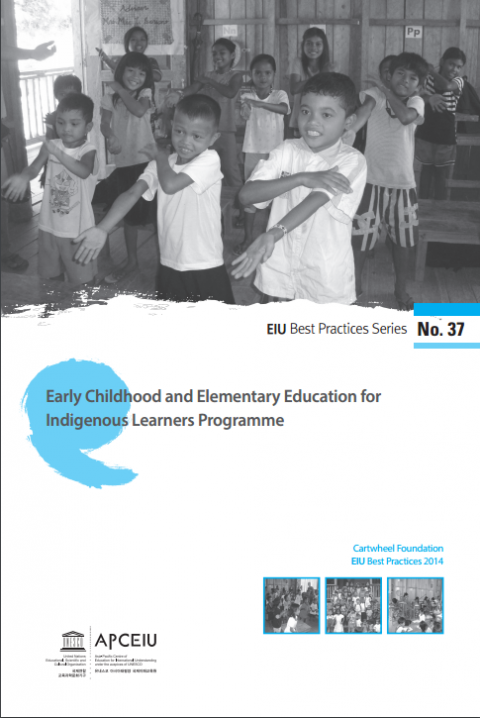 EIU Best Practices Series No. 37: Early Childhood and Elementary Education for Indigenous Learners Programme Año de publicación: 2014 Autor: Bricks Sabella Sintaon Autor corporativo: APCEIU This monograph is one of APCEIU's EIU Best Practices Series, which aims to encourage educators, scholars, and activists to implement and share local initiatives on EIU. The Series No.37 introduces the Early Childhood and Elementary Education (ECEE) for Indigenous Learners Programme initiated in the Philippines. The indigenous peoples (IP) reside in the mountainous regions, away from basic social services and struggling with poverty, malnutrition, and lack of proper education. The aim of ECEE is to facilitate access to quality and culturally-relevant early childhood and elementary education for the Higaonon indigenous children. To achieve this, activities such as curriculum indigenization and teacher training are provided in collaboration with the community members. As the program creates learning process for all through openness, sharing, and collaboration, this is an exemplary case of EIU/GCED pedagogical approach.
 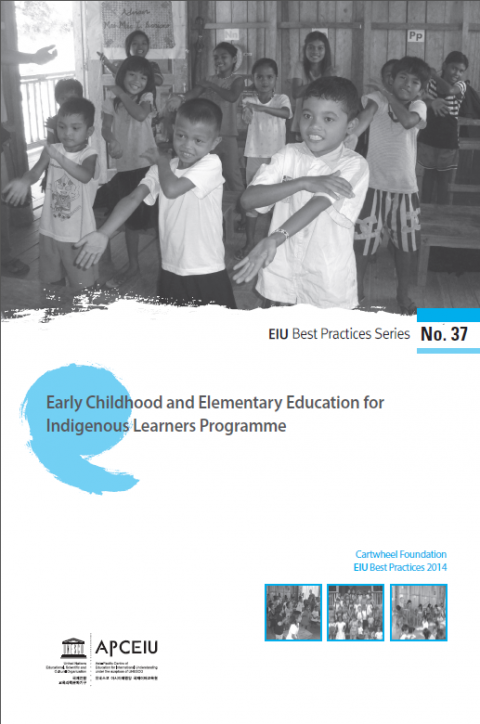 EIU Best Practices Series No.37: Early Childhood and Elementary Education for Indigenous Learners Programme Año de publicación: 2014 Autor corporativo: APCEIU This monograph is one of APCEIU's EIU Best Practices Series, which aims to encourage educators, scholars, and activists to implement and share local initiatives on EIU. The Series No.37 introduces the Early Childhood and Elementary Education (ECEE) for Indigenous Learners Programme initiated in the Philippines. The indigenous peoples (IP) reside in the mountainous regions, away from basic social services and struggling with poverty, malnutrition, and lack of proper education. The aim of ECEE is to facilitate access to quality and culturally-relevant early childhood and elementary education for the Higaonon indigenous children. To achieve this, activities such as curriculum indigenization and teacher training are provided in collaboration with the community members. As the program creates learning process for all through openness, sharing, and collaboration, this is an exemplary case of EIU/GCED pedagogical approach.
 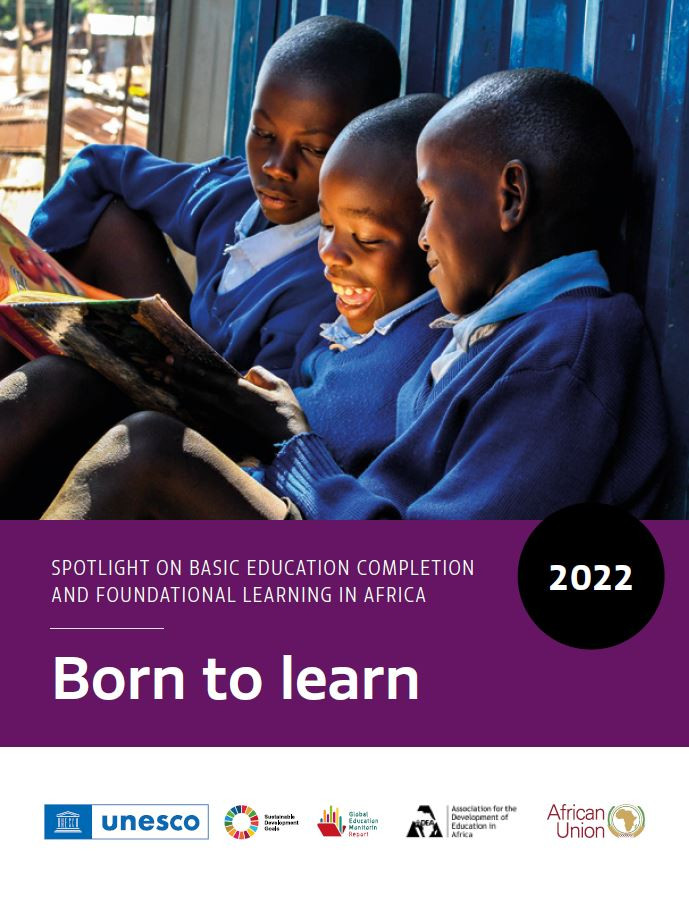 Spotlight on Basic Education Completion and Foundational Learning in Africa, 2022: Born to Learn Año de publicación: 2022 Autor corporativo: UNESCO | Association for the Development of Education in Africa (ADEA) | African Union This publication is the first in a three-part Spotlight series. It is produced by a partnership between the Global Education Monitoring Report, the Association for the Development of Education in Africa and the African Union.The report focuses on why learning levels in the region are low. All children are born to learn yet only one in five children in Africa who reach the end of primary school achieve the minimum proficiency level required to continue their education and fulfil their potential. Combining completion and learning statistics, the report shows that children in Africa are at least five times less likely than children in the rest of the world to be prepared for the future.Given the historically low levels of learning on the continent, fresh thinking is needed to translate the CESA and SDG 4 commitments into focused, coordinated, well-informed and appropriately funded actions. The report contains eight policy-oriented recommendations for driving change.