
Recursos
Exploren una amplia gama de recursos valiosos en GCED para profundizar su comprensión y promover su búsqueda, incidencia, enseñanza y aprendizaje.
20 resultados encontrados
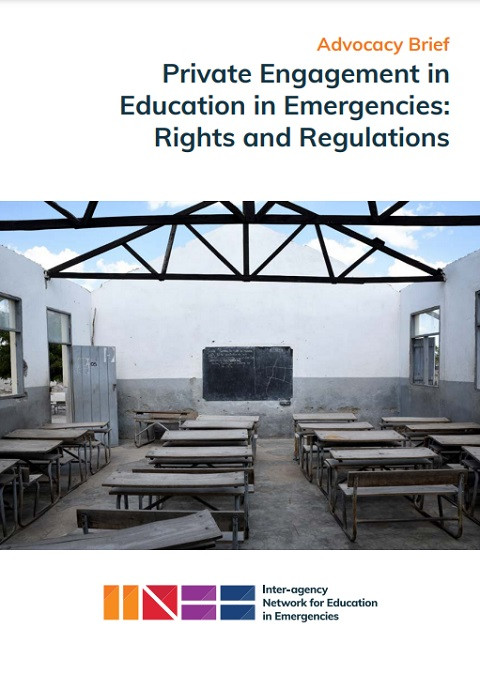 Private Engagement in Education in Emergencies: Rights and Regulations Año de publicación: 2021 Autor: Francine Sara Menashy | Zeena Zhakaria Autor corporativo: Inter-agency Network for Education in Emergencies (INEE) Efforts to secure inclusive and equitable education for all have prompted calls for greater engagement by the private sector, asserting that businesses and foundations can play significant roles as partners in achieving Sustainable Development Goal 4 (SDG4).In recent years, given shortfalls in public financing and the need for urgent responses, private actors have increasingly become involved in various aspects of educational programming for education in emergencies (EiE). This arrangement, however, can produce tensions between private engagement and humanitarian response in education, which need to be addressed and in turn require extra coordination, advocacy and attention. This brief explores some of these tensions and makes recommendations to support the prioritization of safe, equitable, and quality public education for all children and young people affected by crises.INEE supports every young person’s right to education and recognizes the State as the primary duty-bearer of schooling, in alignment with international declarations, frameworks, and legal instruments that assert and protect the right to education. Participación del sector privado en la Educación en situaciones de emergencia: Derechos y regulaciones Año de publicación: 2021 Autor: Francine Sara Menashy | Zeena Zhakaria Autor corporativo: Inter-agency Network for Education in Emergencies (INEE) Las iniciativas que buscan garantizar una educación inclusiva y equitativa para todos han generado peticiones para una mayor involucramiento del sector privado, afirmando que las empresas y las fundaciones pueden jugar un papel importante como socios para alcanzar el Objetivo de Desarrollo Sostenible 4 (ODS4). En los últimos años, debido a la falta de financiamiento público y a la necesidad de respuestas urgentes, ha crecido la participación del sector privado en diversos aspectos de la programación educativa para la educación en situaciones de emergencia (EeE). Esta forma de trabajar, sin embargo, puede causar tensiones entre la participación del sector privado y la respuesta humanitaria en materia de educación. Es necesario resolver estas tensiones, lo cual requiere una mayor coordinación, abogacía y atención. Este informe explora algunas de estas tensiones y ofrece recomendaciones para apoyar la priorización de una educación pública segura, equitativa y de calidad para todos los niños, niñas y jóvenes afectados por crisis. La INEE apoya el derecho que tienen todas las personas jóvenes a la educación y reconoce al Estado como el principal responsable de la escolarización, en línea con declaraciones, marcos e instrumentos legales internacionales que reconocen y protegen el derecho a la educación.
  SDG 4 Midterm Review: Monitoring Implementation of SDG 4 Target 4.1. ~ 4.c. in Rep. of Korea Año de publicación: 2023 Autor: Hunwoo Joo | Mikyung Kim | Mugyeong Moon | Jeongwon Hwang | Kirak Ryu | Hyeseung Cho | Yunjeong Choi | Hyosook Shin | Kyungsook Kang | Minseon Park | Eunju Lee | Nayoung Kim | Hwanbo Park | Hannah Kim | Jonghun Kim Autor corporativo: National Consultative Group on Education 2030 | Korean National Commission for UNESCO This report presents the compiled work from the National Consultative Group and Working Groups on Education 2030 of the Republic of Korea regarding the midterm review on the implementation of SDG 4.
 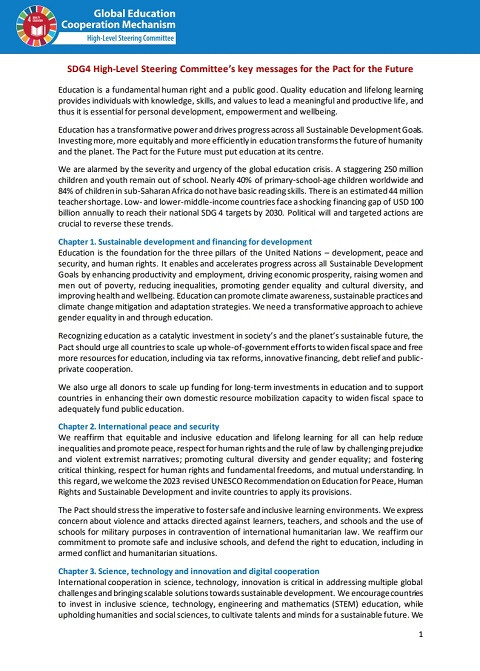 SDG4 High-Level Steering Committee’s Key Messages for the Pact for the Future Año de publicación: 2024 Autor corporativo: SDG4 High-Level Steering Committee Education is a fundamental human right and a public good. Quality education and lifelong learning provides individuals with knowledge, skills, and values to lead a meaningful and productive life, and thus it is essential for personal development, empowerment and wellbeing. Education has a transformative power and drives progress across all Sustainable Development Goals. Investing more, more equitably and more efficiently in education transforms the future of humanity and the planet. The Pact for the Future must put education at its center.
 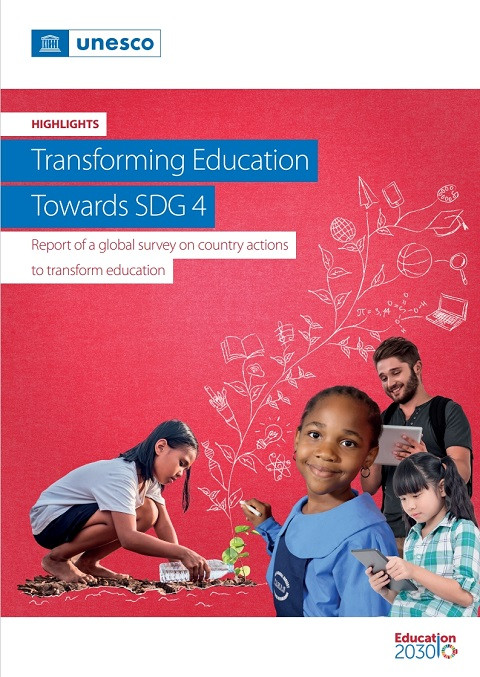 Transforming Education Towards SDG4: Report of a Global Survey on Country Actions to Transform Education; Highlights Año de publicación: 2024 Autor corporativo: UNESCO In 2022, the United Nations Transforming Education Summit responded decisively to mobilize action, ambition and solidarity as well as to elevate education to the top of the political agenda. This powerful mobilization led to 143 countries presenting national statements of commitment, demonstrating their political resolve to reimagine and transform their education systems. On the Summit’s fi rst anniversary, UNESCO invited its Member States to participate in the Survey on Country Actions to Transform Education and report on how they have translated their commitments into actions. This document presents highlights from the Transforming Education Towards SDG 4: Report of a global survey on country actions to transform education. It showcases transformative actions that countries have undertaken to accelerate progress towards SDG 4. The report emphasizes that education must adopt a holistic, lifelong and comprehensive approach that addresses the development and well-being of individual learners and society. Transforming education requires placing inclusion, equity and gender equality at the core of policies and interventions. It also requires more and better education fi nancing, and investments in the teaching profession.
  SDG4 이행 촉진을 위한 지표 연구 Año de publicación: 2025 Autor: 박근영 | 주형미 | 문무경 | 오예진 | 류기락 | 조혜승 | 변종임 | Sunmi Ji | 이슬비 | 박기웅 | 안해정 | 서무계 Autor corporativo: Korean National Commission for UNESCO 지속가능발전목표(SDGs) 이행의 전환점을 맞아 국내 교육의 현황과 과제를 SDG4 지표를 통해 진단하고 향후 방향을 탐색한 연구 보고서 <목차> 발간사 ‘SDG4 이행 촉진을 위한 지표 연구’ 보고서를 발간하며 서론 현 시점의 SDG4 이행 수준 점검과 개선 방향 탐색의 당위성 SDG 4.1 공평하고 양질의 초·중등 교육 이수 보장에 대한 한국 현황 및 향후 과제 SDG 4.2 영유아 교육과 보육 지표 검토와 향후 과제 SDG 4.3 고등교육의 수월성과 형평성 논의 및 향후 과제 SDG 4.4 고용을 위한 스킬: SDG 4.4의 이행 현황과 과제 SDG 4.5 교육 형평성 실현을 위한 SDG 4.5 지표 검토와 이행 현황 분석 SDG 4.6 한국의 SDG 4.6 이행 현행과 과제: 성인 문해력 SDG 4.7 더불어 살기 위한 학습을 향하여: 세계시민교육 및 지속가능발전교육 이행 현황과 모니터링 개선 방안 탐색 SDG 4.a SDG 4.a.1과 한국 디지털 교육 이행 현황: 접근성, 사용도, 스킬 SDG 4.b 공적개발원조(ODA) 장학금 확대 SDG 4.c 자격을 갖춘 교사의 공급 관련 이행 현황 및 개선 방안 결론 엄격한 현실 인식에 기반한 다음 목표로의 이행 준비
  Global Education Meeting: Fortaleza Declaration; Unlocking the Transformative Power of Education for Peaceful, Equitable and Sustainable Futures Año de publicación: 2024 Autor corporativo: UNESCO | Brazil. Ministry of Education The 2024 Global Education Meeting (GEM), held in Fortaleza, Brazil, marked a significant milestone in the global pursuit of education equity and financing, with the adoption of the powerful Fortaleza Declaration by over 650 participants including over 50 Ministers from across the globe. Reunión mundial sobre la educación: Declaración de Fortaleza; Aprovechar el poder transformador de la educación para forjar futuros pacíficos, equitativos y sostenibles Año de publicación: 2024 Autor corporativo: UNESCO | Brazil. Ministry of Education Este documento recoge la declaración de los ministros, los jefes y los miembros de las delegaciones nacionales, los representantes de los organismos de las Naciones Unidas, los asociados humanitarios y para el desarrollo, las organizaciones internacionales y regionales, las organizaciones de la sociedad civil, la profesión docente, los jóvenes y los estudiantes, el sector privado y las fundaciones, a partir de su participación en la Reunión Global sobre Educación (GEM) 2024, llevada a cabo los días 31 de octubre y 1° de noviembre. Esta reunión, organizada por la UNESCO y con sede en Brasil, tuvo el propósito de trazar la ruta para que la educación sea la prioridad de las naciones, las regiones y el mundo como un elemento clave para alcanzar todos los ODS, adoptando un enfoque integrado y de aprendizaje permanente, centrado en el fortalecimiento y la transformación de la educación.
  Literacy for Empowerment and Transformation: Report of the Secretary-General Año de publicación: 2024 Autor corporativo: United Nations | UNESCO The present report is submitted in fulfilment of the request made by the General Assembly, in its resolution 77/192, that the Secretary-General, in cooperation with the Director General of the United Nations Educational, Scientific and Cultural Organization (UNESCO), submit to the Assembly at its seventy-ninth session a report on the implementation of the resolution. The Assembly also invited UNESCO to continue its mandated role to lead and coordinate the Education 2030 Agenda and requested UNESCO to continue its coordinating and catalysing role through the implementation of the strategy of the Global Alliance for Liter acy and by continuing to provide support to Member States. The present report provides an overview of the global literacy landscape, highlighting progress, key challenges and recommendations for further promotion of literacy as part of the 2030 Agenda for Sustainable Development, the follow-up to the Transforming Education Summit and beyond.
 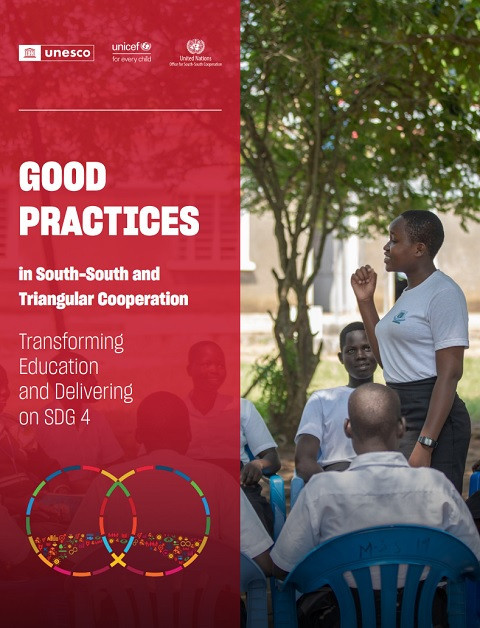 Good Practices in South-South and Triangular Cooperation: Transforming Education and Delivering on SDG 4 Año de publicación: 2023 Autor corporativo: UNESCO | United Nations Children's Fund (UNICEF) | UN. Office for South-South Cooperation (UNOSSC) Quality Education: South-South cooperation as a lever for action. This publication showcases 40 innovative solutions on how South-South and Triangular Cooperation can transform education.South-South and triangular cooperation is at the heart of SDG4 implementation on Quality Education. As demonstrated in the last few years, this kind of cooperation can mobilize action, ambition, solidarity and solutions to transform education in a rapidly changing world. From the inclusive approach to digital learning in Lao People’s Democratic Republic to distance learning and teacher training strategies in Caribbean SIDS, South-South cooperation is a key modality of cooperation for transforming education and supporting internationally agreed development goals, including the 2030 Agenda. This publication showcases 40 innovative solutions on how South-South and Triangular Cooperation can transform education.This publication presents forty innovative solutions from around the world which showcase how South-South and triangular cooperation can support the development of more efficient, equitable and resilient education systems that are adapted to the challenges of the 21st century. Countries of the South, with the support of partners, must enhance South-South and triangular cooperation to exchange resources, technology, skills and knowledge to realize the promise of making inclusive, quality education available to all.