
Recursos
Exploren una amplia gama de recursos valiosos en GCED para profundizar su comprensión y promover su búsqueda, incidencia, enseñanza y aprendizaje.
31 resultados encontrados
 Promoting Youth Well-Being Through Health and Education: Insights and Opportunities Año de publicación: 2019 Autor: Wing Yi Chan | Jennifer Sloan | Anita Chandra Autor corporativo: RAND Corporation Putting well-being at the heart of planning, policy making, and resource allocation is emerging as critical to the development of thriving communities and nations. We examined the academic and grey literature to identify theoretical frameworks that integrate health and education. We identified and described policies and programs supporting well-being around the world, and interviewed experts from each location to gain a deeper understanding of them.The report found that although wellbeing frameworks that integrate education and health exist, few of them have been examined rigorously to reveal how both educational and health outcomes can be achieved together.
  NISSEM Global Briefs (Volume II): Educating for the Social, the Emotional and the Sustainable; Pedagogy, Practice and Materials Año de publicación: 2020 Autor: Andy Smart | Margaret Sinclair Autor corporativo: Networking to Integrate SDG Target 4.7 and SEL skills into Educational Materials (NISSEM) The timeframe for achieving the Sustainable Development Goals (SDGs) is tight, and the world also faces the consequences of Covid-19. NISSEM Global Briefs aim to show how SDG Target 4.7 themes and social and emotional learning (SEL) can be embedded in education policies, programs, curricula, materials, and practice, to help make progress towards sustainable development.
 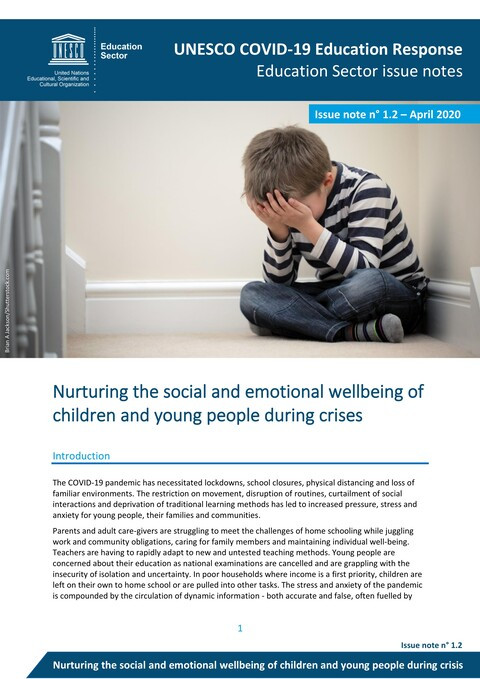 Nurturing the Social and Emotional Wellbeing of Children and Young People During Crises (UNESCO COVID-19 Education Response: Education Sector issue notes; No.1.2, 2020) Año de publicación: 2020 Autor corporativo: UNESCO The COVID-19 pandemic has necessitated lockdowns, school closures, physical distancing and loss of familiar environments. The restriction on movement, disruption of routines, curtailment of social interactions and deprivation of traditional learning methods has led to increased pressure, stress and anxiety for young people, their families and communities. Parents and adult care-givers are struggling to meet the challenges of home schooling while juggling work and community obligations, caring for family members and maintaining individual well-being. Teachers are having to rapidly adapt to new and untested teaching methods. Young people are concerned about their education as national examinations are cancelled and are grappling with the insecurity of isolation and uncertainty. In poor households where income is a first priority, children are left on their own to home school or are pulled into other tasks. The stress and anxiety of the pandemic is compounded by the circulation of dynamic information - both accurate and false, often fuelled by sensationalist media reporting. This not only increases insecurity but also acts as fertile ground for the spread of intolerance, racism, xenophobia and hate crimes. To address and counter the social anxiety, emotional upheaval and fearful insecurity unleashed by COVID-19, it is urgent and necessary that families and communities build vital coping skills and emotional resilience. Social and emotional skills are well established, evidence-based practices, that can be adapted to help equip children, young people, parents and teachers with the knowledge, skills, attitudes and behaviours they need to stay healthy and positive, navigate emotions, practice mindful engagement, exhibit pro-social behaviour and cope with daily challenges. Promoción del bienestar socioemocional de los niños y los jóvenes durante las crisis (Respuesta del ámbito educativo de la UNESCO al COVID-19 Notas temáticas del Sector de Educación; No.1.2, 2020) Año de publicación: 2020 Autor corporativo: UNESCO La pandemia del COVID-19 ha requerido cuarentenas, cierre de escuelas, distanciamiento físico y pérdida de entornos familiares. La restricción de movimiento, la interrupción de las rutinas, la reducción de las interacciones sociales y la privación de los métodos de aprendizaje tradicionales han dado como resultado una mayor presión, estrés y ansiedad en las personas jóvenes, sus familias y sus comunidades. Actualmente las madres, los padres y los cuidadores se esfuerzan por cumplir los desafíos del aprendizaje en el hogar y a la vez tener que hacer malabares con el trabajo y sus obligaciones comunitarias, el cuidado de sus familiares y su propio bienestar individual. Las y los docentes han tenido que adaptarse rápidamente a métodos de enseñanza nuevos y que todavía no han sido probados. La gente joven está preocupada por su propia educación al ver cancelarse los exámenes nacionales y luchan contra la inseguridad producida por el aislamiento y la incertidumbre. En los hogares más pobres, donde los ingresos son la primera prioridad, se deja a los niños y las niñas a cargo de su propio aprendizaje o se les asignan otras tareas. El estrés y la ansiedad de la pandemia se ven agravados por la circulación de información dinámica, tanto verdadera como falsa, que por lo general es fomentada por el trabajo de la prensa sensacionalista. Esto no solo aumenta la inseguridad, sino que también actúa como un campo fértil para la propagación de la intolerancia, el racismo, la xenofobia y los crímenes de odio. Para abordar y contrarrestar la ansiedad social, la convulsión emocional y la atemorizante inseguridad que ha desatado el COVID-19, es urgente que las familias y las comunidades desarrollen habilidades vitales de adaptación y resiliencia emocional. Las habilidades sociomocionales son prácticas bien establecidas y con base empírica que se pueden adaptar con el fin de entregar a niños, niñas, jóvenes, padres, madres y docentes las herramientas, habilidades, actitudes y conductas necesarias para mantenerse sanos y positivos, explorar en sus emociones, practicar un compromiso consciente, exhibir una conducta prosocial y lidiar con los desafíos diarios. Favoriser le bien-être social et émotionnel des enfants et des jeunes en période de crise(Réponse éducative de l’UNESCO face au Covid-19: Notes du Secteur de l’éducation; No.1.2, 2020) Año de publicación: 2020 Autor corporativo: UNESCO La pandémie de COVID-19 a nécessité le confinement, la fermeture des écoles, la distanciation physique et la perte d’environnements familiers. Les restrictions de déplacement, le bouleversement des routines, la diminution des interactions sociales et la privation des méthodes d’apprentissage traditionnelles ont eu pour effet d’augmenter la pression, le stress et l’anxiété chez les jeunes, leurs familles et leurs communautés Les parents et les adultes aidants déploient des efforts considérables pour gérer l’école à la maison, tout en jonglant avec leurs obligations professionnelles et communautaires, s’occupant des membres de la famille et préservant le bien-être de chacun. Les enseignants doivent s’adapter rapidement à de nouvelles méthodes d’enseignement non éprouvées. Les jeunes s’inquiètent pour leurs études à cause de l’annulation des examens et sont aux prises avec un sentiment d’insécurité dû à l’isolement et à l’incertitude. Dans les foyers pauvres, où le revenu est la priorité absolue, les enfants sont livrés à euxmêmes pour leur travail scolaire ou en sont détournés pour effectuer d’autres tâches. Le stress et ’anxiété suscités par la pandémie sont aggravés par la circulation d’informations, exactes ou fausses, souvent exacerbées par les articles à sensation des médias. Non seulement le sentiment d’insécurité en est accru, mais cela crée un terrain propice à la propagation de l’intolérance, du racisme, de la xénophobie et des crimes de haine. Pour combattre et contrer l’anxiété sociale, les troubles émotionnels ainsi que le sentiment d’insécurité et de peur générés par le COVID-19, il est urgent et nécessaire que les familles et les communautés acquièrent des capacités d’adaptation et une résilience émotionnelle vitales. Les compétences sociales et émotionnelles sont des pratiques bien établies, fondées sur des données, qui peuvent être adaptées pour équiper les enfants, les jeunes, les parents et les enseignants des connaissances, compétences, attitudes et comportements nécessaires pour rester en bonne santé et positifs, gérer ses émotions, s’engager en toute conscience, adopter un comportement social positif et faire face aux difficultés quotidiennes. 培育儿童和青少年在危机期间的社会情感健康 (联合国教科文组织针对新冠疫情的教育对策教育部门议题说明; No.1.2, 2020) Año de publicación: 2020 Autor corporativo: UNESCO 新型冠状病毒大流行迫使人们采取隔离措施,保持社交距离并关闭学校,导致人们失去熟悉的环境,行动受限,日常生活被打乱,社交活动减少,传统的学习方式遭遇终结,因此带给年轻人及其家庭和社区成员前所未有的压力和焦虑感。 父母和成人照顾者不仅要兼顾工作和社区义务、照顾家庭成员并保持个人健康,同时,还要努力应对孩子在家上学所带来的挑战。教师需要快速适应未经测试的新教学方法。全国考试取消令年轻人对自身的教育前景备感担忧,社交距离和不确定性带给他们不安全感。对一些贫困家庭而言,维持收入是第一要务,因此他们不得不将孩子独自留在家中学习,或者吩咐他们去做其它工作。实时更新的疫情信息,加剧了人们的压力和焦虑感。这些消息真假参半,时不时蹦出一些耸人听闻的新闻报导,不仅增加人们的不安全感,也为狭隘心理、种族主义、排外情绪以及仇视性犯罪行为提供了生长的土壤。 为了应对新型冠状病毒引起的社交焦虑、情绪波动和令人恐惧的不安全感,家庭和社区迫切需要培养必要的应对技能和情绪复原能力。经实践证明,社会情感技能可以赋予儿童、青年、父母和教师必要的知识、技能、态度和行为,有助于其保持健康和积极的状态,有效管理情绪,采取正念的做法,展现亲社会行为并应对日常挑战。
  دليل ومجموعة أدوات المدارس السعيدة رافد ومصدر للسعادة ورفاه المتعلم والتعلم الاجتماعي والعاطفي في منطقة آسيا والمحيط الهادئ Año de publicación: 2021 Autor corporativo: UNESCO | UNESCO Bangkok تم إعداد هذا الدليل بــهدف دعم المعــلمين والقــادة فــي مجالــي التعــليم األساســي والثــانوي فــي جميــع مناطــق آسيــا والمحيط الهــادئ فــي التــفكير فــي كيفيــة إنشــاء مدرســة ســعيدة، وهو بذلك يستند علــى عدة ركائز إلطــار عمل المدارس الســعيدة. وفــي حين أن دليل المدارس الســعيدة يستــهدف قــادة المدارس والمعــلمين فيمــا يتعلــق بــالمستوى اإلداري وتطوير عــلوم التربيــة، فــإن مجموعــة أدوات المدرســة الســعيدة قد صممت للمعــلمين علــى مستوى الصف الدراســي. Happy Schools Guide and Toolkit: A Resource for Happiness, Learners’ Well-Being and Social and Emotional Learning Año de publicación: 2021 Autor corporativo: UNESCO | UNESCO Bangkok The Happy Schools Guide and Toolkit is designed to support teachers and school leaders in primary and secondary schools across the Asia-Pacific region, in thinking about how they can create their own Happy School. It has therefore drawn from aspects of the Happy Schools Framework, which can be most readily addressed at the school level. While the Happy Schools Guide is targeted towards school leaders and teachers at the school level of administration and pedagogy development, the Happy Schools Toolkit is conceived for teachers at the classroom level.
  Strategies to Counter Antisemitism: A Handbook for Educators Año de publicación: 2025 Autor corporativo: UNESCO Education is the first line of defence against hate and prejudice. By targeting the root causes of hate ideologies, deconstructing the stereotypes that underlie them from an early age, and promoting inclusive models, education is the keystone of a holistic approach to combating discrimination. Tackling antisemitism through education requires tailored content that addresses its complex, shifting and multilayered forms, both past and present.Acknowledging the topic’s complexity and the paucity of resources available to education stakeholders, this concise guide developed by UNESCO and funded by the European Commission aims to provide a roadmap for policymakers, curriculum developers and educators on current approaches and initiatives. It presents ten educational practices, each grounded in academic literature and illustrated by a promising educational initiative that operationalizes core pedagogical principles. The handbook is built around the three core learning domains which inform UNESCO’s approach to Global Citizenship Education: cognitive, socio-emotional, and behavioural learning.Conceived as an accessible operational guide for practitioners, this resource sets out to start a larger conversation about the needs of educators for tackling contemporary forms of antisemitism. It aims to encourage investments in high-quality empirical research that can pave the way for a better approach to combat antisemitism.
  Mainstreaming Social and Emotional Learning in Education Systems: Policy Guide; Highlights Año de publicación: 2024 Autor corporativo: UNESCO UNESCO’s policy guide unpacks social and emotional learning (SEL) as a broadening of the educational process, from a focus on cognitive aspects to a balance between cognitive, social and emotional, and behavioural dimensions of learning, putting forward initial action ideas to guide its systematic mainstreaming in education. It builds on and extends previous work undertaken by UNESCO on SEL from the perspective of Global Citizenship Education (GCED) and Education for Sustainable Development (ESD), Building Strong Foundations for Health and Well-being Education, the Happy Schools Framework, and in multiple UNESCO Offices and Institutes.