
Recursos
Exploren una amplia gama de recursos valiosos en GCED para profundizar su comprensión y promover su búsqueda, incidencia, enseñanza y aprendizaje.
133 resultados encontrados
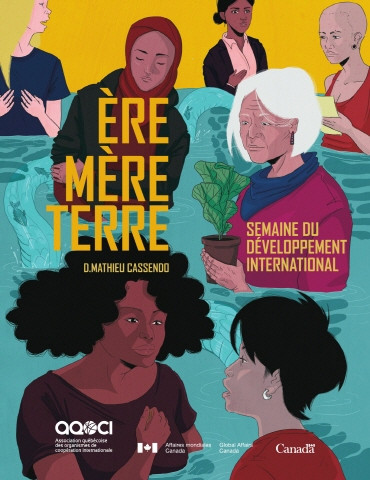 Age, Earth, Sea: International Development Week Año de publicación: 2020 Autor: Dimani Mathieu Cassendo Autor corporativo: Quebec Association of International Cooperation Organizations (AQOCI) Each year, International Development Week (IDW) highlights an international issue of concern to society. In Quebec, the Association québécoise des organismes de coopération internationale (AQOCI) organizes this public awareness week. CRÉDIL plays an active role in this campaign, and has participated in the production of comic strips as educational tools, such as "Ère, Terre, Mer" in 2021, which deals with the impact of the climate change on peoples.
  العنف في الوسط المدرسي:تقرير موضوعاتي Año de publicación: 2023 Autor corporativo: Higher Council for Education, Training, and Scientific Research (CSEFRS) | United Nations Children's Fund (UNICEF) يقدم هذا التقرير نتائج تقييم العنف في الوسط المدرسي الذي أجراه المجلس الأعلى للتربية والتكوين والبحث العلمي، من خلال الهيئة الوطنية للتقييم، بشراكة مع منظمة اليونيسيف. ويسلط هذا التقرير الضوء على أهمية وجود بيئة مدرسية آمنة وخالية من العنف لضمان تعليم ذي جودة.الهدف الرئيسي لهذا التقييم يكمن في تقديم تشخيص مفصل لوضع العنـف في الوسط المدرسي في المغرب. وعليـه، تركــز الدراســة عـلـى قيــاس مــدى انتشــار هــذه الظاهــرة وتحديــد أشــكالها وتجلياتها المختلفة في الوســط المدرسي، وكــذا الفاعلـيـن المعنين بهــا، وهــي لا تســتهدف مرتكبــي العنــف فقــط، بــل أيضــا ضحايــاه مــن تلامذة وأطر تربوية. Violence in Schools: Thematic Report Año de publicación: 2023 Autor corporativo: Higher Council for Education, Training, and Scientific Research (CSEFRS) | United Nations Children's Fund (UNICEF) This report presents the results of an assessment of violence in school settings conducted by the Higher Council for Education, Training and Scientific Research, through the National Evaluation Authority, in partnership with UNICEF. This report highlights the importance of a safe, violence-free school environment to ensure quality education.The main objective of this evaluation is to provide a detailed diagnosis of the situation of violence in the school environment in Morocco. Accordingly, the study focuses on measuring the extent of the spread of this phenomenon and identifying its various forms and manifestations in the school environment, as well as the actors involved in it. It does not only target the perpetrators of violence, but also its victims, including students and educational staff. La violence en Milieu scolaire: Rapport Thématique Año de publicación: 2023 Autor corporativo: Higher Council for Education, Training, and Scientific Research (CSEFRS) | United Nations Children's Fund (UNICEF) Ce rapport présente les résultats de l’évaluation de la violence en milieu scolaire réalisée par le Conseil Supérieur de l’Éducation, de la Formation et de la Recherche Scientifique à travers l’Instance Nationale d’Évaluation en partenariat avec l’UNICEF. Il met en évidence l’importance d’un environnement scolaire sûr et sans violence pour garantir une éducation de qualité. L’objectif principal de cette évaluation est d’apporter un diagnostic détaillé sur la situation de la violence en milieu scolaire au Maroc. Elle vise ainsi à en mesurer la prévalence et à identifier les différentes formes et manifestations de celle-ci, ainsi que les acteurs impliqués, en ciblant, non seulement les auteurs de violence, mais également les victimes parmi les élèves et le personnel éducatif. Cette évaluation repose sur les résultats d’une enquête quantitative réalisée à la fin du premier trimestre de l’année scolaire 2021-2022, auprès de 260 établissements représentatifs à l’échelle nationale, avec la participation de 13 884 élèves représentant les trois cycles de l’enseignement (primaire, secondaire collégial et qualifiant), ainsi qu’une enquête qualitative menée dans 27 établissements.
  Get Global!: Steps Worksheets Año de publicación: 2003 Autor: Joanne Price Autor corporativo: ActionAid | Oxfam Get Global! is a teachers' guide on how to facilitate active global citizenship. It allows learners to move from thinking about issues that are important to them, to planning and participating in action, and to reflect on their performance, and assess their work. Although aimed at 11-16 year olds, some of the activities could easily be adapted for use with younger learners.
  Get Global!: Assessment & Evaluation Worksheets Año de publicación: 2003 Autor: Joanne Price Autor corporativo: ActionAid | Oxfam Get Global! is a teachers' guide on how to facilitate active global citizenship. It allows learners to move from thinking about issues that are important to them, to planning and participating in action, and to reflect on their performance, and assess their work. Although aimed at 11-16 year olds, some of the activities could easily be adapted for use with younger learners.
  Teachers and Migrant Families: Pressing Communication (Iberoamerican Journal of Education; vol. 89, no. 1) Año de publicación: 2022 Autor: Mohamed Chamseddine Habib Allah Autor corporativo: Organización de Estados Iberoamericanos (OEI) This article presents the results of a study whose objective is to analyze the state of communication between migrant families and teachers in Early Childhood and Primary Education Centers in the Region of Murcia. Two questionnaires were chosen to develop a descriptive non-experimental quantitative research. The main results reveal that extracurricular activities are not part of the usual conversations between families and teachers. However, acceptable but improvable aspects are detected, such as delving into discipline issues, and student learning, etc. On the other hand, it is evident that the parents still do not go to visit the teachers on their own initiative to address the relevant elements of the teaching-learning process of their children. Docencia y familias migrantes: comunicación acuciante (Revista Ibero-americana de Educação; vol. 89, núm. 1) Año de publicación: 2022 Autor: Mohamed Chamseddine Habib Allah Autor corporativo: Organización de Estados Iberoamericanos (OEI) Este artículo presenta los resultados de un estudio cuyo objetivo es analizar el estado de comunicación entre las familias migrantes y los docentes en Centros Educativos de Educación Infantil y Primaria de la Región de Murcia. Se optó por dos cuestionarios homólogos para desarrollar una investigación de carácter cuantitativo no experimental de corte descriptivo. De los principales resultados se revela que las actividades extraescolares no forman parte de las conversaciones habituales entre las familias y el profesorado. Sin embargo, se detectan aspectos aceptables pero mejorables, como profundizar en los temas de disciplina, y el aprendizaje del alumnado, etc. Por otro lado, se evidencia que los progenitores siguen sin acudir a visitar a los docentes por iniciativa propia para abordar los elementos relevantes del proceso de enseñanza-aprendizaje de sus hijos e hijas.
  Les transformations des droits sociaux dans la globalisation Año de publicación: 2019 Autor: Jérôme Porta Autor corporativo: La Revue des Droits de l'Homme La globalisation des droits se manifeste par des phénomènes souvent décrits en termes de circulation ou transfert de droits. Parmi ces phénomènes, il en est un dont l’importance paraît croissante en matière sociale. Il s’agit du dépôt de droits sociaux sur des supports n’ayant pas pour objet de réglementer les rapports de travail, mais, d’encadrer les échanges commerciaux, de réguler la production de biens ou de produits, de promouvoir certaines politiques sociales ou encore de coordonner des politiques publiques nationales. Les clauses sociales présentes de manière croissante dans les accords de libre-échange ou l’adossement du socle européen des droits sociaux à un tableau d’indicateurs en sont des illustrations. Ces pratiques d’inclusion des droits du travailleur au sein de support économique, technique ou politique ne font pas véritablement objet d’attention pour elles-mêmes et sont trop souvent interprétés à partir de la normativité juridique. Cette extension de l’analyse juridique à de tels objets aboutit à ne commenter ces instruments qu’en terme d’écart au droit : ces droits sont-ils objets de sanction efficace ? Peuvent-ils être justiciables et invoqués devant un juge ? Ces préoccupations laissent dans l’ombre une question plus fondamentale, celle du changement qu’opère le passage d’une forme normative à une autre. Ces hybridations impliquent en effet une traduction, mieux une transformation. Tel est l’objet de la présente contribution. The globalization of rights is manifested by phenomena often described as the circulation or transfer of rights. Among these phenomena, there is one category, whose importance seems to be growing in international and european social matters. It is manifested by the filing of social rights on instruments not intended to regulate labour relations, but to regulate international trade, regulate the production of goods or products, promote certain social policies or even coordinate national public policies. The social clauses increasingly present in free trade agreements or the linking of the European social rights Pillar to a scoreboard of indicators are examples among many others of this. These practices of including workers' rights in economic, technical or political support do not really attract attention for themselves and are too often interpreted on the basis of legal normativity. This extension of the legal analysis to such objects leads to commenting on these instruments only in terms of deviation from the law : are these rights subject to effective sanctions ? Can they be justiciable and invoked before a judge ? These concerns leave a more fundamental question in the shadows, that of the changes brought about by the passage from one normative form to another. These hybridizations imply a translation, better a transformation. This is the purpose of this contribution to descriptib such a process and its implications.
  Diriger et agir pour l’équité, l’inclusion et la justice sociale : boîte à outils pour les directions d’établissement d’enseignement Año de publicación: 2020 Autor: Julie Larochelle-Audet | Marie-Odile Magnan | Emmanuelle Doré | Maryse Potvin | Lise-Anne St-Vincent | Andréanne Gélinas-Proulx | Anastasie Amboulé Abath Autor corporativo: Observatoire sur la formation à la diversité et l’équité (OFDE) L’objectif principal de ce document est d’outiller les directions d’établissement, en exercice ou en formation, pour qu’ils puissent contribuer à la mise en œuvre d’une éducation permettant à tous et toutes d’avoir des opportunités équivalentes d’accéder aux services, aux ressourceset aux biens collectifs de la société québécoise et d’y participer en toute égalité et dignité. The main objective of this document is to equip school principals and those in training with the tools they need to contribute to the implementation of an education system that gives everyone equal opportunities to access the services, resources and public goods of Quebec society and to participate in them with full equality and dignity.