
Recursos
Exploren una amplia gama de recursos valiosos en GCED para profundizar su comprensión y promover su búsqueda, incidencia, enseñanza y aprendizaje.
126 resultados encontrados
 [فيديو] الغايات العشر للهدف 4 من أهداف التنمية المستدامة ... مع إليكس! Año de publicación: 2017 Autor corporativo: UNESCO شاهد فيديو اليونسكو الجديد الذي يشرح الغايات العشر للهدف 4 من أهداف التنمية المستدامة. واكتشف مع إليكس، أول سفير رقمي للأمم المتحدة، كيفيةضمان وصول التعليم للجميع وتعزيز فرص التعلّم المتساوية والجيدة طوال العمر.
  Historical efforts to implement the UNESCO 1974 Recommendation on Education in light of 3 SDGs Targets Año de publicación: 2017 Autor corporativo: UNESCO This paper presents an analytical overview of historical efforts by Member States of the United Nations Educational, Scientific and Cultural Organization (UNESCO) to implement the 1974 Recommendation concerning education for international understanding, cooperation and peace education relating to human rights and fundamental freedoms. The author of the review was hired in April 2016 to undertake an analysis of Member States’ progress reports submitted for the fourth (2008) and fifth (2012) consultations on implementation of the 1974 Recommendation. The main purpose of the review was to provide a historical overview of efforts to achieve Sustainable Development Goal (SDG) Targets 4.7, 12.8 and 13.3 and their proposed measurement indicators, based on states’ historical reporting on the Recommendation. A total of 94 country reports were reviewed for the exercise: 37 from the 4th Consultation (2008); and 57 from the 5th Consultation (2012). The coding involved retrofitting the content of reportsto conceptsthat may have been developed at a later date for the Sustainable Development Agenda and coding for data that was not explicitly requested in the Consultations. Following the coding, a quantitative and qualitative analysis was undertaken and is presented in the following report.
  Unpacking Sustainable Development Goal 4 Education 2030: Guide Año de publicación: 2017 Autor corporativo: UNESCO This guide, organized around a set of questions and answers to “unpack” SDG4, provides overall guidance for a deeper understanding of SDG4 within the 2030 Agenda for Sustainable Development, in order to support its effective implementation. The guide outlines the key features of SDG4-Education 2030 and the global commitments expressed in the SDG4 targets as articulated in the Incheon Declaration and the Education 2030 Framework for Action. The guide also examines the implications of translating these global commitments within, and through, national education development efforts. This guide supplements the UNESCO technical guidelines (2016) for Mainstreaming SDG4-Education 2030 into sector-wide policy and planning. It was developed by Sobhi Tawil, Margarete Sachs-Israel, Huong Le Thu, and Matthias Eck of the UNESCO Section of Partnerships, Cooperation and Research (PCR) within the Division for Education 2030 Support and Coordination. Comprendre l'Objectif de développement durable 4: Education 2030, guide Año de publicación: 2017 Autor corporativo: UNESCO Le présent guide, qui s’articule autour d’une série de questions et de réponses pour « décoder » l’ODD4, contient des indications générales permettant de mieux comprendre sa place dans le Programme pour le développement durable à l’horizon 2030 et d’assurer sa mise en œuvre efficace. Il met en avant les principales caractéristiques de l’ODD4-Education 2030 et les engagements pris au niveau mondial, manifestés dans les cibles de l’ODD4 telles que formulées par la Déclaration d’Incheon et le Cadre d’action Education 2030.Ce guide complète les principes directeurs techniques de l’UNESCO (2016) pour l’intégration de l’ODD4-Education 2030 au sein de la politique et de la planification sectorielles. Il a été élaboré par Sobhi Tawil, Margarete Sachs-Israel, Huong Le Thu et Matthias Eck de la Section Partenariats, Coopération et Recherche (PCR) de l’UNESCO au sein de la Division d’appui et de coordination d’Éducation 2030.Qu’est-ce que le Programme de développement durable à l’horizon 2030 ?Le Programme de développement durable à l’horizon 2030 est un engagement intergouvernemental et un « plan d’action pour l’humanité, la planète et la prospérité ». Il se compose de 17 Objectifs de développement durable (ODD) « intégrés et indissociables qui concilient les trois dimensions du développement durable : économique, sociale et environnementale », démontrant par ailleurs l’ampleur et l’ambition de ce nouveau Programme universel. Ils ressortent de ce qui a été sans nul doute le processus de consultation le plus inclusif de toute l’histoire des Nations Unies, le fruit de la contribution substantielle de tous les secteurs de la société, de tous les acteurs de la communauté internationale et de toutes les régions du monde. Tous les États membres, l’ensemble du système des Nations Unies, les experts et les représentants de la société civile, du monde des entreprises et, le plus important, des millions de personnes du monde entier, ont pris l’engagement de concrétiser ce large programme qui s’attaque aux préoccupations communes de la planète toute entière et de promouvoir le bien public.
 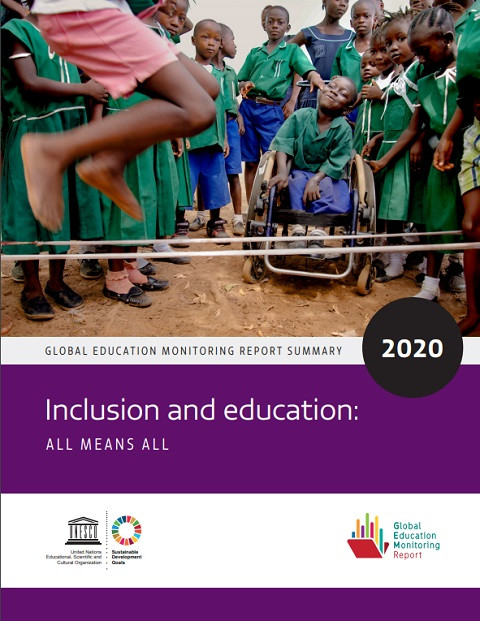 [Summary] Global Education Monitoring Report Summary 2020: Inclusion and Education; All Means All Año de publicación: 2020 Autor corporativo: UNESCO | Global Education Monitoring Report Team The 2020 Global Education Monitoring Report looks at social, economic and cultural mechanisms that discriminate against disadvantaged children, youth and adults, keeping them out of education or marginalized in it. Spurred by their commitment to fulfil the right to inclusive education, countries are expanding their vision of inclusion in education to put diversity at the core of their systems. Yet implementation of well-meaning laws and policies often falters. Released at the start of the decade of action to 2030, and in the middle of the Covid-19 crisis, which has exacerbated underlying inequalities, the Report argues that resistance to addressing every learner’s needs is a real threat to achieving global education targets. [Résumé] Résumé du rapport mondial de suivi sur l’éducation 2020: Inclusion et éducation; Tous, sans exception Año de publicación: 2020 Autor corporativo: UNESCO | Global Education Monitoring Report Team L’édition 2020 du Rapport mondial de suivi sur l’éducation examine les mécanismes sociaux, économiques et culturels qui discriminent les enfants, les jeunes et les adultes défavorisés, les tenant à l’écart de l’éducation ou les marginalisant en son sein. Encouragés par leur engagement à réaliser le droit à l’éducation inclusive, les pays élargissent leur vision de l’inclusion dans l’éducation afin de placer la diversité au cœur de leurs systèmes. Pourtant, la mise en œuvre de lois et de politiques bien intentionnées échoue souvent. Publié au début de la décennie d’action à l’horizon 2030, et en pleine crise de COVID-19 qui a exacerbé les inégalités existantes, rapport affirme que la résistance à la prise en compte des besoins de chaque apprenant constitue une menace réelle pour la réalisation des objectifs mondiaux d’éducation. [Resumen] Resumen del informe de seguimiento de la educación en el mundo 2020: Inclusión y educación; Todos sin excepción Año de publicación: 2020 Autor corporativo: UNESCO | Global Education Monitoring Report Team En el Informe de Seguimiento de la Educación en el Mundo 2020 se examinan los mecanismos sociales, económicos y culturales que discriminan a niños, jóvenes y adultos desprotegidos, manteniéndolos excluidos de la educación o marginados dentro de ella. Estimulados por su compromiso de hacer realidad el derecho a la educación inclusiva, los países están ampliando su visión de la inclusión en la educación y otorgando a la diversidad un lugar central en sus sistemas. Sin embargo, la aplicación de leyes y políticas bienintencionadas suele flaquear. El informe, publicado a principios del decenio de acción que culmina en 2030 y en el contexto de la crisis de Covid-19 que ha exacerbado las desigualdades subyacentes, sostiene que la resistencia a atender las necesidades de todos los educandos es una verdadera amenaza para el logro de los objetivos mundiales de educación. Pезюме всемирного доклада по мониторингу образования 2020: Инклюзивность и образование; для всех означает для всех Año de publicación: 2020 Autor corporativo: UNESCO | Global Education Monitoring Report Team Во Всемирном докладе по мониторингу образования за 2020 г. рассматриваются социальные, экономические и культурные механизмы, которые служат источниками дискриминации обездоленных детей, молодых людей и взрослых, не позволяя им получать образование или отводя им маргинальное место. В подтверждение своей приверженности делу осуществления права на инклюзивное образование страны расширяют свое видение инклюзивности в образовании, отводя разнообразию центральное место в рамках своих систем. Однако воплотить в жизнь правильные, по сути, законы и стратегии часто не удается. В настоящем докладе, вышедшем в начале десятилетия действий на период до 2030 г., в разгар кризиса COVID-19, усугубившего основные формы неравенства, утверждается, что отказ обеспечить удовлетворение потребностей каждого учащегося представляет собой реальную угрозу для решения глобальных задач в области образования.
 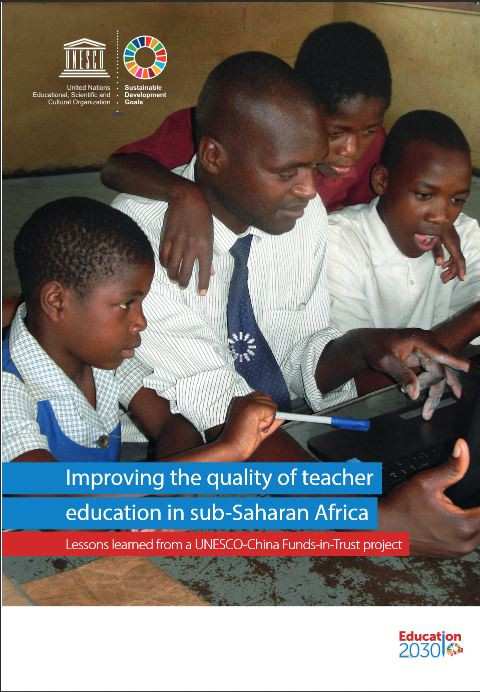 Improving the quality of teacher education in Sub-Saharan Africa: lessons learned from a UNESCO-China Funds-in-Trust project Año de publicación: 2018 Autor corporativo: UNESCO The booklet describes how the project started, the choice of beneficiary countries, the implementation strategies and its achievements. The different sections numbered one to four describe particular aspects of the project, using country cases to illustrate how the success of the project was due to strong country ownership and leadership. UNESCO, in partnership with the Government of the People’s Republic of China, initiated the project to enhance the institutional capacity and the professional development of teacher educators through ICT-supported learning, teaching and research. This technology aided the transformation of capacity teacher training through digitalization of instructional materials. ملخص التقرير العالمي لرصد التعليم 2020: التعليم الشامل للجميع; الجميع بال استثناء Año de publicación: 2020 Autor corporativo: UNESCO | Global Education Monitoring Report Team ينظر التقرير العالمي لرصد التعليم لعام 2020 في اآلليات االجتماعية واالقتصادية والثقافية التي تميز ضد األطفال والشباب والبالغين المحرومين، مما يحرمهم من التعليم أو يجعلهم مهمشين فيه. وبفضل حافز التزامها بإعمال الحق في التعليم الشامل، تعمل البلدان على توسيع نطاق رؤيتها للتعليم الشامل بإدراج التنوع في صلب ً ما يتعثر تنفيذ القوانين والسياسات الهادفة التي تنطوي نظمها التعليمية. لكن غالبا على نوايا حسنة. ويرى التقرير الذي صدر في بداية عقد العمل حتى عام 2030 ، وفي خضم األزمة الناجمة عن جائحة كوفيد-19 ،التي أسفرت عن تفاقم أوجه عدم ً أمام ً حقيقيا المساواة الكامنة، أن مقاومة تلبية احتياجات كل متعلم تشكل تهديدا تحقيق أهداف التعليم العالمية.