
Recursos
Exploren una amplia gama de recursos valiosos en GCED para profundizar su comprensión y promover su búsqueda, incidencia, enseñanza y aprendizaje.
126 resultados encontrados
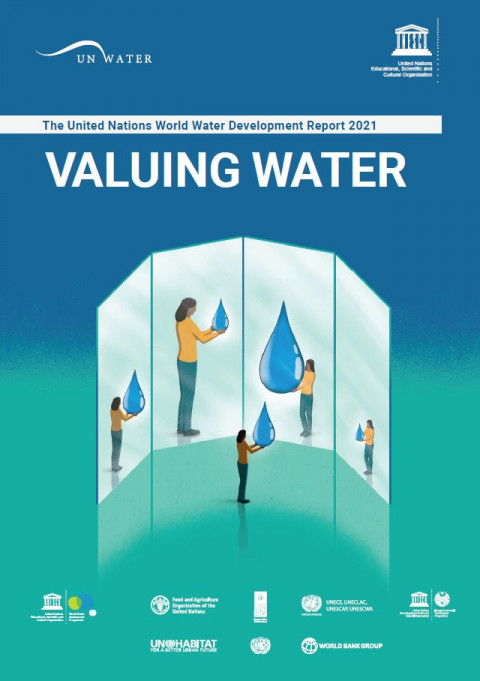 The United Nations World Water Development Report 2021: Valuing Water Año de publicación: 2021 Autor corporativo: UNESCO World Water Assessment Programme (WWAP) The 2021 edition of the United Nations World Water Development Report focuses on valuing water. There is enough water for all provided we use and manage it efficiently. But we don’t. We invest too little, and ineffectively. We use too much water, creating scarcities. Quality is suffering and so is the environment.The value we place on water varies, depending upon who is using it, and why. Value can be a guide to what our goals should be, what actions are needed, and where we should invest. Many of our problems arise because we don’t value water highly enough; all too often water is not valued at all.This report explains various approaches to valuing water for environmental considerations, water-related infrastructure, drinking water, sanitation and hygiene. It looks at valuation issues in food and agriculture, business, industry, energy and financing. And it highlights the perspectives of different value systems and cultures, and associated social and gender-based considerations.
  Concept note for the 2020 Global education monitoring report on inclusion Año de publicación: 2018 In line with its mandate, the 2020 GEM Report will assess progress towards Sustainable Development Goal 4 (SDG 4) on education and its ten targets, as well as other related education targets in the SDG agenda.Echoing the overall orientation in the SDGs to “leave no one behind”, this year's Report will also take an in-depth look at inclusion and education. Inclusion is central in the formulation of SDG 4 but is also taken up in other targets in the goal, notably targets 4.5 on gender equality and 4.a on learning environments. Responding to this emphasis, the 2020 GEM Report will analyse policies the world over and present evidence on the different elements of education systems that can support inclusion, such as laws and policies, governance and finance, curricular and learning materials, teachers, school infrastructure, school selection and parental and community views.The Report will focus on the barriers faced by all learners, especially those with overlapping characteristics that make them particularly vulnerable to exclusion. It will also take an in-depth look at people with disabilities, a group whose particular challenges gave rise to the inclusion debate. The Report will look at a range of indicators measuring inclusion in education using both quantitative and qualitative data. The analysis will be based on geographically balanced evidence, and will pay special attention to contexts where disadvantaged children might be particularly at risk of exclusion from education, such as in situations of conflict.
 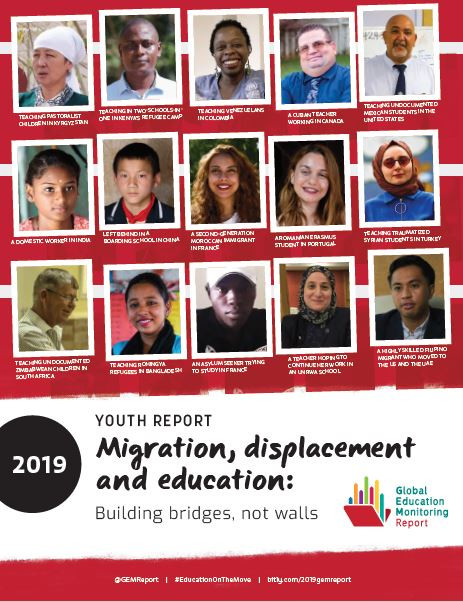 Migration, displacement and education: building bridges, not walls; Global education monitoring report, youth report, 2019 Año de publicación: 2018 Autor corporativo: Global Education Monitoring Report Team The Education 2030 Incheon Declaration and Framework for Action specifies that the mandate of the Global Education Monitoring Report is to be ‘the mechanism for monitoring and reporting on SDG 4 and on education in the other SDGs’ with the responsibility to ‘report on the implementation of national and international strategies to help hold all relevant partners to account for their commitments as part of the overall SDG follow-up and review’. It is prepared by an independent team hosted by UNESCO. This is among the most aspirational global commitments of the United Nations 2030 Agenda for Sustainable Development. Migration and displacement are two global challenges the agenda needs to address in achieving the 17 Sustainable Development Goals (SDGs), including SDG4: ‘Ensure inclusive and equitable quality education and promote lifelong learning opportunities for all’.
 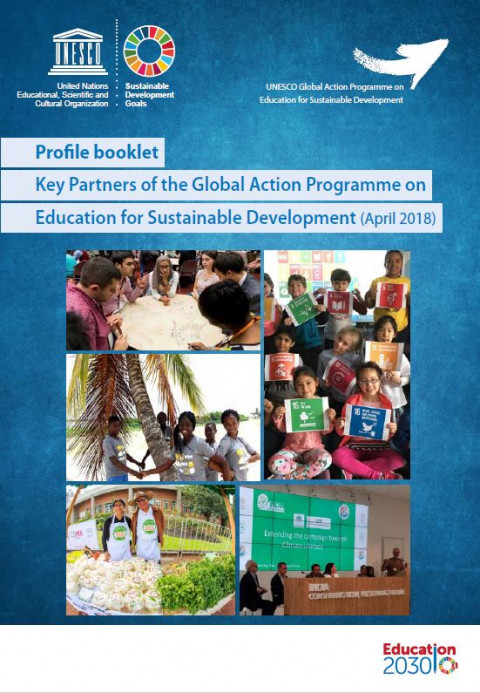 Profile booklet: key partners of the Global Action Programme on Education for Sustainable Development (April 2018) Año de publicación: 2018 UNESCO’s Global Action Programme (GAP) was launched at the World Conference on Education for Sustainable Development (ESD) in November 2014 in Aichi-Nagoya, Japan as a follow-up programme to the Decade of ESD (2005-2014). This booklet contains profiles of the current 96 members (also called Key Partners) of the GAP Partner Networks. Each Key Partner is listed in alphabetical order within one of the five Partner Networks. Each profile presents the main objective of their work, their GAP launch commitment and specific activities that contribute to the GAP, as well as related website links and contact information for the organization’s focal point.
  Integrating education for sustainable development (ESD) in teacher education in South-East Asia: a guide for teacher educators Año de publicación: 2018 Autor corporativo: UNESCO Bangkok This publication is a cumulative output of the project Sustainability Begins with Teachers in South-East Asia, implemented by UNESCO Bangkok, in cooperation with SEAMEO from 2017 to 2018, with the generous support of the Government of Japan. The initial content was developed together with the representatives of the universities and teacher education institutions who participated in the South-East Asia Sub-Regional Workshop on Education for Sustainable Development for Teacher Education Institutions, held from 5 to 9 June 2017 in Chiang Rai, Thailand. Content has since been enhanced through the sharing of knowledge and experiences gathered from a series of in-country workshops held in Cebu, Philippines; Luang Prabang, Lao PDR; Kampot, Cambodia; Bangkok, Thailand; and Yogyakarta, Indonesia. This culminated in a project review workshop in Bangkok from 24 to 26 April 2018 in which different in-country experiences were shared and comments on the guidebook collected. Twenty-six universities and teacher education institutions have taken part in the project process in total. This guidebook is a result of this collaborative journey.
  SDG 4 Data Book 2019 Año de publicación: 2019 Autor corporativo: UNESCO Institute for Statistics (UIS) This publication presents the global monitoring indicators used by countries and the international development community to monitor progress towards Sustainable Development Goal 4 (SDG 4) on education. The indicators were produced by the UNESCO Institute for Statistics (UIS), based on the latest available data.The UIS is the official source of internationally-comparable education data and the custodian agency for SDG 4 data. This mandate reflects the trust of the international community in UIS data and its proven track record in methodological work and standard-setting with national statistical offices, line ministries and technical partners in every region. Recueil de données de l’ODD4 Año de publicación: 2019 Autor corporativo: UNESCO Institute for Statistics (UIS) Cette publication présente les indicateurs de suivi mondiaux utilisés par les pays et la communauté du développement international pour surveiller les progrès réalisés sur la voie de l’Objectif de développement durable 4 (ODD 4) relatif à l’éducation. Les indicateurs ont été produits par l’Institut de statistique de l’UNESCO (ISU), sur la base des dernières données disponibles.L’ISU est la source officielle de données comparables au plan international sur l’éducation et l’organisme dépositaire pour les données relatives à l’ODD 4. Ce mandat témoigne de la confiance de la communauté internationale dans les données de l’ISU et de son expérience avérée dans les travaux méthodologiques et l’élaboration de normes avec les bureaux nationaux de statistique, les ministères compétents et les partenaires techniques dans chacune des regions Libro de Datos del ODS 4 Año de publicación: 2019 Autor corporativo: UNESCO Institute for Statistics (UIS) Esta publicación presenta los indicadores de monitoreo global usados por los países y la comunidad internacional para el desarrollo con el fin de realizar el seguimiento del progreso hacia el Objetivo de Desarrollo Sostenible 4 (ODS 4) en educación. Los indicadores han sido producidos por el Instituto de Estadística de la UNESCO (UIS), con base en los últimos datos disponibles más recientes.El UIS es la fuente oficial de datos en educación internacionalmente comparables y la agencia responsable de la custodia de los datos para el ODS 4. Su mandato refleja la confianza de la comunidad internacional en los datos del UIS y su comprobada trayectoria en el trabajo metodológico y elaboración de estándares con las oficinas nacionales de estadística, los ministerios sectoriales y los socios técnicos en cada región.
  Kindness: The Force That Will Help Us Achieve the Sustainable Development Goals (The Blue Dot Issue 11, 2020) Año de publicación: 2020 Autor corporativo: Mahatma Gandhi Institute of Education for Peace and Sustainable Development (MGIEP) In the eleventh issue of The Blue Dot, we focus on ‘Kindness’ – as the force that will help us achieve the Sustainable Development Goals, towards making the world more peaceful and sustainable – a better place to live in the future for our children. We hear from Ramesh Pokhriyal ‘Nishank’, Minister of Human Resource Development, Government of India on ‘The Need for Kindness and Compassion – Embodying the values of Mahatma Gandhi’, experts such as Zoran Josipovic on the neuroscience behind kindness; Michael Karlin and Brendran Ozawa-De Silve on the science and theory behind kindness, and from educators (Vicki Zakrzewski and John-Tyler Binfet) on how kindness can be practiced in our classrooms.Our cover story on ‘Kindness – the force to Achieve the Sustainable Development Goals’ discusses the biology of kindness, how kindness can help us achieve the SDGs and Kindness and SDGs and the Youth. Further, we have a hand-picked collection of youth stories on kindness, extracted from the 7,300+ stories we have from 120 countries around the world as part of UNESCO MGIEP’s #KindnessMatters for the SDGs youth campaign.
  2030 SDGs GAME Año de publicación: 2016 Autor corporativo: Imacocollabo The 2030 SDGs Game is a multiplayer, in-person, card-based game that simulates taking the “real world” into the year 2030. Designed in Japan in 2016, this experience has become a powerful and impactful social phenomenon in Japan, earning extensive media coverage and reaching over 12,000 participants last year. 2030 SDGs Game events are held in corporate, governmental, educational, and community settings, and now has over 100 trained facilitators in a rapidly growing community within Japan. Now, due to a growing demand to bring the game to the rest of the world, we have created an English edition and are beginning to introduce it to a wider audience overseas. The game is designed to be played with anywhere from 5 to 50 players. (That number can be expanded to a maximum of around 200 with multiple parallel ‘worlds’ operating at the same time.) Play time is approximately 1 hour; with the necessary explanation and reflection afterward, it requires a minimum of 90 minutes, and generally works best in a 2 ½ hour time frame.