
Recursos
Exploren una amplia gama de recursos valiosos en GCED para profundizar su comprensión y promover su búsqueda, incidencia, enseñanza y aprendizaje.
145 resultados encontrados
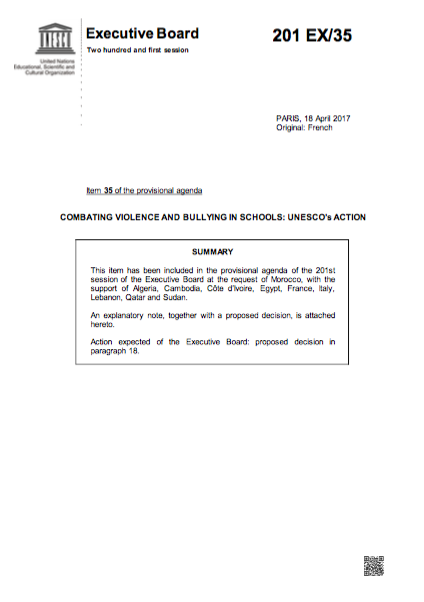 Lucha contra la violencia y el acoso en el entorno escolar: la labor de la UNESCO Año de publicación: 2017 Autor corporativo: UNESCO This item has been included in the provisional agenda of the 201st session of the Executive Board at the request of Morocco, with the support of Algeria, Cambodia, Côte d’Ivoire, Egypt, France, Italy, Lebanon, Qatar and Sudan.
 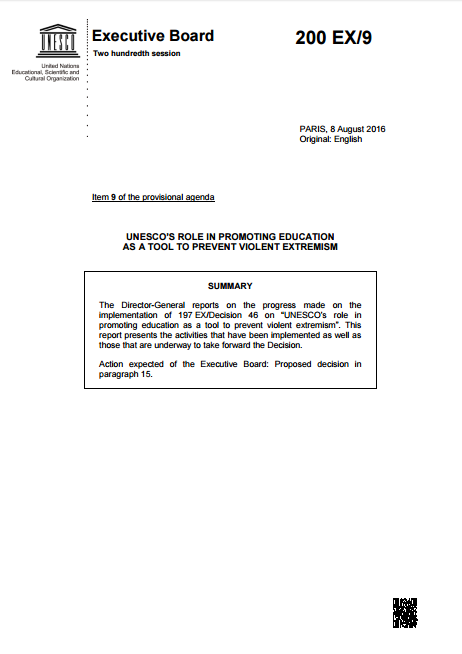 UNESCO's role in promoting education as a tool to prevent violent extremism Año de publicación: 2016 Autor corporativo: UNESCO The Director-General reports on the progress made on the implementation of 197 EX/Decision 46 on “UNESCO’s role in promoting education as a tool to prevent violent extremism”. This report presents the activities that have been implemented as well as those that are underway to take forward the Decision. Rôle de l'UNESCO dans la promotion de l'éducation comme outil de prévention de l'extrémisme violent Año de publicación: 2016 Autor corporativo: UNESCO The Director-General reports on the progress made on the implementation of 197 EX/Decision 46 on “UNESCO’s role in promoting education as a tool to prevent violent extremism”. This report presents the activities that have been implemented as well as those that are underway to take forward the Decision. La Función de la UNESCO en la promoción de la educación como instrumento para prevenir el extremismo violento Año de publicación: 2016 Autor corporativo: UNESCO The Director-General reports on the progress made on the implementation of 197 EX/Decision 46 on “UNESCO’s role in promoting education as a tool to prevent violent extremism”. This report presents the activities that have been implemented as well as those that are underway to take forward the Decision. Роль ЮНЕСКО в популяризации образования в качестве инструмента предотвращения насильственного экстремизма Año de publicación: 2016 Autor corporativo: UNESCO The Director-General reports on the progress made on the implementation of 197 EX/Decision 46 on “UNESCO’s role in promoting education as a tool to prevent violent extremism”. This report presents the activities that have been implemented as well as those that are underway to take forward the Decision. دور اليونسكو في تعزيز التعليم باعتباره وسيلة لدرء التطرف العنيف Año de publicación: 2016 Autor corporativo: UNESCO The Director-General reports on the progress made on the implementation of 197 EX/Decision 46 on “UNESCO’s role in promoting education as a tool to prevent violent extremism”. This report presents the activities that have been implemented as well as those that are underway to take forward the Decision. 教科文组织在促进利用教育手段预防暴力极端主义方面的作用 Año de publicación: 2016 Autor corporativo: UNESCO The Director-General reports on the progress made on the implementation of 197 EX/Decision 46 on “UNESCO’s role in promoting education as a tool to prevent violent extremism”. This report presents the activities that have been implemented as well as those that are underway to take forward the Decision.
 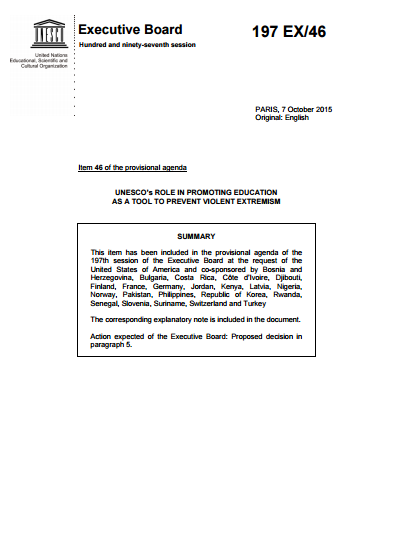 Rôle de l'UNESCO dans la promotion de l'éducation comme outil de prévention de l'extrémisme violent Año de publicación: 2015 Autor corporativo: UNESCO This item has been included in the provisional agenda of the 197th session of the Executive Board at the request of the United States of America and co-sponsored by Bosnia and Herzegovina, Bulgaria, Costa Rica, Côte d’Ivoire, Djibouti, Finland, France, Germany, Jordan, Kenya, Latvia, Nigeria, Norway, Pakistan, Philippines, Republic of Korea, Rwanda, Senegal, Slovenia, Suriname, Switzerland and Turkey La Función de la UNESCO en la promoción de la educación como instrumento para prevenir el extremismo violento Año de publicación: 2015 Autor corporativo: UNESCO This item has been included in the provisional agenda of the 197th session of the Executive Board at the request of the United States of America and co-sponsored by Bosnia and Herzegovina, Bulgaria, Costa Rica, Côte d’Ivoire, Djibouti, Finland, France, Germany, Jordan, Kenya, Latvia, Nigeria, Norway, Pakistan, Philippines, Republic of Korea, Rwanda, Senegal, Slovenia, Suriname, Switzerland and Turkey Роль ЮНЕСКО в популяризации образования в качестве инструмента предотвращения насильственного экстремизма Año de publicación: 2015 Autor corporativo: UNESCO This item has been included in the provisional agenda of the 197th session of the Executive Board at the request of the United States of America and co-sponsored by Bosnia and Herzegovina, Bulgaria, Costa Rica, Côte d’Ivoire, Djibouti, Finland, France, Germany, Jordan, Kenya, Latvia, Nigeria, Norway, Pakistan, Philippines, Republic of Korea, Rwanda, Senegal, Slovenia, Suriname, Switzerland and Turkey