
Recursos
Exploren una amplia gama de recursos valiosos en GCED para profundizar su comprensión y promover su búsqueda, incidencia, enseñanza y aprendizaje.
1,329 resultados encontrados
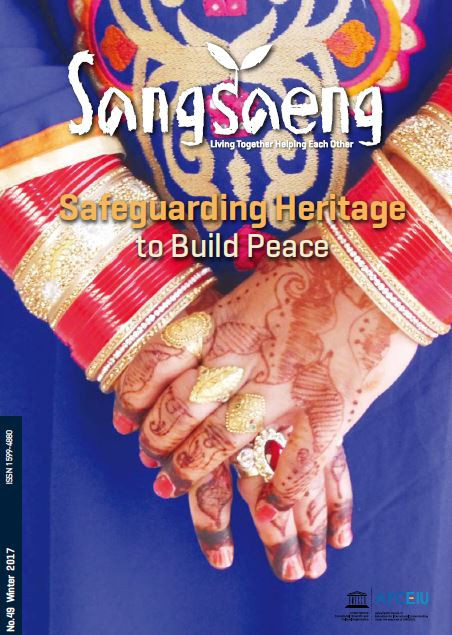 평화를 구축하기 위한 유산 보호 (상생 제49호 2017년 겨울호) Año de publicación: 2017 Autor corporativo: 유네스코 아시아태평양 국제이해교육원 49호 <상생>이 “평화를 구축하기 위한 유산 보호”라는 주제로 발간되었다. 모든 고대 문명은 현대 사회 발전에 어떤 방식으로든 영향을 준다는 점에서 연구의 가치가 있다. 이번 호 상생은 다양한 맥락에서 유산을 살펴보고, 글로벌 사회의 일원으로서 책임을 다하기 위해 나와 다른 유산을 이해하고 관용하도록 돕는다. 3 발간사4 스페셜 칼럼4 우리 지구의 청지기로서 살아가기8 포커스: 평화를 구축하기 위한 유산 보호8 평화와 번영을 위한 유산12 유산 교육: 문화 리터러시 강화의 기회17 포토 에세이: 2017 세계 유산21 스페셜 리포트대의를 위한 학문과 연구에 영향을 미치는 UNAI활동24 국제이해교육 모범사례24 경계선에 있는 사람들을 위한 최전선의 교육29 학생들의 감성과 열망 자극하기 33 인터뷰세계시민교육에 대한 도전들36 유스네트워크평화를 구축하는 청년40 APCEIU에 보내는 편지평화의 마음을 향한 여정42 내 기억 속의 평화폭력적인 세상에서의 평화46 아시아태평양 지역 이해하기계란, 탬버린 그리고 기념49 교육원 활동
  Global Citizenship Concepts in the Curricula of Four Countries Año de publicación: 2017 Autor: Natalie Browes Autor corporativo: UNESCO International Bureau of Education (IBE) | APCEIU This report details the presence of Global Citizenship Education (GCED) concepts in the education systems of four countries: Cambodia, Colombia, Mongolia and Uganda. It highlights the main findings of eight reports: four expert reports, which predominately analyse curriculum content, and four situational analysis reports, which take a broader view and detail some of the country-specific challenges and opportunities with regard to GCED. Findings reveal the presence of GCED concepts across the curricula of the four countries. In addition to cognitive content related to GCED, competency-based content is also found present within the curricula of these countries. However, the majority of this content can only be indirectly linked to GCED, and it is better interpreted as part of the more traditional civics or citizenship education approach. As such, it generally lacks a global perspective and does not engage with all key themes of GCED. Furthermore, this content is often concentrated at the lower and upper secondary levels, instead of being equally distributed across all grade levels. This is particularly true in the case of behaviour-based competencies. Findings also reveal challenges beyond the curriculum. These include lack of teacher training and lack of support to implement GCED, which are concerns expressed by stakeholders in all four countries. A lack of GCED content in textbooks and lack of supplementary materials were also found to be issues. The report concludes with recommendations regarding the effective implementation of GCED within curricula. Among others, the report suggests the transversal integration of GCED - across the curriculum at all grade levels, while at the same time, actors from all levels of the education system, ranging from central government to teachers, should be engaged to ensure the use of complementary learning materials, pedagogies and assessment techniques.
  Herramientas para Desarrollo Curricular: Recursos para la Educación para la Ciudadanía Mundial (ECM) Año de publicación: 2018 Autor corporativo: UNESCO International Bureau of Education (IBE) | El Centro Asia Pacífico de Educación para el Entendimiento Internacional (APCEIU) El objetivo principal de “Recursos para la Educación para la Ciudadanía Mundial (ECM)” es el compartir una comprensión más profunda y amplia de la teoría y práctica de la ECM para poder propiciar su desarrollo efectivo e implementación a nivel de las políticas, escuelas y aulas. Los Recursos propician una guía comprensiva para los diseñadores de políticas nacionales, los especialistas y expertos en desarrollos de planes de estudios, formadores de maestros, educadores, líderes escolares y administradores a nivel de los distritos. Los principales temas abordados son:Módulo 1: IntroducciónMódulo 2: Políticas NacionalesMódulo 3: Diseño curricular Módulo 4: Enseñanza, aprendizaje y evaluaciónMódulo 5: Recursos para Enseñanza y AprendizajeMódulo 6: Enfoque Escolar IntegralMódulo 7: Formación de Maestros y Desarrollo Profesional
  세계시민교육 국내 이행현황 연구보고서: 유·초중등학교 교육과정을 중심으로 Año de publicación: 2018 Autor corporativo: 유네스코 아시아태평양 국제이해교육원 “세계시민교육 국내 이행현황 연구보고서 - 유·초중등학교 교육과정을 중심으로”가 발간되었다. 본 연구보고서는 세계시민교육의 실행과 성과에 대한 국가 수준의 모니터링 및 평가 연구가 희소하다는 문제의식에 기초하여 작성된 결과물이다. 특히, 국내 17개 시·도교육청 산하 유치원, 초·중·고등학교 교육과정 활동에서 세계시민의 개념이 어떻게 반영 및 실행되고 있는지를 살펴보기 위하여 탐색적 연구를 설계하고 관련 자료 조사를 실시하는데 주안점을 두었다. 또한 연구조사 결과를 토대로 동 보고서는 향후 세계시민교육이 교육현장에서 보다 명확하게 이행되고 확산될 수 있도록 하는 정책적 제언도 담고 있다.
 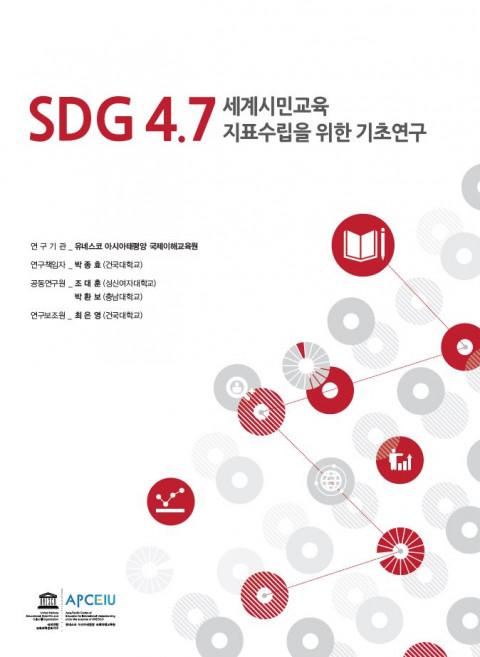 SDG 4.7: 세계시민교육 지표수립을 위한 기초연구 Año de publicación: 2018 Autor corporativo: 유네스코 아시아태평양 국제이해교육원 “SDG 4.7 세계시민교육 지표수립을 위한 기초연구 보고서”가 발간되었다. 본 연구보고서는 국제적으로 합의된 글로벌 지표의 부재로 현재까지 정의가 완료되지 않은 지속가능발전목표 (SDG) 4.7 지표 개발을 위한 기초 연구이다. 즉, 동 보고서는 세계시민교육 및 SDG 4.7 지표에 관한 기존의 국내·외 연구결과를 종합적으로 검토하여 글로벌 지표에 관한 주요 논의를 정리하고, 국내 지표 개발을 위한 함의를 도출하는 데에 목적을 두고 있다. 이를 위하여 유네스코 통계원 (UIS)의 최신 SDG 4.7.1 메타데이터 연구와 국내·외 연구결과에 기초하여 국내에서 활용할 수 있는 정보와 데이터를 검토하고 있다.
 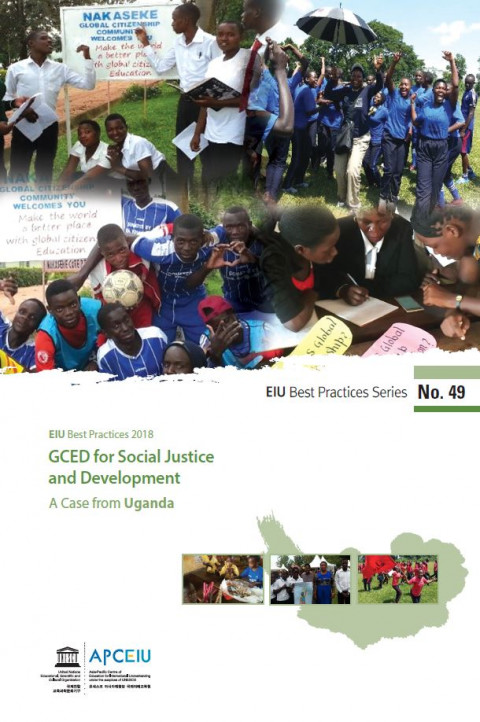 EIU Best Practices Series No. 49: GCED for Social Justice and Development; A Case from Uganda Año de publicación: 2018 Autor corporativo: APCEIU Creating a peaceful, trusting and supportive learning environment is a strong driver for a nation’s sustainable development. Any society whose citizens have no cognitive, socio-emotional and behavioral values like respect for self and humanity, is doomed for chaos. The concepts of Education for International Understanding(EIU) and Global Citizenship Education(GCED) in this programme emerge from the need for harmonious living in the society. Sustainable human and economic development is built upon the successful dissemination and implementation of EIU/GCED practices. To understand this better, let’s use the analogy of a bird that gains its momentum to fly from its feet, lungs and wings.The contributor uses this analogy to illustrate that EIU/GCED is the foundation that exerts momentum for social development.The contributor saw it necessary that for any sustainable development to flourish in Ugandan society, pragmatic values have to be perfectly blended with public awareness for they serve as the foundation of all economic, social, cultural and political efforts. The national value system should be based on a strong foundation on which all national efforts are rooted. The social aspirations of the citizens should be the ones that propel development needs and national priorities.To effect sustainable development, we need to see schools as strategic intervention points. Recent times have, however, witnessed that the level of discipline and value inculcation gradually declined to near extinction. The distortion of the social setting that inculcated the ethical values in the young generation has called for a need to remedy the gap. The EIU/GCED is strategically tailored to inculcate Table of Contents moral principles and values in the children through the direct contact and support of the teachers of Early Childhood Development (ECD), both primary and postprimary levels.The Nakaseke Core Primary Teachers’ College (PTC) is mandated to mainstream and promote the social uprightness of the community being a primary stakeholder in the integration of EIU/GCED in the Ugandan Primary Schools (PS) and Primary Teachers Education (PTE) Curriculum. Consequently, the training programmes were designed to enhance the capacity of PTC’s administrators, tutors and support staff, pre-service student teachers, district education officers and primary school teachers to inculcate the EIU/GCED moral values and principles among the learners. Students are then expected to apply EIU/GCED principles to their families and communities, and uphold the values of integrity, honesty, justice, responsibility, respect for humanity, hard work, unity and creativity.
 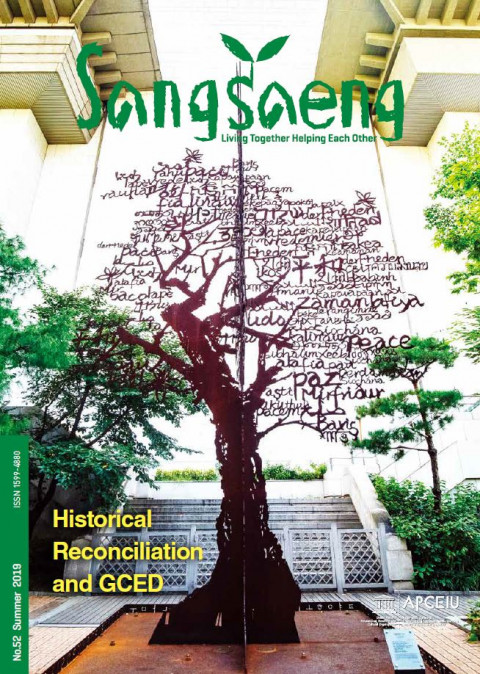 Historical Reconciliation and GCED (SangSaeng no. 52 Summer 2019) Año de publicación: 2019 Autor corporativo: APCEIU The 52th issue of SangSaeng has been published with the theme “Historical Reconciliation and GCED.” This issue explores various endeavours aimed at attaining historical reconciliation and peace, as well as the important role education plays to achieve this goal. How we teach and learn about our past and present conflicts is critical in shaping our future. It can help enhance global citizenship and lead us to peaceful reconciliation and peacebuilding, or it can intensify the hatred of others and build up more conflicts. 3 Editor’s Note4 Special ColumnToward Reconciliation in a Divided, Dangerous World / Jonathan Jansen8 Focus: Historical Reconciliation and GCED8 Historical Dialogue among Korea, China and Japan / Jeongin Kim12 Teaching Shared Histories in Southeast Asia / Doung Bich Hanh16 Learning about Europe’s Common History / Dominik Pick19 Dual Narrative to Teach History / Sami Adwan21 Mystic of ‘General History of Afica’ / Ali Moussa Iye 24 Best Practices24 The Power of Silence / Dylan Wray27 Mobile Library / Andri Nurcahyani31 Special Report31 Migration, Displacement and Education: Building Bridges, Not Walls / Manos Antoninis33 Harmonizing ‘Heart, Head and Hand’ in Hanoi / APCEIU37 InterviewFour Students for One Common Good / Sabine Detzel41 Understanding the Asia-Pacific RegionUniting Under Legends of Ghandhara / Nadeem Omar Tarar44 Youth NetworkHELP Nurtures Youth Citizenship through Collaboration / Nephtaly Pierre-Louis and Meaghan Balzer48 LetterSpeaking Silently in the Loud World / Elvira Sarsenova50 APCEIU in Action
  Being and Becoming Global Citizens: Measuring Progress toward SDG 4.7 (Phase I: Monitoring teacher and school readiness to enact global citizenship in the Asia-Pacific region) Año de publicación: 2023 Autor: Rachel Parker | Jennie Chainey | Payal Goundar | Sarah Richardson | Anna Dabrowski | Amy Berry | Claire Scoular Autor corporativo: Australian Council for Educational Research (ACER) | APCEIU Since 2022, APCEIU and the Australian Council for Educational Research (ACER) have conducted a study to identify enhanced tools and resources for schools and systems in the Asia-Pacific region to monitor and evaluate GCED in line with SDG 4.7.The Report of the Research for Phase 1 is available in three forms: Full report; Summary; and Policy Brief.
 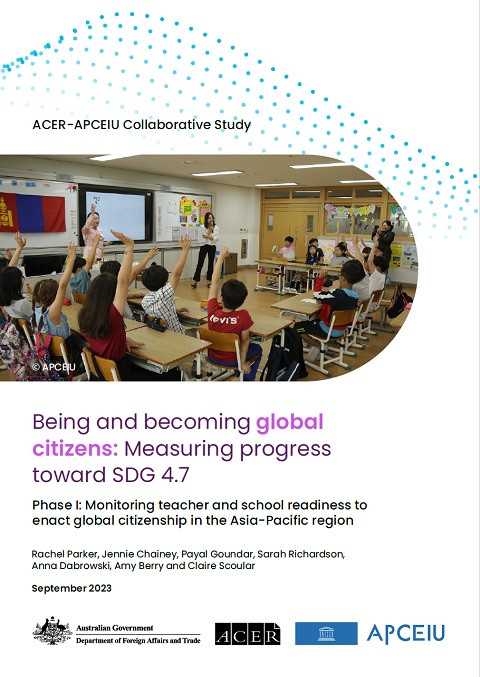 [Summary] Being and Becoming Global Citizens: Measuring Progress toward SDG 4.7 (Phase I: Monitoring teacher and school readiness to enact global citizenship in the Asia-Pacific region) Año de publicación: 2023 Autor: Rachel Parker | Jennie Chainey | Payal Goundar | Sarah Richardson | Anna Dabrowski | Amy Berry | Claire Scoular Autor corporativo: Australian Council for Educational Research (ACER) | APCEIU This is a summary report of the Being and Becoming Global Citizens: Measuring Progress toward SDG 4.7 (Phase I: Monitoring teacher and school readiness to enact global citizenship in the Asia-Pacific region), conducted by APCEIU and ACER in since 2022.
 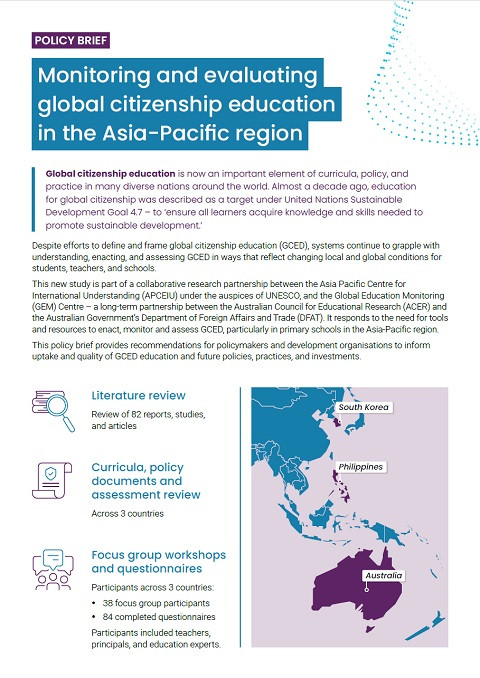 [Policy Brief] Monitoring and Evaluating Global Citizenship Education in the Asia-Pacific Region Año de publicación: 2023 Autor: Payal Goundar | Rachel Parker Autor corporativo: Australian Council for Educational Research (ACER) | APCEIU This is a policy brief version of the reserach report, Being and Becoming Global Citizens: Measuring Progress toward SDG 4.7 (Phase I: Monitoring teacher and school readiness to enact global citizenship in the Asia-Pacific region), conducted by APCEIU and ACER in since 2022.