
Recursos
Exploren una amplia gama de recursos valiosos en GCED para profundizar su comprensión y promover su búsqueda, incidencia, enseñanza y aprendizaje.
1,330 resultados encontrados
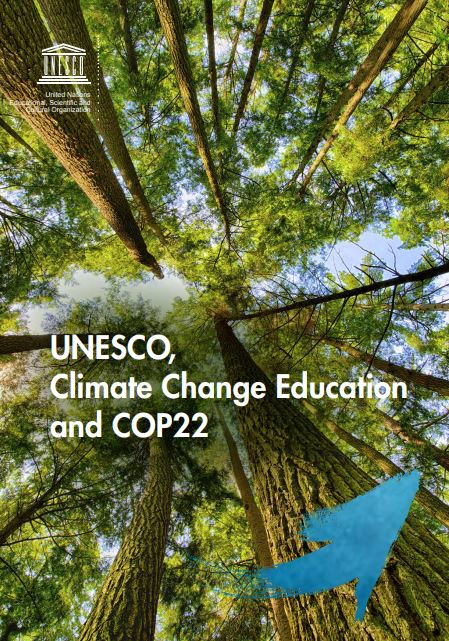 L'UNESCO, l'éducation au changement climatique et la COP22 Año de publicación: 2016 Autor corporativo: UNESCO L’éducation est un vecteur clé pour préparer les sociétés à faire face aux changements globaux. Elle joue un rôle essentiel dans la réalisation des objectifs de développement durable et de mettre en pratique un accord mondial sur le changement climatique.L’éducation joue un rôle primordial dans la promotion de la sensibilisation et le changement de comportement concernant l’atténuation et l’adaptation en matière de changement climatique.Elle aide à accroitre l’atténuation du changement climatique et la capacité d’adaptation des collectivités en permettant aux individus de prendre des décisions informées.
 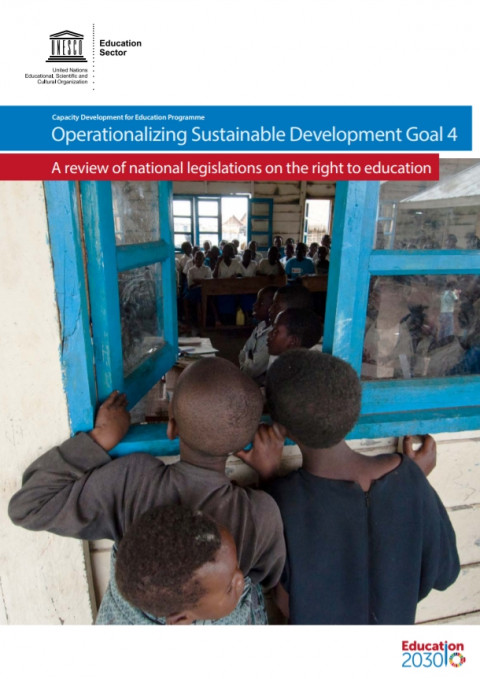 Operationalizing Sustainable Development Goal 4: a review of national legislations on the right to education Año de publicación: 2017 Autor: Santini, Delphine Autor corporativo: UNESCO As part of a wider Capacity Development for Education (CapED) Programme on operationalizing SDG4 at the country level, this paper examines the instrumental role that legislation on the right to education can play in view of achieving the SDG4 targets in Least Developed Countries. It does it by reviewing national legal frameworks relating to the right to education in 11 countries, suggesting some lessons of global interest, both for policy-making and normative work. Opérationnaliser l'Objectif de développement durable 4: examen des législations nationales sur le droit à l'éducation Año de publicación: 2017 Autor: Santini, Delphine Autor corporativo: UNESCO Dans le cadre du Programme de développement des capacités pour l’éducation (CapED) sur l’opérationnalisation de l’ODD 4 au niveau des pays, ce document examine le rôle déterminant de la législation relative au droit à l’éducation en vue d’atteindre les cibles de l’ODD 4 dans les pays les moins avancés. Les cadres juridiques nationaux relatifs au droit à l’éducation dans 11 pays sont passés en revue, tout en suggérant quelques recommandations de portée plus globale, à la fois pour l’élaboration de politiques et le renforcement du travail normatif.
 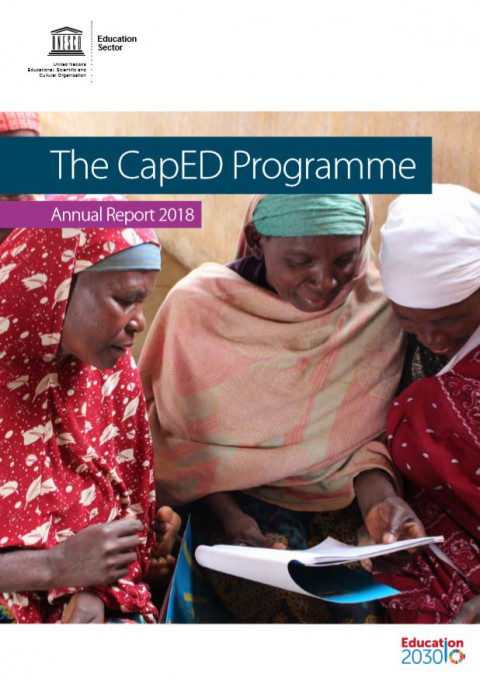 The CapED Programme: annual report 2018 Año de publicación: 2019 Autor corporativo: UNESCO UNESCO is the United Nation’s specialized agency for education and is mandated to lead and coordinate progress towards Sustainable Development Goal 4 – “Ensure inclusive and equitable quality education and promote lifelong learning opportunities for all”. The CapED Programme is central to delivering on this mandate through capacity development. It mobilizes UNESCO’s worldwide network of specialized Institutes and offices and works with partners to assist countries as they develop and implement national plans to deliver on SDG4 commitments. The Annual Report 2018 provides information on achievements and progress made in the 25 countries where CapED is operational.
 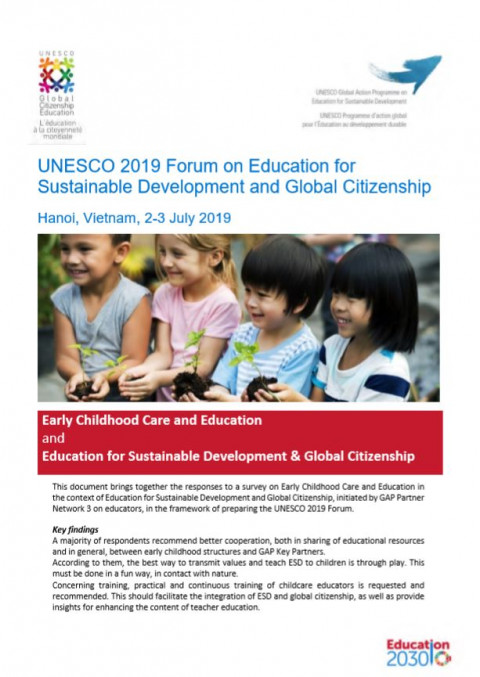 Early childhood care and education and education for sustainable development & global citizenship Año de publicación: 2019 Autor corporativo: UNESCO This document brings together the responses to a survey on Early Childhood Care and Education in the context of Education for Sustainable Development and Global Citizenship, initiated by GAP Partner Network 3 on educators, in the framework of preparing the UNESCO 2019 Forum. Key findings A majority of respondents recommend better cooperation, both in sharing of educational resources and in general, between early childhood structures and GAP Key Partners. According to them, the best way to transmit values and teach ESD to children is through play. This must be done in a fun way, in contact with nature. Concerning training, practical and continuous training of childcare educators is requested and recommended. This should facilitate the integration of ESD and global citizenship, as well as provide insights for enhancing the content of teacher education.
 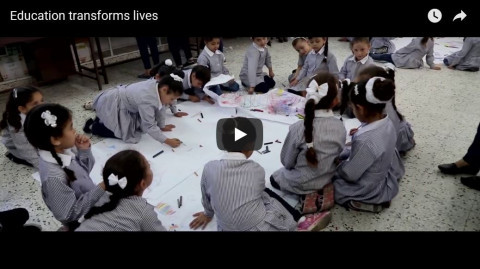 [Video] Education Transforms Lives Año de publicación: 2017 Autor corporativo: UNESCO Education transforms lives every day and in every corner of society. This video explores the power of education and UNESCO’s role in leading and coordinating the Education 2030 Agenda, which is part of a global movement to eradicate poverty through 17 Sustainable Development Goals by 2030.Education is the right of every woman, man and child. Together, we are shaping the global citizens of tomorrow, empowered on the path of education to build a more sustainable future.UNESCO's campaign "Education transforms lives" supports the effort to build peace in the minds of men and women. [Видео] Образование меняет жизни Año de publicación: 2017 Autor corporativo: Организация Объединенных Наций по вопросам образования, науки и культуры (UNESCO) Образование преображает жизнь людей каждый день во всех слоях общества. Ролик повествует о важности образования и роли ЮНЕСКО в ведении и координации Повестки дня «Образование-2030», которая является частью глобального движения для искоренения бедности посредством достижения 17 Целей устойчивого развития до 2030 года.Каждая женщина, каждый мужчина и каждый ребенок имеют право на образование. Вместе мы создаем мировых сограждан завтрашнего дня и даем им силу образования для построения более устойчивого будущего.Кампания ЮНЕСКО "Образование преображает жизнь людей" направлена на то, чтобы нести мир в сознание мужчин и женщин.
 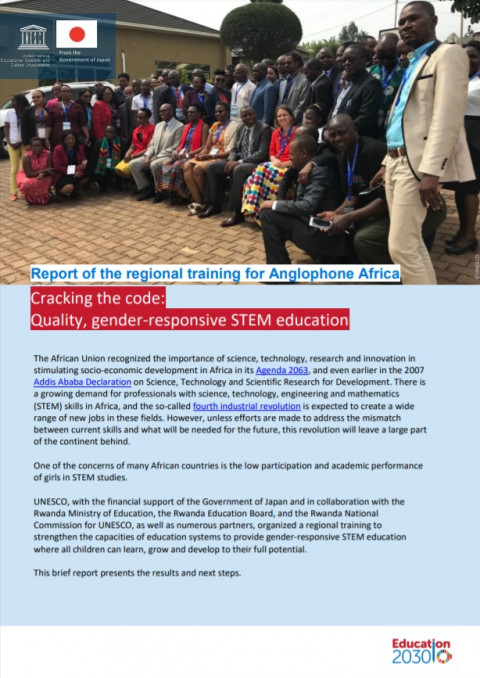 Report of the regional training for Anglophone Africa, Cracking the code: quality, gender-responsive STEM education Año de publicación: 2019 Autor corporativo: UNESCO The African Union recognized the importance of science, technology, research and innovation in stimulating socio-economic development in Africa in its Agenda 2063, and even earlier in the 2007 Addis Ababa Declaration on Science, Technology and Scientific Research for Development. There is a growing demand for professionals with science, technology, engineering and mathematics (STEM) skills in Africa, and the so-called fourth industrial revolution is expected to create a wide range of new jobs in these fields. However, unless efforts are made to address the mismatch between current skills and what will be needed for the future, this revolution will leave a large part of the continent behind. One of the concerns of many African countries is the low participation and academic performance of girls in STEM studies. UNESCO, with the financial support of the Government of Japan and in collaboration with the Rwanda Ministry of Education, the Rwanda Education Board, and the Rwanda National Commission for UNESCO, as well as numerous partners, organized a regional training to strengthen the capacities of education systems to provide gender-responsive STEM education where all children can learn, grow and develop to their full potential. This brief report presents the results and next steps.
 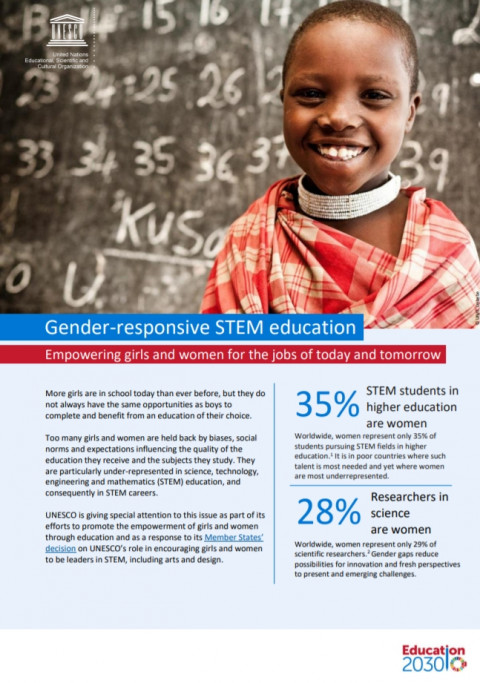 Gender-responsive STEM education: Empowering girls and women for the jobs of today and tomorrow Año de publicación: 2019 Autor corporativo: UNESCO More girls are in school today than ever before, but they do not always have the same opportunities as boys to complete and benefit from an education of their choice. Too many girls and women are held back by biases, social norms and expectations influencing the quality of the education they receive and the subjects they study. They are particularly under-represented in science, technology, engineering and mathematics (STEM) education, and consequently in STEM careers. UNESCO is giving special attention to this issue as part of its efforts to promote the empowerment of girls and women through education and as a response to its Member States’decisionon UNESCO’s role in encouraging girls and women to be leaders in STEM, including arts and design.
  Teaching and Learning Transformative Engagement Año de publicación: 2019 Autor corporativo: UNESCO While there is a large body of literature on citizenship and civic education, there is less clarity about the meaning of ‘responsible transformative engagement’ for young learners in relation to GCED and ESD – notably, the types of transformative engagement and the meaning of ‘responsible’. Understanding better the connection between learners’ engagement and education can clarify the knowledge, skills and competencies that schools may provide, as well as how the role of education can vary depending on context. In this light, this paper explores the meaning of ‘responsible transformative engagement’ with a view to clarifying the role of education in ways that may be reflected by UNESCO and other education stakeholders.