
Recursos
Exploren una amplia gama de recursos valiosos en GCED para profundizar su comprensión y promover su búsqueda, incidencia, enseñanza y aprendizaje.
1,329 resultados encontrados
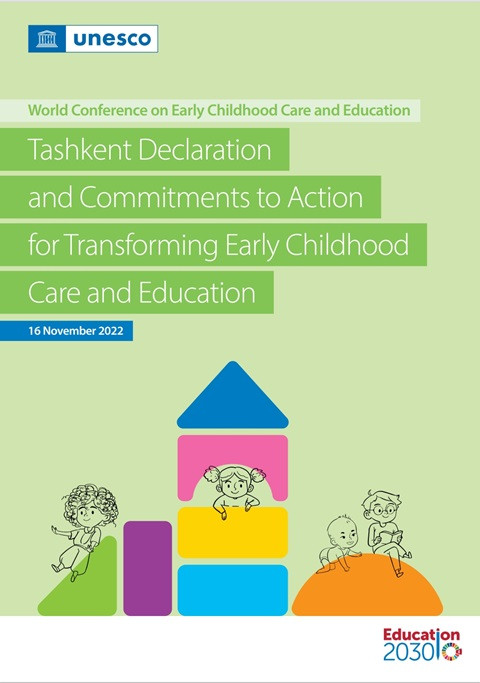 Всемирная конференция по воспитанию и образованию детей младшего возраста. Ташкентская декларация и обязательства по принятию мер в интересах преобразования воспитания и образования детей младшего возраста. 16 ноября 2022 года Año de publicación: 2022 Autor corporativo: Организация Объединенных Наций по вопросам образования, науки и культуры (UNESCO) С 14 по 16 ноября 2022 года в Ташкенте, Узбекистан, прошла вторая Всемирная конференция по воспитанию и образованию детей младшего возраста. Более 2600 участников конференции из 147 государств-членов, включая министров, партнеров по развитию, практиков, ученых, представителей гражданского общества и частных организаций, собрались вместе, чтобы подтвердить право каждого маленького ребенка на качественное развитие, уход и образование в раннем детстве. В Ташкентской декларации и обязательствах к действиям по преобразованию воспитания и образования детей младшего возраста (ВОДМ) изложены руководящие принципы и стратегии срочного преобразования ВОДМ для ускорения достижения задачи 2 ЦУР 4, а также конкретные действия для государств-членов, международного сообщества, неправительственных организаций и ЮНЕСКО, подлежащие регулярному мониторингу, обзору и оценке. 世界幼儿保育和教育大会: 塔什干宣言及变革幼儿保育和教育行动承诺 2022年11月16日 Año de publicación: 2022 Autor corporativo: 联合国教科文组织 (UNESCO) 2022年11月14日至16日,第二届世界幼儿保育和教育大会在乌兹别克斯坦塔 什干举行。来自147个成员国的2600多名与会者,包括部长、发展伙伴、从 业人员、科学家、民间社会和私营组织,汇聚一堂,重申每个幼儿都拥有获 得高质量的幼儿发展、保育和教育的权利。《塔什干宣言和变革幼儿保育和教育行动承诺》提出了为加速实现可持续发 展目标4.2而紧急变革幼儿保育和教育的指导原则和战略,以及会员国、国 际社会、非政府组织和教科文组织应定期监测、审查和评价的具体行动。
  UNESCO Futures of Education Report Explained by Members of the International Commission Año de publicación: 2022 Autor corporativo: UNESCO Initiated by UNESCO, the International Commission on the Futures of Education has prepared a new report on how education can best shape the future of humanity and the planet. In this video, members of the Commission and its chair explain the main recommendations and defining features of their report, Reimagining our futures together: A new social contract for education. The report is part of UNESCO’s Futures of Education initiative which aims to rethink education and shape the future. The initiative is catalyzing a global debate on how knowledge, education and learning need to be reimagined in a world of increasing complexity, uncertainty, and precarity.
 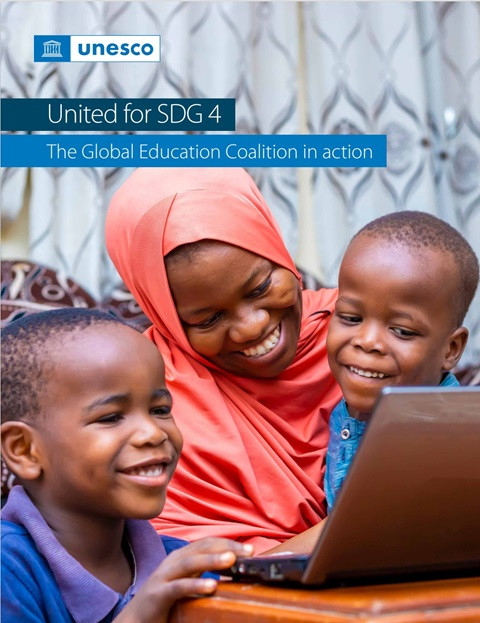 United for SDG 4: The Global Education Coalition in Action Año de publicación: 2024 Autor corporativo: UNESCO The Global Education Coalition, launched by UNESCO, is a platform for collaboration and exchange to protect the right to education and serves as a transformative accelerator towards SDG 4. This progress report of the Coalition builds on documents published in September 2020, March 2021, and March 2023 and covers activity between March 2023 and March 2024. Four years in and moving into its fifth, the Coalition works together to ensure all learners are empowered equally in and through education.
 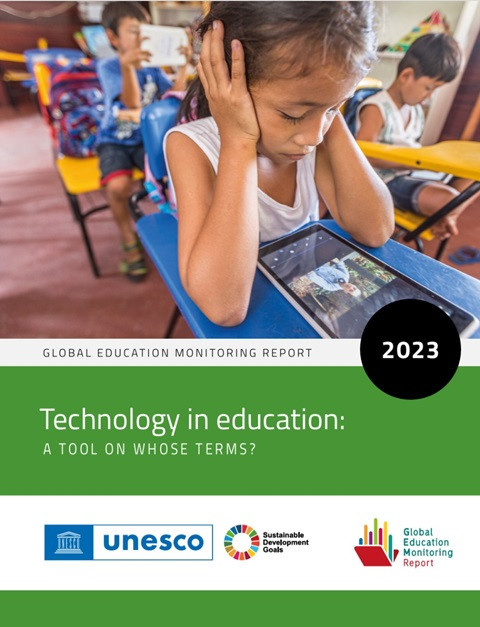 Global Education Monitoring Report 2023: Technology in Education; A Tool on Whose Terms? Año de publicación: 2023 Autor corporativo: UNESCO | Global Education Monitoring Report Team This report recommends that technology should be introduced into education on the basis of evidence showing that it would be appropriate, equitable, scalable and sustainable. In other words, its use should be in learners’ best interests and should complement face-to-face interaction with teachers. It should be seen as a tool to be used on these terms. Midway to the deadline, the 2023 Global Education Monitoring Report assesses the distance still to go to reach the 2030 education targets. Education is the key to unlocking the achievement of other development objectives, not least the goal of technological progress.
 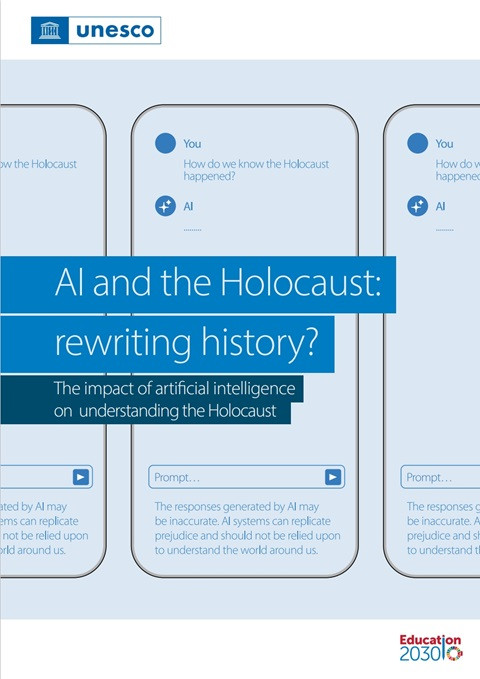 AI and the Holocaust: Rewriting History?; The Impact of Artificial Intelligence on Understanding the Holocaust Año de publicación: 2024 Autor: Mykola Makhortykh | Heather Mann Autor corporativo: UNESCO The threats associated with AI on safeguarding the record of the Holocaust are manifold, including the potential for manipulation by malicious actors, the introduction of falsehoods or dissemination of biased information, and the gradual erosion of public trust in authentic records. This paper provides a warning of what is at stake for the preservation of historical truth in a digital era increasingly mediated by AI. It highlights five major concerns:1. AI automated content may invent facts about the Holocaust2. Falsifying historical evidence: Deepfake Technology3. AI models can be manipulated to spread hate speech4. Algorithmic bias can spread Holocaust denial5. Oversimplifying history While there are some benefits to be gained, such as enhanced engagement and interaction opportunities for learners, as well as more efficient data processing capabilities for researchers, to navigate these challenges and capitalize on the benefits, it’s essential for AI designers, policymakers, educators, and researchers to collaborate closely. Only AI systems equipped with robust safeguards and human rights assessments, coupled with an increased focus on developing digital literacy skills, can uphold the integrity of historical truth and ensure the responsible use of artificial intelligence.
 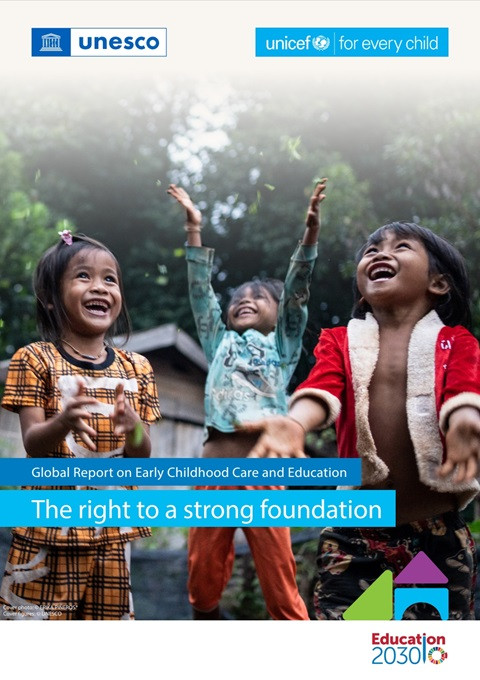 Global Report on Early Childhood Care and Education: The Right to a Strong Foundation Año de publicación: 2024 Autor corporativo: UNESCO | United Nations Children's Fund (UNICEF) Inclusive and quality early childhood care and education (ECCE) are vital for promoting school readiness, foundational learning, and lifelong well-being. Yet almost 60% of children in low-income countries do not have access to early care and learning opportunities. To meet national targets of providing at least one year of organized learning before primary school, low-income and lower-middle-income countries must fill an annual financial gap of USD 21 billion and recruit at least six million more educators before 2030. The first global report, jointly published by UNESCO and UNICEF, offers insights into global and regional ECCE trends. The report, which is a key response to the commitments outlined in the Tashkent Declaration, synthesizes scientific evidence on ECCE’s importance, and exposes persistence gaps in policy and investment. It illustrates how countries have responded to providing equitable and quality ECCE opportunities. The report invites all stakeholders, from governments and policy-makers, to educators, parents and organizations, to ensure that the commitments made in the Tashkent Declaration are fully realized by building a strong foundation for every child.
 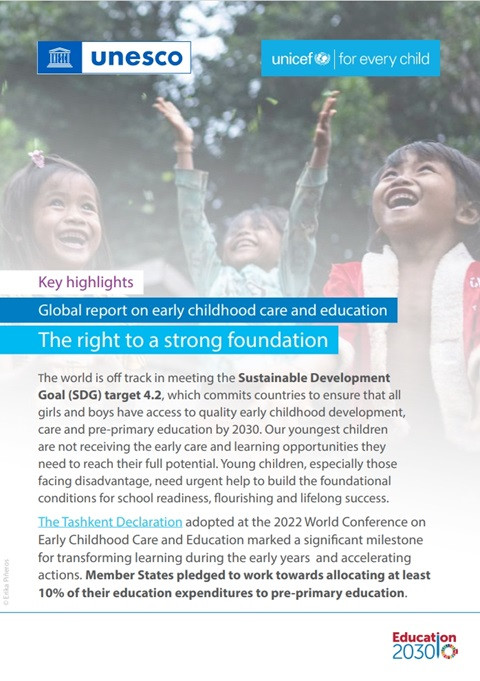 Global Report on Early Childhood Care and Education: The Right to a Strong Foundation; Key Highlights Año de publicación: 2024 Autor corporativo: UNESCO | United Nations Children's Fund (UNICEF) This document is the key highlights of the Global Report on Early Childhood Care and Education: The Right to a Strong Foundation. Rapport mondial sur l’éducation et la protection de la petite enfance : le droit à une base solide; points saillants Año de publicación: 2024 Autor corporativo: Organisation des Nations Unies pour l'éducation, la science et la culture (UNESCO) | United Nations Children's Fund (UNICEF) Ce document présente les points clés du Rapport mondial sur l'éducation et la prise en charge de la petite enfance : Le droit à une base solide.
 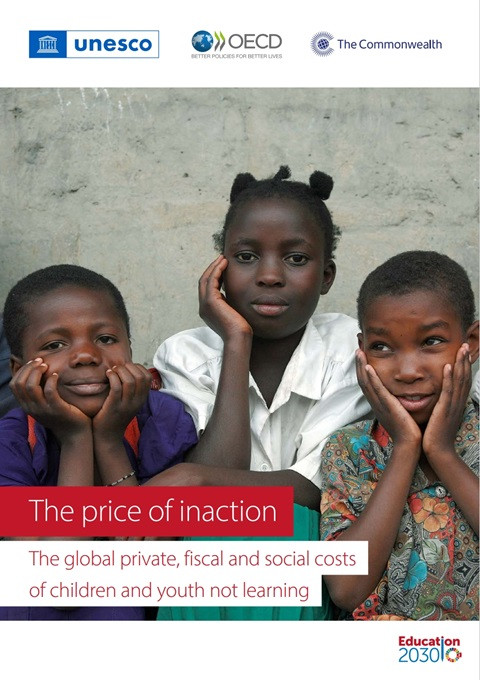 The Price of Inaction: The Global Private, Fiscal and Social Costs of Children and Youth Not Learning Año de publicación: 2024 Autor: Giorgio Brunello | Lorenzo Rocco | Matthias Eck Autor corporativo: UNESCO | Organisation for Economic Co-operation and Development (OECD) | Commonwealth Secretariat Despite efforts by countries, the number of out-of-school children remains significant, with 128 million boys and 122 million girls excluded from schooling. Educational skills deficits are also immense – 57 per cent of the world’s children have not gained basic skill levels. UNESCO, OECD and the Commonwealth Secretariat have developed the first global report to illustrate the monetary costs to economies around the world of leaving children and youth behind in education. Using available evidence, the report calculates the costs, globally and by region, of children and youth that are not in school or gaining basic skills. Calculations are also provided for twenty selected countries in which there are gender disparities in education at either girls’ or boys’ expense. If governments were to increase efforts so that every child was in school and achieving basic skills, the future world GDP would raise by more than US$6.5 trillion annually, not to mention eliminating the social costs of failure. This publication offers the evidence and insights that show that for economic development to accelerate, so must prioritizations and investments in education and gender-transformative action.