
Recursos
Exploren una amplia gama de recursos valiosos en GCED para profundizar su comprensión y promover su búsqueda, incidencia, enseñanza y aprendizaje.
1,364 resultados encontrados
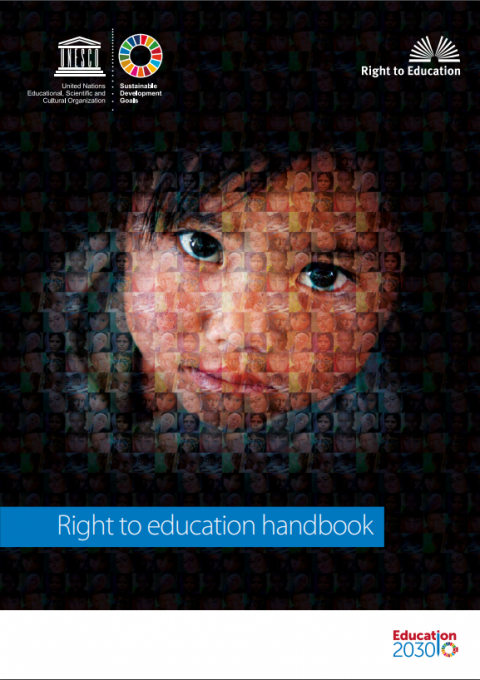 Right to Education Handbook Año de publicación: 2019 Autor corporativo: Right to Education Initiative (UK) The ultimate aim of this handbook is to facilitate the realization and universal enjoyment of the right to education. Its objective is not to present the right to education as an abstract, conceptual, or purely legal concept, but rather to be action-oriented. Where possible, practical guidance is given on how to implement and monitor the right to education along with recommendations to overcome persistent barriers. It seeks to do this by: Increasing awareness and knowledge of the right to education. This includes the normative content of the right to education, states’ legal obligations, the various sources of law regarding the right to education, what states must do to domestically implement the right to education, how to monitor the right to education, and how to increase accountability of the right to education. Providing a summary of current debates and issues regarding education and what human rights law says about them, including on forced migration, education in emergencies, the privatization of education, and the challenge of reaching the most marginalized. Providing an overview of the UN landscape and its mechanisms, including a clear understanding of the role of UNESCO and more generally the UN, as well as all relevant stakeholders in education, particularly civil society. UNESCO’s Strategy on standard-setting instruments in the field of education (2016-2021) encourages Member States of the Organization to use normative action in relation with the right to education as a strategic tool to implement and achieve SDG4. In line with this, this handbook – specifically foreseen by the Strategy– will also serve as a reference tool for the design and organization of training modules and workshops in the field of right to education. Finally, the handbook will also be an important reference for those working towards the achievement of SDG4, by offering guidance on how to leverage legal commitment to the right to education as a strategic way to achieve this goal.
 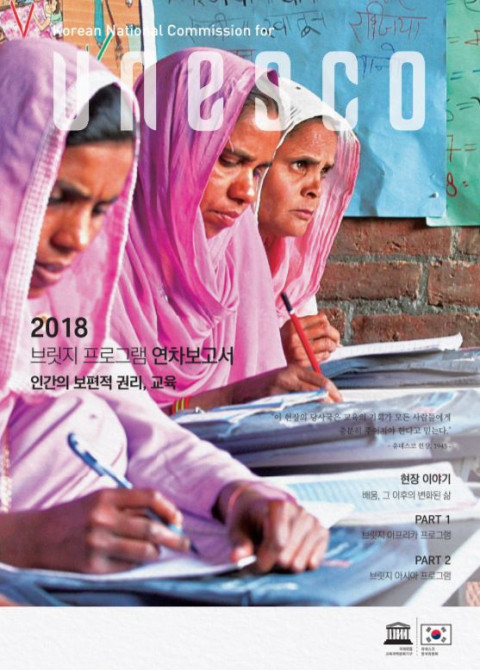 2018-2019 브릿지 프로그램 연차보고서 Año de publicación: 2019 Autor corporativo: 유네스코한국위원회 국제사회는 지속가능발전목표 4번(SDG4)를 통해 2030년까지 모든 이들에게 포용적이고 공평한 양질의 교육을 보장하고, 평생학습의 기회가 증진되도록 노력하자는 교육 기치를 내세웠다.특히 SDG4는 아동의 초등교육 강화에 중심을 둔 '새천년개발목표' 2번(MDG2)과 모든 연령대의 기초교육에 초점을 둔 '모두를위한교육'(EFA)의 미완의 목표를 포괄함은 물론, 기초교육 이후의 교육(중등, 고등) 및 훈련(직업,기술)을 평생학습 차원에서 촉진함으로써 교육의 보편성을 강조하고 있다. 유네스코한국위원회의 브릿지 사업은 이러한 국제사회의 노력에 동참하며, 교육의 보편적 기본권이 확산될 수 있도록 돕기 위해, 전 세계적으로 교육 소외자가 집중되어 있는 사하라 이남 아프리카 지역과 남아시아 지역의 모든 연련대 교육 소외자들을 대상으로 교육권 강화에 이바지하고 있다. 브릿지 사업은 나이, 성별, 종교 그리고 사회적 배경으로 인해 공교육으로부터 배제된 이들이 교육을 받음으로써 자존감을 회복하고 삶의 질을 향상시킬 수 있게 도우며, 이러한 개인의 성장만이 궁극적으로 지역사회의 변화와 발전으로 이어진다는 확신을 갖고 있다.이 보고서에서는 브릿지 아프리카 프로그램, 브릿지 아시아 프로그램과 국별 프로젝트 및 성과를 확인할 수 있다.
 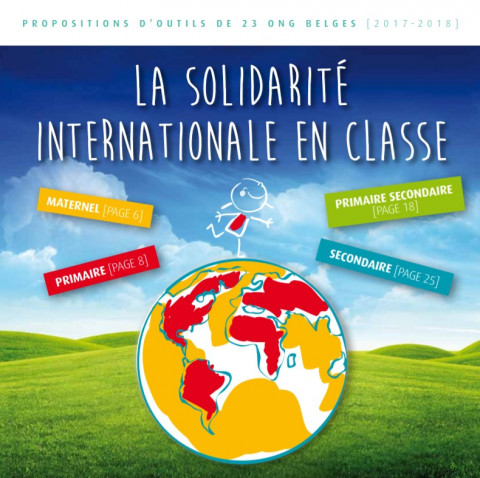 La solidarité internationale en classe: Proposition d'outils pédagogiques de 23 ONG belges Año de publicación: 2017 Autor corporativo: Plan Belgique La solidarité internationale en classe Proposition d'outils pédagogiques de 23 ONG belges Très pratique, ce catalogue recense les outils pédagogiques de 23 ONG destinés à l’enseignement maternel, primaire et secondaire. Un classement thématique permet d’identifier les sujets abordés par chacun de ces outils. En plus des sujets, le catalogue reprend les ONG qui proposent des trajets pour l'ensemble des écoles, comme le font les Partenaires des Ecoles des droits de l'enfant.Très utile pour organiser votre année scolaire, vous retrouverez toutes les informations utiles pour sensibiliser vos élèves à une problématique qui vous tient à coeur.
 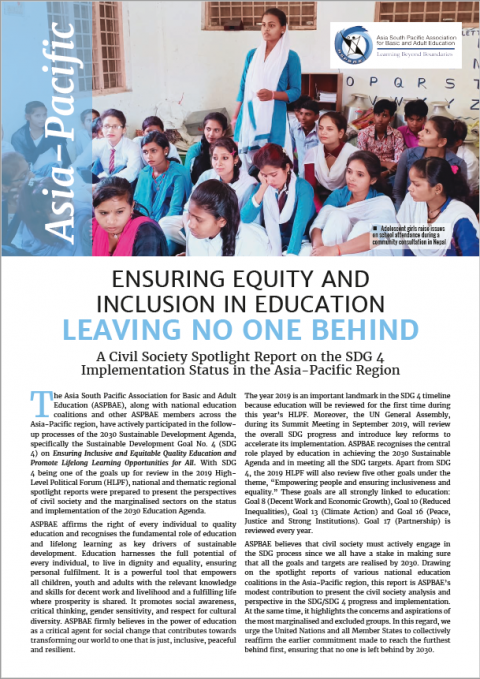 Asia-Pacific Spotlight Report on SDG 4 Año de publicación: 2019 Autor corporativo: Asia South Pacific Association for Basic and Adult Education (ASPBAE) ASPBAE believes that civil society must actively engage in the SDG process since we all have a stake in making sure that all the goals and targets are realised by 2030. Drawing on the spotlight reports of various national education coalitions in the Asia-Pacific region, this report is ASPBAE’s modest contribution to present the civil society analysis and perspective in the SDG/SDG 4 progress and implementation. At the same time, it highlights the concerns and aspirations of the most marginalised and excluded groups. In this regard, we urge the United Nations and all Member States to collectively reaffirm the earlier commitment made to reach the furthest behind first, ensuring that no one is left behind by 2030.
  Results Report 2019 Año de publicación: 2019 Autor corporativo: GPE The Global Partnership for Education (GPE) is a multi-stakeholder partnership and fund dedicated to improving education in the world’s poorest countries, and those with the most children out of school. Founded in 2002, the partnership is designed to harness the power of collaboration among developing countries, donor countries, civil society, foundations, the private sector and youth (represented through civil society organizations) to support inclusive and quality education for all.The partnership is now implementing GPE 2020, its strategic plan for the 2016-2020 period that outlines an ambitious course of action to achieve three strategic goals:Strategic Goal 1: Improved and more equitable student learning outcomes through quality teaching and learningStrategic Goal 2: Increased equity, gender equality and inclusion for all in a full cycle of quality education, targeting the poorest and most marginalized, including by gender, disability, ethnicity and conflict or fragilityStrategic Goal 3: Effective and efficient education systems delivering equitable, quality educational services for allThese efforts are aligned with and support Sustainable Development Goal 4, the world’s commitment to inclusive and equitable quality education for all. Rapport sur les résultats 2019 Año de publicación: 2019 Autor corporativo: GPE Le partenariat met en oeuvre le plan stratégique GPE 2020, son plan stratégique pour la période 2016-2020, qui définit une série de mesures ambitieuses pour la réalisation des trois buts stratégiques suivants: But stratégique 1: Des résultats d’apprentissage meilleurs et plus équitables grâce à un enseignement et un apprentissage de qualité But stratégique 2: Renforcement de l’équité, de l’égalité des sexes et de l’inclusion pour tous dans un cycle complet d’enseignement de qualité, en donnant la priorité aux plus démunis et aux plus marginalisés, notamment en raison de leur sexe, leur handicap, leur appartenance ethnique ou parce qu’ils se trouvent dans une situation de conflit ou de fragilité But stratégique 3: Des systèmes éducatifs efficaces et efficients offrant des services d’éducation équitables et de qualité pour tous Ces efforts sont alignés sur l’objectif de développement durable 4, l’engagement mondial en faveur d’une éducation inclusive et équitable de qualité pour tous.
 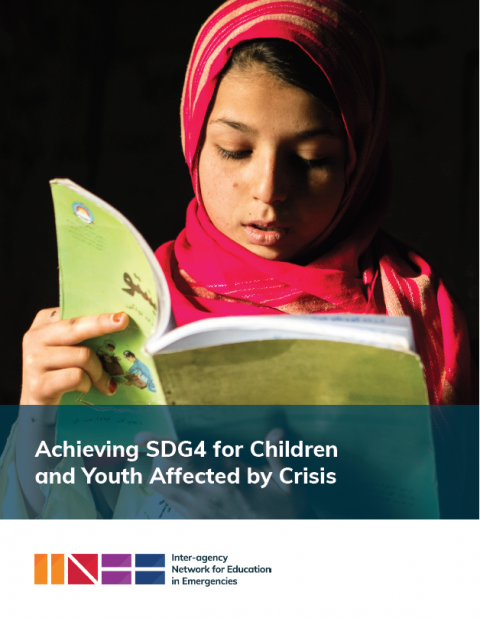 Achieving SDG4 for Children and Youth Affected by Crisis Año de publicación: 2019 Autor corporativo: Inter-agency Network for Education in Emergencies (INEE) With the Sustainable Development Goal 4 (SDG4), the global community committed to ensuring a quality education for all children and youth. Despite this promise, children and youth in crisis contexts continue to be neglected. We will never achieve SDG4 unless all children and youth affected by conflict and crisis are able to access and attend school and learn in a quality, safe, relevant and inclusive education environment. There is an urgent need for governments and the international community to make and adhere to political, financial and legal commitments if we truly are to leave no child behind. This brief offers recommendations for addressing the disparities in safe, quality, inclusive education for children affected by crisis. It begins by highlighting key areas for policy and practice, and looks at ways to use the various tools developed by the Inter-agency Network of Education in Emergencies (INEE). It takes a look at overall themes and trends, as well as the specific issues of gender disparities, the importance of supporting teachers, children’s psycho-social wellbeing and the protection and safety of education in conflict.
  Policy brief: rethinking schooling for the 21st century Año de publicación: 2018 Autor corporativo: Mahatma Gandhi Institute of Education for Peace and Sustainable Development (MGIEP) Analysing how far the ideals of SDG 4.7 are embodied in policies and curricula across 22 Asian countries, this study establishes benchmarks against which future progress can be assessed. It also argues forcefully that we must redefine the purposes of schooling, addressing the fundamental challenges to efforts to promote peace, sustainability and global citizenship through education.
 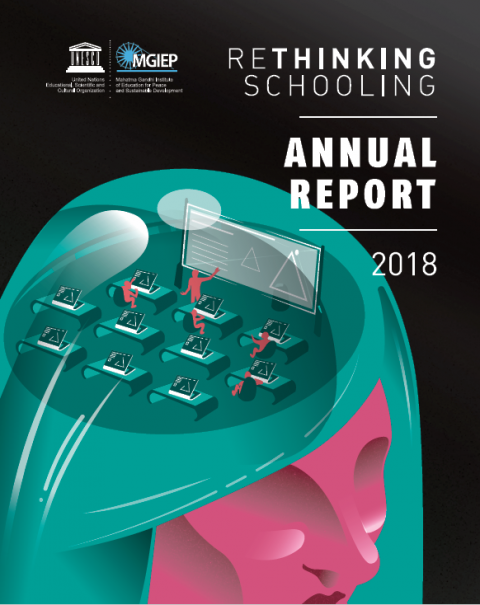 Rethinking schooling: annual report 2018 Año de publicación: 2019 Autor corporativo: Mahatma Gandhi Institute of Education for Peace and Sustainable Development (MGIEP) Calls to gear up schools for the 21st century are ubiquitous today. Some Asian education systems are held up as models for an innovation-led utopian future. Across much of Asia, however, neither the reality of schooling nor the patterns of development with which it is associated give cause for blithe optimism. This study is informed by UNESCO’s commitment to realizing the Sustainable Development Goals (SDGs) through educational reform worldwide. Since its inception, UNESCO has championed a humanistic vision of education (UNESCO, 2015)—a vision today encapsulated in SDG 4.7. These ideals need to be strongly restated and defended in an era when educational debate has come to be framed by a narrowly economistic and instrumentalist agenda. Deriving urgent significance from this broader context, the Rethinking Schooling report analyses how far the ideals of SDG 4.7 are embodied in policies and curricula across 22 Asian countries (UNESCO MGIEP, 2017a). The report seeks to develop benchmarks against which future progress can be assessed. It also argues forcefully that the fundamental purposes of schooling need to be reconfigured, if the ideals to which the global community has subscribed are actually to be realized.
 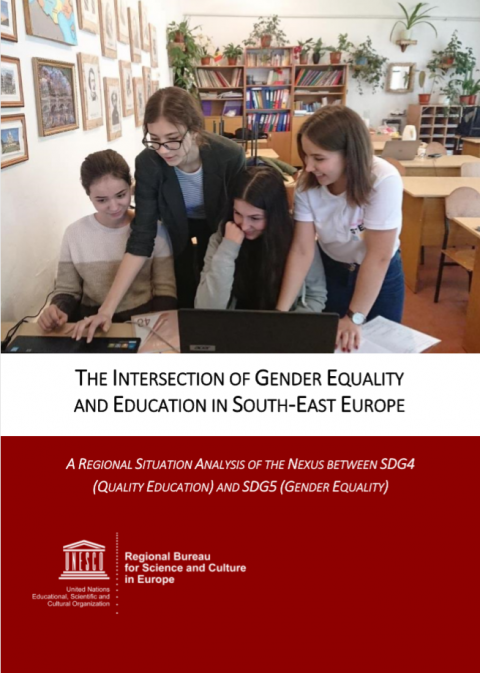 The Intersection of gender equality and education in South-East Europe: a regional situation analysis of the Nexus between SDG4 (Quality Education) and SDG5 (Gender Equality) Año de publicación: 2019 Autor corporativo: UNESCO Venice This report focuses on highlighting both progress and persistent challenges.It does so by analyzing the current situation of gender equality in education, including gender parity in participation, education quality, and outcomes, aswell as issues related to gender equality in which education plays an important role, suchas policies that disproportionately affect women, early and unintended pregnancy, child marriage, and human trafficking. It relies on the most recent available data from the UNESCO Institute of Statistics (UIS), as well as supplemental data including from UNICEF, UN Women, and theOrganization for Economic Cooperation and Development(OECD), to descriptively analyze the rates for females and males, considering also progress over the last decade, and to identify where progress in gender equality has been made and whereactions are needed to ensure gender equality in and through education.