
Recursos
Exploren una amplia gama de recursos valiosos en GCED para profundizar su comprensión y promover su búsqueda, incidencia, enseñanza y aprendizaje.
1,330 resultados encontrados
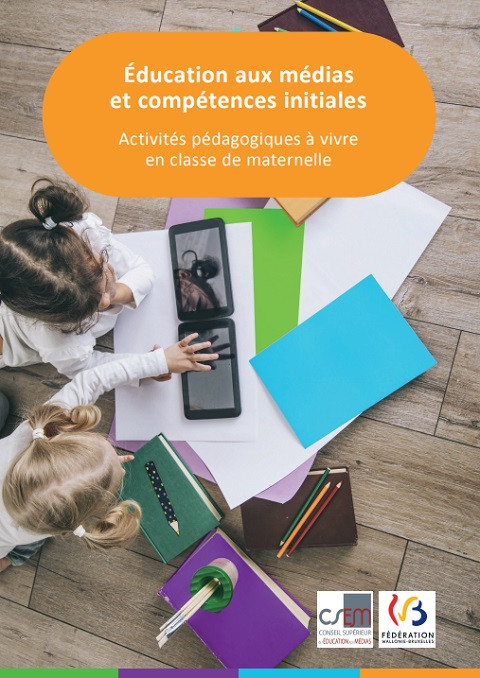 Éducation aux médias et compétences initiales: Activités pédagogiques à vivre en classe de maternelle Año de publicación: 2020 Autor corporativo: Conseil supérieur de l’éducation aux médias (CSEM) Cet outil du Conseil supérieur de l’éducation aux médias propose aux enseignant.e.s, une série d’activités pédagogiques directement reliées aux visées transversales.Souple et modulable, ce recueil de quinze activités d’analyse et de production médiatiques complètera le panel d’activités déjà menées en classe. Chaque fiche proposée est adaptable en fonction des objectifs poursuivis, des moyens et du temps disponibles.
  Respuestas de política pública y desafíos para garantizar el bien-estar de la primera infancia en tiempos de COVID-19: Un análisis comparado para américa latina Año de publicación: 2021 Autor: Ana María Osorio | Ernesto Cárdenas Autor corporativo: UNESCO IIEP Oficina para América Latina y el Caribe Este documento tiene un doble objetivo. En primer lugar, ofrecer un panorama de la situación de la primera infancia antes de la pandemia en América Latina, que permita identificar vulnerabilidades y riesgos del entorno físico-social que rodea a niños y niñas, y que pueden ser exacerbados por la pandemia y/o por las medidas adoptadas para contenerla. Para esto se presentan indicadores comparables, intentando priorizar al niño y a la niña como unidad principal de análisis. Asimismo, se usa la información más reciente de UNICEF y UNESCO para hacer seguimiento a la niñez en el periodo de afectación por la pandemia de la COVID-19. En segundo lugar, esta publicación busca identificar las principales respuestas de políticas públicas orientadas a garantizar el bien-estar de la primera infancia en la región, enfatizando en las estrategias implementadas por los gobiernos para continuar brindando servicios de cuidado y educación inicial en el contexto de la actual emergencia sanitaria
  Cultura de paz y resolución de conflictos Año de publicación: 2018 Autor: Patricia García Maza | Luis Miguel Ferrer Bueno Autor corporativo: Asociación Conexión Tejiendo Cuidados | Global Schools | Comisión Europea La primera tarea está enfocada hacia el trabajo con uno mismo, fundamental a la hora de resolver conflictos. Saber cómo reacciono, cuáles son mis potencialidades y debilidades, aprender a manejar mis emociones, facilitará la interacción con el otro. La segunda tarea se centra en esa interacción, somos personas diferentes, reaccionamos de distintas maneras, por lo que ver al otro, descubrir qué siente y piensa, exige la suficiente flexibilidad para tolerar la diferencia. 4 La tercera tarea está más enfocada a la cultura de paz para una ciudadanía global, pues esta también debe ser abordada desde una visión de bien común. Su línea estratégica es relacional hacia el bien común; solamente así se pueden enfrentar conflictos más globales.
 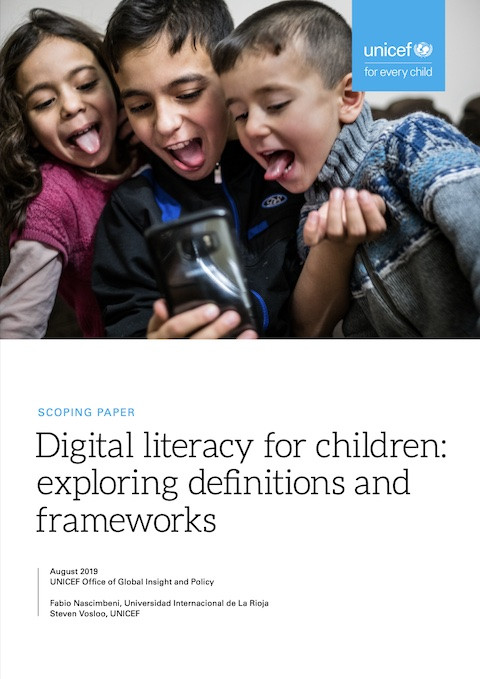 Digital Literacy for Children: Exploring Definitions and Frameworks Año de publicación: 2019 Autor: Fabio Nascimbeni Autor corporativo: United Nations Children's Fund (UNICEF) This paper presents the results of a scoping exercise on children’s digital literacy that has been undertaken with the following objectives:To understand the current digital literacy policy and practice landscape;To highlight existing competence frameworks and how they can be adapted to UNICEF’s needs;To analyze the needs and efforts of UNICEF country offices; andTo reflect on policy and programme recommendations, including a definition of digital literacy for UNICEF
  Critical Media Literacy and Popular Culture in ELA Classrooms Año de publicación: 2021 Autor: Jamila Lyiscott | Nicole Mirra | Antero Garcia Autor corporativo: National Council of Teachers of English (NCTE) This publication explores key issues on the Media Literacy impacting literacy educators and their students and articulate student-centered policy recommendations.
 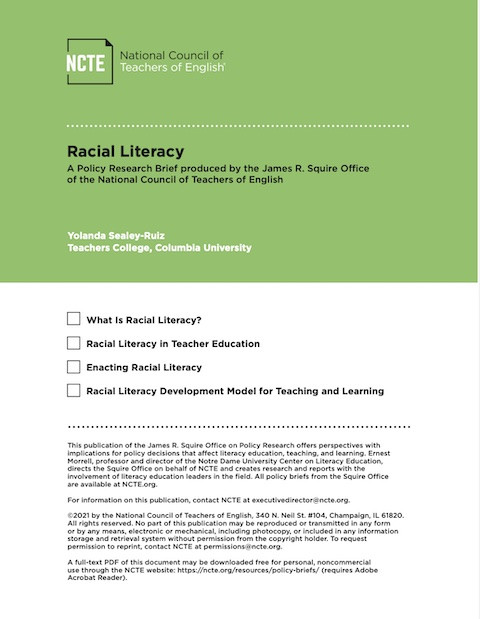 Racial Literacy Año de publicación: 2021 Autor: Yolanda Sealey-Ruiz Autor corporativo: National Council of Teachers of English (NCTE) This paper gives a clear definition of the racial literacy connected to the concepts of democracy and equity and presents racial literacy development model for teaching and learning.
 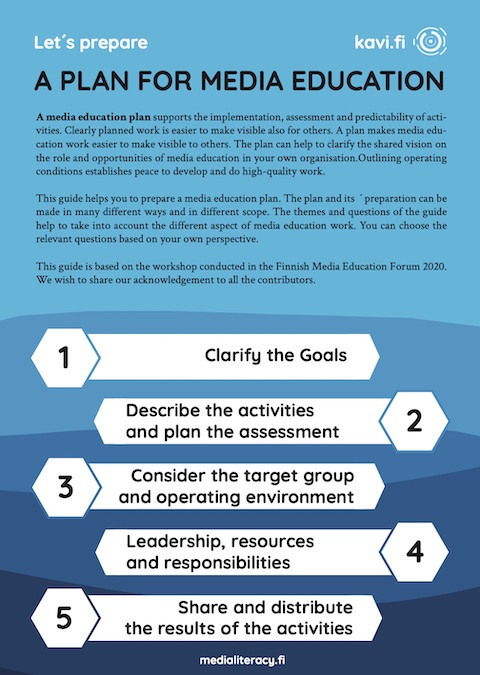 Let's Prepare: A Plan For Media Education Año de publicación: 2020 Autor corporativo: KAVI National Audiovisual Institute (Finland) This guide helps you to prepare a media education plan. The plan and its preparation can be made in many different ways and in different scope. The themes and questions of the guide help to take into account the different aspect of media education work. You can choose the relevant questions based on your own perspective. This guide is based on the workshop conducted in the Finnish Media Education Forum 2020.
  Rethinking Pedagogy: Exploring the Potential Of Digital Technology In Achieving Quality Education Año de publicación: 2019 Autor: Lorena Alemán de la Garza | Alessandra Anichini | Péter Antal | Aurélie Beaune | Éric Bruillard | Diane Burke | Pedro Henrique Cacique Braga | Ruma Chakravarti | Sriya Chakravarti | Deng Chen | Lidiya Chikalova | Helen Crompton | Ilana De Almeida Souza Concilio | William Cope | Lorenz Denks | Matthew Farber | Giovanni Fonseca | Pintér Gergely | Marcela Georgina Gómez Zermeño | Russell Hazard | Laura Hosman | Mary Kalantzis | Kojanitz László | Xavier Levoin | Kristen Linzy | Arnab Mandal | Yoko Mochizuki | Ariam Mogos | Tünde-Lengyel Molnár | Matthew Montebello | Sadaqat Mulla | Sandra Gudiño Paredes | Christelle Pauty-Combemore | Boyka Parfitt | Réka Racsko | Irais Monserrat Santillán Rosas | Khitam Shraim | Jisoo Song | Avgoustos Tsinakos Autor corporativo: Mahatma Gandhi Institute of Education for Peace and Sustainable Development (MGIEP) With the exponential growth of digitally mediated communication, digital media and gaming, the landscape of what we understand as learning environments is changing significantly. Today the use of digital technology in education is attracting considerable public and policy attention as
well as private investment. With a rise in discourses both heralding and cautioning against the use of digital technology in education, there is a need to pool the expertise and experience on the use of technology in education from around the world to advance public debate and evidence-informed policymaking. Based on the literature review, mapping of digital education resources in circulation, and examples of implementation of digital education initiatives from around the world, this report aims to provide insights that would help lead to the wise, innovative and ethical use of digital technology in education as a new dimension in achieving SDG 4 — inclusive and equitable quality education and lifelong learning opportunities for all. By so doing, it also attempts to contribute to a rethink of teaching and learning in the face of enormous opportunities and challenges brought about by digital technology in the times of change and turmoil.
Rethinking Pedagogy: Exploring the Potential Of Digital Technology In Achieving Quality Education Año de publicación: 2019 Autor: Lorena Alemán de la Garza | Alessandra Anichini | Péter Antal | Aurélie Beaune | Éric Bruillard | Diane Burke | Pedro Henrique Cacique Braga | Ruma Chakravarti | Sriya Chakravarti | Deng Chen | Lidiya Chikalova | Helen Crompton | Ilana De Almeida Souza Concilio | William Cope | Lorenz Denks | Matthew Farber | Giovanni Fonseca | Pintér Gergely | Marcela Georgina Gómez Zermeño | Russell Hazard | Laura Hosman | Mary Kalantzis | Kojanitz László | Xavier Levoin | Kristen Linzy | Arnab Mandal | Yoko Mochizuki | Ariam Mogos | Tünde-Lengyel Molnár | Matthew Montebello | Sadaqat Mulla | Sandra Gudiño Paredes | Christelle Pauty-Combemore | Boyka Parfitt | Réka Racsko | Irais Monserrat Santillán Rosas | Khitam Shraim | Jisoo Song | Avgoustos Tsinakos Autor corporativo: Mahatma Gandhi Institute of Education for Peace and Sustainable Development (MGIEP) With the exponential growth of digitally mediated communication, digital media and gaming, the landscape of what we understand as learning environments is changing significantly. Today the use of digital technology in education is attracting considerable public and policy attention as
well as private investment. With a rise in discourses both heralding and cautioning against the use of digital technology in education, there is a need to pool the expertise and experience on the use of technology in education from around the world to advance public debate and evidence-informed policymaking. Based on the literature review, mapping of digital education resources in circulation, and examples of implementation of digital education initiatives from around the world, this report aims to provide insights that would help lead to the wise, innovative and ethical use of digital technology in education as a new dimension in achieving SDG 4 — inclusive and equitable quality education and lifelong learning opportunities for all. By so doing, it also attempts to contribute to a rethink of teaching and learning in the face of enormous opportunities and challenges brought about by digital technology in the times of change and turmoil. 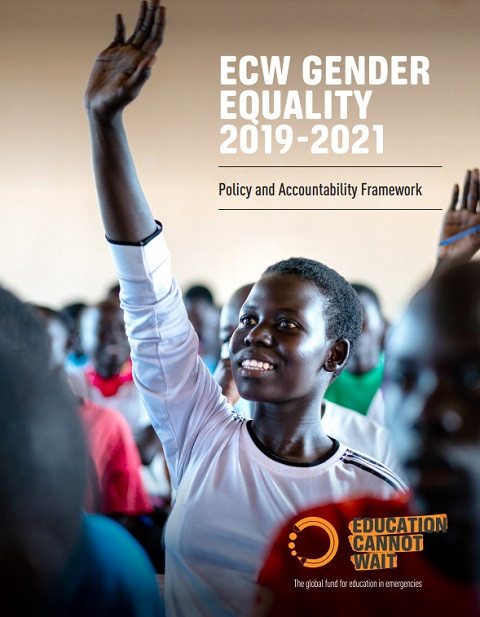 ECW Gender Equality 2019-2021: Policy and Accountability Framework Año de publicación: 2020 Autor corporativo: Education Cannot Wait (ECW) Education cannot wait (ECW) is committed to supporting the delivery of inclusive and quality education to 9 million girls, boys and youth most affected by emergencies and protracted crises by 2021. The purpose of ECW’s Gender Equality Policy is to articulate the Fund’s vision to advance gender equality and the empowerment of women and girls. Igualdad de género en el marco de las actividades para 2019-2021 de ECW : Política y marco de rendición de cuentas Año de publicación: 2020 Autor corporativo: Education Cannot Wait (ECW) ECW se ha comprometido a respaldar la provisión de educación inclusiva y de calidad a 9 millones de niñas, niños y jóvenes afectados por emergencias y crisis prolongadas no más tarde de 2021. La finalidad de la Política de Igualdad de Género de ECW, que se apoya en normas y estándares internacionales2 , consiste en estructurar la visión del Fondo para promover la igualdad de género y el empoderamiento de las mujeres y las niñas.