
Recursos
Exploren una amplia gama de recursos valiosos en GCED para profundizar su comprensión y promover su búsqueda, incidencia, enseñanza y aprendizaje.
1,330 resultados encontrados
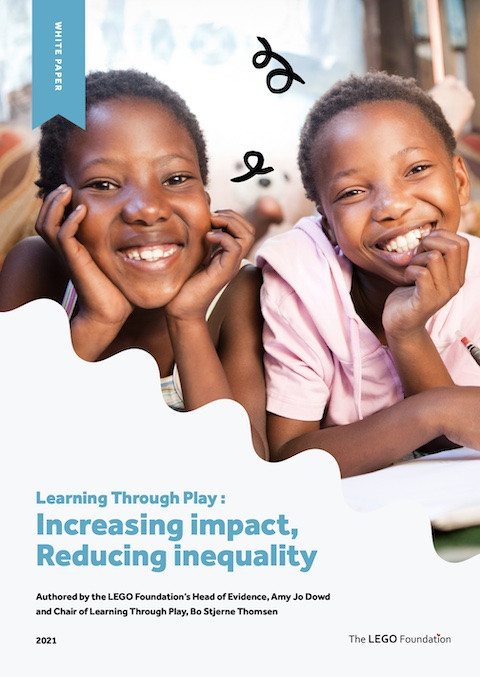 Learning Through Play: Increasing Impact, Reducing Inequality Año de publicación: 2021 Autor: Amy Jo Dowd | Bo Stjerne Thomsen Autor corporativo: LEGO Foundation This study explores the role of play in contributing to the effort to promote learning and reduce inequality. Reviews of play’s importance for learning present mostly correlational evidence from small samples in high-income, developed contexts, most often the United States, and often under laboratory conditions. This review expands both the geographic breadth and the scale of this evidence and explores the use of play in early childhood classroom and home-based educational interventions that have demonstrated causal impact on learning and the closing of achievement gaps. By doing so, it aims to understand whether and how the evidence about play and learning relates to tackling the learning crisis, especially in terms of inequality in learning outcomes around the globe.
 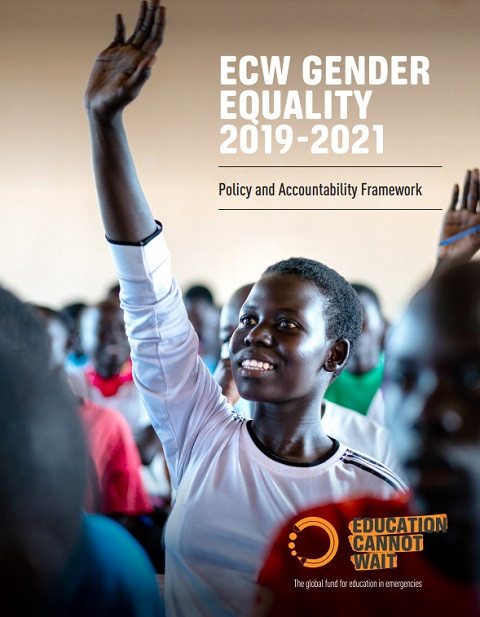 Égalité des genres dans le cadre des activités d’ECW 2019-2021: Politique et cadre de responsabilité Año de publicación: 2020 Autor corporativo: Education Cannot Wait (ECW) Éducation sans délai s’est engagé à soutenir la prestation de services d’éducation inclusive et de qualité auprès de 9 millions d’enfants et de jeunes parmi les plus touchés par une situation d’urgence ou de crise prolongée d’ici à 2021. La Politique ECW pour l’égalité des genres vise à détailler, en s’appuyant sur les normes internationales, les aspirations du fonds en matière d’égalité des genres et d’autonomisation des femmes et des filles.
  Educating for American Democracy: Excellence in History and Civics for All Learners Año de publicación: 2021 Autor corporativo: Educating for American Democracy (EAD) This material presents a Roadmap to Educating for American Democracy— guidance and an inquiry framework that states, local school districts, and educators in U.S. to transform teaching of history and civics to meet the needs of a diverse 21st century K-12 student body. It also recommends approaches to learning that do five critical things as follow: inspire students to want to become involved in their constitutional democracy tell a full narrative of America’s plural yet shared story explore the need for compromise to make constitutional democracy work cultivate civic honesty and patriotism that leaves space both to love and to critique this country teach history and civics both through a timeline of events and the themes that run through those events.
 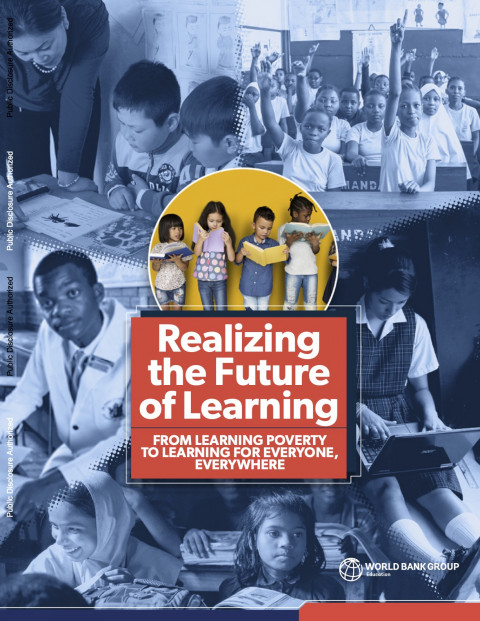 Realizing the Future of Learning: From Learning Poverty to Learning for Everyone, Everywhere Año de publicación: 2020 Autor: Jaime Saavedra | Cristian Aedo | Omar Arias | Adelle Pushparatnam | Halsey Rogers | Marcela Gutierrez Bernal | Sanna Ellinore Ahlgren | Maria Qureshi Autor corporativo: World Bank This report describes the World Bank’s vision for the future of learning and a strategic approach that lays out the lines of actions needed for education systems to move forward in accelerating learning improvement. To guide its policy advisory and operational support to countries, the report discusses policy actions that are needed to accelerate learning and that characterize the way many successful systems operate. These are presented within five interrelated pillars of a well-functioning education system that underpin the World Bank’s strategic education policy approach: learners, teachers, learning resources, schools, and system management.This report also reviews the current learning crisis, including the extent to which COVID-19 has exacerbated it, and then lays out a vision, policy priorities and some principles for education policy reform.
 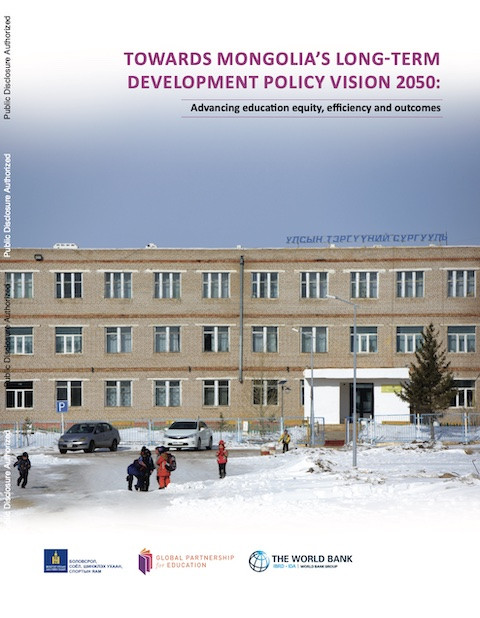 Towards Mongolia’s Long-Term Development Policy Vision 2050: Advancing Education Equity, Efficiency and Outcomes Año de publicación: 2020 Autor corporativo: Mongolia Ministry of Education, Culture, Science and Sports | World Bank This report seeks to synthesize and analyze education outcomes with a view of identifying the main priorities for strengthening the education sector in support of Mongolia’s Sustainable Development Vision 2050. The report highlights data and findings generated from a series of source reports (see bibliography) related to the goals and targets set out in the Vision 2050. The report is composed of six thematic chapters: Access; Equity; Internal Efficiency, Education Cost and Finance; External Efficiency; Management. Each chapter will include an overview of the current situation and recent development with a focus on, key achievements and persistent challenges. As a synthesis report, the information on each topic is not exhaustive but rather seeks to present key findings. Specific activities highlighted in the Vision 2050 have been included at the beginning of each chapter and a complete mapping by activity is annexed (Annex 1. Vision 2050 Chapter mapping). This synthesis report draws on conclusions, finding, data and surveys produced in collaboration with MECSS by the Asian Development Bank, the Global Partnership for Education and the World Bank. The synthesis also draws from key UNESCO reports. The scope, research, and focus of the source reports differ, and precise findings are, on occasions, incongruent however the overall conclusions are fundamentally compatible. Whereas most of the source reports focus on one or two key stages, the synthesis report seeks to extract cross-cutting and/or recurring challenges that have an impact, positive or negative, on equity, efficiency and outcomes which ultimately may contribute to the implementation of Vision 2050. Mongolia’s State Education Policy (2014-2024) states: ‘Education is the main key factor of each citizen’s lifelong support and guarantee of life quality, and of the State’s societal and economical, science and technological development, and guarantee of national independence and security. Mongolian State shall develop education as a leading sector in society’.
  SDG4 관점에서 한국의 COVID-19 대응 진단 및 Post COVID-19를 위한 제언 Año de publicación: 2020 Autor: 장상현 | 계보경 | 김민 | 박기웅 | 백송이 | 김명량 | 김동진 | 장경숙 | 김정희 | 황정원 | 김철희 | 최현식 | 박민선 | 엄정민 Autor corporativo: 한국교육학술정보원 본 연구는 UN의 지속가능개발목표(SDGs)의 네 번째인 SDG4의 관점에서 한국의 COVID-19에 대한 교육정책 분야의 대응 방안과 사례를 진단하고, COVID-19 이후에 맞이하게 될 시대의 SDG4 세부목표를 제안하기 위해 수행되었다. 모든 이를 위한 포용적이고 공평한 양질의 교육 보장과 평생학습의 증진을 위한 ‘교육2030 인천 선언(Education 2030: Incheon Declaration and Framework for Action)’이 채택된 이후, SDG4 교육목표를 달성하기 위한 범 정부와 민간 차원의 지원이 계속되었으나, COVID-19 팬데믹으로 인해 학생들 간의 학습 격차가 발생하고, 학습 기회가 약화되는 등 적극적인 대응책이 필요해지고 있는 상황이다. 이에 본 연구에서는 COVID-19 상황 하에서 한국의 교육 현황을 점검하고 포용성, 형평성, 양질의 교육을 실현할 수 있는 대응 방안을 탐색하며, 이를 바탕으로 글로벌 의제와 한국적 대응 방안을 융합한 포스트 COVID-19를 위한 SDG4 세부목표별 제언을 도출하고자 하였다. 본 저작물은 한국교육학술정보원에서 2020년 작성하여 공공누리 제 4유형으로 개방한 ‘SDG4 관점에서 한국의 COVID-19 대응 진단 및 Post COVID-19를 위한 제언(장상현 외)’을 이용하였으며 해당 저작물은 한국교육학술정보원(www.keris.or.kr)에서 무료로 다운받으실 수 있습니다.
  한국사회와 지속가능발전목표 4: 지속가능한 사회를 꿈꾸는 교육 Año de publicación: 2018 Autor: 임현묵 | 박환보 Autor corporativo: 유네스코한국위원회 지속가능발전목표에 대한 시민의 이해를 돕고자 유네스코한국위원회가 발간하는 ‘한국사회와 지속가능발전목표’ 시리즈 중 4번째로, 세계시민교육과 지속가능발전교육을 포함한 지속가능발전목표 4번을 집중적으로 다루고 있다. 유네스코한국위원회는 2017년 <<한국사회와 지속가능발전목표 7: 우리의 지속가능한 에너지>>와 <<한국사회와 지속가능발전목표 11: 우리의 지속가능한 도시>>를 펴낸 데 이어, 2018년에는 <<한국사회와 지속가능발전목표 15: 우리의 지속가능한 생물다양성>>과 이 책을 발간했다.
  Mindfulness in the Context of Education Año de publicación: 2021 Autor corporativo: Campus Virtual MIMI This podcast deals with the concept of mindfulness, understood as an Eastern tradition that in recent years has been adapting to Western culture from different contexts to work on its own well-being. It is also defined by the author Jon Kabat-Zinn, who has brought to the West is practical, as the possibility of paying attention in a determined way to the present moment, without judgments. It has 3 components: attention, the intention to be present and attitudes individuals. It shows to be an inherent quality of the human being, as well as a capacity and ability that is trained, a practice that helps the brain in terms of its predispositions and has scientific bases that strongly relate it to mental health, due to its intervention in the nervous system , which generate a balance in the activation of this system. Therefore, the objective of mindfulness is to generate a possibility to balance emotions and learn to regulate them. It allows thoughts to connect with the body, which impacts on affective symptoms by strengthening the immune system. The video shows the ways to use it in everyday life in the academic context. La atención plena en el contexto de la educación Año de publicación: 2021 Autor corporativo: Campus Virtual MIMI Este Podcast trata acerca del concepto de atención plena, entendido como una tradición oriental que en los ultimos años se ha venido adaptando a la cultura occidental desde distintos contextos para trabajar en el bienestar propio. La define también a partir de el autor Jon Kabat-Zinn, quien ha traido a occidente está practica, como la posibilidad de prestar atención de manera determinada al momento presente, sin juicios.Tiene 3 componentes la atencjón, la intención de estar presente y actitudes particulares. Evidencia ser una cualidad inherente al ser humano, así como una capacidad y habilidad que se entrena, una práctica que ayuda al cerebro en cuanto a sus predisposiciones y tiene bases científicas que la relacionan fuertemente con la salud mental, por su intervención en el sistema nervioso, que generan un equilibrio en la activación de este sistema. Por tanto el objetivo de la atención plena es generar una posibilidad de equilibrar las emociones y aprender a regularlas. Permite que los pensamientos se conecten con el cuerpo lo que impacta en los síntomas de tipo afectivo fortaleciendo el sistema inmune. El video muestra las maneras para usarlo en la vida cotidiana en el contexto académico.
  Chouette, pas chouette: Livret pédagogique; Activités d’éducation aux médias et à l'information sur le thème de l’égalité filles-garçons Año de publicación: 2021 Autor corporativo: Centre pour l’éducation aux médias et à l’information (CLEMI) Chouette, pas chouette ! une série de 16 programmes courts animés pour sensibiliser les 4-6 ans aux stéréotypes sexistes avec intelligence et humour a été réalisée avec l’appui de l’expertise pédagogique du CLEMI. C’est aussi un univers peuplé de personnages attachants, décliné en un livret pédagogique pour permettre aux professeurs des écoles de développer leurs actions en éducation aux médias et à l'information sur le thème de l’égalité filles/garçons, de la maternelle à la 6e.