
Recursos
Exploren una amplia gama de recursos valiosos en GCED para profundizar su comprensión y promover su búsqueda, incidencia, enseñanza y aprendizaje.
1,330 resultados encontrados
 Education for Sustainable Development: Partners in Action; Global Action Programme (GAP) Key Partners' Report (2015-2018) Año de publicación: 2019 Autor corporativo: UNESCO The Global Action Programme (GAP) on Education for Sustainable Development (ESD) was launched by UNESCO as a follow up to the United Nations Decade of ESD in order to accelerate progress on sustainable development and scale up action in all areas of education and learning. Its duration is from 2015 to 2019.To that end, UNESCO works with a network of 97 GAP Key Partners from government, civil society, the private sector and academia active in five Priority Action Areas: advancing policy, transforming learning environments, building the capacity of educators, empowering youth, and accelerating sustainable solutions at the local level. Each GAP Key Partner committed to meet specific targets by 2019. To measure progress in meeting the targets set by the GAP Key Partners, 10 indicators were identified, two in each Priority Action Area. Through surveys sent to them by UNESCO, GAP Key Partners report against these 10 indicators and toward the targets set for each indicator. In the surveys, GAP Key Partners are also invited to rate the benefits of participation in the GAP for their work and provide qualitative data concerning their implementation progress. Three progress reports are scheduled to be produced: The first report, covering progress between 2015 and 2016, was released by UNESCO in 2017 This second report, covering 2015-2018, is to be published in 2019 The third and final report, covering the entire period of the GAP, 2015-2019, will be published in 2020 This second report presents the results of the GAP Key Partners survey carried out at the end of 2018, with a response rate of 78%. The report presents the analysis of the quantitative responses of GAP Key Partners to each of the 10 indicators. Based on the qualitative responses provided by the GAP Key Partners, a short comment on each of the progress status is also provided. Éducation en vue du développement durable: Partenaires dans l’action; Rapport des partenaires clés du Programme d’action global (2015-2019) Año de publicación: 2019 Autor corporativo: UNESCO Le Programme d’action global pour l’éducation en vue du développement durable (EDD) a été lancé par l’UNESCO dans le cadre du suivi de la Décennie des Nations Unies pour l’éducation au service du développement durable afin de donner un coup d’accélérateur à la réalisation des objectifs de développement durable et d’intensifier l’action en faveur de l’EDD dans tous les domaines de l’éducation et de l’apprentissage. Le Programme a été mis en œuvre entre 2015 et 2019. L’UNESCO a travaillé avec un réseau constitué des 97 partenaires clés du Programme d’action global. Issus des gouvernements, de la société civile, du secteur privé et de l’université, ces partenaires interviennent dans cinq domaines d’action prioritaires : promouvoir des politiques, transformer les environnements d’apprentissage, renforcer les capacités des éducateurs, autonomiser les jeunes et accélérer la recherche de solutions durables à l’échelle locale. Les partenaires clés du Programme d’action global se sont engagés à atteindre des objectifs précis en 2019. Dix indicateurs, soit deux par domaine d’action prioritaire, ont été définis.Les partenaires clés du Programme d’action global ont rendu compte des progrès accomplis au regard de ces indicateurs à l’aide des trois enquêtes que l’UNESCO leur a envoyées au cours de la mise en œuvre du Programme.Les partenaires clés ont par ailleurs été invités à évaluer en quoi leur participation au Programme d’action global avait été bénéfique à leurs activités et à fournir des données qualitatives sur le déroulement de la mise en œuvre. Trois rapports d’étape ont ainsi été produits : le premier rapport, relatif aux progrès accomplis en 2015 et 2016, a été publié par l’UNESCO en 2017 ; le second, qui concerne la période de 2015 à 2018, est paru en 2019 ; le troisième et dernier rapport (le présent document) couvre l’ensemble de la période de mise en œuvre du Programme d’action global, de 2015 à 2019. Le présent rapport livre une analyse des données quantitatives fournies par les partenaires clés du Programme d’action global pour chacun des dix indicateurs. En s’appuyant sur ces données quantitatives, il indique brièvement quels ont été les progrès réalisés par rapport aux indicateurs. On trouvera en conclusion de ce bref rapport quelques-uns des enseignements tirés du Programme d’action global qui pourront utilement guider la mise en œuvre du nouveau cadre global établi pour la période 2020-2030, L’éducation en vue du développement durable : vers la réalisation des ODD (L’EDD pour 2030).
  Proposal for a Global Action Programme on Education for Sustainable Development as Follow-up to the United Nations Decade of Education for Sustainable Development (DESD) after 2014 Año de publicación: 2013 Autor corporativo: UNESCO The present document contains the proposal for a Global Action Programme on Education for Sustainable Development (ESD) and the comments and observations of the Executive Board thereon.
  United Nations Decade on Education for Sustainable Development (2005-2014): Education for Sustainable Development Año de publicación: 2005 Autor corporativo: UNESCO The Declaration of the International Conference on Ecology and Development, held in Rio de Janeiro in 1992, begins with the following words: "People are the main concern for sustainable development. They have the right to a healthy and productive life in harmony with nature. "The Declaration adopted at the World Summit on Sustainable Development, held in Johannesburg in 2002, reflected the commitment of world leaders to "create a humane, equitable and attentive to civil society, recognizing that each member of this society has its own human dignity". Education is the foundation of sustainable development, as discussed in chapter 36 of the Program-21 of the summit that was held in Rio de Janeiro in 1992. This idea was reiterated at the Johannesburg summit. The implementation plan foresees a link between the Millennium Development Goals for universal primary education for both boys and girls, with special attention paid to girls, and the Dakar Plan of Action on Education for All. The creation of a gender-sensitive educational system at all levels and in all types of education - formal, informal and informal - to reach those who are not involved in the educational process is an essential component of education for sustainable development. Education is considered a tool to address such important issues as rural development, health, the prevention of the spread of HIV / AIDS, the environment, as well as broader ethical and legal issues (for example, human values and human rights).There is no universal model of education for sustainable development. Despite the countries' agreement on the overall concept, the approaches to education in each country will differ due to local characteristics and priorities. Each country should define its priorities and actions, as well as goals, accents and processes, based on environmental, social, economic conditions and appropriate ways of solving the problem. Education for sustainable development is equally critical for both developed and developing countries. ОБРАЗОВАНИЕ ДЛЯ УСТОЙЧИВОГО РАЗВИТИЯ: Декада ООН по образованию для устойчивого развития (2005 – 2014) Año de publicación: 2005 Autor corporativo: Организация Объединенных Наций по вопросам образования, науки и культуры (UNESCO) Декларация Международной конференции по экологии и развитию, прошедшей в Рио-де-Жанейро в 1992 г., начи-нается следующими словами: “Люди являются главной за-ботой устойчивого развития. Они имеют право на здоровую и продуктивную жизнь в гармонии с природой”. Декларация, принятая на Всемирном саммите по устойчи-вому развитию, состоявшемся в Йоханнесбурге в 2002 г., отразила обязательства лидеров мировых держав “создать гуманное, равноправное и внимательное к проблемам че-ловека общество, признающее то, что каждый член этого общества имеет свое человеческое достоинство”. Образование является фундаментом устойчивого развития, об этом говорится в главе 36 Программы–21 саммита, про-шедшего в Рио-де-Жанейро в 1992 г. Еще раз эта мысль была подтверждена на саммите в Йоханнесбурге. План реализации предусматривает установление связи между Целями развития тысячелетия в отношении всеобщего на-чального образования как для мальчиков, так и для девочек, где девочкам уделяется особое внимание, и Дакарским пла-ном действий по Образованию для всех. Создание гендер-но–чувствительной системы образования на всех уровнях и во всех типах образования – формальном, неформальном и неофициальном – в целях охвата тех, кто не принимает участия в образовательном процессе, – важнейший компо-нент образования для устойчивого развития. Образование считается инструментом, направленным на решение таких важных вопросов, как развитие сельских регионов, здраво-охранение, предотвращение распространения ВИЧ/СПИД, экология, а также более широких вопросов этического и правового характера (например, общечеловеческие цен-ности и права человека).Универсальной модели образования для устойчивого разви-тия не существует. Несмотря на согласие стран в отношении общей концепции, подходы к образованию в каждой стране будут различаться в силу местных особенностей и приори-тетов. Каждая страна должна определить свои приоритеты и действия, а также цели, акценты и процессы, исходя из экологических, социальных, экономических условий и со-ответствующих путей решения проблемы. Образование для устойчивого развития в равной степени является критиче-ски важным как для развитых, так и для развивающихся стран.
  Promouvoir l’education a la citoyennete mondiale en afrique de l’ouest : Atelier international de renforcement de capacités des pays de la CEDEAO 07 – 09 Juillet 2015, Dakar, Sénégal Año de publicación: 2015 Autor corporativo: Организация Объединенных Наций по вопросам образования, науки и культуры (UNESCO) Ce rapport est le fruitde l’atelier international de renforcement de capacités organisé par l’UNESCO dans l’objectif de renforcer les capacités des pays membres de la Communauté économique des États de l'Afrique de l'Ouest (CEDEAO) pour la promotion de l’Education à la citoyenneté mondiale aux niveaux nationaux et régionaux. Autonomiser des citoyens du mon de actifs et construire un sens d’appartenance à une humanité commune ne font pas uniquement partie du mandat de l’UNESCO mais sont aussi des problèmes prioritaires pour l’Afrique de l’Ouest. Ce rapport d’atelier fournit des ressources, stratégies et feuilles de routes pour l’avancée et une meilleure intégration de l’ECM dans les politiques et les programmes éducatifs en Afrique de l’Ouest. Les feuilles de route ont été proposées par les Etats membres eux-mêmes et leur mise en œuvre dépendra de la disponibilité des ressources et des partenariats potentiels.
 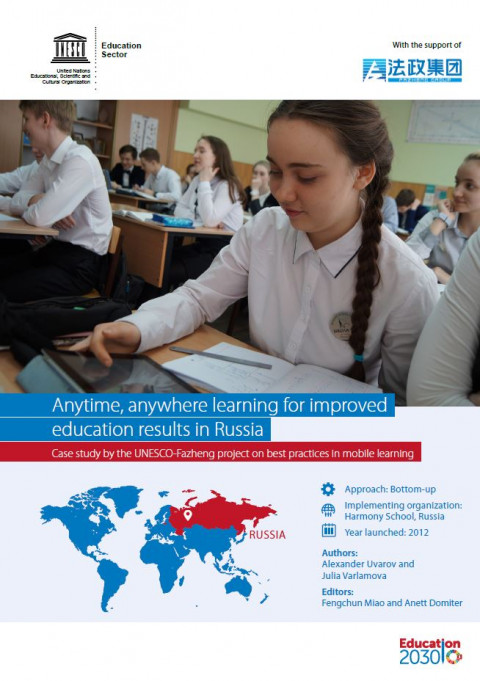 Anytime, Anywhere Learning for Improved Education Results in Russia: Case Study by the UNESCO-Fazheng Project on Best Practices in Mobile Learning Año de publicación: 2019 Autor: Alexander Uvarov | Julia Varlamova Autor corporativo: UNESCO The Harmony School in Izhevsk is a regular municipal school located in one of the city districts of the capital city of the Udmurt Republic in Russia. Students come to Harmony school from different cultural and social environments, with various physical and mental abilities, and the school is eager to create the best conditions for learning and developing for each of them. In 2012, Harmony School took a part in the School of Digital Age project supported by the federal Skolkovo project and the Russian branch of Microsoft. The mobile technologies in the school are implemented as a tool for anytime and anywhere learning to differentiate and individualize learning to improve education results.According to the school vision, mobile learning technologies should provide all students and teachers anytime and anywhere access to a variety of teaching and learning materials and digital instruments and students who are unable to attend classes should be able to continue their systematic studies. The mobile learning model should enable every student to experience independent learning activities in the digital educational environment and improve their educational results with new methods and organizational forms of teaching and learning. To implement this vision, the new school-wide teaching and learning practices including online/blended learning, mobile learning in the classroom and outside-classroom learning have been developed and used actively. The new in-school teachers’ professional development model has become a crucially important element for the project’s success.
 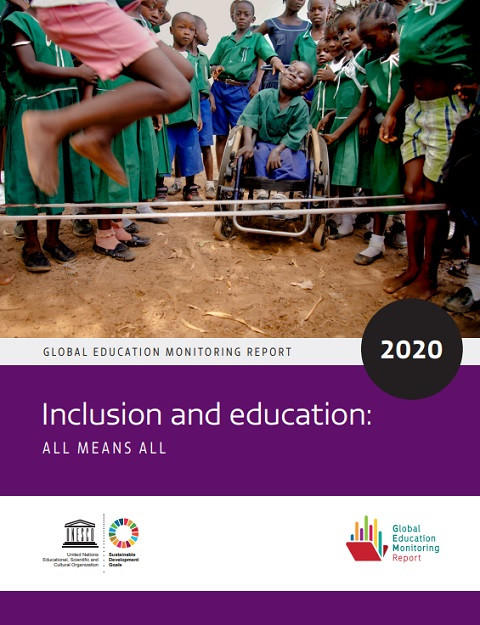 Informe de seguimiento de la educación en el mundo 2020: Inclusión y educación: Todos y todas sin excepción Año de publicación: 2020 Autor corporativo: Global Education Monitoring Report Team | UNESCO En el Informe de Seguimiento de la Educación en el Mundo 2020 se examinan los mecanismos sociales, económicos y culturales que discriminan a niños, jóvenes y adultos desprotegidos, manteniéndolos excluidos de la educación o marginados dentro de ella. Estimulados por su compromiso de hacer realidad el derecho a la educación inclusiva, los países están ampliando su visión de la inclusión en la educación y otorgando a la diversidad un lugar central en sus sistemas. Sin embargo, la aplicación de leyes y políticas bienintencionadas suele flaquear. El informe, publicado a principios del decenio de acción que culmina en 2030 y en el contexto de la crisis de Covid-19 que ha exacerbado las desigualdades subyacentes, sostiene que la resistencia a atender las necesidades de todos los educandos es una verdadera amenaza para el logro de los objetivos mundiales de educación.En Inclusión y educación: todos y todas sin excepción se definen prácticas en materia de gobernanza y finanzas; planes de estudios, manuales escolares y evaluaciones; formación de los docentes; infraestructura escolar; y relaciones con los alumnos, los padres y las comunidades que pueden desbloquear el proceso hacia la inclusión. Se formulan recomendaciones de política para que la diversidad de los educandos sea una fuerza que se valora, una fuerza de cohesión social.Dos nuevos sitios web complementan la cuarta edición del Informe de Seguimiento de la Educación en el Mundo. Education Profiles (Perfiles educativos) describe la manera en que los países abordan la inclusión, y constituye un medio útil para el diálogo sobre políticas. Education Progress (El Progreso de la educación) brinda la oportunidad de interactuar con los datos y explorar una serie de indicadores del ODS 4.
 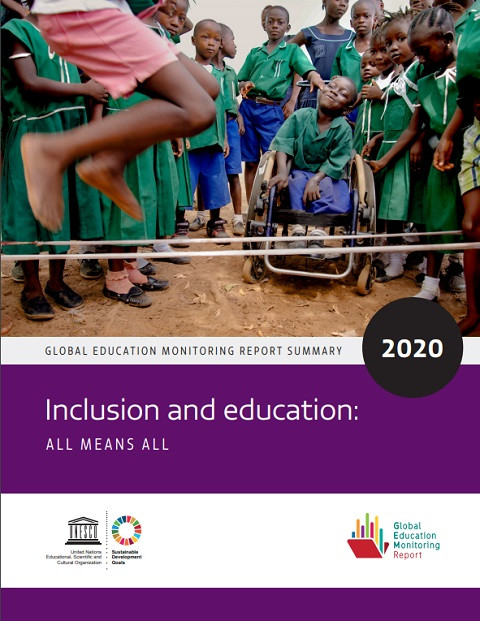 [요약문] 세계 교육 현황 보고서 요약본 2020: 포용과 교육; 모두는 모든 이를 의미한다 (All Means All) Año de publicación: 2020 Autor corporativo: 유네스코 | 세계교육현황보고서팀 『2020 세계 교육 현황 보고서』는 취약계층 아동, 청소년 및 청년을 차별하여 교육에서 배제시키거나 소외시키는 사회적, 경제적, 문화적 메커니즘을 살펴본다. 포용적 교육에 대한 권리를 실현하겠다는 약속에 힘입어 모든 국가는 다양성을 교육제도의 핵심에 두기 위해 포용에 대한 비전을 확대하고 있다. 그러나 선의의 법과 정책의 시행은 종종 비틀거리곤 한다. 2030년까지 10년간의 실행이 시작되는 시점이자 근본적인 불평등을 악화시킨 코로나19 위기의 중간에 발표된 이 보고서는 모든 학습자의 요구를 해결하는 것에 대한 저항이 세계 교육 목표를 달성하는데 실질적인 위협이라고 주장한다. 『포용과 교육: 모두는 모든 이를 의미한다(ALL MEANS ALL)』는 거버넌스와 재정, 교육과정, 교과서 및 평가, 교사 교육, 학교 인프라, 그리고 포용의 과정을 밝힐 수 있는 학생, 학부모, 지역사회와의 관계 등에서 많은 실천들을 확인할 수 있다. 이 보고서는 학습자의 다양성을 사회적 응집력으로 만들기 위한 정책 권고안을 제공한다. ملخص التقرير العالمي لرصد التعليم 2020: التعليم الشامل للجميع; الجميع بال استثناء Año de publicación: 2020 Autor corporativo: UNESCO | Global Education Monitoring Report Team ينظر التقرير العالمي لرصد التعليم لعام 2020 في اآلليات االجتماعية واالقتصادية والثقافية التي تميز ضد األطفال والشباب والبالغين المحرومين، مما يحرمهم من التعليم أو يجعلهم مهمشين فيه. وبفضل حافز التزامها بإعمال الحق في التعليم الشامل، تعمل البلدان على توسيع نطاق رؤيتها للتعليم الشامل بإدراج التنوع في صلب ً ما يتعثر تنفيذ القوانين والسياسات الهادفة التي تنطوي نظمها التعليمية. لكن غالبا على نوايا حسنة. ويرى التقرير الذي صدر في بداية عقد العمل حتى عام 2030 ، وفي خضم األزمة الناجمة عن جائحة كوفيد-19 ،التي أسفرت عن تفاقم أوجه عدم ً أمام ً حقيقيا المساواة الكامنة، أن مقاومة تلبية احتياجات كل متعلم تشكل تهديدا تحقيق أهداف التعليم العالمية.