
Recursos
Exploren una amplia gama de recursos valiosos en GCED para profundizar su comprensión y promover su búsqueda, incidencia, enseñanza y aprendizaje.
3,182 resultados encontrados
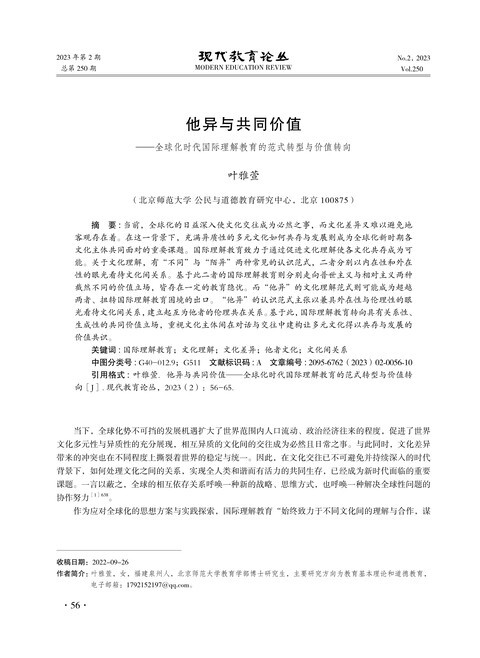 他异与共同价值: 全球化时代国际理解教育的范式转型与价值转向 (现代教育论丛; No.2, 2023) Año de publicación: 2023 Autor: 叶雅萱 当前,全球化的日益深入使文化交往成为必然之事,而文化差异又难以避免地客观存在着。在这一背景下,充满异质性的多元文化如何共存与发展则成为全球化新时期各文化主体共同面对的重要课题。国际理解教育致力于通过促进文化理解使各文化共存成为可能。关于文化理解,有“不同”与“陌异”两种常见的认识范式,二者分别以内在性和外在性的眼光看待文化间关系。基于此二者的国际理解教育则分别走向普世主义与相对主义两种截然不同的价值立场,皆存在一定的教育隐忧。而“他异”的文化理解范式则可能成为超越两者、扭转国际理解教育困境的出口。“他异”的认识范式主张以兼具外在性与伦理性的眼光看待文化间关系,建立起互为他者的伦理共在关系。基于此,国际理解教育转向具有关系性、生成性的共同价值立场,重视文化主体间在对话与交往中建构让多元文化得以共存与发展的价值共识。
 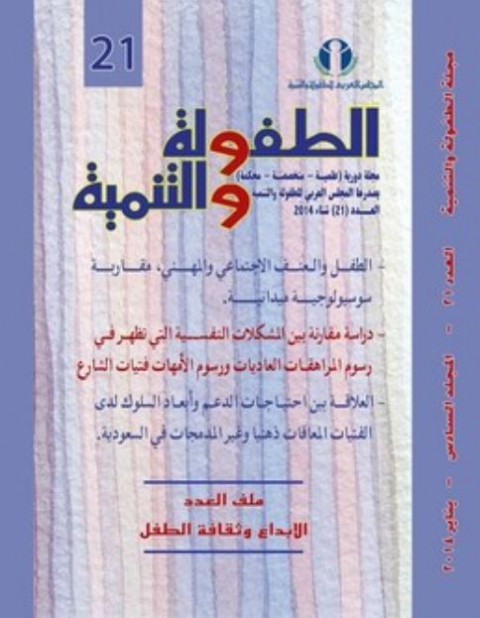 Arts Education for the Children of the Arab World as a Mediator for Development and the Axis of International Understanding: The Child's Song Año de publicación: 2014 Autor: Amal Sadiq Autor corporativo: Arab Council for Childhood and Development (ACCD) This paper focuses on art education and music in the Arab world and its link to development. The paper goes on critical understanding on how music and art can educate children for international understanding. تعليم الفنون لأطفال العالم العربى وسيط للتنمية ومحور التفاهم الدولى : أغنية الطفل Año de publicación: 2014 Autor: Amal Sadiq Autor corporativo: Arab Council for Childhood and Development (ACCD) تركز الورقة على التربية الفنية والموسيقى في الوطن العربي وصلتها بالتنمية. تتناول الورقة فهمًا نقديًا لكيفية تعليم الموسيقى والفن للأطفال من أجل التفاهم الدولي.
 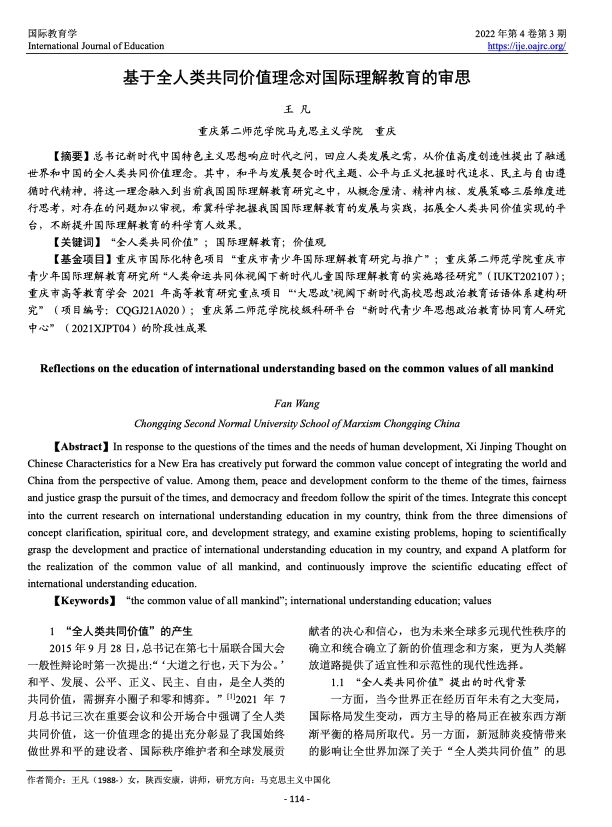 基于全人类共同价值理念对国际理解教育的审思 Año de publicación: 2022 Autor: 王凡 总书记新时代中国特色主义思想响应时代之问,回应人类发展之需,从价值高度创造性提出了融通世界和中国的全人类共同价值理念。其中,和平与发展契合时代主题、公平与正义把握时代追求、民主与自由遵循时代精神。将这一理念融入到当前我国国际理解教育研究之中,从概念厘清、精神内核、发展策略三层维度进行思考,对存在的问题加以审视,希冀科学把握我国国际理解教育的发展与实践,拓展全人类共同价值实现的平台,不断提升国际理解教育的科学育人效果。
 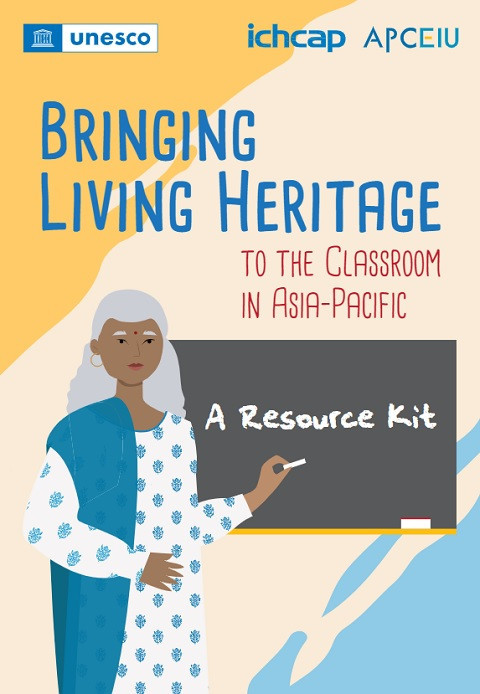 Bringing Living Heritage to the Classroom in Asia-Pacific: A Resource Kit Año de publicación: 2022 Autor corporativo: UNESCO Bangkok | APCEIU | International Information and Networking Centre for Intangible Cultural Heritage in the Asia-Pacific Region (ICHCAP) Integrating living heritage in school teaching and learning can enhance education quality, enliven the experiences of students and teachers, and contribute to keeping this heritage alive for current and future generations. In addition, as the ongoing COVID-19 pandemic has also demonstrated, living heritage can play an important role in ensuring the well-being and resilience of communities. UNESCO encourages countries to safeguard living heritage through formal and non-formal education. From the end of 2019 to early 2022, UNESCO has been working with partners to implement a pilot project “Teaching and Learning with Living Heritage in Schools” in six countries in Asia and the Pacific - including Cambodia, Kazakhstan, Kyrgyzstan, Nepal, Republic of Korea and Thailand. Over 1900 students from 21 schools had the opportunity to participate in these innovative classes. Throughout the process, 86 teachers, with more than two thirds being women, have developed and tested 101 lesson plans and activities. This Resource Kit provides step-by-step guidance and key resources on why and how to integrate living heritage in lessons and extracurricular activities in schools. Whoever you are – policy-maker, school director, teacher, student, parent, heritage practitioner – you have a vital role to play in this process.
 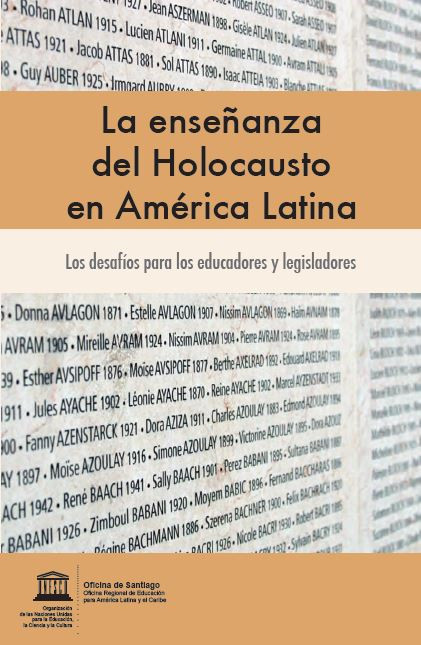 The Teaching of the Holocaust in Latin America the Challenges for Educators and Legislators Año de publicación: 2017 Autor: María Celeste Adamoli | Emmanuel Kahan, Pablo Luzuriaga | Ministerio de Educación Autor corporativo: UNESCO Santiago This book provides an overview of opportunities that may arise from educating about the Holocaust in diverse cultural contexts and educational situations, with a special focus on Latin American countries. We can actually be away from the places where the genocide against the Jewish people was perpetrated, but Latin America is still taking charge of its own past of violence and crimes against humanity. With this publication, Latin American educators will have at their fingertips an updated account of the most outstanding topics that are discussed on pedagogy and policy making. You can also explore how, even today in Europe, education about the Holocaust shapes a culture of memory. On the other hand, you can see how in other places the memory of the Holocaust can be a starting point to relate to other difficult pasts. UNESCO is convinced that the prevention of genocide begins at school. In a world where mass violence is possible, this publication will show the importance of teaching young people about the Holocaust and about other genocides in history. It is a condition to prevent similar crimes from happening in the future. La Enseñanza del Holocausto en América Latina: los desafíos para los educadores y legisladores Año de publicación: 2017 Autor: María Celeste Adamoli | Emmanuel Kahan, Pablo Luzuriaga | Ministerio de Educación Autor corporativo: UNESCO Santiago Este libro proporciona un panorama de oportunidades que pueden surgir de educar sobre el Holocausto en diversos contextos culturales y situaciones educativas, con un foco especial en los países latinoamericanos. Podemos en realidad estar lejos de los lugares donde el genocidio contra el pueblo judío fue perpetrado, pero también América Latina está todavía haciéndose cargo de su propio pasado de violencia y crímenes contra la humanidad. Con esta publicación, los educadores latinoamericanos van a tener al alcance de la mano un recuento actualizado de los temas más destacados que se discuten sobre pedagogía y construcción de políticas. También podrán explorar cómo, todavía hoy en Europa, la educación sobre el Holocausto da forma a una cultura de la memoria. Por otra parte, pueden ver cómo en otros lugares la memoria del Holocausto puede ser un punto de partida para relacionarse con otros pasados difíciles. La UNESCO está convencida de que la prevención del genocidio comienza en la escuela. En un mundo en donde la violencia masiva es posible, esta publicación mostrará lo importante de enseñar a los jóvenes sobre el Holocausto y sobre otros genocidios en la historia. Es una condición para prevenir que crímenes similares sucedan en el futuro.
  World Report on the Culture of Peace: Civil Society Report at Midpoint of the Culture of Peace Decade Año de publicación: 2005 Autor corporativo: Foundation for a Culture of Peace The year 2005 marks the midpoint of the International Decade for a Culture of Peace and Non-Violence for the Children of the World (2001-2010) as proclaimed by the United Nations General Assembly.The present report has been submitted to the UN Secretary-General for the General Assembly's consideration at its next session under the relevant agenda item which will review the midpoint of the Culture of Peace Decade. This initiative responds to the invitation contained in operative paragraph 10 of General Assembly resolution A/59/143.The report is based on the accounts submitted by 700 organizations from all regions of the world. From the information received, it can be concluded that the culture of peace is advancing.The report provides the first comprehensive view of the progress made by the global movement for a culture of peace, since it was called for in 1999 by General Assembly resolution A/53/243 (annexed to the end of this report). Rapport Mondial de la Culture de la Paix: Rapport de la société civile à mi-parcours de la Décennie de la Culture de Paix Año de publicación: 2005 Autor corporativo: Foundation for a Culture of Peace L'année 2005 se situe à mi-parcours de la Décennie internationale de la promotion d'une culture de la nonviolence et de la paix au profit des enfants du monde (2001-2010), conformément à la proclamation de l'Assemblée générale de l'Organisation des Nations Unies.Le présent rapport a été présenté au secrétaire général de l'Organisation des Nations Unies pour être étudié lors de la 60e session de l'Assemblée générale, lorsque sera abordé le point de l'ordre du jour relatif aux cinq premières années de la Décennie pour une culture de la paix. Cette initiative répond à l'invitation formulée au paragraphe 10 de la résolution A/59/143 de l'Assemblée générale.Le rapport est élaboré à partir d'informations présentées par 700 organisations provenant de toutes les régions du monde. Toutes les informations reçues permettent de conclure que la culture de la paix progresse.Le rapport fournit le premier panorama exhaustif des progrès réalisés par le mouvement mondial pour une culture de la paix depuis sa proclamation en 1999 par l'Assemblée générale dans sa résolution A/53/243 (en annexe au présent rapport). Informe Mundial de Cultura de Paz: Informe de la sociedad civil en la mitad del Decenio de Cultura de Paz Año de publicación: 2005 Autor corporativo: Foundation for a Culture of Peace El año 2005 marca la mitad del Decenio Internacional de una cultura de paz y no violencia para los niños del mundo (2001-2010), tal y como proclamó la Asamblea General de las Naciones Unidas.Este informe se ha presentado al Secretario General de las Naciones Unidas para la consideración de la Asamblea General en su 60º periodo de sesiones dentro del punto del orden del día donde se examinarán los primeros cinco años del Decenio de una Cultura de Paz. Esta iniciativa responde a la invitación recogida en el párrafo operativo 10 de la resolución A/59/143 de la Asamblea General.El informe se basa en la información presentada por 700 organizaciones provenientes de todas las regiones del mundo. De toda la información recibida, se puede concluir que la cultura de paz está avanzando.El informe proporciona la primera visión exhaustiva del progreso hecho por el movimiento global por una cultura de paz, desde que fue proclamado en 1999 por la Asamblea General en su resolución A/53/243 (anexada al presente informe).