
Recursos
Exploren una amplia gama de recursos valiosos en GCED para profundizar su comprensión y promover su búsqueda, incidencia, enseñanza y aprendizaje.
3,158 resultados encontrados
 Media Literacy: eMedia Año de publicación: 2021 Autor corporativo: e-Media project Consortium The eMedia: Media Literacy and Digital Citizenship for All project aims to promote education for all by producing educational guidelines (handbooks) related to digital practices. These handbooks support possibilities for a new and innovative way of teaching different subjects at school. They address educators who are interested in developing their digital competence and improving their understanding of educational robotics as a pedagogical approach in formal or non-formal education.The handbooks are devoted to three aspects of digital competence:Educational robotics: to develop computational thinking with hands-on activities.Media literacy: to understand the power and the risks of online social media.Online Expression: to promote a more responsible use of social media, blogs, web radios and web TVs.In addition to the printed manuals, their electronic versions are also available, with additional information on the topic in question. Free online courses have been created on the Moodle platform.The handbook on Media Literacy gives an insight on the influence of media on young people development and the role of of new information technology in manipulating reality. It is intended to be used as a guideline and source for inspiration for teachers who are willing to expand their knowledge thanks to the practical examples that the handbook provides in order to deal with media literacy in class. The handbook:explains in brief the influence of media on young people developmentgives technical considerations on what media literacy isprovides an overview of the legislative frame, licenses and media ownershipgives practical examples to deal with media literacy in class.
  Irish Aid Development Education Strategy 2017-2023: Development Education Año de publicación: 2016 Autor corporativo: Irish Aid Ireland has a long and proud history in development education thanks to many of the civil society organisations represented here today and which pre-dates the start of Ireland’s official aid programme which is itself now over 40 years old.The Development Education Strategy 2017-2023 aims to increase access to development education in Ireland, in schools and colleges, in local and community groups, and among the old and young.Development education is a lifelong educational process which encourages people to critically analyse and challenge the root causes and consequences of global hunger, poverty and injustice, challenge stereotypes and engage in action to bring about change in both their local and global communities.
  Private Engagement in Education in Emergencies: Rights and Regulations Año de publicación: 2021 Autor: Francine Sara Menashy | Zeena Zhakaria Autor corporativo: Inter-agency Network for Education in Emergencies (INEE) Efforts to secure inclusive and equitable education for all have prompted calls for greater engagement by the private sector, asserting that businesses and foundations can play significant roles as partners in achieving Sustainable Development Goal 4 (SDG4).In recent years, given shortfalls in public financing and the need for urgent responses, private actors have increasingly become involved in various aspects of educational programming for education in emergencies (EiE). This arrangement, however, can produce tensions between private engagement and humanitarian response in education, which need to be addressed and in turn require extra coordination, advocacy and attention. This brief explores some of these tensions and makes recommendations to support the prioritization of safe, equitable, and quality public education for all children and young people affected by crises.INEE supports every young person’s right to education and recognizes the State as the primary duty-bearer of schooling, in alignment with international declarations, frameworks, and legal instruments that assert and protect the right to education. Participación del sector privado en la Educación en situaciones de emergencia: Derechos y regulaciones Año de publicación: 2021 Autor: Francine Sara Menashy | Zeena Zhakaria Autor corporativo: Inter-agency Network for Education in Emergencies (INEE) Las iniciativas que buscan garantizar una educación inclusiva y equitativa para todos han generado peticiones para una mayor involucramiento del sector privado, afirmando que las empresas y las fundaciones pueden jugar un papel importante como socios para alcanzar el Objetivo de Desarrollo Sostenible 4 (ODS4). En los últimos años, debido a la falta de financiamiento público y a la necesidad de respuestas urgentes, ha crecido la participación del sector privado en diversos aspectos de la programación educativa para la educación en situaciones de emergencia (EeE). Esta forma de trabajar, sin embargo, puede causar tensiones entre la participación del sector privado y la respuesta humanitaria en materia de educación. Es necesario resolver estas tensiones, lo cual requiere una mayor coordinación, abogacía y atención. Este informe explora algunas de estas tensiones y ofrece recomendaciones para apoyar la priorización de una educación pública segura, equitativa y de calidad para todos los niños, niñas y jóvenes afectados por crisis. La INEE apoya el derecho que tienen todas las personas jóvenes a la educación y reconoce al Estado como el principal responsable de la escolarización, en línea con declaraciones, marcos e instrumentos legales internacionales que reconocen y protegen el derecho a la educación.
  A Study on Information Literacy in Social Media Age: Focusing on Redefinition, Contents and Media of Information Literacy Año de publicación: 2013 Autor: Euikyung Oh Autor corporativo: Korean Society for Library and Information Science This study redefines information literacy (IL) and recommends its contents and media (platforms). Redefinition of IL was based on concepts such as ‘Information Literacy 2.0’, ‘Social Context’, ‘Metaliteracy’, ‘Transliteracy’, ‘Social Media Literacy’ and related researches. ‘Social Relationship’, ‘Media Convergence’, ‘Critical and Evaluative Insight on Information’ was extracted by major contents of new IL. To determine program methods, mass media’s ‘ubiquity’ was applied to the study. Some social statistics reports proved that ubiquity of social media is quite high. Finally, proposed empirical study of IL using social media by follow-up study.)
  소셜미디어 시대의 정보리터러시에 관한 소고: 재정의, 교육내용, 교육방법을 중심으로 Año de publicación: 2013 Autor: Euikyung Oh Autor corporativo: Korean Society for Library and Information Science 본 연구는 정보리터러시의 개념을 재정의하고, 이를 바탕으로 정보리터러시의 교육내용과 교육방법을 제안하였다. 재정의를 위하여, 오늘날의 정보환경을 표현하는 정보리터러시 2.0, 사회적 맥락, 메타리터러시, 트랜스리터러시, 소셜미디어 리터러시의 개념을 조사, 분석하였다. 정보리터러시를 구성하는 주요 요소로 ‘사회적 관계’, ‘미디어 융합과 다양성 인식’, ‘정보에 대한 평가적 안목’ 등을 추출하였다. 교육의 방법(미디어)을 결정하기 위하여, 소셜미디어의 편재성을 조사하였고, 조사결과 소셜미디어는 편재성이 높은 미디어로서, 정보리터러시 교육에 활용되는 것이 적절함을 밝혔다. 후속연구로 소셜미디어를 활용한 정보리터러시 교육에 관한 실증적 연구가 수행되어야 할 것을 제안하였다.
  Localizing the 2030 Agenda and Global Citizenship Education: An Essential Dialogue Año de publicación: 2020 Autor corporativo: Diputació de Barcelona Diputació de Barcelona has produced a document that offers guidelines to strengthen the links between Global Citizenship Education (GCE) actions and localizing SDGs initiatives, in order to drive real changes in local policies.What we call Global Citizenship Education (GCE) brings together key elements of different educational trends, such as development education, peace education or education for sustainability, among others. Each of them has decades of experience in promoting changes in citizen’s knowledge, attitudes and behaviours through formal or informal channels. This experience can help to reinforce the 2030 Agenda’s capacity to generate real change towards a more sustainable future for the planet, connecting local and global realities and highlighting interdependencies and co-responsibility. The document points out what can be done at the local level to improve this dialogue between SDG and GCE with practical proposals such as introducing GCE perspective in the SDGs training activities or implementing joint initiatives between development cooperation departments and other areas to reach new audiences. Localización de la agenda 2030 y la educación para la ciudadanía global: Un diálogo imprescindible Año de publicación: 2020 Autor corporativo: Diputació de Barcelona Este documento pretende contribuir al diálogo entre los procesos de localización de la Agenda 2030 y la ECG, así como ofrecer orientaciones concretas para la acción local.
 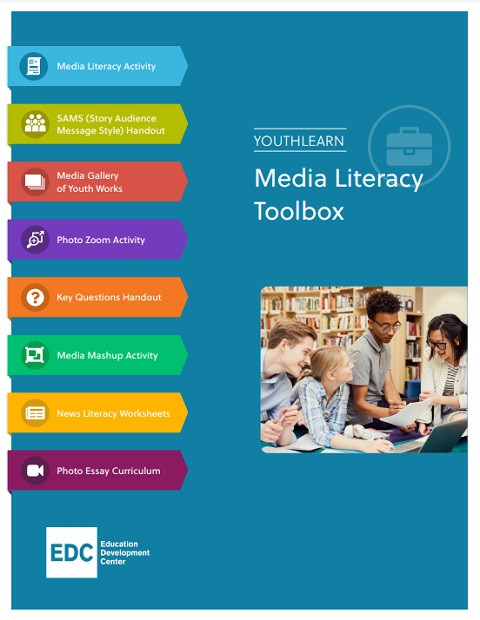 YouthLearn: Media Literacy Toolbox Año de publicación: 2020 Autor corporativo: Education Development Center (EDC) YouthLearn’s Media Literacy Toolbox includes activities, handouts, and curricular resources to support media literacy education in a variety of settings—classroom or afterschool program, low-tech or high-tech, children or teens.
  Digital Empowerment of Girls Año de publicación: 2018 Autor corporativo: Plan International Despite the accumulated efforts and commitments of the past 20 years, today’s women and girls continue to face gender-based barriers that prevent them from accessing and utilising technology and digital tools at the same level as boys and men.Girls are 5 times less likely to consider a career in tech than boys.Equality of education is essential to redress the digital gender gap – which is sadly growing – but it’s not the only method.We must make tech safe, affordable and accessible to girls – wherever they live. We must tackle the ingrained gender norms that prevent girls from seeing digital roles as accessible career paths.Rather than making assumptions about what girls want and need from technology, we must work with them to create solutions for the issues that affect them by enabling them to learn digital skills.Technology can be a powerful tool for girls’ voices to become even louder and reach even further.This briefing paper provides recommendations for closing the digital gender gap that will enable girls to participate in and contribute to our increasingly digital future.Despite the accumulated efforts and commitments of the past 20 years, today’s women and girls continue to face gender-based barriers that prevent them from accessing and utilising technology and digital tools at the same level as boys and men.Promoting girls’ digital literacy and closing the digital gender gap will play an important role in achieving gender equality and promoting the rights of girls and women worldwide.Plan International strives to build a world in which girls have the tools and the power to shape their own futures and influence decision making and policy processes at local and global levels. Technology is not a prerequisite for being a change agent or a leader, but it can be a powerful tool for girls’ voices to become even louder and reach even further. Similarly, social media can be used as a vehicle to spread inspirational stories of female leaders and connect activists and changemakers across the world.Digital technologies have a strong potential to empower girls and women economically and socially. Girls feel safer and more connected when they have a mobile phone, and they use mobile phones to save time and money and access educational opportunities. Yet girls and women are, on average, less likely than men to own a mobile phone, use mobile data, social media apps or SMS. There is also a stark gender disparity in access to the Internet, which limits the ability of girls and women to benefit from many innovations of the digital economy, such as digital payments and mobile money. The gender disparity in access to technology is compounded by a significant gender divide in terms of career and academic aspirations related to ICTs.Advancing digital equality for girlsThis briefing paper argues that promoting girls’ digital literacy and closing the digital gender gap will play an important role in achieving gender equality and promoting the rights of girls and women worldwide. Indeed, bridging the digital gender divide is essential in ensuring girls and women are not left behind in an increasingly digital future.The paper also argues that actions promoting girls’ digital empowerment should be guided by the principle of engaging girls and women as active, capable partners in our work, not merely passive recipients or targets. Rather than making assumptions about what girls want and need from technology, it is important to work together with girls to strengthen and develop their use and creation of technology and digital tools.