
Recursos
Exploren una amplia gama de recursos valiosos en GCED para profundizar su comprensión y promover su búsqueda, incidencia, enseñanza y aprendizaje.
3,158 resultados encontrados
 أساسيّات الحوار: مورد لمنح الطلاب الشباب من حول العالم مهارات وتجربة الحوار Año de publicación: 2016 Autor corporativo: Tony Blair Institute for Global Change يزود "أساسيات الحوار" المعلمين بمقدمة للتعلم القائم على الحوار ويوفر أنشطة مهمة لبناء المهارات الأساسية لبناء مهارات الحوار، سواء كان ذلك شخصيًا أو عن بُعد.يقدم هذا الدليل دروسًا قابلة للتكيف ويركز على المهارات الخمسة الأساسية للحوار، والملاحظات الموجزة، وخطوات إعداد الشباب للانخراط في الحوار بين الثقافات عبر الإنترنت لدعم تنمية المواطنة العالمية.
  Supporting Quality Journalism Through Media and Information Literacy Año de publicación: 2020 Autor: Martina Chapman | Markus Oermann Autor corporativo: Council of Europe MIL - Media and Information Literacy used to be seen as the responsibility of the educational sector mostly targeting younger people in full-time education. This responsibility has to be extended to all stakeholders who are in a position to reach citizens of all age groups where they currently are and create new dissemination networks for MIL knowledge and skills.All relevant stakeholders, especially member states, need to recognise their own roles and responsibilities in relation to media literacy. They should be prepared to lead on, participate in, and fund MIL projects on a long-term basis.
  Achieving 100 for a Fair Wolrd: Exploring the Teaching Notes on Poverty Año de publicación: 2019 Autor corporativo: Oxfam Hong Kong This material provides some poverty concepts and related activities for teachers to refer to and continue to explore new and improved methods of creating a fair world. 樂施會童創100公平世界:探索貧窮教學備忘 Año de publicación: 2019 Autor corporativo: Oxfam Hong Kong 這本備忘提供一些貧窮 概念和相關活動讓老師參考,延續創造公 平世界的探勘。
  The Ultimate Dialogue Adventure: An Online Global Citizenship Game for Students Ages 13-17 Autor corporativo: Generation Global An interactive online platform that leads young people ages 13-17, through a game to learn the skills of intercultural dialogue and participate in forums focused on a variety of global topics and issues. The Ultimate Dialogue Adventure can be used as a self-directed learning journey for young people, or as an in-class companion for teachers, to support rigorous dialogue about a global topic or provide a place of practice when using our offline materials.
  Strengthening Democracy Is the Key to Preventing Far-Right Extremism Año de publicación: 2021 Autor: Cynthia Miller-Idriss This article emphasizes that disinformation, misinformation and propaganda undermine democratic practices in ways that should be fought not only by trying to shrink or contain the extremist fringe, but also by strengthening democratic values and practices within the mainstream. It also highlights that it is critical to engage proactively and consistently in order to prevent further escalations in far-right extremism and interrupt violent radicalisation at early stages.
  Explained: What is False Information? Año de publicación: 2020 With so much information at our fingertips it can be easy to come across something online that isn’t quite as accurate or reliable as it should be. This kind of information is often called Fake News but a better description might be false information because it affects more than news stories. This animation, explaining false information, supports the education resource Connected - an introduction to digital media literacy.
 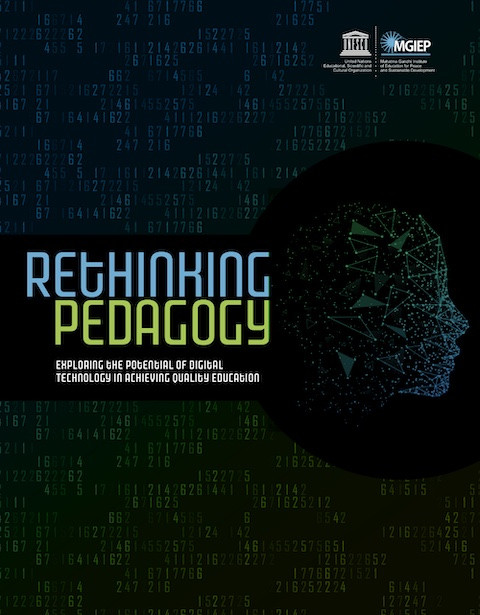 Rethinking Pedagogy: Exploring the Potential Of Digital Technology In Achieving Quality Education Año de publicación: 2019 Autor: Lorena Alemán de la Garza | Alessandra Anichini | Péter Antal | Aurélie Beaune | Éric Bruillard | Diane Burke | Pedro Henrique Cacique Braga | Ruma Chakravarti | Sriya Chakravarti | Deng Chen | Lidiya Chikalova | Helen Crompton | Ilana De Almeida Souza Concilio | William Cope | Lorenz Denks | Matthew Farber | Giovanni Fonseca | Pintér Gergely | Marcela Georgina Gómez Zermeño | Russell Hazard | Laura Hosman | Mary Kalantzis | Kojanitz László | Xavier Levoin | Kristen Linzy | Arnab Mandal | Yoko Mochizuki | Ariam Mogos | Tünde-Lengyel Molnár | Matthew Montebello | Sadaqat Mulla | Sandra Gudiño Paredes | Christelle Pauty-Combemore | Boyka Parfitt | Réka Racsko | Irais Monserrat Santillán Rosas | Khitam Shraim | Jisoo Song | Avgoustos Tsinakos Autor corporativo: Mahatma Gandhi Institute of Education for Peace and Sustainable Development (MGIEP) With the exponential growth of digitally mediated communication, digital media and gaming, the landscape of what we understand as learning environments is changing significantly. Today the use of digital technology in education is attracting considerable public and policy attention as
well as private investment. With a rise in discourses both heralding and cautioning against the use of digital technology in education, there is a need to pool the expertise and experience on the use of technology in education from around the world to advance public debate and evidence-informed policymaking. Based on the literature review, mapping of digital education resources in circulation, and examples of implementation of digital education initiatives from around the world, this report aims to provide insights that would help lead to the wise, innovative and ethical use of digital technology in education as a new dimension in achieving SDG 4 — inclusive and equitable quality education and lifelong learning opportunities for all. By so doing, it also attempts to contribute to a rethink of teaching and learning in the face of enormous opportunities and challenges brought about by digital technology in the times of change and turmoil.
Rethinking Pedagogy: Exploring the Potential Of Digital Technology In Achieving Quality Education Año de publicación: 2019 Autor: Lorena Alemán de la Garza | Alessandra Anichini | Péter Antal | Aurélie Beaune | Éric Bruillard | Diane Burke | Pedro Henrique Cacique Braga | Ruma Chakravarti | Sriya Chakravarti | Deng Chen | Lidiya Chikalova | Helen Crompton | Ilana De Almeida Souza Concilio | William Cope | Lorenz Denks | Matthew Farber | Giovanni Fonseca | Pintér Gergely | Marcela Georgina Gómez Zermeño | Russell Hazard | Laura Hosman | Mary Kalantzis | Kojanitz László | Xavier Levoin | Kristen Linzy | Arnab Mandal | Yoko Mochizuki | Ariam Mogos | Tünde-Lengyel Molnár | Matthew Montebello | Sadaqat Mulla | Sandra Gudiño Paredes | Christelle Pauty-Combemore | Boyka Parfitt | Réka Racsko | Irais Monserrat Santillán Rosas | Khitam Shraim | Jisoo Song | Avgoustos Tsinakos Autor corporativo: Mahatma Gandhi Institute of Education for Peace and Sustainable Development (MGIEP) With the exponential growth of digitally mediated communication, digital media and gaming, the landscape of what we understand as learning environments is changing significantly. Today the use of digital technology in education is attracting considerable public and policy attention as
well as private investment. With a rise in discourses both heralding and cautioning against the use of digital technology in education, there is a need to pool the expertise and experience on the use of technology in education from around the world to advance public debate and evidence-informed policymaking. Based on the literature review, mapping of digital education resources in circulation, and examples of implementation of digital education initiatives from around the world, this report aims to provide insights that would help lead to the wise, innovative and ethical use of digital technology in education as a new dimension in achieving SDG 4 — inclusive and equitable quality education and lifelong learning opportunities for all. By so doing, it also attempts to contribute to a rethink of teaching and learning in the face of enormous opportunities and challenges brought about by digital technology in the times of change and turmoil. 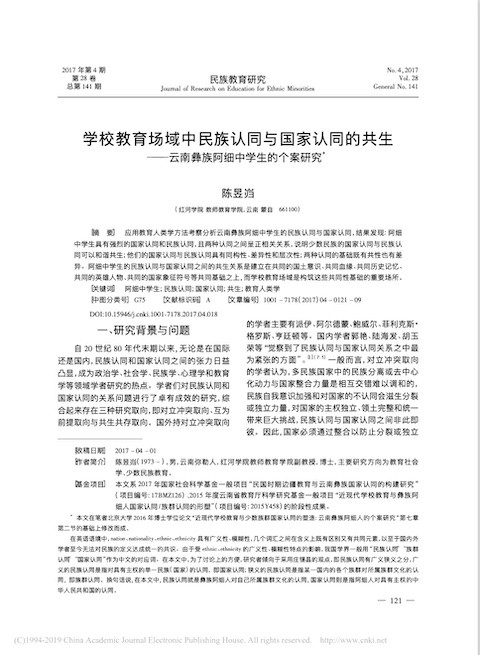 The Symbiosis Relationship Between Ethnic Identity and National Identity in School Education Field: A Case Study Of Axi Yi High School Students in Yunnan (Journal of Research on Education for Ethnic Minorities; Vol. 28, No. 141) Año de publicación: 2017 Autor: Chen Yukui Autor corporativo: Minzu University of China This paper uses educational anthropolog to examine and analyse ethnic identity and national identity of ethnic Axi Yi high school students. It finds that they have both very strong ethnic and national identities, and there is a moderate positive correlation between the two identities. This shows that the two identities can coexist harmoniously for ethnic minorities. This paper also finds that the symbiosis relationship between students’ ethnic identity and national identity is built on common foundations, such as common territorial awareness, common consanguinity,common historical memory,common heroic characters and common national symbols. This paper argues that schools are the important place where those common foundations are built. 学校教育场域中民族认同与国家认同的共生:云南彝族阿细中学生的个案研究 (民族教育研究; 第28卷, 总第 141 期) Año de publicación: 2017 Autor: Chen Yukui Autor corporativo: Minzu University of China 应用教育人类学方法考察分析云南彝族阿细中学生的民族认同与国家认同,结果发现: 阿细 中学生具有强烈的国家认同和民族认同,且两种认同之间呈正相关关系,说明少数民族的国家认同与民族认 同可以和谐共生; 他们的国家认同与民族认同具有同构性、差异性和层次性; 两种认同的基础既有共性也有差 异。阿细中学生的民族认同与国家认同之间的共生关系是建立在共同的国土意识、共同血缘、共同历史记忆、 共同的英雄人物、共同的国家象征符号等共同基础之上,而学校教育场域是构筑这些共同性基础的重要场所。