
Recursos
Exploren una amplia gama de recursos valiosos en GCED para profundizar su comprensión y promover su búsqueda, incidencia, enseñanza y aprendizaje.
3,158 resultados encontrados
 Vivir con la controversia: Cómo enseñar temas controvertidos mediante la Educación para la ciudadanía y los derechos humanos (EDC/HRE) Módulo de formación para el profesorado Año de publicación: 2015 Autor corporativo: European Union (EU) Learning how to engage in dialogue with people whose values are different from one’s own and to respect them is central to the democratic process and essential for the protection and strengthening of democracy and fostering a culture of human rights. ■ Yet in Europe young people do not often have an opportunity to discuss controversial issues in school because they are seen as too challenging to teach, e.g., issues to do with extremism, gender violence, child abuse, or sexual orientation. Unable to voice their concerns, unaware of how others feel or left to rely on friends and social media for their information, young people can be frustrated or confused about some of the major issues which affect their communities and European society today. In the absence of help from school, they might have no reliable means of dealing with these issues constructively and no one to guide them. ■ The idea for this Pack came out of a call from policy-makers and practitioners in a number of European countries for more effective training for teachers in the teaching of controversial issues. Toolkit on the Holocaust and Human Rights Education in the EU Autor corporativo: European Union Agency for Fundamental Rights | Yad Vashem Responding to a practical need expressed by teachers and students with a view toward examining the connections between Holocaust and Human Rights Education, the Fundamental Rights Agency (FRA) and Yad Vashem have developed this Toolkit to provide first insights into Holocaust and Human Rights Education content and methodologies, which can be used for teaching about and from the Holocaust and human rights. The Toolkit is a practical guide for teachers and educators who wish to develop teaching projects, by linking Holocaust and human rights. In addition, some examples of teaching projects and learning activities of Holocaust Education and Human Rights Education are provided in the Toolkit. Boîte à outils sur l'éducation sur l'Holocauste et les droits de l'homme dans l'UE Autor corporativo: European Union Agency for Fundamental Rights | Yad Vashem Répondant à un besoin pratique exprimée par les enseignants et les étudiants en vue vers l'examen des liens entre l'Holocauste et l'éducation aux droits humains, l'Agence des droits fondamentaux (FRA) et Yad Vashem ont développé cette trousse pour fournir les premiers aperçus sur l'Holocauste et l'éducation aux droits humains contenu et méthodes, qui peuvent être utilisés pour enseigner et de l'Holocauste et les droits humains. La boîte à outils est un guide pratique pour les enseignants et les éducateurs qui souhaitent développer des projets pédagogiques, en reliant l'Holocauste et les droits humains. En outre, quelques exemples de projets d'enseignement et des activités d'apprentissage de l'éducation de l'Holocauste et l'éducation aux droits de l'homme sont fournis dans la boîte à outils. Excursion to the past - teaching for the future : Handbook for teachers Año de publicación: 2010 Autor corporativo: European Union Agency for Fundamental Rights What role do Holocaust-related sites play in today's societies? What do they offer young people? What should schools and teachers consider when planning a visit to such a site? And how can teachers make best use of such visits for teaching about the Holocaust and human rights? This Handbook provides a number of examples, hints and historical background information, which will help teachers and students to make visits to Holocaust-related sites and exhibitions a meaningful and enriching experience. Excursion vers le passé - leçons pour l'avenir: Manuel pour les enseignants Año de publicación: 2010 Autor corporativo: European Union Agency for Fundamental Rights Quel est le rôle liés Holocauste sites dans les sociétés d'aujourd'hui? Qu'est-ce qu'ils offrent aux jeunes? Qu'est-ce que les écoles et les enseignants doivent prendre en compte lors de la planification d'une visite à un tel site? Et comment les enseignants font le meilleur usage de ces visites pour l'enseignement sur l'Holocauste et les droits humains? Ce manuel fournit un certain nombre d'exemples, des conseils et des informations d'arrière-plan historique, ce qui aidera les enseignants et les élèves à faire des visites de sites liés à l'Holocauste et des expositions d'une expérience significative et enrichissante. Exkurze do minulosti – výuka pro budoucnost: příručka pro pedagogy Año de publicación: 2010 Autor corporativo: European Union Agency for Fundamental Rights What role do Holocaust-related sites play in today's societies? What do they offer young people? What should schools and teachers consider when planning a visit to such a site? And how can teachers make best use of such visits for teaching about the Holocaust and human rights? This Handbook provides a number of examples, hints and historical background information, which will help teachers and students to make visits to Holocaust-related sites and exhibitions a meaningful and enriching experience.
 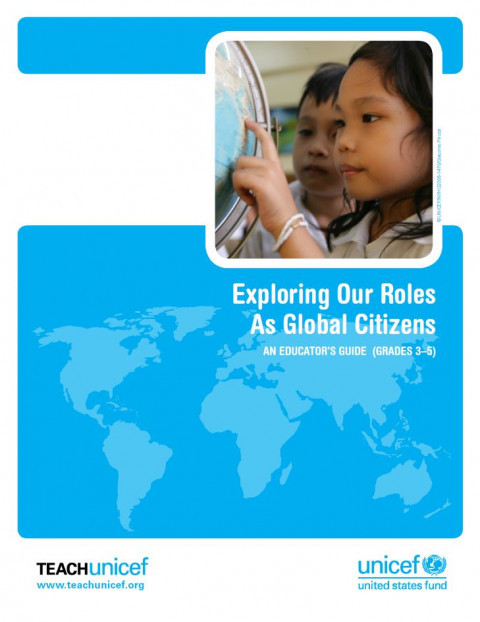 Exploring our roles as global citizens: an educator's guide (grades 3-5) Año de publicación: 2013 Autor: Elizabeth O. Crawford Autor corporativo: TeachUNICEF ‘Exploring Our Roles as Global Citizens’ is a four-lesson unit with extension activities and a student-led inquiry project that is designed to introduce the concept of global citizenship, including relevant knowledge, skills, values, and civic actions; to educate students about universal human rights outlined in the Convention on the Rights of the Child (CRC) and what their responsibilities are to ensure these rights are protected; to foster students’ skills in developing perspectives, critical and creative thinking, research, and decision-making about a chosen global issue using a student-led inquiry model; and to empower students to recognize and use their individual strengths to make a positive difference in their local communities. Lesson 1: What Is Global Citizenship? This lesson engages students in reflecting upon what it means to be a global citizen. Although students are often taught the concepts of citizenship and the characteristics of good citizenship during the elementary years, students may not have considered previously their roles as citizens in a global society. Using authentic examples of global citizenship among youth as a springboard for discussion, students determine how they are citizens at various levels. Afterward, students begin their inquiry of a chosen global issue about which they will take informed action at the end of the unit. Lesson 2: We Are Citizens of the World and We Have Rights! Building upon their prior learning about citizenship, students are introduced to human rights, or those rights to which all persons are entitled. Students learn about the Convention on the Rights of the Child (CRC) and create a concept map outlining categories and examples of human rights. Afterward, students relate human rights to contemporary global issues and how it is our responsibility to take action when the rights of others are violated. Lesson 3: Global Citizens Take Responsibility In this lesson, students learn about their individual and collective responsibility to protect human rights. Through analysis of authentic photographs depicting responsible citizenship, students explore the idea that global citizens are proactive when the rights of others are threatened. To demonstrate their learning, students role-play characteristics of global citizenship. Subsequently, in cooperative groups, students continue their global issue research and begin to consider how they will take informed action as global citizens. Lesson 4: Global Change Begins With Me In this culminating lesson, students reflect upon their learning about global citizenship and how they can be positive change agents in their communities. Students first explore how individuals take action to solve a problem or to improve conditions for others. Using these examples as inspiration, students determine how they, too, can be “changemakers.” As a final assessment, students synthesize what they have learned by creating a comprehensive definition of global citizenship, and develop an action plan to address the global issue they have researched. Exploring our roles as global citizens: an educator's guide (grades 3-5) Año de publicación: 2013 Autor: Elizabeth O. Crawford Autor corporativo: TeachUNICEF La définition se fonde sur le travail séminal dans les états et un large éventail d'organisations de travail pour faire avancer les connaissances mondiales et de la pensée critique. Un processus d'articulation minutieuse et vetting a abouti à la définition de la compétence globale proposée ici: la compétence globale est la capacité et la disposition pour comprendre et agir sur les questions d'importance mondiale. Globalement les personnes compétentes sont au courant, curieux et intéressés à en apprendre sur le monde et comment il fonctionne. Ils peuvent utiliser les grandes idées, des outils, des méthodes et des langues qui sont au cœur de toutes les disciplines (mathématiques, la littérature, l'histoire, la science et les arts) pour engager les questions pressantes de notre temps. Ils déploient et développer cette expertise comme ils enquêtent sur ces questions, reconnaissent de multiples points de vue, de communiquer leurs points de vue de manière efficace, et prendre des mesures pour améliorer les conditions. Eduquer pour Global Competence: Préparer les jeunes d'engager le monde est destiné aux enseignants, administrateurs, éducateurs informels, les décideurs, les leaders communautaires, les chercheurs, les parents, les étudiants et toutes les autres parties intéressées à préparer nos jeunes pour le 21e siècle. Devenir meilleur à l'éducation pour la compétence globale implique de repenser les pratiques et en reconnaissant qu'il n'y a pas de recettes simples pour le succès. En tant que tel, ce livre est destiné à être utilisé avec souplesse - parcourir, faire des liens, et de se concentrer sur les chapitres que vous trouverez les plus pertinents pour votre travail. Expérience avec des idées, des concepts de défi, et de partager avec des collègues. En fin de compte ce livre doit travailler pour vous. Il est destiné à être lu de la manière qui répond le mieux à vos besoins, inspire votre curiosité, et prouve fructueuse dans la salle de classe. Le premier chapitre offre un rationnel pour l'éducation mondiale dans notre pays et dans le monde. Le deuxième chapitre présente un cadre conceptuel pour la compétence globale et explique le rôle clé des fondations disciplinaires et interdisciplinaires dans l'apprentissage des élèves. Chapitre trois, quatre, cinq et six focus, respectivement, sur quatre capacités essentielles associées à la compétence mondiale: enquête dans le monde, reconnaissant les perspectives, communiquer des idées, et de prendre des mesures. Le chapitre sept considère les principes de base de l'enseignement pour l'enseignement de la compétence globale. Chapitre huit examine ce que les étudiants et les établissements d'enseignement peuvent faire pour promouvoir la compétence globale - et comment ils pourraient créer une culture de compétence globale pour les jeunes et les adultes. Enfin, le chapitre neuf places compétence globale dans le cadre plus large des systèmes d'éducation du public dans et au-delà des États-Unis. En rejse tilbage i tiden – en lære for fremtiden Håndbog for lærere Año de publicación: 2010 Autor corporativo: European Union Agency for Fundamental Rights What role do Holocaust-related sites play in today's societies? What do they offer young people? What should schools and teachers consider when planning a visit to such a site? And how can teachers make best use of such visits for teaching about the Holocaust and human rights? This Handbook provides a number of examples, hints and historical background information, which will help teachers and students to make visits to Holocaust-related sites and exhibitions a meaningful and enriching experience. Een stap in het verleden – een les voor de toekomst: Handboek voor leraren Año de publicación: 2010 Autor corporativo: European Union Agency for Fundamental Rights What role do Holocaust-related sites play in today's societies? What do they offer young people? What should schools and teachers consider when planning a visit to such a site? And how can teachers make best use of such visits for teaching about the Holocaust and human rights? This Handbook provides a number of examples, hints and historical background information, which will help teachers and students to make visits to Holocaust-related sites and exhibitions a meaningful and enriching experience.