
Recursos
Exploren una amplia gama de recursos valiosos en GCED para profundizar su comprensión y promover su búsqueda, incidencia, enseñanza y aprendizaje.
3,559 resultados encontrados
 Ensuring Inclusive and Equitable Quality Education: Sustainable Development Goal 4 in Canada Año de publicación: 2020 Autor corporativo: Council of Ministers of Education, Canada (CMEC) This report provides a framework to share information at the pan-Canadian and international levels on work underway in Canada to achieve SDG 4. The report builds on SDG 4 data and indicators and includes, where possible, provincial and territorial data.
  Transitional Justice and Education: Learning Peace (Advancing Transitional Justice Series) Año de publicación: 2017 Autor: Clara Ramírez-Barat | Roger Duthie Autor corporativo: Social Science Research Council (SSRC) | United Nations Children's Fund (UNICEF) After periods of conflict and authoritarianism, education institutions often need to be reformed or rebuilt. But in settings where education has been used to support repressive policies and human rights violations, or where conflict and abuses have resulted in lost educational opportunities, legacies of injustice may pose significant challenges to effective reform. Peacebuilding and development perspectives, which normally drive the reconstruction agenda, pay little attention to the violent past. Transitional Justice and Education: Learning Peace presents the findings of a collaborative research project of the International Center for Transitional Justice and UNICEF on the relationship between transitional justice and education in peacebuilding contexts. The book examines how transitional justice can shape the reform of education systems by ensuring programs are sensitive to the legacies of the past, how it can facilitate the reintegration of children and youth into society, and how education can engage younger generations in the work of transitional justice.
  Global Citizenship Education: Solidar Foundation Policy Paper Año de publicación: 2020 Autor corporativo: Solidar Foundation | Erasmus+ The purpose of this paper is to provide recommendations supported by our members, based on their work in formal, non-formal and informal education, to expand GCE at national and European level. Considering how GCE is linked many times with formal education, the recommendations reveal the work of our members outside of this, building upon the need for a multi-stakeholder approach that spans across the entire learning process. This policy paper guides SOLIDAR Foundation’s work in influencing developments related to the EU’s Updated Skills Agenda, European Education Area, Action Plan for the Implementation of the European Pillar of Social Rights, and the European Green Deal, given how all provide an opportunity for GCE to be embraced as a necessity rather than an added-value.
 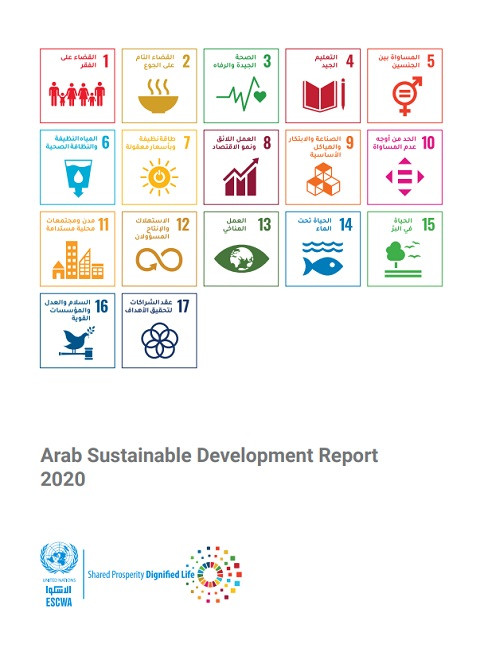 التقرير العربي للتنمية المسـتدامة 2020 Año de publicación: 2020 Autor corporativo: United Nations Economic and Social Commission for Western Asia (ESCWA) تدعو خطة عام 2030 إلى تغيير جذري وتحوّل في الأنماط السائدة. فحشد الموارد المحلية والخارجية يُعدّ من التحدّيات الملحة في المنطقة العربية، كما يُعدّ تكثيف الجهود نحو تحقيق أهداف التنمية المستدامة أمراً مُلحاً. إلّا أنّ التحوّل الجذري، لا يستلزم موارد مالية وتسريع الجهود فحسب، بل يتطلب، أكثر ما يتطلب، تحولًا في التوجه والنهج نحو التكامل في السياسات والاستدامة البيئية والحقوق مع التركيز على المساواة، والعدالة، والشمول الاجتماعي، والحريات الأساسية، والمشاركة في السياسة.قصة أهداف التنمية المستدامة في المنطقة العربية هي إذاً قصة الحقوق والمساواة بين الجنسين والاستدامة والتنمية المتكاملة. ولهذه المهمة من الضخامة والطموح ما يتعدى قياس التقدم على مستوى الأهداف والمقاصد والمؤشرات. وهذا التقرير، الصادر بعد مرور خمسة أعوام على اعتماد خطة عام 2030 وأهداف التنمية المستدامة، هو بمثابة تذكير بضرورة تحديد نقطة الانطلاق في التنفيذ على ضوء الإنجاز المنشود، حتى يكون في التغيير تحوّلٌ حقيقي. وإنّما المواءمة بين السياسات وسائر التدخلات مع الإطار الشامل لخطة عام 2030 هي الطريق الوحيد لعبور المنطقة والعالم إلى تنفيذ خطة عام 2030. أما مدى قرب المنطقة العربية من هذه المواءمة أو بعدها عنها، فهو ما يسرده هذا التقرير.
 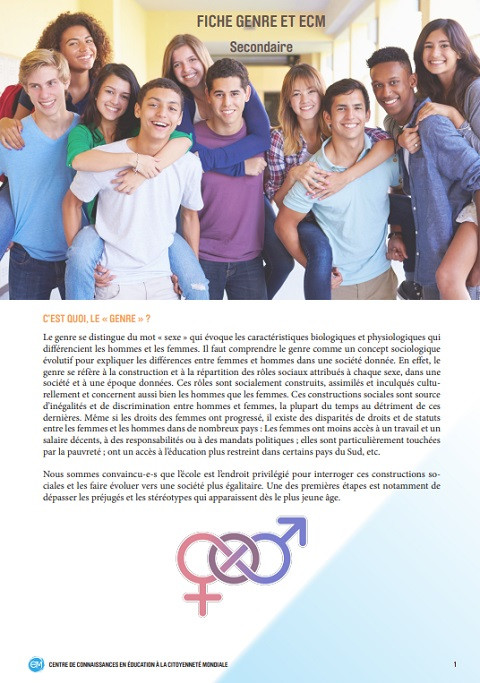 Fiche Genre et ECM: Secondaire Año de publicación: 2017 Autor: Carl Michiels Autor corporativo: Annoncer la Couleur (ALC) | Centre de Connaissances en Éducation à la Citoyenneté Mondiale (WikiCM) Ce document présente la définition du genre, des animations spécifiques à réaliser en classe, un lexique du genre, les contacts des organismes spécialistes du genre et les outils pédagogiques existant sur l’ECM à destination des enseignant·e·s ainsi qu’à destination des élèves du secondaire.
  Education and Migration: An Assessment of the Types and Range of IOM’s Education and Vocational Training Projects Año de publicación: 2018 Autor: Rocio Sanz Autor corporativo: International Organization for Migration (IOM) This report presents the results of the assessment of the range and types of IOM’s education and vocational training programmes as of December 2017. Within an overall framework of reviewing the Organization’s role in supporting the development and implementation of migration policy, the purpose of this assessment is to understand how these programmes contribute to education and vocational training outcomes, especially in the specific context of SDG 4 (Quality Education) of the 2030 Agenda for Sustainable Development.
  Global Citizenship Education in a Secondary Geography Course: The Students’ Perspectives (Review of International Geographical Education Online; Vol. 4, No. 2) Año de publicación: 2014 Autor: Kyle Massey Autor corporativo: Eskisehir Osmangazi University Global citizenship education is increasingly appreciated in Ontario, Canada, as an important component of formal schooling. Although all disciplinary areas have a role to play in global citizenship education, geography provides an especially relevant context in which to foster the values and attitudes often cited as important for global citizenship. This study investigates how Grade 12 students, who had recently completed the course “Canadian and World Issues: A Geographic Analysis”, conceive of the concept of global citizenship, and experienced its values within this course. Qualitative data was collected through interviews with seven students. The interviews revealed four major themes relating to how the students conceptualized global citizenship: global awareness, belonging, caring, and commitment to action. It revealed students’ personal involvement with the concepts studied helped them learn to be global citizens, as did the rich discussions of global issues they experienced in class. Careful analysis of both students’ conceptions of global citizenship and how they experienced global citizenship in the curriculum exposed an uncritical perspective – one which emphasizes acts of charity and volunteerism rather than a commitment to social justice. The findings are valuable to teachers and teacher candidates seeking to better engage their students in global issues and equip them with global thinking strategies, and to curriculum developers wishing to effectively incorporate values and topics concerning global citizenship within school curricula.
  International Environmental Politics and Critical Approach to Global Citizenship Education (International and Comparative Education; No. 8) Año de publicación: 2017 Autor: Zheng Fuxing Autor corporativo: Beijing Normal University The research and practice of global citizenship education have thrived since 1990s, but the effectiveness of global citizenship education is limited. The researcher cannot avoid the problematic premise of the possibility of global citizenship education. The identity predicament of global citizen and alienation of local implementing make probability of the global citizenship education problematic. The practical predicament of the global citizenship education manifests that the nation state is the key factor of policy implementation. Environmental question, which is about global common good, attracts the attention from the government of most of nations, and becomes the good case for exploring the feasibility of global citizenship education. Environmental politics explain the inequality and injustice in the globally environmental governance which made the global citizenship education critical. The critical ecopedagogy becomes the new form of global citizenship. The practice of the global citizenship education becomes viable by hybrid activism generated by dialectical movement between local and global in the limit of nation-state. 国际环境政治与全球公民教育的批判路径 (比较教育研究; No. 8) Año de publicación: 2017 Autor: Zheng Fuxing Autor corporativo: Beijing Normal University 自 20 世纪 90 年代以来 , 全球公民教育研究和实践蓬勃发展,然而全球公民教育 实践的效果很有限。对于全球公民教育的探讨不能回避“全球公民教育如何可能”这一前提性 问题。“全球公民”身份推衍困境、“在地实施”的“异化”后果让全球公民教育实施的可能性成 为问题。环境问题既是一个“全球共同利益”问题,也是各国政府关心的问题,为解答“全球 公民教育何以可能”提供了较好的切入点。国际环境政治解释了全球环境治理中发展中国家与 发达国家的不合作与不平等状况。以全球环境问题及其治理作为教育内容,全球公民教育具有 批判性。批判的生态教育学成为全球公民教育的重要实践形态。在既有的国家边界限制下,批 判的生态教育学通过全球与在地的混合行动,让全球公民教育获得了一种新的可能性。
  Education Disrupted Education Reimagined: Responses from Education’s Frontline During the COVID-19 Pandemic and Beyond Año de publicación: 2020 Autor corporativo: WISE | Salzburg Global Seminar | Diplomatic Courier The special edition E-Book you are reading about today was produced in real time, as WISE, in partnership with Salzburg Global Seminar, convened key stakeholders and education leaders from over 98 countries in a three-part series of global conferences aimed at bringing the global education community together. The result is a contemporary historical record of how schools, NGOs, governments, and international organizations responded to school closures during the crisis and how they are attempting to use this crisis as a springboard to reimagine—and even transform—education in their communities and countries.The E-Book offers an opportunity to a global audience to make sense of what happened but it also offers a breeding ground of ideas from some of the world’s top education thinkers. It is the editors’ sincere hope that through this publication we provide the education community with a reference point from the crisis from which future research, policy, and innovation can grow.