
Recursos
Exploren una amplia gama de recursos valiosos en GCED para profundizar su comprensión y promover su búsqueda, incidencia, enseñanza y aprendizaje.
3,559 resultados encontrados
 중등 예비교사와 현장교사의 세계시민교육 교수효능감과 관련된 변인 연구 (글로벌교육연구; Vol. 9, No. 3) Año de publicación: 2017 Autor: 양미석 | 김정겸 | 김기덕 Autor corporativo: 글로벌교육연구학회 본 연구는 중등 예비교사와 현장교사의 세계시민의식과 세계시민교육 태도와 세계시민교육 교수효능감과의 관계를 알아보고자 연구를 수행하였다. 연구대상은 중등 예비교사는 C대학의 사범대생 233명, 현장교사는 D시의 11개 중학교의 교사 216명의 설문지를 최종분석에 사용하였다. 최종 자료 분석은 빈도분석, 신뢰도분석, t검정, 상관관계, 중다회귀분석 등의 방법으로 분석하였다. 첫째, 예비교사와 현장교사 두 집단 간 차이분석 결과, 현장교사가 예비교사보다 세계시민의식의 하위변인 중 사회적 책무성, 글로벌 역량, 글로벌 참여가 높았으며, 세계시민교육 태도의 하위변인 중 교사역할 태도와 세계시민교육 교수효능감이 높은 것으로 나타났다. 둘째, 예비교사의 세계시민의식, 세계시민교육 태도, 세계시민교육 교수효능감과의 상관관계 분석 결과, 예비교사는 변인들 간 서로 유의한 상관관계가 나타났으나, 세계시민교육 교수효능감과 세계시민교육 태도의 하위변인 중 교육과정 태도에서만 유의한 상관관계가 나타나지 않았다. 또한, 예비교사의 세계시민의식과 세계시민교육 태도가 세계시민교육 교수효능감에 유의한 영향을 미치는 것으로 나타났다. 셋째, 현장교사의 세계시민의식, 세계시민교육 태도, 세계시민교육 교수효능감과의 상관관계 분석 결과, 현장교사의 모든 변인에서 서로 유의한 상관관계가 나타났다. 또한, 현장교사의 세계시민의식은 세계시민교육 교수효능감에 유의한 영향을 미치는 것으로 나타났다. 본 연구결과를 바탕으로 향후, 교원양성단계에서 필요한 교육과정의 기초자료제공과 실제 학교현장에서 요구되는 세계시민교육의 교사전문성을 높이는데 도움을 주고자 한다.
  The Intersection and Division between Ideological and Political Education and Civic Education: Starting from the question of the Jewish Question (Journal of North Minzu University; No. 2) Año de publicación: 2020 Autor: Liu Yan Autor corporativo: North Minzu University Based on the analysis of Marx’s critique of western citizenship contained in On the Jewish Question, ideological and political education and citizenship education have overlaps and divergences in three aspects, core content, basic attributes and value orientation:the difference between actual and expected of citizenship, the difference between the unity and fragmentation of political personality and social personality, the difference between the authenticity and contradiction of patriotism education and the cultivation of international vision. Compared with civic education, ideological and political education does not have any regrets, but has characteristics and advantages that civic education does not have.
  A Desirable and Practical Approach to Global Citizenship Education: An Exploration of “Global Storylines” in Scotland (Studies in Foreign Education; Vol. 47, No. 3) Año de publicación: 2020 Autor: Rao Shuqi Autor corporativo: Northeast Normal University The problems that global citizenship education has to deal with are threefold. “Global Storylines”, which provides corresponding solutions to practical difficulties, has emerged as the most effective approach to global citizenship education in Scotland. Firstly, global citizenship education has enjoyed a long continuity of government support. Through integrating with the current curriculum landscape, “Global Storylines” experiences secure curriculum status. Secondly, by utilizing “storylines” and educational drama, global society and global issues are introduced in subtle forms, which benefits students’ experienced-based learning. The contradiction between students’ cognitive need and ability is resolved accordingly. Thirdly, WOSDEC as the co-creator of “Global Storylines” offers a professional learning program. Teachers are universally supported in terms of theoretical knowledge, practical skills and being involved in the teaching community of global citizenship education.
  Global Citizenship Education in Hong Kong Año de publicación: 2015 Autor: Jun Xing Autor corporativo: IACSIT Press Education is in the midst of massive reforms in different parts of the world. Over the last few decades, there is an increasing call for global citizenship education(GCE) in the academy. In this paper, the author will first explain why the concept is a game changer in higher education, and then explorethe opportunities as well challenges for GCE, particularly in the Hong Kong academy, from the perspectives of public policies, curriculum and pedagogy. Finally, the author wants to explore how the pedagogy of service learning (SL) can serve as a powerful vehicle to achieve the intended learning outcomes of GCE while, in the meantime, GCEcan inform the theory and practice of international SL.
  The Teaching of Regional and Minority Languages in Schools in Europe: Eurydice Report Año de publicación: 2019 Autor corporativo: European Commission This Eurydice report provides a short overview of policy efforts made across Europe in support of the teaching of regional or minority languages in schools. It firstly presents the reference made to regional or minority languages by top-level education authorities in official documents. It then illustrates some of the policies and measures related to the teaching of regional or minority languages that are in place in the different European education systems. This is followed by an overview of some of the EU-funded projects and initiatives aiming to support the teaching of regional or minority languages in schools in Europe.
  From Rhetoric to Reality: Identifying Teacher Opportunities and Barriers in Educating for Human Rights (Journal of Global Citizenship & Equity Education; Vol. 7, No. 1) Año de publicación: 2020 Autor: Wanda Cassidy | Özlem Sensoy | Kumari Beck Autor corporativo: Centennial College In this paper we report findings from a four-year study into legal literacy that examined educational opportunities and barriers when teaching about legal literacy, citizenship education, and human rights education. Detailed findings are drawn from interviews with eleven teachers who self-identify as valuing and embedding legal literacy and related themes (human rights, identity, citizenship, and ecological sustainability) in their classrooms. Results show that despite deep rhetorical commitments to human rights education, teachers are stymied by perceived barriers to implementing HRE, particularly the action dimension. We name these perceived barriers and examine the case of one of the teachers who seemingly has overcome them, in order to identify potential constructive interventions in teacher education.
  Mapping Digital Literacy Policy and Practice in the Canadian Education Landscape Año de publicación: 2015 Autor: Michael Hoechsmann | Helen DeWaard Autor corporativo: MediaSmarts This paper Mapping Digital Literacy Policy and Practice in the Canadian Landscape draws on policy and curriculum documents from across Canada to synthesize key concepts and best practices in current digital literacy education.
 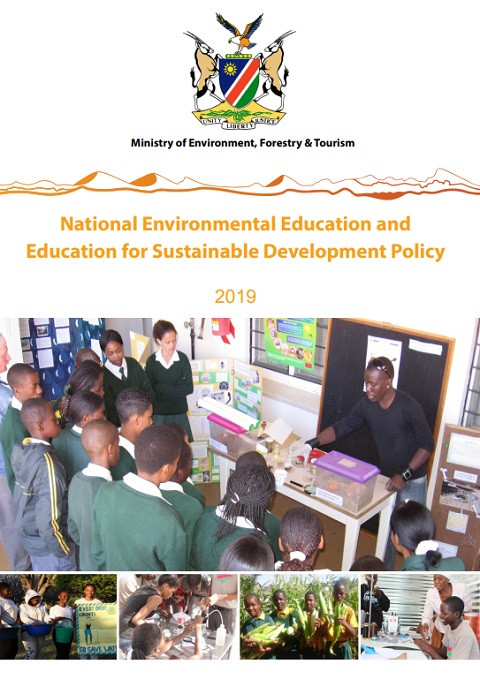 National Environmental Education and Education for Sustainable Development Policy Año de publicación: 2019 Autor corporativo: Namibia. Ministry of Environment, Forestry and Tourism Namibia has become the first country in the SADC region to have a stand-alone National Environmental Education (EE) and Education for Sustainable Development (ESD) Policy. The development of the policy was a long time collaboration between government ministries and civil society. UNESCO through the Sustainability Starts with Teachers programme also supported the process.The vision of the national EE/ESD Policy is an “educated and empowered Namibia with environmentally literate people taking responsibility and action for a sustainable future”.The policy is designed to support EE and ESD in formal, non-formal and informal education processes across all sectors of the Namibian society including higher education, teacher education, technical and vocational education institutions, and general education. It gives Namibia the much-needed foundation to work towards ESD for 2030 and the sustainable development goals (SDGs). L’enseignement des à l’école en Europe langues régionales ou minoritaires: Rapport Eurydice Año de publicación: 2019 Autor corporativo: European Commission Ce rapport d’Eurydice offre un bref aperçu des efforts politiques déployés dans toute l’Europe pour soutenir l’enseignement des langues régionales ou minoritaires à l’école. Il présente tout d’abord les références aux langues régionales ou minoritaires figurant dans les documents officiels émanant des plus hautes autorités responsables de l’éducation. Sont ensuite illustrées certaines des stratégies et mesures liées à l’enseignement de langues régionales ou minoritaires qui sont déployées dans les différents systèmes éducatifs européens. Enfin, le rapport donne un aperçu de certains projets et initiatives financés par l’Union européenne afin de soutenir l’enseignement des langues régionales ou minoritaires à l’école en Europe.
  Citoyenneté mondiale: Citoyens du monde au 21e siècle Año de publicación: 2016 Autor corporativo: Conseil Arts Canada Des participants de la Conférence nationale des écoles UNESCO se sont exprimés sur la définition de la citoyenneté mondiale et sur les qualités d'un citoyen du monde. L’événement avait lieu dans le cadre de la 56e Assemblée générale annuelle de la Commission canadienne pour l’UNESCO et avait pour but de promouvoir le rôle de chef de file de l'UNESCO dans l'Agenda 2030 pour l'éducation. Cette vidéo a été produite au Musée canadien pour les droits de la personne, à Winnipeg, au Manitoba.