
Recursos
Exploren una amplia gama de recursos valiosos en GCED para profundizar su comprensión y promover su búsqueda, incidencia, enseñanza y aprendizaje.
3,559 resultados encontrados
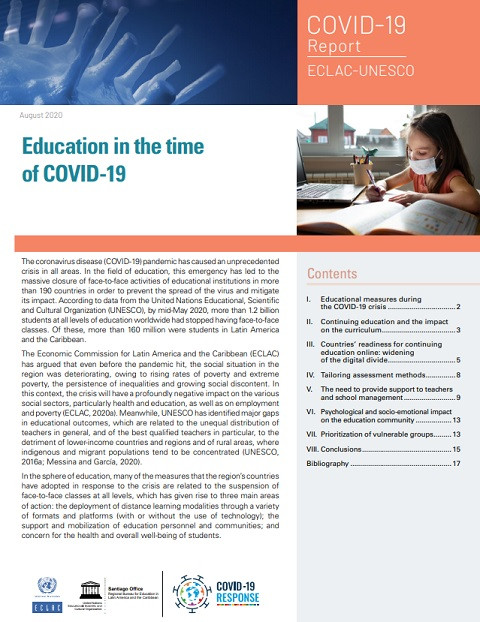 Education in the Time of COVID-19 (COVID-19 Report; ECLAC-UNESCO) Año de publicación: 2020 Autor corporativo: Economic Commission for Latin America and the Caribbean (ECLAC) | UNESCO Santiago The coronavirus disease (COVID-19) pandemic has caused an unprecedented crisis in all areas. In the field of education, this emergency has led to the massive closure of face-to-face activities of educational institutions in more than 190 countries in order to prevent the spread of the virus and mitigate its impact. The Economic Commission for Latin America and the Caribbean (ECLAC) has argued that even before the pandemic hit, the social situation in the region was deteriorating, owing to rising rates of poverty and extreme poverty, the persistence of inequalities and growing social discontent. In this context, the crisis will have a profoundly negative impact on the various social sectors, particularly health and education, as well as on employment and poverty. Meanwhile, UNESCO has identified major gaps in educational outcomes, which are related to the unequal distribution of teachers in general, and of the best qualified teachers in particular, to the detriment of lower-income countries and regions and of rural areas, where indigenous and migrant populations tend to be concentrated.In the sphere of education, many of the measures that the region’s countries have adopted in response to the crisis are related to the suspension of face-to-face classes at all levels, which has given rise to three main areas of action: the deployment of distance learning modalities through a variety of formats and platforms (with or without the use of technology); the support and mobilization of education personnel and communities; and concern for the health and overall well-being of students.The aim of this document is to shed light on various consequences that these measures will have on educational communities in the short and medium term, and to offer key recommendations on how to manage those consequences in the best possible manner, drawing attention to opportunities for learning and innovation in the post-pandemic education system. La educación en tiempos de la pandemia de COVID-19 (Inform COVID-19; CEPAL-UNESCO) Año de publicación: 2020 Autor corporativo: Economic Commission for Latin America and the Caribbean (ECLAC) | UNESCO Santiago La pandemia de enfermedad por coronavirus (COVID-19) ha provocado una crisis sin precedentes en todos los ámbitos. En la esfera de la educación, esta emergencia ha dado lugar al cierre masivo de las actividades presenciales de instituciones educativas en más de 190 países con el fin de evitar la propagación del virus y mitigar su impacto.La Comisión Económica para América Latina y el Caribe (CEPAL) ha planteado que, incluso antes de enfrentar la pandemia, la situación social en la región se estaba deteriorando, debido al aumento de los índices de pobreza y de pobreza extrema, la persistencia de las desigualdades y un creciente descontento social. En este contexto, la crisis tendrá importantes efectos negativos en los distintos sectores sociales, incluidos particularmente la salud y la educación, así como en el empleo y la evolución de la pobreza. Por su parte, la UNESCO ha identificado grandes brechas en los resultados educativos, que se relacionan con una desigual distribución de los docentes, en general, y de los docentes mejor calificados, en particular, en desmedro de países y regiones con menores ingresos y de zonas rurales, las que suelen concentrar además a población indígena y migrante.En el ámbito educativo, gran parte de las medidas que los países de la región han adoptado ante la crisis se relacionan con la suspensión de las clases presenciales en todos los niveles, lo que ha dado origen a tres campos de acción principales: el despliegue de modalidades de aprendizaje a distancia, mediante la utilización de una diversidad de formatos y plataformas (con o sin uso de tecnología); el apoyo y la movilización del personal y las comunidades educativas, y la atención a la salud y el bienestar integral de las y los estudiantes.El objetivo de este documento es visibilizar la diversidad de consecuencias que estas medidas tendrán sobre las comunidades educativas a corto y mediano plazo, así como plantear las principales recomendaciones para sobrellevar el impacto de la mejor manera posible, proyectando oportunidades para el aprendizaje y la innovación en la educación posterior a la pandemia.
 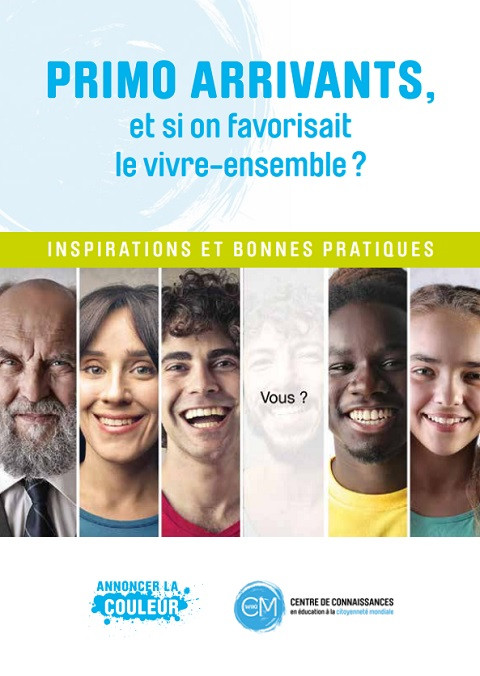 Primo arrivants, et si on favorisait le vivre-ensemble: Inspirations et bonnes pratiques Año de publicación: 2018 Autor corporativo: Annoncer la Couleur (ALC) | Centre de Connaissances en Éducation à la Citoyenneté Mondiale (WikiCM) Depuis plusieurs années, Annoncer la Couleur soutient des projets qui ont pour objectif de favoriser le vivre-ensemble dans les écoles avec des primo-arrivants. Ces projets, créés dans des contextes multiples et variés, nous ont questionné sur le rôle que joue l’éducation à la citoyenneté mondiale dans l’intégration des élèves. À travers cette publication, nous souhaitons vous présenter le fruit de la réflexion menée lors de la journée d’échanges et d’inspiration qui s’est déroulée le vendredi 12 octobre 2018 à Namur autour de la thématique « Primo-arrivants à l’école : et si on favorisait le vivreensemble ? » Lors de celle-ci, nous avons rassemblé des spécialistes et des enseignant∙e∙s porteur∙euse∙s de projets pour réfléchir et questionner la place des projets d’éducation à la citoyenneté mondiale face à ce défi toujours plus grand d’ouverture et d’acceptation des différences. L’ensemble des interventions, témoignages et échanges sont venus éclairer et enrichir nos pratiques de projets dans ce contexte d’intégration des primo-arrivants. Cette journée nous a confirmé que l’éducation à la citoyenneté mondiale peut être un levier pour favoriser le vivre-ensemble dans les écoles avec des élèves primo-arrivants (en DASPA ou non). Au sein de cet ouvrage, vous trouverez les articles tirés des interventions de Martine AbdellahPretceille « Éducation interculturelle et éducation la citoyenneté » et de Danièle Crutzen et Ahmed Talbi « Discours directs et indirects ». Ensuite, vous découvrirez huit projets d’éducation à la citoyenneté mondiale qui visent à favoriser l’intégration des primo-arrivants à l’école. Pour conclure, nous vous proposons un article synthétisant les « bonnes pratiques » que nous avons relevées pour la mise en projet.
  ICT융합교육 글로벌 동향: 초·중등교육 글로벌 동향 (2020년 5호 통권 128호) Año de publicación: 2020 Autor: 김민 | 이민주 | 윤환선 Autor corporativo: 한국교육학술정보원 이 자료는 코로나 19로 인한 학교 폐쇄와 재개에 대한 글로벌동향과 사례를 미주, 유럽, 아시아 등 각 지역별로 나누어 정리하고 학교 재개에 대하여 국제기구가 제시하는 프레임 워크에 대해서 설명하고 있다. 또한 코로나 19에 대응하는 교육대책으로 ICT를 활용한 온라인 교육과 원격 수업에 대한 방안과 현황을 제시한다.
  A Case Study on Teaching and Learning Process for Global Citizenship Education: Focused on Classes on the Refugee Disputes (Journal of Educational Innovation Research; Vol. 26, No. 3) Año de publicación: 2016 Autor: Junho Choi Autor corporativo: Pusan National University. Educational Development Institute Purpose: With the advent of the global civil society, this study is initiated from the necessity to design and make practical educational contents and methods which help us find relevant social studies’ topics and deal with them profoundly. For this reason, this study, in relation to our Global Citizenship Education(GCE) at school, was to focus on finding out practical strategies for the solutions to the refugee disputes and to find practical syllabuses. Method: This study was performed by using a literature research methods. I collected and examined relevant existing paper materials such as journals, reports, and books. Thereby, I searched a related topic and extracted meanings, values, perspectives on the topic which each materials contained. And then, I analyzed them by categorizing, integrating, and comparing the each extracted content. Based on this method, I can find the general characteristics and present practical strategies on the global citizenship education. Results: This study makes it possible to be well organized, based on self-directed and small group cooperative learning process by utilizing the PBL method(Problem Based Learning). In particular, this method allows students to make ‘Virtual Commission of Refugees’, and to debate and negotiate issues on their own. Conclusion: This process intends for students to recognize that the refugee disputes are the problem which as a member of the global civil society, all of the people should consider and overcome for the public welfare and developments. For this reason, this study, in relation to our Global Citizenship Education(GCE) at school, tries to focus on finding out practical strategies for the solutions to the refugee disputes and to find practical syllabuses. 세계시민교육을 위한 교수․학습과정안 사례연구: 난민문제 수업을 중심으로 (교육혁신연구; Vol 26, No. 3) Año de publicación: 2016 Autor: 최준호 Autor corporativo: 부산대학교 교육발전연구소 연구목적: 본 연구는 세계시민사회 도래에 대응한 적합성이 높은 사회과교육의 주제를 발굴하고 이를 더욱 심층적으로 다룰 수 있도록 하는 교육적 내용 및 방법에 관한 설계와 실천이 절실히 필요하다고 보았다. 이 같은 취지에서 본 연구의 목적은 사회교과를 통해 세계시민교육을 하고자 할 때 시의적절한 주제를 선정하고 실제 수업에 활용하기에 적절한 내용과 방법을 구체적으로 살펴보고자 함에 있다. 연구방법: 본 연구는 문헌 연구 방법을 통해 국내·외 선행연구로서의 학술논문, 단행본, 연구보고서 및 자료 등을 수집·분석하여 세계시민교육의 배경과 특징을 파악하고, 세계시민교육의 의미와 가치에 대한 이해를 바탕으로 세계시민교육 차원의 사회교과 교수·학습을 위한 구체적인 주제를 발굴함과 동시에 그에 따른 내용과 방법상의 실천 전략을 제시하고자 하였다. 연구결과: 본 연구는 PBL 기법(문제중심학습)을 활용하여 난민문제의 교수·학습 과정을 학습자의 자기주도 학습 및 소집단별 협동학습에 주안점을 두며 지식, 기능, 가치·태도, 그리고 실천적 목표를 달성하기 위한 내용과 절차를 유기적으로 구성하였다. 특히, 학습자 중심의 가상의 ‘난민조정위원회’의 구성과 토론 및 협상 과정이라는 상황을 입혀 난민문제를 학습자들이 직접 다루도록 하였다. 논의 및 결론: 세계시민교육 차원에서 난민문제가 사실상 세계시민사회 전체의 공공복리와 공영발전을 위해 극복해야 할 필수 과제이며, 세계시민의 일원으로서의 관심과 참여적 역할이 필요하다는 점을 학생들이 직접 깨닫도록 하였다.
 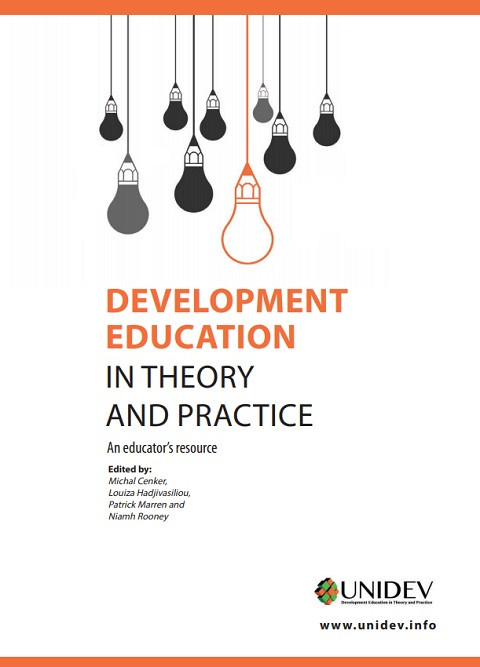 Development Education in Theory and Practice: An Educator’s Resource Año de publicación: 2016 Autor: Michal Cenker | Louiza Hadjivasiliou | Patrick Marren | Niamh Rooney Autor corporativo: UNIDEV | NGO Support Centre (Cyprus) | Pontis Foundation (Slovakia) | Kimmage Development Studies Centre (Ireland) This publication has been produced to provide a new teaching resource for academics and educators active in the field of Development Education and related disciplines. It covers twelve themes, each chapter includes both a conceptual overview and a teaching methodology section. The conceptual overview introduces the topic, explores the key concepts, theories and current debates. The teaching methodology section gives educators a set of tools that could help them introduce the topic in both formal and non-formal settings.
 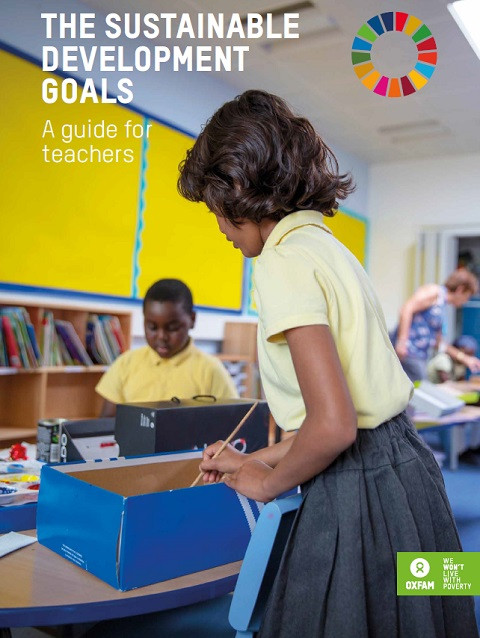 The Sustainable Development Goals: A Guide for Teachers Año de publicación: 2019 Autor corporativo: Oxfam GB This guide supports teachers and educators working with young people to deepen their understanding of education about and for the SDGs and to see how global citizenship education (GCE) approaches and methodologies can underpin good practice. The guide also explores the benefits and challenges of using the SDG framework with learners in schools.
 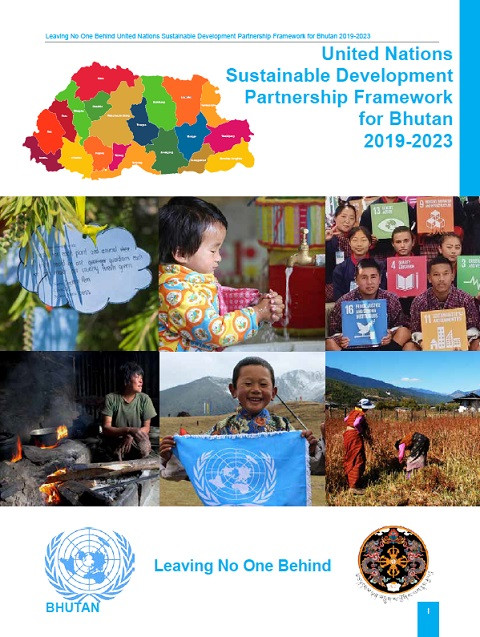 United Nations Sustainable Development Partnership Framework for Bhutan 2019-2023: Leaving No One Behind Año de publicación: 2019 Autor corporativo: UN Bhutan This Partnership Framework 2019-2023 is the common strategic framework for UN activities in Bhutan, working closely with the different agencies to effectively meet the needs of the current stage of development in the country. Strongly committed to the promotion of “A Just, harmonious and sustainable Bhutan where no one is left behind”, this document highlights strategic priorities, integrated programming, and continued partnership between the Royal Government of Bhutan, its development partners, key stakeholders, as well as between UN agencies to overcome the many inequalities still present in Bhutan.
 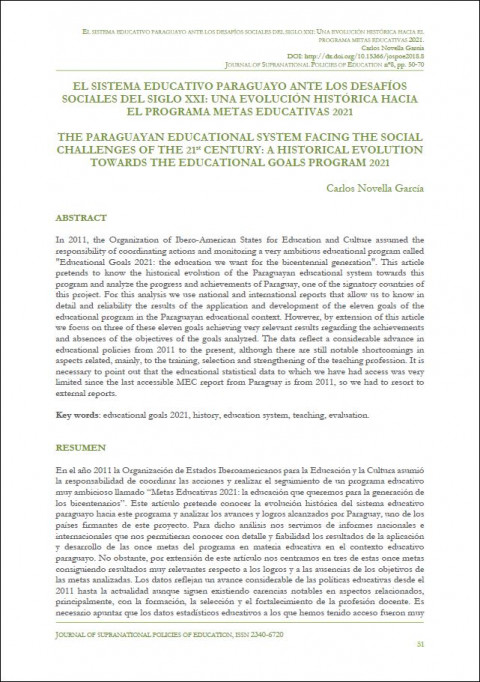 The Paraguayan Educational System Facing the Social Challenges of the 21st Century: A Historical Evolution Towards the Educational Goals Program 2021 Año de publicación: 2018 Autor: Carlos Novella García Autor corporativo: Autonomous University of Madrid In the summary the author sustains: "In 2011 the Iberoamerican States Organization for Education and Culture assumed the responsibility of coordinatin the actions and follow a challenging educative programa called "Educative Goals 2021: the education that we want for the generations of the bicentenary". This article pretends to learn the full details of this program and analyze the progresses and achievements made by Paraguay, one of the countries that signed this project. Different national and international reports were analysed in order to know, in detail and in a reliable way, the results of the application and development of the eleven goals of the program regarding education in the Paraguayan context. Nevertheless, due to the extension of this article, the authors focused on three of the eleven goals and obtained very relevant results concerning the absences and achievements of the objectives of these goals. The data evidences considerable progress in the education policies since 2011 although education, selection and professional development of teachers is still lacking development." I would add that the author highlights the importance of an international and Iberoamerican citizenship.